Positive and negative sentences are opposites. A positive sentence says that something is true: She likes tea. A negative sentence says that something is not true: She does not like tea. Learning how to switch between them is one of the most useful skills in English.
This chapter shows you what positive sentences and negative sentences are, how using not works with different verbs, how contractions such as don’t are made, and which negative words to use. It also warns you about the common mistakes in making sentences negative. Thirty exercises and a quiz follow.
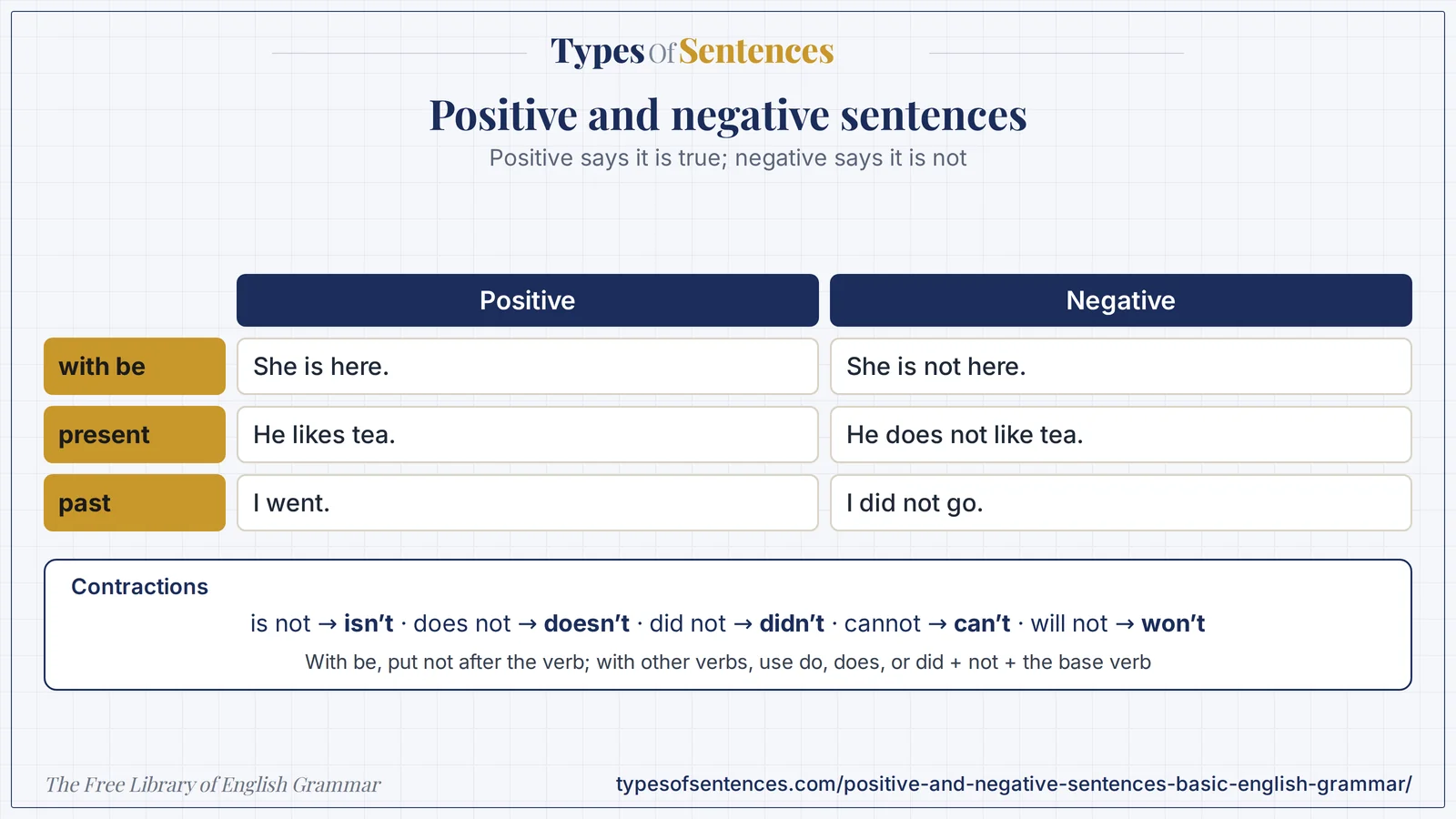
A positive sentence says yes. A negative sentence says no. To turn yes into no, you add the word not, but the way you add it depends on the verb.
Why it matters: Negative sentences are everywhere in daily life, from I don’t know to It isn’t ready. Getting them right makes your English sound natural.
Summary: A positive sentence states that something is true. A negative sentence states that it is not true. With the verb be, put not after the verb. With other verbs, use do not, does not, or did not before the base verb.
- Be: She is not here.
- Present: He does not like tea. / They do not like tea.
- Past: I did not go.
- Contractions: isn’t, don’t, doesn’t, didn’t, can’t, won’t.
What You’ll Learn
- 1. Positive and Negative Sentences: What Are Positive Sentences?
- 2. What Are Negative Sentences?
- 3. Using Not with Verbs
- 4. Contractions with Not
- 5. Negative Words
- 6. Practice: Converting Positive to Negative
- 7. Common Mistakes with Negatives
- 8. Exercises
- 9. Test Your Knowledge
- 10. Frequently Asked Questions
- 11. Conclusion
1. Positive and Negative Sentences: What Are Positive Sentences?
A positive sentence says that something is true or happens. It does not contain a negative word such as not or never. Positive sentences are also called affirmative sentences.
- She likes tea. positive
- They are at home. positive
- We went to the park. positive
- I can swim. positive
Most of the sentences you have studied so far are positive. They tell the reader what is, what happens, or what happened.
2. What Are Negative Sentences?
A negative sentence says that something is not true or does not happen. It usually has the word not, or another negative word such as never, no, or nothing.
| Positive | Negative |
|---|---|
| She likes tea. | She does not like tea. |
| They are at home. | They are not at home. |
| We went to the park. | We did not go to the park. |
| I can swim. | I cannot swim. |
Negative sentences are as common as positive ones, and both follow the sentence patterns from the chapter on sentences.
3. Using Not with Verbs
Using not depends on the verb. There are three situations.
I. With the verb be: put not after it
| Positive | Negative |
|---|---|
| I am ready. | I am not ready. |
| She is here. | She is not here. |
| They are late. | They are not late. |
| It was cold. | It was not cold. |
II. With other verbs in the present: use do not or does not
Add do not (with I, you, we, they) or does not (with he, she, it) before the base verb, the plain form without -s.
| Positive | Negative |
|---|---|
| I like tea. | I do not like tea. |
| She likes tea. | She does not like tea. |
| They play soccer. | They do not play soccer. |
| He works here. | He does not work here. |
III. With other verbs in the past: use did not
| Positive | Negative |
|---|---|
| We went home. | We did not go home. |
| She called me. | She did not call me. |
| They played. | They did not play. |
With he, she, and it, use does not or doesn’t.
4. Contractions with Not
In speech and informal writing, we shorten not and join it to the verb. The apostrophe replaces the missing letter.
| Full form | Contraction |
|---|---|
| is not | isn’t |
| are not | aren’t |
| was not | wasn’t |
| were not | weren’t |
| do not | don’t |
| does not | doesn’t |
| did not | didn’t |
| can not / cannot | can’t |
| will not | won’t |
| have not | haven’t |
The form am not is usually kept in full: I am not ready (not I amn’t). Cannot is written as one word, and will not becomes won’t. Use the full forms in formal writing, and see the chapter on punctuation for apostrophes.
5. Negative Words
Not is not the only way to make a sentence negative. These words carry a negative meaning.
| Word | Example |
|---|---|
| no | I have no money. |
| never | She is never late. |
| nobody / no one | Nobody called. |
| nothing | I heard nothing. |
| nowhere | They went nowhere. |
| none | None of them came. |
| neither … nor | Neither Tom nor Maria came. |
Don’t and no are both negative. Use any after a negative verb, or use no alone.
6. Practice: Converting Positive to Negative
Make this sentence negative: She plays the piano.
- Find the verb: plays. It is not be, so use do-support.
- The subject is she, so use does not.
- Change plays to the base form play.
- Result: She does not play the piano.
Make negative: We visited Paris last year.
Reveal answer
We did not visit Paris last year. Use did not and the base form visit.
7. Common Mistakes with Negatives
Making sentences negative causes a few predictable errors. Watch for these.
- Adding -s or -ed after does not or did not: She does not likes is wrong; use She does not like.
- Double negatives: I don’t know nothing should be I don’t know anything.
- Using don’t with he, she, it: use doesn’t.
- Putting not before the main verb: She not likes tea is wrong; use She does not like tea.
After did not, use the base form of the verb, not the past form.
Recap in 12 seconds
Watch the lesson build itself: Positive sentences and their negatives with be, in the present, and in the past, plus common contractions. The video has no sound.
Exercises
Part A: Positive or Negative? (Exercises 1–6)
Exercise 1: Positive or negative: She likes tea.
Show Answer
Answer: Positive.
Exercise 2: Positive or negative: She does not like tea.
Show Answer
Answer: Negative.
Exercise 3: Positive or negative: They are at home.
Show Answer
Answer: Positive.
Exercise 4: Positive or negative: They are not at home.
Show Answer
Answer: Negative.
Exercise 5: Positive or negative: Nobody called.
Show Answer
Answer: Negative. Nobody is a negative word.
Exercise 6: Positive or negative: We went to the park.
Show Answer
Answer: Positive.
Part B: Make It Negative with Be (Exercises 7–12)
Exercise 7: Make negative: I am ready.
Show Answer
Answer: I am not ready.
Exercise 8: Make negative: She is here.
Show Answer
Answer: She is not here.
Exercise 9: Make negative: They are late.
Show Answer
Answer: They are not late.
Exercise 10: Make negative: It was cold.
Show Answer
Answer: It was not cold.
Exercise 11: Make negative: We were happy.
Show Answer
Answer: We were not happy.
Exercise 12: Make negative: He is a doctor.
Show Answer
Answer: He is not a doctor.
Part C: Make It Negative with Do (Exercises 13–18)
Exercise 13: Make negative: I like tea.
Show Answer
Answer: I do not like tea.
Exercise 14: Make negative: She likes tea.
Show Answer
Answer: She does not like tea.
Exercise 15: Make negative: They play soccer.
Show Answer
Answer: They do not play soccer.
Exercise 16: Make negative: He works here.
Show Answer
Answer: He does not work here.
Exercise 17: Make negative: We went home.
Show Answer
Answer: We did not go home.
Exercise 18: Make negative: She called me.
Show Answer
Answer: She did not call me.
Part D: Contractions (Exercises 19–24)
Exercise 19: Contract: is not
Show Answer
Answer: isn’t.
Exercise 20: Contract: do not
Show Answer
Answer: don’t.
Exercise 21: Contract: does not
Show Answer
Answer: doesn’t.
Exercise 22: Contract: did not
Show Answer
Answer: didn’t.
Exercise 23: Contract: will not
Show Answer
Answer: won’t.
Exercise 24: Contract: cannot
Show Answer
Answer: can’t.
Part E: Fix the Mistake (Exercises 25–28)
Exercise 25: Fix it: He don’t like tea.
Show Answer
Answer: He doesn’t like tea.
Exercise 26: Fix it: She does not likes tea.
Show Answer
Answer: She does not like tea.
Exercise 27: Fix it: I don’t know nothing.
Show Answer
Answer: I don’t know anything.
Exercise 28: Fix it: They did not went home.
Show Answer
Answer: They did not go home.
Part F: Review (Exercises 29–30)
Exercise 29: Review (Chapter 24, structure): what structure is The dog barked, and the cat ran?
Show Answer
Answer: Compound.
Exercise 30: Review (Chapter 23, functions): what end mark follows an interrogative sentence?
Show Answer
Answer: A question mark.
Test Your Knowledge
Ready to check what you learned? Answer all 10 questions, then submit. You need 80% (8 of 10) to pass. Your answers are not stored.
View correct answers and explanations
Question 1: Which sentence is negative?
✓ Correct Answer: B – She does not like tea.
She does not like tea contains not and says something is not true.
Question 2: How do you make I am ready negative?
✓ Correct Answer: A – I am not ready.
With be, put not after the verb: I am not ready.
Question 3: Which is correct?
✓ Correct Answer: C – She does not like tea.
Use does not and the base verb like.
Question 4: Which is correct?
✓ Correct Answer: D – He doesn’t like tea.
With he, she, and it, use doesn’t plus the base verb.
Question 5: What is the contraction of will not?
✓ Correct Answer: B – won’t
Will not becomes won’t.
Question 6: Which is correct?
✓ Correct Answer: D – They did not go home.
After did not, use the base form go.
Question 7: Which is a double negative?
✓ Correct Answer: A – I don’t know nothing.
Don’t and nothing are both negative, so the sentence is a double negative.
Question 8: Which word is a negative word?
✓ Correct Answer: C – never
Never is a negative word.
Question 9: Which is correct?
✓ Correct Answer: D – I don’t have any money.
After a negative verb, use any.
Question 10: How is cannot written?
✓ Correct Answer: A – As one word
Cannot is normally written as one word.
Frequently Asked Questions
What are positive and negative sentences?
A positive sentence says something is true (She likes tea). A negative sentence says something is not true (She does not like tea). Together they are positive and negative sentences.
How do I make sentences negative?
Use not after be (She is not here). With other verbs use do not, does not, or did not plus the base verb (She does not like tea).
What are negative sentences with did not?
They are negatives in the simple past. Use did not plus the base verb: We did not go home, not We did not went home.
What is the rule for using not?
Put not after the verb be and after helping verbs. With other verbs, add do, does, or did and then not. This pattern is called do-support.
Are contractions correct in formal writing?
Contractions such as don’t are normal in speech and informal writing. Many formal documents use the full forms, such as do not, so check what your teacher or style guide prefers.
What is a double negative?
A double negative uses two negative words in one clause, such as I don’t know nothing. Standard English uses one: I don’t know anything or I know nothing.
Conclusion
You now know how positive and negative sentences work, and how using not changes with be, do, does, and did. You can form contractions, choose negative words, and avoid the common mistakes.
Practice by writing a positive sentence and then its negative form. Next, you will begin the study of verb tenses.
- Merriam-Webster Dictionary: negative: dictionary definition of the grammatical term.
- Purdue Online Writing Lab: Grammar: reference section on verbs and negation.
- Quirk, Randolph, et al. A Comprehensive Grammar of the English Language. Longman, 1985.: description of negation and do-support.
Last reviewed: October 29, 2026. How it was made: drafted with AI assistance, then checked with automated tests (structure, links, answer keys, spelling) and against the sources above. A person has not yet read this chapter line by line. Found a mistake? Report it.