Modal verbs are a special group of auxiliary verbs that add meaning to the main verb: ability, permission, possibility, obligation, advice, prediction, and the speaker’s attitude. The core modal auxiliaries are can, could, may, might, will, would, shall, should, and must. A modal always comes first in the verb phrase and is followed by the base form of the main verb: She can swim, They must leave.
This chapter introduces modal verbs, with modal verbs examples for each meaning. You will see the list of modals and the semi-modals, the features that make modals different from other verbs, the present and past forms, negatives and questions, a chart of the main uses, and the common errors. The next chapters study the modals by meaning. Thirty exercises and a quiz follow.
A modal changes the meaning of the verb after it. She swims is a fact; She can swim adds ability; She may swim adds permission or possibility; She must swim adds obligation.
Why it matters: Modals are small words with big jobs. Learning how they behave (always followed by the base form, never with -s) solves most of the errors learners make with them.
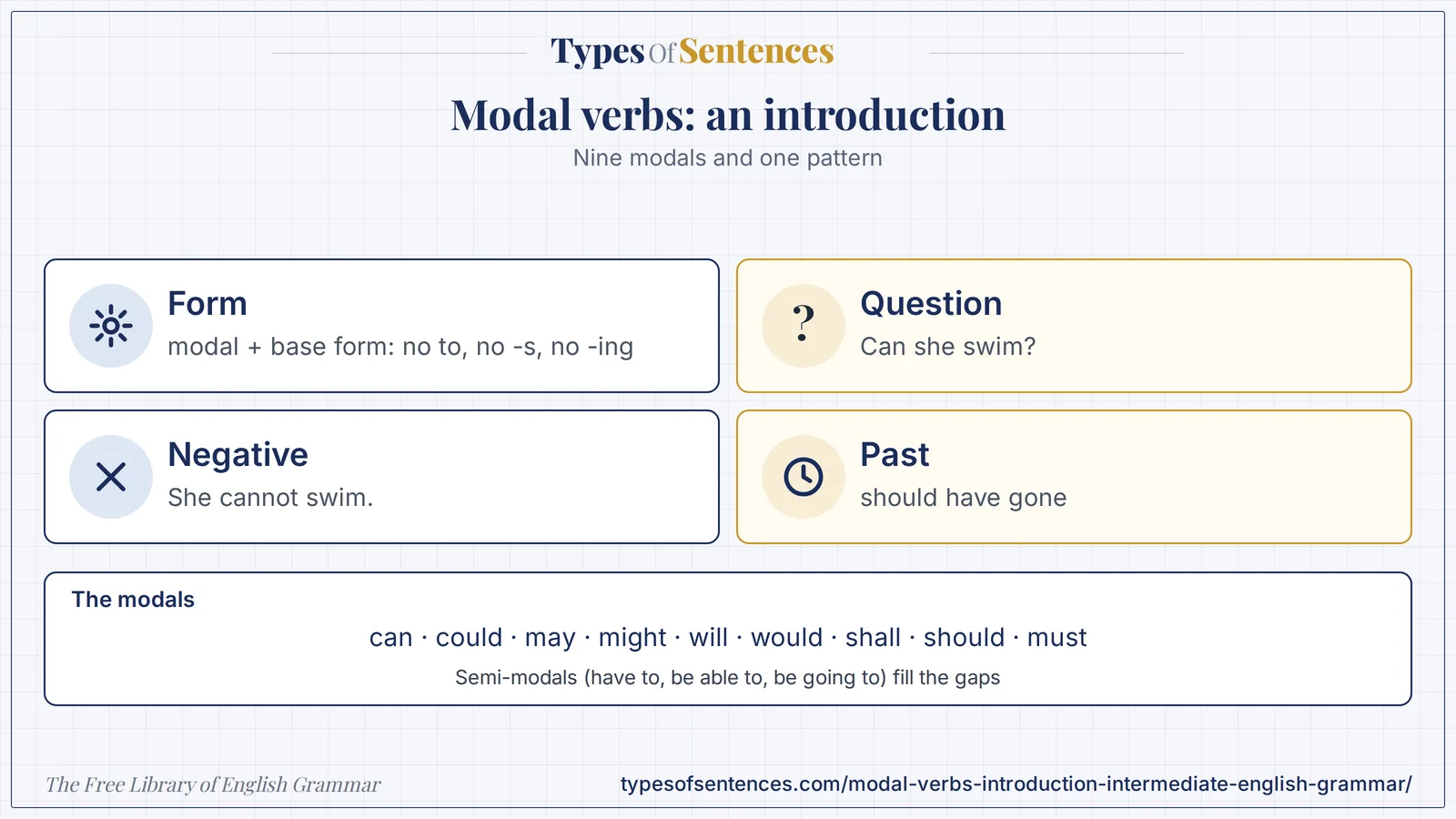
Summary: Modals (can, could, may, might, will, would, shall, should, must) are followed by the base form, take no -s, make questions by inversion, and make negatives with not. They express ability, permission, possibility, obligation, advice, prediction, and attitude. Past reference uses a modal plus have and the past participle.
- Form: modal + base form (no to, no -s, no -ing).
- Question: Can she swim? Negative: She cannot swim.
- Past: should have gone, could have gone, must have gone.
- Semi-modals (have to, be able to, be going to) fill the gaps.
What You’ll Learn
- 1. What Are Modal Verbs?
- 2. List of Modals
- 3. Features of Modal Verbs
- 4. Using Modals: The Main Meanings
- 5. Present and Past Modals
- 6. Negatives with Modals
- 7. Questions with Modals
- 8. Modal Overview Chart
- 9. Common Errors with Modal Verbs
- 10. Exercises
- 11. Test Your Knowledge
- 12. Frequently Asked Questions
- 13. Conclusion
1. What Are Modal Verbs?
Modal verbs are auxiliary verbs that express the speaker’s view of the action: how possible, necessary, permitted, or certain it is. They are also called modal auxiliaries. They belong to the auxiliary system described in the guide to auxiliary verbs and in the chapter on verb phrases, where a modal is the first auxiliary.
| Without a modal | With a modal | Added meaning |
|---|---|---|
| She swims. | She can swim. | ability |
| You leave now. | You may leave now. | permission |
| It rains tomorrow. | It might rain tomorrow. | possibility |
| You see a doctor. | You should see a doctor. | advice |
| He is at home. | He must be at home. | deduction |
| I help you. | I will help you. | offer or promise |
2. List of Modals
The core modals are nine words. They are used in these modal verbs examples.
| Modal | Typical meanings | Example |
|---|---|---|
| can | ability, permission, possibility | She can swim. Can I sit here? |
| could | past ability, polite request, possibility | He could run fast. Could you help me? |
| may | permission (formal), possibility | You may leave. It may rain. |
| might | weak possibility | It might rain. |
| will | prediction, promise, decision | It will be hot. I will help. |
| would | polite request, habit, hypothetical | Would you wait? We would swim every summer. |
| shall | offers and suggestions (US); future (UK) | Shall we go? |
| should | advice, expectation | You should rest. |
| must | strong obligation, deduction | You must stop. She must be tired. |
| Other modal-like verbs | Examples |
|---|---|
| marginal modals | ought to (You ought to rest), need (You needn’t come), dare (How dare you?) |
| semi-modals (have a different form) | have to, be able to, be going to, had better, would rather, be supposed to, be allowed to, used to |
| modal expressions | may as well, might as well, would rather, had better |
The semi-modals work like modals in meaning but follow the rules of ordinary verbs: they change for person (she has to) and have all the tenses (she will have to, she had to). They fill the gaps where a modal has no form of its own.
3. Features of Modal Verbs
| Feature | Modal | Ordinary verb |
|---|---|---|
| third person -s | no: She can swim. | yes: She swims. |
| followed by | the base form: can swim | a variety of forms |
| to before the next verb | no: must go | often: wants to go |
| question | inversion: Can she swim? | needs do: Does she swim? |
| negative | not directly: She cannot swim. | needs do: She does not swim. |
| infinitive and participles | none: no to can, no canning | yes: to swim, swimming |
| two together | no: not will can | yes in some patterns: have to go |
- A modal has no -s form, no infinitive, and no -ing or past participle form.
- A modal has no real past tense. Could, would, and might can refer to the past, but they are mainly used for present and hypothetical meanings; the past is shown by the perfect (should have gone).
- Because a modal is a verb, it can combine with the continuous and the passive: She may be sleeping, The work must be finished.
4. Using Modals: The Main Meanings
| Meaning | Modals | Example | Studied in |
|---|---|---|---|
| ability | can, could, be able to | She can swim. | the next chapter |
| permission | may, can, could | May I come in? | the chapter on modals of permission |
| possibility | may, might, could, can | It might rain. | the chapter on modals of possibility |
| obligation and necessity | must, have to, should, ought to | You must wear a seat belt. | the chapter on modals of obligation |
| deduction (certainty) | must, can’t, may, might | She must be home. | the chapter on modals of deduction |
| advice and suggestion | should, ought to, could, had better | You should see a doctor. | the chapter on other uses |
| request and offer | can, could, would, shall, will | Could you help me? Shall I help? | the chapter on other uses |
| prediction and promise | will, would | It will be hot. I will call. | the chapter on other uses |
The chapter on ability follows this one. The uses not listed separately are collected in the chapter on uses of modal verbs.
5. Present and Past Modals
A modal followed by the base form refers to the present or the future. A modal followed by have and the past participle refers to the past.
| Present or future | Past | Meaning |
|---|---|---|
| She should go. | She should have gone. | she did not go (criticism) |
| She could go. | She could have gone. | she had the chance but did not |
| She may be late. | She may have been late. | possibility about the past |
| She must be tired. | She must have been tired. | deduction about the past |
| She can’t be home. | She can’t have been home. | impossible in the past |
| She would help. | She would have helped. | hypothetical past |
| Modal | No past form, so use | Example |
|---|---|---|
| must (obligation) | had to | She had to leave. |
| can (ability) | could / was able to | She could swim as a child. |
| will | would (in reported speech) | She said she would come. |
| may (permission) | was allowed to | She was allowed to leave. |
The tenses of the perfect forms are in the chapter on verb tenses. The form should of is a common mistake for should have; see the errors below.
6. Negatives with Modals
| Positive | Negative | Contraction |
|---|---|---|
| can | cannot (one word) / can not | can’t |
| could | could not | couldn’t |
| may | may not | (mayn’t is rare) |
| might | might not | mightn’t (rare in US) |
| will | will not | won’t |
| would | would not | wouldn’t |
| shall | shall not | shan’t (UK) |
| should | should not | shouldn’t |
| must | must not | mustn’t |
| Modal negative | Meaning | Example |
|---|---|---|
| must not | prohibition | You mustn’t smoke here. |
| don’t have to / needn’t | no obligation | You don’t have to come. |
| can’t | impossibility or inability | She can’t be home. She can’t swim. |
| may not | not permitted or possibly not | You may not enter. It may not rain. |
| shouldn’t | advice not to | You shouldn’t go. |
Modals do not use do. Choose between must not and do not have to, because they mean different things.
7. Questions with Modals
| Statement | Question | Short answer |
|---|---|---|
| She can swim. | Can she swim? | Yes, she can. / No, she can’t. |
| You may leave. | May I leave? | Yes, you may. / No, you may not. |
| It will rain. | Will it rain? | Yes, it will. |
| He should go. | Should he go? | Yes, he should. |
| They must wait. | Must they wait? | Yes, they must. / No, they needn’t. |
- Put the modal before the subject: Can you help? What should I do? Where could she be?
- Use the modal again in a short answer, and do not repeat the main verb.
- Question tags repeat the modal: She can swim, can’t she?
- In an indirect question, the order returns to normal: I wonder whether she can swim.
8. Modal Overview Chart
Use this chart as a reminder of the main modals and their strengths. The scale for certainty runs from strongest to weakest.
| Certainty (about the present) | Modal | Example |
|---|---|---|
| 100% sure (true) | must | She must be at home. (deduction) |
| very likely | will, should | She will be home. She should be home. |
| possible | may, could | She may be home. She could be home. |
| less likely | might | She might be home. |
| 100% sure (not true) | can’t, couldn’t | She can’t be home. |
| Obligation and advice (strongest to weakest) | Modal | Example |
|---|---|---|
| required | must, have to | You must wear a seat belt. |
| strongly advised | should, ought to | You should rest. |
| suggested | could, might, had better | You could ask her. |
| not necessary | don’t have to, needn’t | You don’t have to come. |
| forbidden | must not, can’t | You mustn’t smoke. |
Modal meanings overlap and vary with context. Could can mean past ability, a polite request, or a present possibility. Some forms are more common in British English (shall, needn’t, shan’t) and others in American English (have to, don’t have to). When two choices are possible, choose by the formality of the context.
9. Common Errors with Modal Verbs
| Error | Correction | Rule |
|---|---|---|
| She cans swim. | She can swim. | no -s on a modal |
| You must to go. | You must go. | no to after a modal |
| She can swimming. | She can swim. | base form after a modal |
| I will can help. | I will be able to help. | no double modals |
| He might could help. | He might be able to help. | no double modals in standard English |
| Do you can swim? | Can you swim? | no do with a modal |
| I should of gone. | I should have gone. | have, not of |
| She doesn’t can swim. | She can’t swim. | no do with a modal |
| May I to go? | May I go? | no to after a modal |
| You don’t must come. | You mustn’t come. / You don’t have to come. | choose the right negative |
Fix: She said she should of called, but she cans not find the number, so she don’t must worry, and I will can help her to call.
- should of: should have.
- cans not: cannot (or could not after a past verb).
- don’t must worry: doesn’t have to worry.
- will can help her to call: will be able to help her call.
- Result: She said she should have called, but she cannot find the number, so she doesn’t have to worry, and I will be able to help her call.
Recap in 12 seconds
Watch the lesson build itself: Modals take the base form, make questions by inversion, and express ability, permission, possibility, obligation, and advice. The video has no sound.
Exercises
Part A: Recognizing Modals (Exercises 1–6)
Exercise 1: Name the modal: She can swim.
Show Answer
Answer: can.
Exercise 2: Name the modal: You must leave.
Show Answer
Answer: must.
Exercise 3: Is have to a core modal?
Show Answer
Answer: No. It is a semi-modal.
Exercise 4: Which is not a modal: should, might, swim?
Show Answer
Answer: swim.
Exercise 5: Name the nine core modals.
Show Answer
Answer: can, could, may, might, will, would, shall, should, must.
Exercise 6: What form of the verb follows a modal?
Show Answer
Answer: The base form.
Part B: Features (Exercises 7–12)
Exercise 7: Fix it: She cans swim.
Show Answer
Answer: She can swim.
Exercise 8: Fix it: You must to go.
Show Answer
Answer: You must go.
Exercise 9: Fix it: She can swimming.
Show Answer
Answer: She can swim.
Exercise 10: Fix it: Do you can swim?
Show Answer
Answer: Can you swim?
Exercise 11: Fix it: I will can help.
Show Answer
Answer: I will be able to help.
Exercise 12: Fix it: He might could help.
Show Answer
Answer: He might be able to help.
Part C: Meanings (Exercises 13–18)
Exercise 13: Meaning of can in She can swim.
Show Answer
Answer: Ability.
Exercise 14: Meaning of may in You may leave.
Show Answer
Answer: Permission.
Exercise 15: Meaning of might in It might rain.
Show Answer
Answer: Weak possibility.
Exercise 16: Meaning of should in You should rest.
Show Answer
Answer: Advice.
Exercise 17: Meaning of must in She must be tired.
Show Answer
Answer: Deduction.
Exercise 18: Meaning of will in I will help you.
Show Answer
Answer: Offer or promise.
Part D: Past Modals (Exercises 19–23)
Exercise 19: Past form: She should go. (she did not)
Show Answer
Answer: She should have gone.
Exercise 20: Past form: She must be tired.
Show Answer
Answer: She must have been tired.
Exercise 21: Past form: She can’t be home.
Show Answer
Answer: She can’t have been home.
Exercise 22: Past of must (obligation):
Show Answer
Answer: had to.
Exercise 23: Fix it: I should of gone.
Show Answer
Answer: I should have gone.
Part E: Negatives and Questions (Exercises 24–28)
Exercise 24: Contraction of will not:
Show Answer
Answer: won’t.
Exercise 25: Explain: You mustn’t come. and You don’t have to come.
Show Answer
Answer: The first means it is forbidden; the second means it is not necessary.
Exercise 26: Make a question: She can swim.
Show Answer
Answer: Can she swim?
Exercise 27: Add a tag: She can swim, ___?
Show Answer
Answer: can’t she.
Exercise 28: Fix it: You don’t must come.
Show Answer
Answer: You mustn’t come. (or You don’t have to come.)
Part F: Chart and Review (Exercises 29–30)
Exercise 29: Which modal shows the most certainty about the present: must or might?
Show Answer
Answer: must.
Exercise 30: Which is stronger: should or must?
Show Answer
Answer: must.
Test Your Knowledge
Ready to check what you learned? Answer all 10 questions, then submit. You need 80% (8 of 10) to pass. Your answers are not stored.
View correct answers and explanations
Question 1: What does a modal verb express?
✓ Correct Answer: B – Ability, permission, possibility, obligation, and other attitudes
Modals add meaning such as ability and obligation.
Question 2: Which is a core modal?
✓ Correct Answer: C – must
Must is one of the nine core modals.
Question 3: Which is correct?
✓ Correct Answer: A – She can swim.
A modal is followed by the base form.
Question 4: Which is correct?
✓ Correct Answer: A – Can you swim?
A modal forms a question by inversion.
Question 5: Which is correct?
✓ Correct Answer: B – I should have gone.
Use have, not of.
Question 6: Which expresses prohibition?
✓ Correct Answer: D – You mustn’t come.
Must not forbids.
Question 7: Which expresses no obligation?
✓ Correct Answer: C – You don’t have to come.
Don’t have to means not necessary.
Question 8: Which is a semi-modal?
✓ Correct Answer: D – have to
Have to is a semi-modal.
Question 9: Which shows the strongest certainty?
✓ Correct Answer: B – must
Must shows the strongest deduction.
Question 10: Which is correct?
✓ Correct Answer: C – He might be able to help.
Standard English avoids double modals.
Frequently Asked Questions
What are modal verbs?
Modal verbs are auxiliary verbs such as can, could, may, might, will, would, shall, should, and must. They express ability, permission, possibility, obligation, advice, and other attitudes.
What are some modal verbs examples?
She can swim. You may leave. It might rain. You should rest. She must be tired. are modal verbs examples, each with a different meaning.
What are examples of modals in the past?
She should have gone. He could have called. They must have left. are examples of modals with past meaning, formed with the modal plus have plus the past participle.
What are modal auxiliaries?
Modal auxiliaries are the modal verbs that act as the first auxiliary in a verb phrase. They have no -s, no infinitive, and no participle forms, and they are followed by the base form.
What is the meaning of can, could, may, might?
Can shows ability or permission, could past ability or polite requests, may formal permission or possibility, and might weak possibility. The details are in the chapters on ability, permission, and possibility.
What is the difference between must not and do not have to?
Must not means forbidden (You mustn’t smoke). Do not have to means not necessary (You don’t have to come).
Why can I not say will can?
Modals cannot be combined, because each one needs a base form after it, and a modal has none. Use will be able to instead.
Conclusion
You now have an introduction to modal verbs: what they are, the list of modals and semi-modals, their special features, the main meanings, how to refer to the past, how to make negatives and questions, and the common errors.
Notice the modals you meet and ask what each one adds. Next, you will study modals of ability in detail.
- Merriam-Webster Dictionary: modal verb: the dictionary definition of a modal verb.
- Purdue Online Writing Lab: Grammar: reference section on verbs.
- Quirk, Randolph, et al. A Comprehensive Grammar of the English Language. Longman, 1985.: central modals, marginal modals, and modal idioms.
- Huddleston, Rodney, and Geoffrey K. Pullum. The Cambridge Grammar of the English Language. Cambridge University Press, 2002.: the modal auxiliaries and the NICE properties.
Last reviewed: October 29, 2026. How it was made: drafted with AI assistance, then checked with automated tests (structure, links, answer keys, spelling) and against the sources above. A person has not yet read this chapter line by line. Found a mistake? Report it.