Modality in English is the way that language expresses the speaker’s attitude to the truth of a statement or to the necessity or possibility of an action. The sentence He must be tired says that the speaker has concluded something; You must go says that someone is obliged to act. Both use must, but they mean different things. These advanced modals have several meanings each, and the grammar of modality is mostly the grammar of deciding which one is meant.
You will study the main kinds of modality (epistemic, deontic, and dynamic), the tests that separate them, the modal meanings of each core modal, modal remoteness (how the past forms could, might, and would make a statement tentative or polite), the semi-modals and marginal modals (have to, be able to, be supposed to, ought to, dare, need), modal harmony and the combination of modal expressions, perfect and progressive modal forms, negation and scope, and register. This is the route to complex modality and the control of epistemic deontic modals. Thirty editing exercises and a quiz follow.
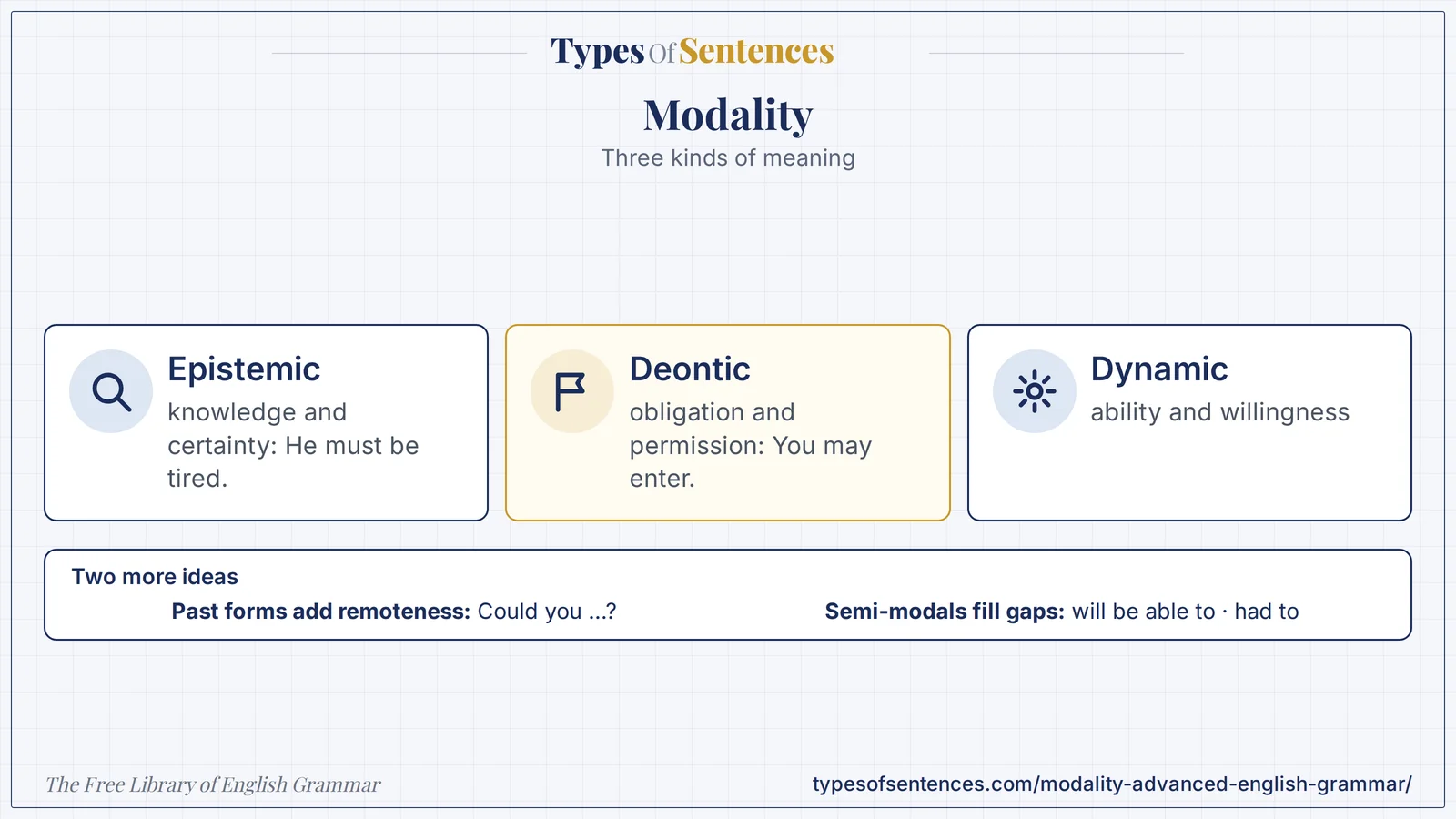
Every modal is a small package of meanings. May can mean that something is possible, or that someone is allowed; can can mean ability, permission, or possibility; will can mean prediction or willingness. Context decides which meaning is intended, and the grammar gives clues.
Why it matters: The practical skill is to read the meaning from the sentence, to choose the modal that expresses exactly the degree of certainty or obligation that you intend, and to know when a different modal or a different construction is needed.
Summary: Epistemic modality concerns knowledge and certainty (He must be tired, It may rain). Deontic modality concerns obligation and permission (You must leave, You may enter). Dynamic modality concerns ability and willingness of the subject (She can swim, He will help). The past forms could, might, would, and should express remoteness, which gives tentativeness or politeness. Semi-modals fill gaps in the modal system (have to, be able to). Modal expressions also occur in adverbs, adjectives, nouns, and lexical verbs, and they can reinforce each other (modal harmony).
- Epistemic = what you know; deontic = what you must do; dynamic = ability or willingness.
- Past forms add remoteness: politeness (Could you …?) or weaker possibility (might).
- Semi-modals supply missing forms: will be able to, had to.
- Perfect modals report past judgment or unfulfilled duty: must have, should have.
What You’ll Learn
- 1. Modality in English: What Is Modality?
- 2. Epistemic vs. Deontic Modality
- 3. Dynamic Modality: Ability and Willingness
- 4. Modal Remoteness: Past Forms and Politeness
- 5. Complex Modal Phrases: Semi-Modals and Marginal Modals
- 6. Modal Harmony and Combinations
- 7. Perfect and Progressive Modals
- 8. Modals and Negation: Scope and Pairs
- 9. Modals in Different Registers
- 10. Common Errors with Modals and Modality
- 11. Exercises
- 12. Test Your Knowledge
- 13. Frequently Asked Questions
- 14. Conclusion
1. Modality in English: What Is Modality?
Modality is the expression of the speaker’s judgment about whether a situation is true, necessary, possible, or desirable. In English it is expressed mainly by the modal auxiliaries, but also by adverbs, adjectives, nouns, and lexical verbs.
| Word class | Examples | Sense |
|---|---|---|
| modal verbs | may, might, can, could, will, would, shall, should, must, ought to | possibility, necessity, obligation, prediction |
| semi-modals | have to, be able to, be supposed to, had better, be going to, be to | the same range, with ordinary verb inflection |
| adverbs | perhaps, possibly, probably, certainly, necessarily, obviously | degree of certainty |
| adjectives | possible, probable, certain, necessary, likely, sure | It is possible that she left. |
| nouns | possibility, probability, certainty, necessity, obligation, permission | There is a possibility that … |
| lexical verbs | seem, appear, suggest, expect, allow, require, permit, oblige | She seems tired. They require us to leave. |
The nine core modals (can, could, may, might, shall, should, will, would, must) have the NICE properties of auxiliaries and are followed by the base form; see the chapter on advanced verb concepts. They occupy the first slot in a verb phrase, as described in the chapter on complex verb phrases. The Intermediate chapters on modals introduced the main uses.
2. Epistemic vs. Deontic Modality
Linguists distinguish three main kinds of modal meaning. The same modal verb can express more than one, and the distinction explains many puzzles.
| Kind | Concerns | Question | Examples |
|---|---|---|---|
| epistemic | the speaker’s knowledge or judgment about the truth of a proposition | How certain is it? | He must be tired. It may rain. She can’t be home. That will be the postman. |
| deontic | obligation, permission, prohibition (the world as it should be) | What is required or allowed? | You must leave. You may enter. You mustn’t smoke. You should apologize. |
| dynamic | the ability, willingness, or disposition of the subject | What can or will the subject do? | She can swim. He will help. Lions can be dangerous. |
| Modal | Epistemic | Deontic | Dynamic |
|---|---|---|---|
| must | He must be tired. (a deduction) | You must leave. (obligation) | — |
| may | It may rain. (possibility) | You may enter. (permission) | — |
| can | It can’t be true. (impossibility) | You can go. (permission) | She can swim. (ability) |
| could | It could be true. (possibility) | You could ask her. (suggestion) | She could swim at five. (past ability) |
| should | She should be home by now. (expectation) | You should apologize. (advice) | — |
| will | That will be the postman. (assumption) | You will report at six. (command) | He will help. (willingness) |
| would | That would be Tom. (assumption) | — | He would sit for hours. (habit) |
| Test | Epistemic | Deontic |
|---|---|---|
| perfect aspect with reference to the proposition | She must have left (the deduction is about the past event). | *She must have left (as an obligation to have left earlier) is not natural; should have left is the deontic past |
| progressive aspect | He must be sleeping (the state of affairs). | *You must be sleeping (as an obligation) is odd |
| negation | epistemic must is negated by can’t: He can’t be tired. | deontic must is negated by mustn’t (prohibition) or needn’t (no obligation) |
| subject | any subject, including inanimate (It must be late.) | usually an agent (You must leave.) |
| paraphrase | It is certain/possible/probable that … | It is obligatory/permitted that … or X is obliged to … |
The perfect test is a good one: must have + past participle is epistemic, while the deontic must has no past form and uses had to. The meanings of must have and should have are in the chapter on complex verb phrases. The Intermediate chapters on deduction and obligation introduced the contrast.
3. Dynamic Modality: Ability and Willingness
| Meaning | Modal | Example | Notes |
|---|---|---|---|
| general ability | can, could, be able to | She can swim. She could swim at five. | could is the past of can for general ability |
| specific success in the past | was able to, managed to | She was able to escape. She managed to finish. | not could for a single achieved event |
| willingness | will, would | I will help. He wouldn’t listen. | won’t expresses refusal, also for objects: The car won’t start |
| disposition or capacity | can | Lions can be dangerous. Prices can fall. | a general tendency |
| habit (typical behavior) | will, would | She will sit for hours. He would walk by the river. | will in the present; would in the past |
| marginal modals | dare, need | Dare he ask? She dared not speak. You needn’t come. | mostly in negatives and questions |
4. Modal Remoteness: Past Forms and Politeness
The pairs can/could, may/might, will/would, shall/should were once present and past forms. Today the “past” forms usually refer to the present or the future, and they express remoteness: distance from certainty, from the speaker, or from the reality of the situation. Remoteness gives tentativeness, politeness, or unreality.
| Present form | Remote form | Effect | Example |
|---|---|---|---|
| can | could | politeness; tentative possibility | Can you help? / Could you help? It can be true. / It could be true. |
| may | might | weaker possibility; tentativeness | It may rain. / It might rain. |
| will | would | politeness; hypothetical; future in the past | Will you wait? / Would you wait? I would go if I could. |
| shall | should | advice; expectation | Shall I go? / I should go. |
| must | (none) | must has no remote form; use would have to, had to | You would have to apply first. |
| Remoteness | Example | Meaning |
|---|---|---|
| temporal (past time) | She could swim when she was five. | a past ability |
| hypothetical (unreal) | If I had time, I could help. | an unreal condition |
| social (politeness) | Could you pass the salt? | a polite request |
| epistemic (tentativeness) | It might be true. | lower certainty than may |
| reported (backshift) | She said that she would come. | past reference to a future |
Remoteness is also expressed by other tenses: I was wondering if you could help (past progressive) is more tentative than I wonder if you could help. The same logic explains the past forms in the unreal conditionals, treated in the chapter on advanced conditionals, and in the soft expressions of hedging in the chapter on hedging.
5. Complex Modal Phrases: Semi-Modals and Marginal Modals
| Expression | Meaning | Example | Notes |
|---|---|---|---|
| have to | external obligation | I have to work on Saturday. | inflects: has to, had to, will have to |
| have got to | obligation or necessity (informal) | I’ve got to go. | also a deduction in American English: It’s got to be true |
| need to | necessity | You need to sign here. | ordinary verb: needs, needed |
| be able to | ability, specific success | She was able to escape. | fills the gaps of can |
| be supposed to | expectation or duty, often unfulfilled | You are supposed to be here at nine. | — |
| be to | arrangement or order (formal) | The president is to visit Delhi. You are to report at six. | also fate in narrative: was to become |
| be going to | intention; prediction from evidence | It is going to rain. | — |
| had better | strong advice or warning | You had better leave. | form of past, meaning of present |
| would rather | preference | I would rather stay. | followed by the base form |
| used to | past habit or state | She used to live here. | — |
| ought to | duty; expectation | You ought to rest. She ought to be home. | takes to; marginal modal |
| dare, need (as modals) | daring; necessity | He dared not speak. You needn’t come. | mostly negatives and questions |
| Missing form of the modal | Semi-modal supplies it | Example |
|---|---|---|
| infinitive: to can | to be able to | I want to be able to swim. |
| future: will can | will be able to | She will be able to come. |
| perfect: has can | has been able to | She has been able to help. |
| past of must (obligation) | had to | I had to leave early. |
| must after another modal | will have to, would have to | You will have to wait. |
| -ing form | having to | I hate having to wait. |
The semi-modals show a gradient between ordinary verbs and auxiliaries: have to takes do-support (Do you have to go?), while ought to forms questions by inversion (Ought I to go?, rare). They also differ in strength and source: must often expresses the speaker’s authority and have to an external requirement (compare the Intermediate chapter on uses of modal verbs).
6. Modal Harmony and Combinations
Modal expressions often occur together in one clause and reinforce each other. This is called modal harmony (or modal concord): the two items express the same degree of modality, so the combination sounds like a single, emphasized modal meaning and not a doubled one.
| Combination | Example | Effect |
|---|---|---|
| modal verb + modal adverb | It may possibly rain. She must certainly be home. They could perhaps help. | harmony: both mark possibility or certainty |
| may/might well | It may well rain. She might well win. | a strong possibility |
| may/might just | It might just work. | a slight possibility |
| may/might as well | We may as well go. | a mild suggestion |
| modal + adjective construction | It is possible that she may be late. | redundant; avoid |
| modal + lexical verb | She seems to be able to swim. I suppose he must be tired. | speaker’s attitude doubled |
| double modals (dialect) | You might could try it. She used to could swim. | regional (American South); not Standard English |
7. Perfect and Progressive Modals
| Form | Epistemic meaning | Deontic or other meaning |
|---|---|---|
| must have + -en | a deduction about the past: She must have left. | — |
| can’t / couldn’t have + -en | a negative deduction: He can’t have taken it. | — |
| may / might / could have + -en | a possibility about the past: She might have forgotten. | an unrealized past possibility: You could have been killed. |
| should / ought to have + -en | an expectation not met: The mail should have arrived. | a duty not done: You should have called. |
| needn’t have + -en | — | an unnecessary action that was done: I needn’t have gone. |
| would have + -en | — | a result in an unreal past: I would have helped. |
| modal + be + -ing | a deduction about the present: He must be sleeping. | a future plan: She will be arriving at six. |
| modal + have been + -ing | a past action in progress: She must have been working. | — |
The perfect modals combine a modal meaning with a time reference. The difference between She could have won (an unrealized possibility) and She could win (a present possibility) is the difference between the past and the present or future. The structures are analyzed in the chapter on complex verb phrases.
8. Modals and Negation: Scope and Pairs
| Positive | Negative | Kind | Meaning of the negative |
|---|---|---|---|
| must (deduction) | can’t / couldn’t | epistemic | it is impossible: He can’t be home. |
| may / might (possibility) | may not / might not | epistemic | it is possible that not: She may not come. |
| must (obligation) | mustn’t | deontic | forbidden: You mustn’t smoke. |
| must (obligation) | needn’t / don’t have to | deontic | not necessary: You needn’t come. |
| may (permission) | may not / can’t | deontic | not allowed: You may not leave. |
| should | shouldn’t | deontic or epistemic | advice not to / not expected: It shouldn’t take long. |
| can (ability) | can’t / cannot | dynamic | lacks ability: She can’t swim. |
| will (willingness) | won’t | dynamic | refuses: He won’t help. |
The negation of a modal can apply to the modal (the necessity) or to the main verb. You must not go negates the verb (it is necessary that you not go), while You don’t have to go negates the necessity. The structure of scope is treated in the chapter on negation. May not is ambiguous between possibility and prohibition (She may not come: perhaps she won’t come, or she is not allowed to), so careful writers use might not or is not allowed to to avoid ambiguity.
9. Modals in Different Registers
| Context | Typical modals | Example |
|---|---|---|
| legal and regulatory | shall (duty), may (permission), must | The tenant shall pay rent monthly. The committee may recommend. |
| academic writing | may, might, could, would (hedging) | The results may suggest a link. This could indicate that … |
| instructions | must, should, imperative | You must wear a helmet. Applicants should submit … |
| spoken, informal | gonna, gotta, wanna, can, have to | I’m gonna go. I gotta run. You can’t park here. |
| formal requests | might I, may I, would you be so kind | Might I suggest a different approach? |
| British and American differences | shall (British: first person future), need as a modal (British), ought (rare in American) | British: Shall I help? Need I go? American: Should I help? Do I need to go? |
Register matters. May for permission is formal, while can is used in everyday speech (Can I leave early?). Shall in the sense of obligation is mainly legal. In academic writing, modals are the main tools of hedging, a function discussed in the chapter on hedging. Pronunciations such as gonna and gotta are written only in informal contexts.
10. Common Errors with Modals and Modality
| Error | Correction | Rule |
|---|---|---|
| She can to swim. | She can swim. | base form after a modal |
| She will can come. | She will be able to come. | no double modals |
| I should of called. | I should have called. | have, not of |
| He musts leave. | He must leave. | no -s on a modal |
| Do you can help? | Can you help? | no do with a modal |
| She could finish the report yesterday. (she did) | She was able to finish the report yesterday. | specific past success |
| You mustn’t come. (meaning: not necessary) | You needn’t come. / You don’t have to come. | prohibition versus no obligation |
| He must to be at home. | He must be at home. | no to |
| It may rains. | It may rain. | base form |
| She may not come. (ambiguous) | She might not come. / She is not allowed to come. | scope and ambiguity |
| You had better to go. | You had better go. | bare infinitive |
| It is possible that she may possibly come. | It is possible that she will come. | redundant modal expressions |
Edit: She musts can to swim, and she will can come tomorrow, but she should of called, and she could finish the report yesterday, and you mustn’t come because it is not necessary, and he may not be late, and it is possible that he may possibly arrive.
- musts can to swim: can swim.
- will can come: will be able to come.
- should of called: should have called.
- could finish … yesterday (a success): was able to finish.
- mustn’t come because it is not necessary: needn’t come.
- may not be late: ambiguous: might not be late.
- it is possible that he may possibly arrive: it is possible that he will arrive.
- Result: She can swim, and she will be able to come tomorrow, but she should have called, and she was able to finish the report yesterday, and you needn’t come, and he might not be late, and it is possible that he will arrive.
Recap in 12 seconds
Watch the lesson build itself: Epistemic modality concerns knowledge, deontic modality obligation and permission, and dynamic modality ability and willingness. The video has no sound.
Exercises
Part A: Kinds of Modality (Exercises 1–7)
Exercise 1: Epistemic or deontic: He must be tired.
Show Answer
Answer: Epistemic.
Exercise 2: Epistemic or deontic: You must leave.
Show Answer
Answer: Deontic.
Exercise 3: Epistemic, deontic, or dynamic: She can swim.
Show Answer
Answer: Dynamic.
Exercise 4: Epistemic or deontic: You may enter.
Show Answer
Answer: Deontic (permission).
Exercise 5: Epistemic or deontic: It may rain.
Show Answer
Answer: Epistemic.
Exercise 6: Epistemic or deontic: That will be the postman.
Show Answer
Answer: Epistemic (assumption).
Exercise 7: Which test: She must have left. (perfect)
Show Answer
Answer: Epistemic (a deduction about the past).
Part B: Dynamic and Remote Forms (Exercises 8–13)
Exercise 8: Choose: She (could/was able to) escape. (a single success)
Show Answer
Answer: was able to.
Exercise 9: Name the meaning: The car won’t start.
Show Answer
Answer: Refusal (willingness negated).
Exercise 10: Name the meaning: She will sit for hours.
Show Answer
Answer: Habit (typical behavior).
Exercise 11: Which is more polite: Can you help? or Could you help?
Show Answer
Answer: Could you help?
Exercise 12: Which is weaker: It may rain or It might rain?
Show Answer
Answer: It might rain.
Exercise 13: Name the effect of the past form would in Would you wait?
Show Answer
Answer: Remoteness (politeness).
Part C: Semi-Modals (Exercises 14–19)
Exercise 14: Fill the gap: She ___ be able to come. (future)
Show Answer
Answer: will.
Exercise 15: Edit: She will can come.
Show Answer
Answer: She will be able to come.
Exercise 16: Past of must (obligation):
Show Answer
Answer: had to.
Exercise 17: Name the meaning: You are to report at six.
Show Answer
Answer: An arrangement or order (be to).
Exercise 18: Name the meaning: You had better leave.
Show Answer
Answer: Strong advice or a warning.
Exercise 19: Edit: You had better to go.
Show Answer
Answer: You had better go.
Part D: Harmony and Perfect Modals (Exercises 20–25)
Exercise 20: Name the phenomenon: It may possibly rain.
Show Answer
Answer: Modal harmony.
Exercise 21: Name the meaning: She must have left.
Show Answer
Answer: A past deduction.
Exercise 22: Name the meaning: You should have called.
Show Answer
Answer: A past duty not done.
Exercise 23: Name the meaning: You could have been killed.
Show Answer
Answer: An unrealized past possibility.
Exercise 24: Name the meaning: I needn’t have gone.
Show Answer
Answer: An unnecessary action that was done.
Exercise 25: Edit: I should of called.
Show Answer
Answer: I should have called.
Part E: Negation, Register, Errors (Exercises 26–30)
Exercise 26: Choose the negative: You (mustn’t/needn’t) come. It is not necessary.
Show Answer
Answer: needn’t.
Exercise 27: Choose the negative of a deduction: He (mustn’t/can’t) be home.
Show Answer
Answer: can’t.
Exercise 28: Why is She may not come ambiguous?
Show Answer
Answer: It may mean possibility or prohibition.
Exercise 29: Name the register: The tenant shall pay rent monthly.
Show Answer
Answer: Legal.
Exercise 30: Edit: Do you can help?
Show Answer
Answer: Can you help?
Test Your Knowledge
Ready to check what you learned? Answer all 10 questions, then submit. You need 80% (8 of 10) to pass. Your answers are not stored.
View correct answers and explanations
Question 1: Which kind of modality concerns obligation and permission?
✓ Correct Answer: C – deontic
Deontic modality concerns what is required or allowed.
Question 2: Which kind concerns the speaker’s judgment about truth?
✓ Correct Answer: A – epistemic
Epistemic modality is about knowledge.
Question 3: Which is epistemic?
✓ Correct Answer: D – He must be tired.
A deduction.
Question 4: Which is correct for a single success in the past?
✓ Correct Answer: B – She was able to finish it.
Was able to for a specific success.
Question 5: Which is the negative of the deduction He must be home?
✓ Correct Answer: C – He can’t be home.
Can’t is the negative of the epistemic must.
Question 6: Which means “not necessary”?
✓ Correct Answer: B – You needn’t come.
Needn’t means not necessary.
Question 7: Which is correct?
✓ Correct Answer: D – She will be able to come.
Use a semi-modal.
Question 8: What does remoteness give?
✓ Correct Answer: C – politeness or tentativeness
Remote forms soften a statement.
Question 9: Which is modal harmony?
✓ Correct Answer: A – It may possibly rain.
Two items express the same degree.
Question 10: Which is a perfect modal expressing a past duty not done?
✓ Correct Answer: A – You should have called.
Should have + past participle.
Frequently Asked Questions
What is modality in English?
Modality in English is the expression of the speaker’s attitude to the truth, necessity, or possibility of a situation. It is expressed by modal verbs, semi-modals, adverbs, adjectives, nouns, and lexical verbs.
What are advanced modals?
Advanced modals are the finer points of modal verbs: epistemic, deontic, and dynamic meanings, remoteness and politeness, perfect and progressive modals, semi-modals, harmony, and the negation of modals.
What are modal meanings?
Modal meanings are the senses that modal verbs express: possibility, necessity, obligation, permission, ability, willingness, prediction, and habit. Most modals have several modal meanings.
What are epistemic deontic modals?
Epistemic modals express the speaker’s judgment about truth (He must be tired), and deontic modals express obligation or permission (You must leave). The same modal can have both.
What is complex modality?
Complex modality is the combination and interaction of modal meanings: modal harmony, perfect and progressive modals, semi-modals, negation and scope, and remoteness.
What is the difference between must and have to?
Must often expresses the speaker’s authority or a deduction; have to expresses an external obligation and can be used in all tenses. In the negative, mustn’t means forbidden and don’t have to means not necessary.
Why do could, might, and would sound more polite?
Because they are remote forms: they put distance between the speaker and the statement, which makes a request or a claim tentative and polite.
Conclusion
You now have a deep study of modality: the kinds of modal meaning, the tests that separate them, dynamic modality, remoteness and politeness, semi-modals and marginal modals, modal harmony, perfect and progressive modals, negation and scope, and register. You can use modals with expert control and avoid the usual errors.
When a modal verb has more than one meaning, ask which kind of modality is intended, and check that the form fits it. Next, you will study voice.
- Palmer, F. R. Mood and Modality. 2nd ed. Cambridge University Press, 2001.: the standard account of modality and its kinds.
- Huddleston, Rodney, and Geoffrey K. Pullum. The Cambridge Grammar of the English Language. Cambridge University Press, 2002.: the reference analysis of modal auxiliaries and the epistemic, deontic, and dynamic senses.
- Quirk, Randolph, et al. A Comprehensive Grammar of the English Language. Longman, 1985.: the classic treatment of modals and semi-modals.
- Biber, Douglas, et al. Longman Grammar of Spoken and Written English. Longman, 1999.: corpus evidence on the frequency and register of modals.
- Merriam-Webster Dictionary: modal: the dictionary entry.
Last reviewed: October 29, 2026. How it was made: drafted with AI assistance, then checked with automated tests (structure, links, answer keys, spelling) and against the sources above. A person has not yet read this chapter line by line. Found a mistake? Report it.