Time words tell us when something happens. Today, yesterday, tomorrow, morning, Monday, June, and at six o’clock are all time words. They are some of the most useful words in English, because almost every sentence has a time.
This chapter teaches basic time vocabulary: today, yesterday, tomorrow and other everyday time expressions, the parts of the day, the days and months, the prepositions that go with them, and how to tell time. Thirty exercises and a quiz help you practice.
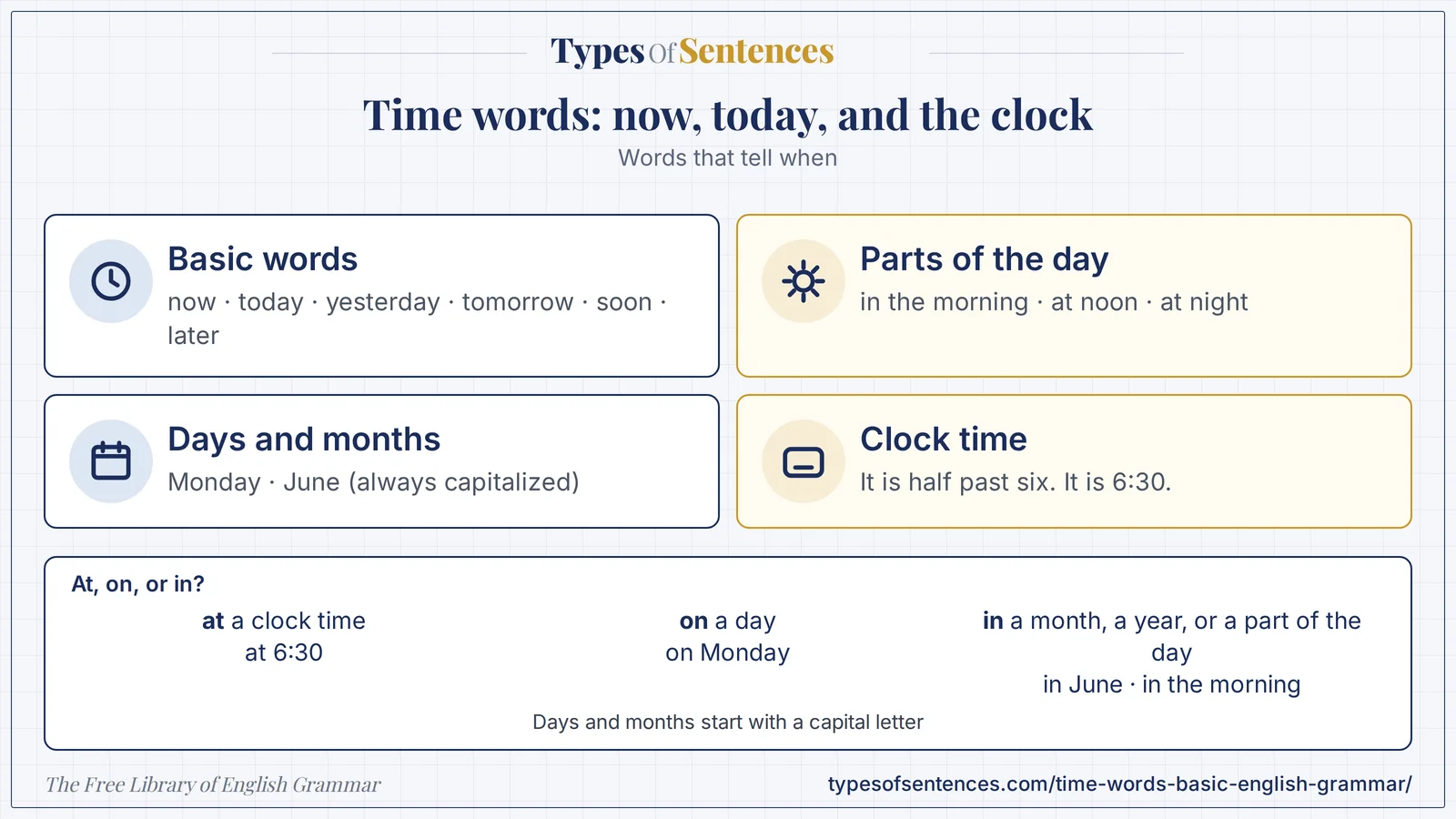
Time words are the clues that show when an action happens. They help you choose the right tense and make your meaning clear.
Why it matters: You will use them every day: to make plans, to tell stories, to give directions, and to read schedules.
Summary: Time words include basic words (now, today, yesterday, tomorrow), parts of the day (morning, evening), days, months, and clock times. Use at for clock times, on for days, and in for months, years, and parts of the day.
- Basic words: now, today, yesterday, tomorrow, soon, later.
- Parts of the day: in the morning, at noon, at night.
- Days and months start with a capital letter.
- Clock time: It is half past six. or It is 6:30.
What You’ll Learn
- 1. What Are Time Words?
- 2. Basic Time Words: Today, Yesterday, Tomorrow
- 3. Parts of the Day
- 4. Days of the Week and Months of the Year
- 5. Time Expressions with Prepositions
- 6. Telling Time: Basic Rules
- 7. Practice: Using Time Words
- 8. Exercises
- 9. Test Your Knowledge
- 10. Frequently Asked Questions
- 11. Conclusion
1. What Are Time Words?
Time words and time expressions answer the question When? They can be single words (today), phrases (next week), or prepositional phrases (at six o’clock).
| Time | Time words | Tense usually used |
|---|---|---|
| Past | yesterday, last week, two days ago, in 2020 | simple past |
| Present | now, today, every day, always | simple present |
| Future | tomorrow, next week, soon, in two days | will / going to |
You met the three main times in the chapter on verb tenses. Time words give the clues that tell you which one to choose.
2. Basic Time Words: Today, Yesterday, Tomorrow
Learn these first. The words today, yesterday, tomorrow, and now make a base for all the others.
| Word | Meaning | Example |
|---|---|---|
| now | at this moment | I am busy now. |
| today | this day | We have a test today. |
| yesterday | the day before today | I called her yesterday. |
| tomorrow | the day after today | I will call you tomorrow. |
| tonight | this evening or night | We are going out tonight. |
| soon | in a short time | The bus will arrive soon. |
| later | after now | See you later. |
| early / late | before or after the expected time | She arrived early. He was late. |
| already / yet | before now | I have already eaten. Have you eaten yet? |
Many of these time words are adverbs, which you studied in the chapter on adverbs. Yesterday goes with the simple past tense.
3. Parts of the Day
| Part of the day | Preposition | Example |
|---|---|---|
| morning | in the | I exercise in the morning. |
| afternoon | in the | We have lunch in the afternoon. |
| evening | in the | They watch TV in the evening. |
| night | at | Owls hunt at night. |
| noon / midnight | at | The class ends at noon. |
Notice the pattern: in the morning, in the afternoon, in the evening, but at night. Morning means the time from sunrise until noon; afternoon runs from noon until evening.
4. Days of the Week and Months of the Year
| Days of the week | Months of the year |
|---|---|
| Monday, Tuesday, Wednesday, Thursday | January, February, March, April, May, June |
| Friday, Saturday, Sunday | July, August, September, October, November, December |
Days and months always begin with a capital letter, as you learned in the chapter on capital letters. Seasons do not: spring, summer, fall (or autumn), winter.
- I have a class on Monday.
- My birthday is in June.
- We go skiing in winter.
5. Time Expressions with Prepositions
Prepositions go with time words. These are the most useful time expressions.
| Preposition | Use | Example |
|---|---|---|
| at | clock times, noon, night | at six, at noon, at night |
| on | days and dates | on Monday, on June 5 |
| in | months, years, seasons, parts of the day | in June, in 2025, in winter, in the morning |
| for | how long | for two hours |
| since | from a starting point to now | since Monday, since 2020 |
| ago | how long before now | two days ago |
| before / after | earlier or later than | before dinner, after school |
| until / by | end point | until Friday, by Friday |
Days take on, and clock times take at.
Here are the words with next and last: next week, next month, next year (future) and last week, last month, last year (past). They need no preposition. The prepositions themselves have their own chapter earlier in the Basic level.
6. Telling Time: Basic Rules
There are two ways to say clock times: with words or with numbers.
| Clock time | In words | Alternative |
|---|---|---|
| 6:00 | six o’clock | six |
| 6:15 | a quarter past six | six fifteen; a quarter after six (US) |
| 6:30 | half past six | six thirty |
| 6:45 | a quarter to seven | six forty-five |
| 6:10 | ten past six | six ten |
| 6:50 | ten to seven | six fifty |
Add a.m. for times from midnight to noon and p.m. for times from noon to midnight: 7:30 a.m., 7:30 p.m. Noon is 12 p.m. and midnight is 12 a.m. Many schedules use a 24-hour clock, where 7:30 p.m. is 19:30.
- The class starts at 9 o’clock.
- We eat dinner at half past six.
- The train leaves at 7:45 a.m.
7. Practice: Using Time Words
Complete: I have a class ___ Monday ___ 9 a.m. ___ June.
- Days take on: on Monday.
- Clock times take at: at 9 a.m.
- Months take in: in June.
- Write: I have a class on Monday at 9 a.m. in June.
Say 3:30 in words.
Reveal answer
Half past three (or three thirty).
Recap in 12 seconds
Watch the lesson build itself: Basic time words, parts of the day, days and months, and clock time, with the prepositions at, on, and in. The video has no sound.
Exercises
Part A: Past, Present, or Future? (Exercises 1–6)
Exercise 1: Time word shows: yesterday
Show Answer
Answer: Past.
Exercise 2: Time word shows: tomorrow
Show Answer
Answer: Future.
Exercise 3: Time word shows: now
Show Answer
Answer: Present.
Exercise 4: Time word shows: last week
Show Answer
Answer: Past.
Exercise 5: Time word shows: next year
Show Answer
Answer: Future.
Exercise 6: Time word shows: every day
Show Answer
Answer: Present.
Part B: In, On, At (Exercises 7–12)
Exercise 7: Choose: I wake up (in/on/at) the morning.
Show Answer
Answer: in.
Exercise 8: Choose: Owls hunt (in/on/at) night.
Show Answer
Answer: at.
Exercise 9: Choose: The meeting is (in/on/at) Monday.
Show Answer
Answer: on.
Exercise 10: Choose: The class starts (in/on/at) nine.
Show Answer
Answer: at.
Exercise 11: Choose: We travel (in/on/at) June.
Show Answer
Answer: in.
Exercise 12: Choose: She was born (in/on/at) 2012.
Show Answer
Answer: in.
Part C: Capital Letters (Exercises 13–18)
Exercise 13: Fix it: we meet on monday.
Show Answer
Answer: We meet on Monday.
Exercise 14: Fix it: school starts in august.
Show Answer
Answer: School starts in August.
Exercise 15: Fix it: it is cold in Winter.
Show Answer
Answer: It is cold in winter.
Exercise 16: Fix it: my birthday is on friday.
Show Answer
Answer: My birthday is on Friday.
Exercise 17: Name the months with 31 days that start with J.
Show Answer
Answer: January and July.
Exercise 18: How many days are in a week?
Show Answer
Answer: Seven.
Part D: Telling Time (Exercises 19–24)
Exercise 19: Say in words: 6:00
Show Answer
Answer: Six o’clock.
Exercise 20: Say in words: 6:30
Show Answer
Answer: Half past six.
Exercise 21: Say in words: 6:15
Show Answer
Answer: A quarter past six (or a quarter after six).
Exercise 22: Say in words: 6:45
Show Answer
Answer: A quarter to seven.
Exercise 23: Say in words: 6:10
Show Answer
Answer: Ten past six.
Exercise 24: Say in words: 6:50
Show Answer
Answer: Ten to seven.
Part E: Use the Time Word (Exercises 25–28)
Exercise 25: Complete: I called her ___. (yesterday/tomorrow)
Show Answer
Answer: yesterday.
Exercise 26: Complete: We will meet ___. (yesterday/tomorrow)
Show Answer
Answer: tomorrow.
Exercise 27: Complete: He studied ___ two hours. (for/since)
Show Answer
Answer: for.
Exercise 28: Complete: She has lived here ___ 2020. (for/since)
Show Answer
Answer: since.
Part F: Review (Exercises 29–30)
Exercise 29: Review (Chapter 38, question words): which word asks about a time?
Show Answer
Answer: When.
Exercise 30: Review (Chapter 28, past): past of go:
Show Answer
Answer: went.
Test Your Knowledge
Ready to check what you learned? Answer all 10 questions, then submit. You need 80% (8 of 10) to pass. Your answers are not stored.
View correct answers and explanations
Question 1: What do time words tell us?
✓ Correct Answer: B – When
Time words tell when something happens.
Question 2: Which time word means the day before today?
✓ Correct Answer: D – Yesterday
Yesterday means the day before today.
Question 3: Which preposition goes with a day?
✓ Correct Answer: C – on
Days take on: on Monday.
Question 4: Which preposition goes with a clock time?
✓ Correct Answer: A – at
Clock times take at: at six.
Question 5: Which is correct?
✓ Correct Answer: C – at night
Say at night, but in the morning.
Question 6: Which is correct?
✓ Correct Answer: A – in the morning
Say in the morning.
Question 7: Which is correct?
✓ Correct Answer: D – in June
Months take in.
Question 8: What time is 6:30?
✓ Correct Answer: B – Half past six
6:30 is half past six.
Question 9: What time is 6:45?
✓ Correct Answer: C – A quarter to seven
6:45 is a quarter to seven.
Question 10: Which is capitalized?
✓ Correct Answer: A – Monday
Days and months are capitalized; seasons are not.
Frequently Asked Questions
What are time words?
Time words are words and phrases that tell when something happens, such as today, yesterday, tomorrow, morning, Monday, June, and at six o’clock.
What are time expressions?
Time expressions are phrases that say when, such as next week, two days ago, in the morning, and at noon. They often use prepositions such as at, on, and in.
How do I use today, yesterday, tomorrow?
Use today for this day, yesterday for the day before, and tomorrow for the day after. Yesterday goes with the past tense, and tomorrow goes with the future.
What is the best way to learn time vocabulary?
Learn it in groups: basic words, parts of the day, days, months, and clock times. Then practice each group in short sentences about your own day.
What are the telling time basic rules?
Say o’clock for the hour, past or after for up to the half hour, half past for 30 minutes, and to for the second half. Use a.m. before noon and p.m. after.
Do I use in, on, or at with time?
Use at for clock times, on for days and dates, and in for months, years, seasons, and parts of the day (except at night).
Conclusion
You now know the basic time words and time expressions: today, yesterday, tomorrow, the parts of the day, days, months, the prepositions that go with them, and the basic rules for telling time.
Practice by describing your daily schedule with exact times. Next, you will study place words and their opposites.
- Merriam-Webster Dictionary: time: dictionary entries for time words.
- Purdue Online Writing Lab: Grammar: reference section on prepositions and time.
- Quirk, Randolph, et al. A Comprehensive Grammar of the English Language. Longman, 1985.: description of time adverbials.
Last reviewed: October 29, 2026. How it was made: drafted with AI assistance, then checked with automated tests (structure, links, answer keys, spelling) and against the sources above. A person has not yet read this chapter line by line. Found a mistake? Report it.