Tense consistency means keeping the verbs in a passage in the same time frame unless the meaning of the time changes. If you begin telling a story in the past, you continue in the past; if you summarize a book in the present, you stay in the present. Needless switching between tenses confuses the reader about when things happen. The matching of tenses between clauses is called the sequence of tenses, and it is also known as tense agreement.
This chapter explains what consistency requires, the sequence of tenses between a main clause and a subordinate clause, the shifts that are correct, and the tense shifts that are errors. You will learn rules for maintaining tense in writing in the past and in the present, how tense works in reported speech and conditionals, and a proofreading method. Thirty exercises and a quiz follow.
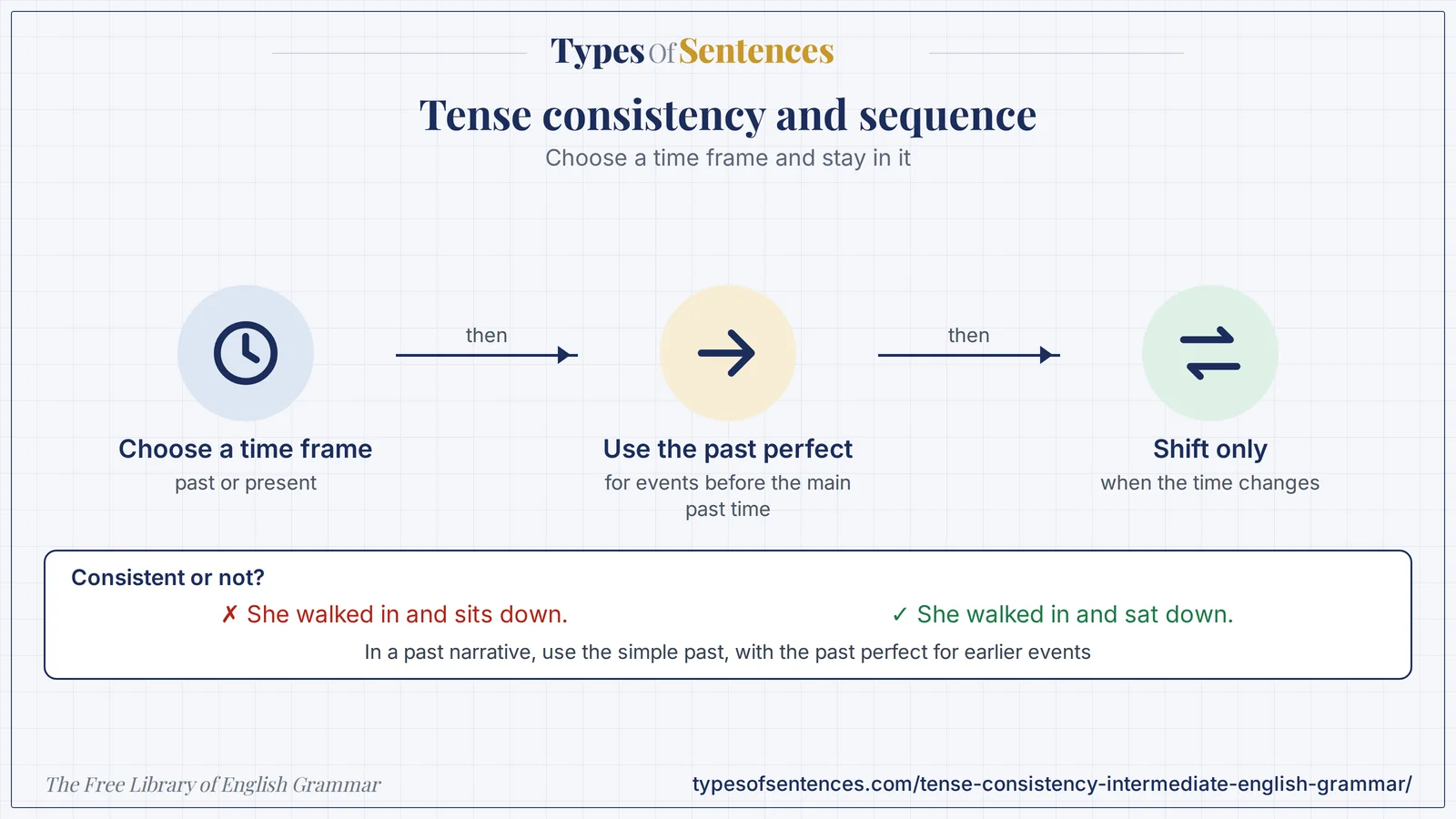
Time is a thread through your writing. If you keep changing from past to present without a reason, the reader loses the thread.
Why it matters: The rule is simple: choose the time frame, stay in it, and change only when the time itself changes. A few exceptions, such as general truths and reported speech, follow clear patterns.
Summary: Keep tenses consistent within a sentence, a paragraph, and a text unless the time changes. In a past narrative, use the simple past, with the past perfect for earlier events. In a sentence with a past main verb, subordinate clauses usually shift back (the sequence of tenses). General truths stay in the present. Check each shift: is the time really different?
- Choose a time frame (past or present) and stay in it.
- Past main clause: past or past perfect in the subordinate clause (She said she was tired).
- Shift when the time changes: She said she is tired is fine if she still is.
- Reported speech and conditionals follow their own sequence patterns.
What You’ll Learn
- 1. What Is Tense Consistency?
- 2. Sequence of Tenses
- 3. When to Shift Tenses
- 4. Common Tense Errors and Tense Shifts
- 5. Writing in the Past
- 6. Writing in the Present
- 7. Consistency in Time Clauses and Conditionals
- 8. A Proofreading Method for Tense
- 9. Exercises
- 10. Test Your Knowledge
- 11. Frequently Asked Questions
- 12. Conclusion
1. What Is Tense Consistency?
Tense consistency is keeping the verbs in the same time frame within a sentence, a paragraph, or a whole text. The tenses themselves are described in the chapter on verb tenses. Consistency is about how you choose and match them.
| Inconsistent | Consistent | Time frame |
|---|---|---|
| She opened the door and sees a stranger. | She opened the door and saw a stranger. | past |
| When I was young, I live in Texas. | When I was young, I lived in Texas. | past |
| The hero escapes and ran away. | The hero escapes and runs away. | present |
| I will call you when I will arrive. | I will call you when I arrive. | future (time clause) |
Tense agreement is not the same as subject-verb agreement. Subject-verb agreement matches the verb to its subject (She walks); tense agreement matches the verb to the time frame of the surrounding verbs.
2. Sequence of Tenses
The sequence of tenses is the pattern by which the tense of a subordinate clause depends on the tense of the main clause. It is strongest when the main verb is in the past.
| Main verb | Subordinate clause | Example |
|---|---|---|
| present | any tense that fits the meaning | She says that he works / worked / will work there. |
| past | past (same time) | She said that he worked there. |
| past | past perfect (earlier time) | She said that he had worked there before. |
| past | would (later time) | She said that he would work there next year. |
| past | past continuous (in progress) | She said that he was working there. |
| future | present (time clause) | She will call when he arrives. |
The backward shift after a past main verb is also called backshift. It is the rule that governs reported speech: “I am tired” becomes She said she was tired. See the chapter on reported speech.
| Direct speech | Reported speech after a past verb |
|---|---|
| “I work here.” (simple present) | She said she worked here. |
| “I am working.” (present continuous) | She said she was working. |
| “I have worked.” (present perfect) | She said she had worked. |
| “I worked.” (simple past) | She said she had worked. |
| “I will work.” | She said she would work. |
| “I can work.” | She said she could work. |
3. When to Shift Tenses
A change of tense is correct when the time actually changes. These are the main reasons.
| Reason | Example |
|---|---|
| the time frame changes | I lived in Texas for years. Now I live in Ohio. |
| an earlier event (flashback) | She sat down. She had been walking all day. |
| a general truth or permanent fact | The teacher said that water boils at 100 degrees. (still true) |
| something still true now | She told me that she is a nurse. (she still is) |
| a future event seen from the past | He said that he would call tomorrow. |
| a quotation or title in the present | Shakespeare writes that “all the world’s a stage.” |
| conditionals and unreal situations | If I had known, I would have called. |
| a present result of a past event | I lost my keys, so I can’t get in. |
Style guides differ on how strictly to apply the backshift when the reported statement is still true. She said she is a nurse and She said she was a nurse are both accepted in speech. In formal writing, use the backshifted form unless you want to stress that the statement is still true.
4. Common Tense Errors and Tense Shifts
| Error (unneeded shift) | Correction | Problem |
|---|---|---|
| She opened the door and sees a stranger. | She opened the door and saw a stranger. | shift within a sentence |
| Last night I went to a party. I meet many people. I have a great time. | Last night I went to a party. I met many people. I had a great time. | shift between sentences |
| After he left, he walks home. | After he left, he walked home. | shift in a time clause |
| The detective enters the room. He looked around and said nothing. | The detective enters the room. He looks around and says nothing. | shift in a narrative |
| When I was young, I live in Texas. | When I was young, I lived in Texas. | main and subordinate clause mismatch |
| She said that she goes tomorrow. | She said that she was going / would go tomorrow. | backshift |
| If I will go, I will call. | If I go, I will call. | future in an if clause |
| The study shows that most students fail, and it recommended changes. | The study shows that most students fail, and it recommends changes. | shift in a summary |
Another common error is a shift in a list of verbs (She sings, danced, and plays). Keep all the verbs in a series parallel in tense: She sings, dances, and plays.
5. Writing in the Past
Narratives, histories, and accounts of finished events are written in the past. The simple past carries the main events, the past continuous gives the background, and the past perfect gives events that came earlier; see the chapter on the past tenses.
| Part of the text | Tense | Example |
|---|---|---|
| main events | simple past | She walked into the room and sat down. |
| scene and background | past continuous | The rain was beating on the windows. |
| events before the story | past perfect | She had come from the station. |
| facts still true now | present | The room is on the second floor. |
Fix the shifts: When I walked into the house, I see that the lights were off. My brother sits in the dark, and he looks upset. I ask him what happened, and he said that he lost his job.
- The time frame is the past: walked, saw.
- Change each present verb to the past: sat, looked, asked.
- The reported clause: he had lost his job (earlier than the asking).
- Result: When I walked into the house, I saw that the lights were off. My brother sat in the dark, and he looked upset. I asked him what happened, and he said that he had lost his job.
6. Writing in the Present
Some kinds of writing use the present as the main time frame. In each, the present is the default and the other tenses show earlier or later events.
| Kind of writing | Tense | Example |
|---|---|---|
| plot summaries and literary analysis (the “literary present”) | simple present | In the novel, Maria leaves her village and finds a new life. |
| news headlines | simple present | Mayor Announces New Plan |
| instructions and recipes | simple present or imperative | Add the flour and stir. |
| general facts and explanations | simple present | Plants need light to grow. |
| what a text says | simple present | The author argues that technology isolates people. |
- In an essay about a book, use the present for what happens in it, and the past for events outside it: Dickens wrote the novel in 1861, and in it Pip dreams of a better life.
- In academic writing, many writers use the past for completed studies and results (Smith found that…), the present for current knowledge and the paper’s own structure (This paper argues…), and the present perfect for ongoing research (Researchers have shown…). Conventions differ by field and style guide.
7. Consistency in Time Clauses and Conditionals
| Pattern | Example | Rule |
|---|---|---|
| future main + time clause | When she arrives, we will eat. | present in the time clause |
| future main + if clause | If it rains, we will stay home. | present in the if clause |
| past main + when clause | When she arrived, we ate. | same time frame |
| unreal present | If I were rich, I would travel. | past in the if clause, would in the main clause |
| unreal past | If I had known, I would have called. | past perfect + would have |
The time clauses are studied in the chapter on adverb clauses, and the full system of conditionals in the chapter on conditional sentences. In each pattern, the tense of one clause depends on the other, and the pair makes a consistent frame.
8. A Proofreading Method for Tense
- Underline every finite verb in the passage.
- Decide the main time frame: past or present.
- Mark every verb that is not in that frame.
- For each one, decide: does the time really change (earlier, later, general truth)? If yes, keep it. If not, change it.
- Check the sequence of tenses in each sentence with a main and a subordinate clause.
- Read the paragraph aloud for the flow of time.
Edit: The scientists conducted an experiment last year. They find that the plants grow faster in blue light. The results are published in a journal, and many researchers had cited them since.
- The experiment is a finished event in the past: conducted. Keep.
- They find: a past finding, so the past: found.
- grow: after a past verb: grew (or grow as a general truth).
- are published: a past event: were published.
- had cited them since: a duration to now: have cited them since.
- Result: The scientists conducted an experiment last year. They found that the plants grew faster in blue light. The results were published in a journal, and many researchers have cited them since.
Recap in 12 seconds
Watch the lesson build itself: Keep tenses consistent unless the time changes; use the past perfect for earlier events in a past narrative. The video has no sound.
Exercises
Part A: Spotting Shifts (Exercises 1–6)
Exercise 1: Consistent or not: She opened the door and sees a stranger.
Show Answer
Answer: Not consistent (past, then present).
Exercise 2: Consistent or not: She opened the door and saw a stranger.
Show Answer
Answer: Consistent (past).
Exercise 3: Find the unneeded shift: When I was young, I live in Texas.
Show Answer
Answer: live (should be lived).
Exercise 4: Find the unneeded shift: After he left, he walks home.
Show Answer
Answer: walks (should be walked).
Exercise 5: Is the shift justified: I lived in Texas for years. Now I live in Ohio.
Show Answer
Answer: Yes. The time changes (now).
Exercise 6: Is the shift justified: The detective enters the room. He looked around.
Show Answer
Answer: No. The narrative is in the present, so use looks.
Part B: Fixing Shifts (Exercises 7–13)
Exercise 7: Fix: She opened the door and sees a stranger.
Show Answer
Answer: She opened the door and saw a stranger.
Exercise 8: Fix: Last night I went to a party. I meet many people.
Show Answer
Answer: Last night I went to a party. I met many people.
Exercise 9: Fix: The hero escapes and ran away.
Show Answer
Answer: The hero escapes and runs away.
Exercise 10: Fix: She sings, danced, and plays.
Show Answer
Answer: She sings, dances, and plays.
Exercise 11: Fix: The study shows that most students fail, and it recommended changes.
Show Answer
Answer: …and it recommends changes.
Exercise 12: Fix: If I will go, I will call.
Show Answer
Answer: If I go, I will call.
Exercise 13: Fix: I will call you when I will arrive.
Show Answer
Answer: I will call you when I arrive.
Part C: Sequence of Tenses (Exercises 14–19)
Exercise 14: Backshift: “I work here.” → She said she ___ here.
Show Answer
Answer: worked.
Exercise 15: Backshift: “I am working.” → She said she ___.
Show Answer
Answer: was working.
Exercise 16: Backshift: “I have worked.” → She said she ___.
Show Answer
Answer: had worked.
Exercise 17: Backshift: “I will work.” → She said she ___.
Show Answer
Answer: would work.
Exercise 18: Backshift: “I can work.” → She said she ___.
Show Answer
Answer: could work.
Exercise 19: Choose: She said that he (works/had worked) there before. (an earlier time)
Show Answer
Answer: had worked.
Part D: Justified Shifts (Exercises 20–24)
Exercise 20: Choose: The teacher said that water (boils/boiled) at 100 degrees. (general truth)
Show Answer
Answer: boils (still true; boiled is also accepted).
Exercise 21: Choose: He said that he (will call/would call) tomorrow.
Show Answer
Answer: would call.
Exercise 22: Choose: She sat down. She (walked/had been walking) all day.
Show Answer
Answer: had been walking.
Exercise 23: Is Shakespeare writes that “all the world’s a stage” acceptable?
Show Answer
Answer: Yes, the present tense is used for what a text says.
Exercise 24: Which tense is used for a plot summary?
Show Answer
Answer: The simple present (literary present).
Part E: Writing and Editing (Exercises 25–30)
Exercise 25: Which time frame for a story of last summer?
Show Answer
Answer: The past.
Exercise 26: Which time frame for a summary of a novel?
Show Answer
Answer: The present.
Exercise 27: Fix: When I walked in, I see the lights were off.
Show Answer
Answer: When I walked in, I saw the lights were off.
Exercise 28: Fix: The results are published last year.
Show Answer
Answer: The results were published last year.
Exercise 29: Fix: She said that she goes tomorrow.
Show Answer
Answer: She said that she was going (or would go) tomorrow.
Exercise 30: Name the first step of the proofreading method.
Show Answer
Answer: Underline every finite verb.
Test Your Knowledge
Ready to check what you learned? Answer all 10 questions, then submit. You need 80% (8 of 10) to pass. Your answers are not stored.
View correct answers and explanations
Question 1: What is tense consistency?
✓ Correct Answer: A – Keeping verbs in the same time frame unless the time changes
Tenses match the time frame unless the time really changes.
Question 2: Which is consistent?
✓ Correct Answer: C – She opened the door and saw a stranger.
Both verbs are in the past.
Question 3: Which is correct?
✓ Correct Answer: D – When I was young, I lived in Texas.
The main and subordinate clauses are both past.
Question 4: Which is correct backshift: “I will work.”
✓ Correct Answer: C – She said she would work.
Will becomes would.
Question 5: Which is correct?
✓ Correct Answer: A – If I go, I will call.
Use the present in an if clause about the future.
Question 6: Which tense is used for a plot summary?
✓ Correct Answer: B – Present
The literary present is used for what happens in a story.
Question 7: When is a shift in tense correct?
✓ Correct Answer: C – When the time actually changes
A shift is correct when the time changes.
Question 8: Which is correct?
✓ Correct Answer: D – She sings, dances, and plays.
Keep a series parallel in tense.
Question 9: Which is correct?
✓ Correct Answer: B – She said that he had worked there before.
An earlier time takes the past perfect.
Question 10: What do you do first when proofreading for tense?
✓ Correct Answer: B – Underline every finite verb
Find the verbs first.
Frequently Asked Questions
What is tense consistency?
Tense consistency is keeping the verbs in a sentence, paragraph, or text in the same time frame unless the time actually changes. It prevents confusion about when things happen.
What is the sequence of tenses?
The sequence of tenses is the pattern by which the tense of a subordinate clause depends on the main clause. After a past main verb, the subordinate verb usually shifts back: She said she was tired.
What is tense agreement?
Tense agreement is another name for matching the tenses of verbs in related clauses so that they fit the same time frame. It is different from subject-verb agreement, which matches the verb to its subject.
What does maintaining tense mean?
Maintaining tense means staying in one time frame throughout a passage. A narrative of a past event stays in the past, and a summary of a book stays in the present.
What are tense shifts?
Tense shifts are changes from one tense to another. They are errors when the time does not change (She opened the door and sees a stranger), and correct when it does (I lived in Texas; now I live in Ohio).
When can I use the present after a past main verb?
Use the present for a general truth or a fact that is still true: The teacher said that water boils at 100 degrees. In formal writing, the backshifted form is also accepted.
Should I use the present or the past when writing about a book?
Use the present for what happens in the book and what the author says (the literary present). Use the past for events outside the book, such as when it was written.
Conclusion
You now understand tense consistency and the sequence of tenses. You can keep one time frame, match main and subordinate clauses, backshift in reported speech, shift when the time changes, write in the past and in the present, and proofread for needless tense shifts.
Underline the verbs in your next draft and check every shift. Next, you begin the study of modal verbs.
- Merriam-Webster Dictionary: tense: the dictionary definition of tense.
- Purdue Online Writing Lab: Grammar: reference section on verb tense consistency.
- Quirk, Randolph, et al. A Comprehensive Grammar of the English Language. Longman, 1985.: backshift and the sequence of tenses.
- Huddleston, Rodney, and Geoffrey K. Pullum. The Cambridge Grammar of the English Language. Cambridge University Press, 2002.: tense in subordinate clauses and indirect reports.
Last reviewed: October 29, 2026. How it was made: drafted with AI assistance, then checked with automated tests (structure, links, answer keys, spelling) and against the sources above. A person has not yet read this chapter line by line. Found a mistake? Report it.