Tense and aspect are the two grammatical systems that English uses to place events in time and to show how the speaker views them. Tense locates an event relative to the moment of speaking: present or past. Aspect shows the internal shape of the event: simple, in progress, completed, or both. The familiar “twelve tenses” are really combinations of these systems, and their meanings are subtler than the textbook labels suggest. These advanced tenses are the subject of this chapter.
You will study the difference between tense, aspect, and time, aspect in English (simple, progressive, perfect, and perfect progressive), the twelve tense-aspect combinations with their subtle differences, the classes of verb meaning that decide how aspect works (states, activities, accomplishments, and achievements), the historical present, the future in the past (was going to, would), the sequence of tenses, and how writers choose tenses in narrative and academic prose. The result is control of temporal relationships and complex tense usage. Thirty editing exercises and a quiz follow.
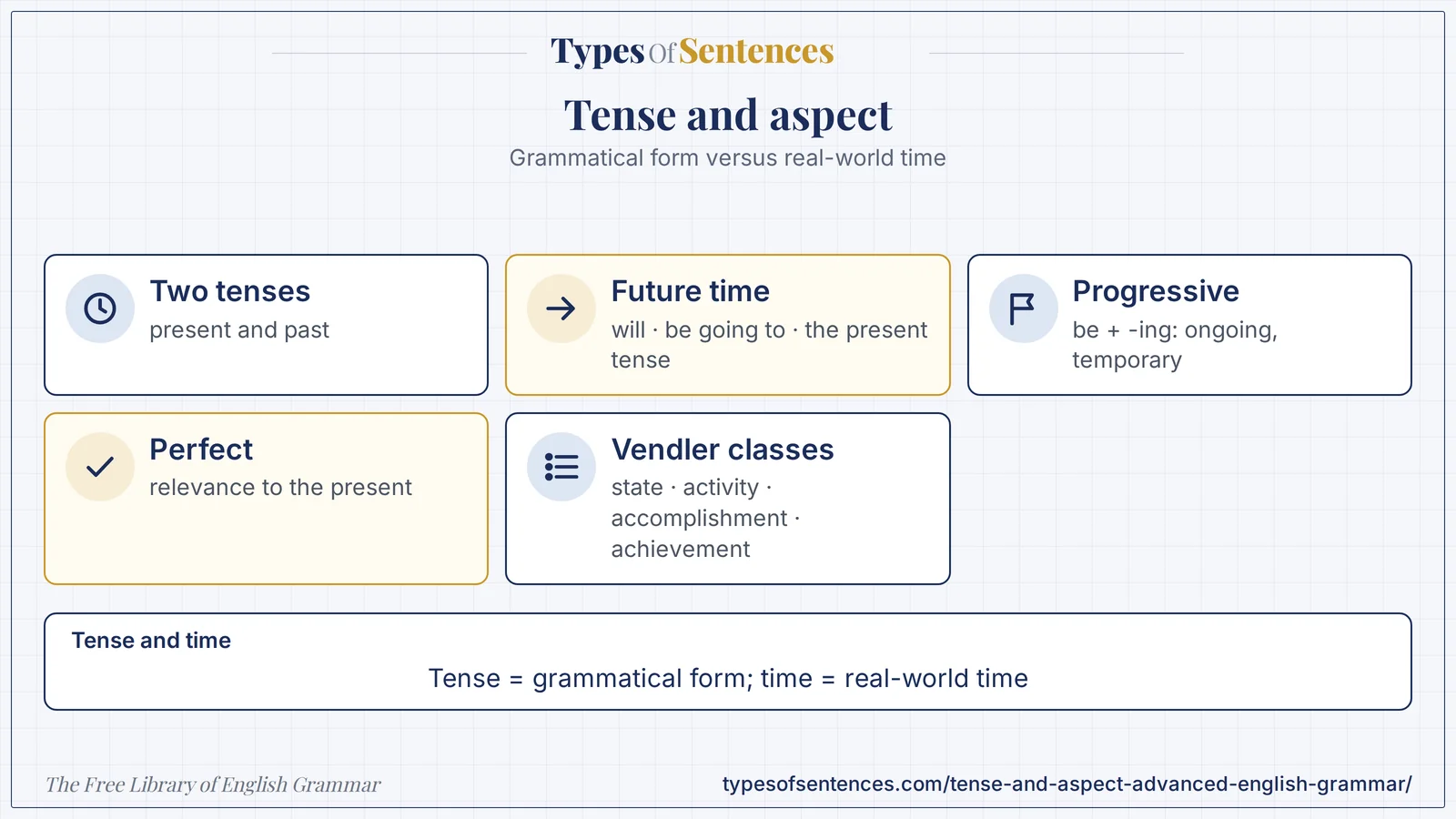
A time is a point or period in the world; a tense is a grammatical form. They are related but not identical: The train leaves at six tomorrow uses the present tense for a future time. Aspect adds another dimension: whether the speaker sees the event as a whole (She wrote a letter), as in progress (She was writing a letter), or in relation to another time (She had written a letter).
Why it matters: The choice of tense and aspect is a choice of viewpoint. Once you see tenses as viewpoints and not as rigid rules about time, the “exceptions” make sense.
Summary: English has two morphological tenses, present and past; future time is expressed by will, be going to, the present tense, and other forms. Aspect has three markers: the progressive (be + -ing: ongoing), the perfect (have + -en: relevance or anteriority), and the simple form (neutral). The twelve tenses combine time (past, present, future) and aspect (simple, progressive, perfect, perfect progressive). The meaning of aspect depends on the verb’s class (state, activity, accomplishment, achievement). Sequence of tenses links clauses in time.
- Tense = grammatical form (present, past); time = real-world position; aspect = viewpoint.
- Progressive = in progress, temporary; perfect = relevance or earlier; simple = neutral.
- Vendler classes: state, activity, accomplishment, achievement.
- Backshift and sequence follow the viewpoint, not only the clock.
What You’ll Learn
- 1. Tense and Aspect: Tense, Aspect, and Time
- 2. Aspect in English: Simple, Progressive, and Perfect
- 3. The Twelve Tenses Revisited: Subtle Meaning Differences
- 4. Vendler’s Classes of Situations: States, Activities, Accomplishments, Achievements
- 5. The Historical Present
- 6. Future in the Past
- 7. The Sequence of Tenses: Complex Patterns
- 8. Time Adverbials and Tense Restrictions
- 9. Tense Choice in Discourse and Academic Writing
- 10. Common Errors in Tense and Aspect
- 11. Exercises
- 12. Test Your Knowledge
- 13. Frequently Asked Questions
- 14. Conclusion
1. Tense and Aspect: Tense, Aspect, and Time
| Term | Meaning | Example |
|---|---|---|
| time | the real-world position of an event: past, present, or future | tomorrow, yesterday, now |
| tense | a grammatical form of the verb that locates the situation relative to the time of speaking | walk (present), walked (past) |
| aspect | the speaker’s view of the internal structure of the event | walks (simple), is walking (progressive), has walked (perfect) |
| mood and modality | the speaker’s attitude to the event | may walk, will walk |
English has only two tenses in the strict sense: the present and the past, marked on the first verb of the verb phrase (walk(s), walked). There is no inflected future. Future time is expressed by modal will, by be going to, by the present progressive (I am leaving tomorrow), by the present simple for timetables (The train leaves at six), and by other forms. For this reason many grammarians say that English has two tenses and several ways of expressing future time, and the traditional list of twelve “tenses” is a combination of time and aspect.
| simple | progressive | perfect | perfect progressive | |
|---|---|---|---|---|
| present | writes | is writing | has written | has been writing |
| past | wrote | was writing | had written | had been writing |
| future (with will) | will write | will be writing | will have written | will have been writing |
The verb phrase is the structure that carries them, as described in the chapter on complex verb phrases. Notice that the “future tenses” add the modal will to the base forms. The modal verbs are treated in the next chapter, on modality.
2. Aspect in English: Simple, Progressive, and Perfect
Aspect is the grammatical expression of how an event is viewed. In many languages the main distinction is between perfective aspect (the event as a whole, complete) and imperfective aspect (the event from the inside, in progress or habitual). English marks aspect in two ways, and the simple form is the unmarked choice.
| Aspect | Form | Viewpoint | Example |
|---|---|---|---|
| simple (unmarked) | verb alone | the event as a whole; habit; fact | She wrote a letter. She writes novels. |
| progressive | be + -ing | an event in progress, temporary or incomplete; seen from the inside | She was writing a letter when I called. |
| perfect | have + -en | a situation before a reference time, with relevance to it | She has written a letter. She had written it before I arrived. |
| perfect progressive | have + been + -ing | an event in progress up to a reference time | She has been writing all day. |
| Contrast | Meaning | Notes |
|---|---|---|
| She wrote a letter. / She was writing a letter. | completed event / in progress at a time | the progressive does not say that the letter was finished (the “imperfective paradox”) |
| I live in Delhi. / I am living in Delhi. | permanent / temporary | the progressive suggests a temporary situation |
| She talks a lot. / She is always talking. | habit / repeated and annoying habit | progressive with always adds an attitude |
| He is rude. / He is being rude. | a trait / behaving rudely now | be is dynamic in the progressive |
| It gets dark. / It is getting dark. | a general fact / a change in progress | the progressive shows gradual change |
| I leave tomorrow. / I am leaving tomorrow. | a fixed schedule / a plan | the progressive suggests a plan or arrangement |
Stative and dynamic verbs behave differently with aspect (see the chapter on advanced verb concepts). Stative verbs (know, love, belong) normally take the simple form, and a progressive with them suggests a temporary or dynamic reading (I’m loving it, She is being difficult).
3. The Twelve Tenses Revisited: Subtle Meaning Differences
| Form | Main uses | Example |
|---|---|---|
| present simple | habits and states; general truths; scheduled future; narrative present; commentary | Water boils at 100 degrees. The train leaves at six. Messi passes to Neymar. |
| present progressive | action in progress now; temporary situations; fixed plans; changing situations; annoying habits | She is working. I am staying with friends. We are leaving tomorrow. |
| present perfect | a past event with present relevance; unfinished time; experience; a result | I have lost my keys. She has lived here for ten years. I have been to Paris. |
| present perfect progressive | an activity up to now, with duration or a visible result | I have been waiting for an hour. You look wet. — It has been raining. |
| past simple | a finished event at a past time; a sequence; a past habit or state | She left at six. He lived in Delhi for years. |
| past progressive | an event in progress at a past time; background; interrupted action | She was sleeping when I called. While he was reading, she cooked. |
| past perfect | an event before another past time; a reported earlier event; unreal past | She had left before I arrived. If I had known … |
| past perfect progressive | an activity before a past time, with duration | She had been working for hours when he came. |
| future simple (will) | prediction; spontaneous decision; promise; willingness | It will rain. I’ll help you. I will call. |
| be going to | a plan or intention; a prediction based on present evidence | I am going to study. Look at those clouds! It’s going to rain. |
| future progressive | an event in progress at a future time; a routine; polite inquiry | This time tomorrow I will be flying. Will you be using the car? |
| future perfect | an event completed before a future time | By June she will have finished. |
| future perfect progressive | duration up to a future time | By June she will have been working here for ten years. |
| Contrast | Present perfect | Past simple |
|---|---|---|
| time reference | unfinished or indefinite time (this week, ever, already) | finished time (yesterday, in 2010, last year, ago) |
| example | I have seen that film. | I saw that film last week. |
| relevance | the present result or experience matters | the event is past and closed |
| news reports | Police have arrested a man. (lead) | The man was seen at six. (details) |
| American and British | American: Did you eat yet? is also heard | British: Have you eaten yet? is usual |
The present perfect with a finished-time adverbial (*I have seen him yesterday) is an error in standard English because the perfect links the past to the present, and yesterday ends the link. Some varieties and some learners’ languages use it, but standard written English does not. In American English, the simple past is also used with already, yet, and just in speech (I already ate).
4. Vendler’s Classes of Situations: States, Activities, Accomplishments, Achievements
The meaning of aspect depends on the verb, or more exactly on the kind of situation that the verb phrase describes. The philosopher Zeno Vendler proposed four classes, still used in linguistics.
| Class | Dynamic? | Duration? | Endpoint? | Examples |
|---|---|---|---|---|
| state | no | yes | no | know French, love music, be tall, own a house |
| activity | yes | yes | no | run, swim, push a cart, write poetry |
| accomplishment | yes | yes | yes | build a house, write a letter, run a mile, eat an apple |
| achievement | yes | no (instant) | yes | reach the summit, win the race, find the keys, notice a stain |
| Test | State | Activity | Accomplishment | Achievement |
|---|---|---|---|---|
| progressive possible? | no (*is knowing) | yes (is running) | yes (is building a house) | rare (is winning = approaching) |
| for an hour | yes (knew for years) | yes (ran for an hour) | odd (*built a house for an hour) | odd (*won for an hour) |
| in an hour | no | no | yes (built a house in a year) | yes (reached the top in an hour) |
| “stopped” entails “did”? | — | yes: stopped running → ran | no: stopped building does not entail built | — |
These classes explain how the progressive and the perfect behave. With an activity, the progressive entails the simple past: She was running implies She ran. With an accomplishment, it does not: She was building a house does not imply that she built it; this is the imperfective paradox. With an achievement, the progressive shifts the meaning to the lead-up (He is dying, The plane is landing) or to repetition (She is winning every game). Present simple with achievements and accomplishments often indicates a schedule: The plane lands at six.
5. The Historical Present
| Use | Example | Effect |
|---|---|---|
| vivid narrative of past events | So I walk into the room, and he looks at me, and he says … | immediacy; informal storytelling |
| news headlines | Prime Minister resigns. Storm hits coast. | brevity; present immediacy |
| commentary | Messi passes to Neymar, who shoots … | events as they happen |
| summaries of plots and works | In the novel, Maria leaves her village and travels to Delhi. | convention in literary criticism |
| reporting what authors say | Orwell argues that language corrupts thought. The study shows that … | academic present for texts |
| reporting what one hears | I hear that she is leaving. They say it’s true. | present of communication |
| stage directions | Enter Hamlet. He pauses. | convention |
The historical present (also called the narrative present) uses the present tense for past events to make them vivid. It is common in spoken storytelling and in some fiction, and it is a convention in plot summaries and in writing about literature. If you use it, keep it consistent, and switch to the past only for events that are explicitly earlier. A shift between the past and the historical present within a passage can mark a climax or a change of scene, but unplanned shifts confuse the reader.
6. Future in the Past
| Form | Example | Meaning |
|---|---|---|
| would + base form | She said she would come. He knew he would fail. | a backshifted will |
| was/were going to + base form | She was going to call. I knew it was going to rain. | intention or expectation, often unfulfilled |
| was/were to + base form | She was to become president. We were to meet at six. | fate (literary) or an arrangement |
| was/were about to + base form | I was about to leave when the phone rang. | on the point of |
| was/were on the point of + -ing | He was on the point of leaving. | formal equivalent |
| would in narration (retrospective) | He would later become a famous writer. | a later event from the vantage point of the story |
| would have + past participle | By then he would have left. | a completed future event, seen from the past |
The future in the past describes an event that was in the future from a past point of view. I was going to call you, but I forgot suggests that the intention was not carried out, while I would call you in the same context would be a report of a promise. In narrative, would and was to provide a retrospective view from the narrator’s vantage point: She did not know then that she would meet him again.
7. The Sequence of Tenses: Complex Patterns
| Main clause | Subordinate clause | Example | Notes |
|---|---|---|---|
| present | any tense, as needed | She says that he left / is leaving / will leave. | no change of tense |
| past | past forms (backshift) | She said that he left / was leaving / would leave / had left. | the verb is “backshifted” |
| past | present (still true) | She said that the Earth moves round the sun. She said she is a nurse. (she still is) | backshift is optional when the statement is still true |
| past | past perfect (earlier) | She said that she had finished. | an event before the reporting time |
| future | present for the future | I will call when she arrives. I will leave before she comes. | no will in a time clause |
| past | present perfect not used | *She said that he has left. | use the past perfect or the past |
| unreal | past forms | I wish I had more time. It’s time we left. I’d rather you stayed. | the past marks unreality |
| Time clauses | Past events | Notes |
|---|---|---|
| before + past | She left before he arrived. | either tense often works |
| after + past perfect (or past) | After she had left, he called. / After she left, he called. | the past perfect shows the order explicitly |
| when + past (sequence) | When she arrived, he left. | one event after the other |
| when + past perfect | When she had finished, he left. | the first event is completed |
| while + past progressive | While she was reading, he cooked. | simultaneous events |
| until + past | She waited until he came. | — |
Reported speech is the main application of the sequence of tenses; it is treated at length in the chapter on advanced reported speech. The sequence is also at work in conditionals (If she had known, she would have come), covered in the chapter on advanced conditionals, and in the non-finite forms that express time relative to the main verb, studied in the chapter on non-finite verbs.
8. Time Adverbials and Tense Restrictions
| Adverbial | Tense used | Example | Not used with |
|---|---|---|---|
| yesterday, last week, in 2010, ago | past simple | I saw him yesterday. She left two years ago. | present perfect |
| since, for (with the perfect) | present perfect (or past perfect) | I have lived here since 2015. She had worked there for years. | — |
| already, yet, still, just | present perfect (British); past simple also (American) | Have you finished yet? I’ve just eaten. / I just ate. | — |
| ever, never, before (experience) | present perfect | Have you ever been to Paris? I have never seen it. | — |
| recently, lately | present perfect or past simple | I have seen him recently. I saw him recently. | — |
| this morning, today, this week | present perfect (unfinished) or past simple (finished) | I have worked a lot today. I worked a lot this morning (it is now afternoon). | — |
| always, usually, often, every day | present simple (habit) | She always arrives early. | present progressive (except with irritation) |
| tomorrow, next week | will, present progressive, present simple for schedules | I will call tomorrow. We are leaving next week. | — |
| at the moment, now, currently | present progressive (or simple with states) | She is working at the moment. | — |
| by + future time | future perfect | By Friday I will have finished. | — |
9. Tense Choice in Discourse and Academic Writing
| Function | Tense | Example |
|---|---|---|
| narrative: main sequence of events (foreground) | past simple | She entered the room. She sat down. She opened the letter. |
| narrative: background and scene | past progressive; past perfect | The sun was shining. She had not slept. |
| news lead and details | present perfect then past simple | A man has been arrested. He was seen at the station at six. |
| general truths and facts | present simple | Water boils at 100 degrees. |
| reporting authors and texts | present simple | Smith argues that … The study shows … |
| reporting a particular past study | past simple | Smith (2020) found that … |
| summarizing the state of research | present perfect | Researchers have shown that … |
| describing a procedure in a report | past simple (passive) | The samples were heated to 100 degrees. |
| predictions and plans | will, be going to | We will analyze the results. |
- Keep the main tense consistent within a passage and shift only for a change of time or viewpoint.
- Use the past perfect for the earlier event when the order might be unclear.
- In academic writing, use the present for what a text says, the past for what a study did, and the present perfect for what is established.
- Use the present perfect in the news lead to link an event to now, and then the past simple for the details.
10. Common Errors in Tense and Aspect
| Error | Correction | Rule |
|---|---|---|
| I have seen him yesterday. | I saw him yesterday. | finished time: past simple |
| She is knowing the answer. | She knows the answer. | stative verb |
| I live here since 2015. | I have lived here since 2015. | since + present perfect |
| When she will arrive, I will call. | When she arrives, I will call. | no will in a time clause |
| If I will see him, I will tell him. | If I see him, I will tell him. | no will in an if clause |
| She said that he has left. | She said that he had left. | backshift |
| He was go to call. | He was going to call. | was going to |
| I am wanting a coffee. | I want a coffee. | stative |
| By Friday I finish. | By Friday I will have finished. | future perfect |
| I was knowing him for years. | I had known him for years. | stative and past perfect |
| The train is leaving at six. (timetable) | The train leaves at six. | present simple for a schedule |
| Yesterday I am going to the market. | Yesterday I went to the market. | past time |
Edit: I have seen him yesterday, and she is knowing the answer, but I live here since 2015, and when she will arrive I will call, and she said that he has left, and by Friday I finish.
- have seen him yesterday: saw him yesterday.
- is knowing: knows.
- live here since 2015: have lived here since 2015.
- when she will arrive: when she arrives.
- has left (after said): had left.
- by Friday I finish: by Friday I will have finished.
- Result: I saw him yesterday, and she knows the answer, but I have lived here since 2015, and when she arrives I will call, and she said that he had left, and by Friday I will have finished.
Recap in 12 seconds
Watch the lesson build itself: English has two tenses, present and past; aspect and other forms express progressive and perfect meaning and future time. The video has no sound.
Exercises
Part A: Tense, Aspect, Time (Exercises 1–6)
Exercise 1: How many tenses does English have in the strict sense?
Show Answer
Answer: Two (present and past).
Exercise 2: Is will a tense or a modal?
Show Answer
Answer: A modal.
Exercise 3: Tense or time: The train leaves at six tomorrow. (present tense, future time)
Show Answer
Answer: Present tense referring to future time.
Exercise 4: Name the aspect: She was writing a letter.
Show Answer
Answer: Progressive.
Exercise 5: Name the aspect: She has written a letter.
Show Answer
Answer: Perfect.
Exercise 6: Name the aspect: She writes novels.
Show Answer
Answer: Simple.
Part B: Subtle Differences (Exercises 7–13)
Exercise 7: Explain: I live in Delhi. and I am living in Delhi.
Show Answer
Answer: Permanent versus temporary.
Exercise 8: Explain: She talks a lot. and She is always talking.
Show Answer
Answer: A habit versus an annoying repeated habit.
Exercise 9: Explain: He is rude. and He is being rude.
Show Answer
Answer: A trait versus behaving rudely now.
Exercise 10: Edit: She is knowing the answer.
Show Answer
Answer: She knows the answer.
Exercise 11: Edit: I have seen him yesterday.
Show Answer
Answer: I saw him yesterday.
Exercise 12: Edit: I live here since 2015.
Show Answer
Answer: I have lived here since 2015.
Exercise 13: Choose: I (have lost/lost) my keys; can you help? (present result)
Show Answer
Answer: have lost.
Part C: Vendler Classes (Exercises 14–19)
Exercise 14: Name the class: know French
Show Answer
Answer: State.
Exercise 15: Name the class: run
Show Answer
Answer: Activity.
Exercise 16: Name the class: build a house
Show Answer
Answer: Accomplishment.
Exercise 17: Name the class: reach the summit
Show Answer
Answer: Achievement.
Exercise 18: Which class: for an hour works, in an hour does not?
Show Answer
Answer: Activity.
Exercise 19: Explain the imperfective paradox.
Show Answer
Answer: The progressive of an accomplishment (was building a house) does not entail completion.
Part D: Historical Present and Future in the Past (Exercises 20–25)
Exercise 20: Name the use: So I walk into the room and he says …
Show Answer
Answer: Historical (narrative) present.
Exercise 21: Name the use: Orwell argues that language corrupts thought.
Show Answer
Answer: Present for what a text says.
Exercise 22: Rewrite as future in the past: She said, “I will come.”
Show Answer
Answer: She said she would come.
Exercise 23: Express an unfulfilled intention: I (call) you, but I forgot.
Show Answer
Answer: was going to call.
Exercise 24: Express “on the point of”: I (leave) when the phone rang.
Show Answer
Answer: was about to leave.
Exercise 25: Name the form: She was to become president.
Show Answer
Answer: Future in the past with was to (fate).
Part E: Sequence and Errors (Exercises 26–30)
Exercise 26: Edit: When she will arrive, I will call.
Show Answer
Answer: When she arrives, I will call.
Exercise 27: Edit: She said that he has left.
Show Answer
Answer: She said that he had left.
Exercise 28: Edit: By Friday I finish.
Show Answer
Answer: By Friday I will have finished.
Exercise 29: Choose: After she (had left/leave), he called.
Show Answer
Answer: had left (or left).
Exercise 30: Why can She said she is a nurse be correct?
Show Answer
Answer: Because the statement is still true; backshift is optional.
Test Your Knowledge
Ready to check what you learned? Answer all 10 questions, then submit. You need 80% (8 of 10) to pass. Your answers are not stored.
View correct answers and explanations
Question 1: How many tenses does English have in the strict sense?
✓ Correct Answer: A – two
Present and past.
Question 2: Which is a modal, not a tense?
✓ Correct Answer: C – will
Will is a modal.
Question 3: Which aspect is was writing?
✓ Correct Answer: B – progressive
Be + -ing.
Question 4: Which is correct?
✓ Correct Answer: D – I saw him yesterday.
Finished time: past simple.
Question 5: Which is correct?
✓ Correct Answer: C – She knows the answer.
A stative verb.
Question 6: Which Vendler class is build a house?
✓ Correct Answer: C – accomplishment
It has duration and an endpoint.
Question 7: Which is the historical present?
✓ Correct Answer: D – So I walk in and he says …
Present for past events.
Question 8: Which is future in the past?
✓ Correct Answer: A – She said she would come.
Would is a backshifted will.
Question 9: Which is correct?
✓ Correct Answer: B – When she arrives, I will call.
No will in a time clause.
Question 10: Which tense reports what an author says?
✓ Correct Answer: B – present simple
The academic present.
Frequently Asked Questions
What are tense and aspect?
Tense is the grammatical form that locates a situation relative to the time of speaking (present or past); aspect is the viewpoint on the event (simple, progressive, perfect). Together they make the twelve traditional tenses.
What are advanced tenses?
Advanced tenses are the finer points of the verb system: how tense differs from time, how aspect works, the subtle differences among the twelve combinations, the historical present, the future in the past, and the sequence of tenses.
What is aspect English?
Aspect English grammar expresses is the viewpoint on an event: the simple form sees it as a whole, the progressive sees it in progress, and the perfect relates it to another time. It is marked by be + -ing and have + -en.
What are temporal relationships in grammar?
Temporal relationships are the relations of time between events: before, after, at the same time, or in progress. They are expressed by tense, aspect, time clauses, and adverbials, and by the sequence of tenses.
What is complex tense usage?
Complex tense usage covers the uses that go beyond simple time reference: the historical present, the present for the future, the progressive for plans and attitudes, the future in the past, and tense choice in discourse.
What are Vendler’s classes?
Vendler’s classes are four types of situation: states (know), activities (run), accomplishments (build a house), and achievements (reach the summit). They explain how aspect works with different verbs.
Is there a future tense in English?
Not in the strict sense. English has present and past tenses; future time is expressed by will (a modal), be going to, the present progressive, and the present simple.
Conclusion
You now have a deep study of tense and aspect: the difference between tense, aspect, and time, the three aspects, the twelve tense-aspect combinations and their subtle differences, Vendler’s classes, the historical present, the future in the past, the sequence of tenses, tense choice in discourse, and the common errors. You can use tenses and aspect with expert control.
When you choose a tense, ask which time you mean and from what viewpoint. This chapter begins Part 3, the advanced verb system; next, you will study modality.
- Huddleston, Rodney, and Geoffrey K. Pullum. The Cambridge Grammar of the English Language. Cambridge University Press, 2002.: the reference analysis of tense and aspect, including the view that English has two tenses.
- Quirk, Randolph, et al. A Comprehensive Grammar of the English Language. Longman, 1985.: the classic treatment of tense, aspect, and time.
- Comrie, Bernard. Aspect. Cambridge University Press, 1976.: the standard account of aspect.
- Vendler, Zeno. Linguistics in Philosophy. Cornell University Press, 1967.: the classification of states, activities, accomplishments, and achievements.
- Biber, Douglas, et al. Longman Grammar of Spoken and Written English. Longman, 1999.: corpus evidence on tense and aspect.
Last reviewed: October 29, 2026. How it was made: drafted with AI assistance, then checked with automated tests (structure, links, answer keys, spelling) and against the sources above. A person has not yet read this chapter line by line. Found a mistake? Report it.