Comma rules tell you where the small mark (,) belongs inside a sentence. A comma gives the reader a short pause and separates parts of a sentence so the meaning is clear. It is the most used punctuation mark, and also the one most often misused.
This chapter explains commas meaning, shows how using commas works in lists, after introductory words, in compound sentences, in dates, and in addresses, and gives you comma examples for every rule. Thirty exercises and a quiz follow.
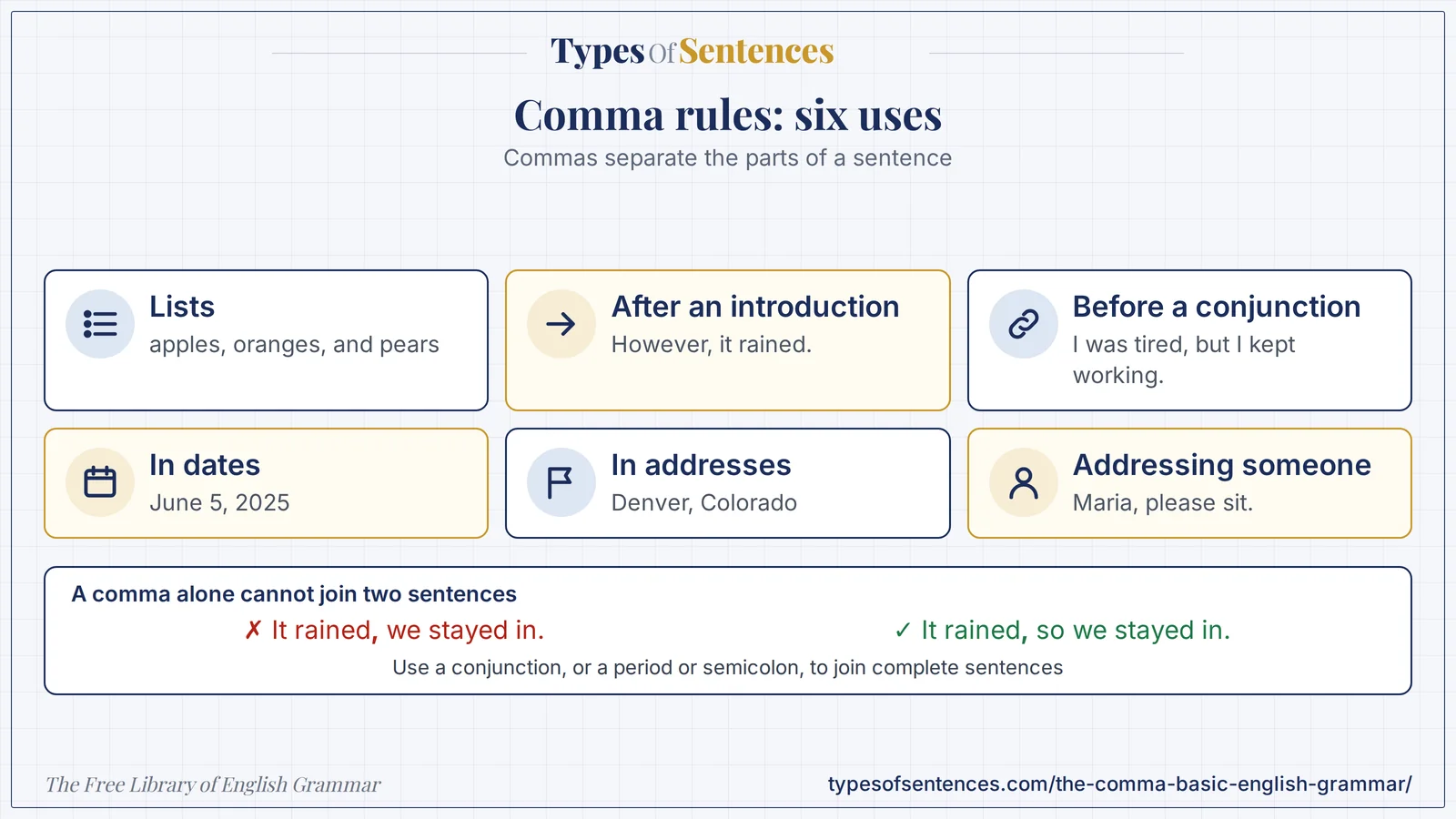
A comma is a tiny pause. It separates items in a list, sets off an opening phrase, and splits parts of a long sentence so readers can breathe.
Why it matters: Putting a comma in the right place makes your sentence clear. Putting it in the wrong place can change the meaning.
Summary: Use commas to separate items in a list, after introductory words and phrases, before a conjunction that joins two sentences, in dates and addresses, and to address someone. Do not use a comma to join two sentences by itself.
- List: apples, oranges, and pears.
- Introductory word: However, it rained.
- Compound sentence: I was tired, but I kept working.
- Dates and addresses: June 5, 2025; Denver, Colorado.
What You’ll Learn
- 1. Comma Rules: What Is a Comma?
- 2. Why Commas Matter: Humorous Examples
- 3. Using Commas in Lists (Series)
- 4. Commas After Introductory Words and Phrases
- 5. Commas in Compound Sentences
- 6. Commas in Dates and Addresses
- 7. Practice: Using Commas
- 8. Common Comma Mistakes
- 9. Exercises
- 10. Test Your Knowledge
- 11. Frequently Asked Questions
- 12. Conclusion
1. Comma Rules: What Is a Comma?
A comma (,) is a punctuation mark that shows a short pause or separation inside a sentence. The comma meaning is separate: commas in a sentence separate items, parts, and ideas so readers can see where one stops and the next begins.
| Use | Example |
|---|---|
| Separate items in a list | I bought apples, oranges, and pears. |
| After an opening word or phrase | Yesterday, we visited Rome. |
| Before and, but, or, so joining sentences | I was tired, but I kept working. |
| In dates and addresses | June 5, 2025; Denver, Colorado |
| To address someone | Tom, please come here. |
2. Why Commas Matter: Humorous Examples
A comma can change the meaning of a sentence completely. These pairs are famous for it.
| Without the comma | With the comma |
|---|---|
| Let’s eat Grandma. | Let’s eat, Grandma. |
| I like cooking my family and my dog. | I like cooking, my family, and my dog. |
The first sentence in each pair is about eating, or cooking, something awful. The second is correct. Commas are not decoration: they are part of the meaning.
3. Using Commas in Lists (Series)
Put a comma between items in a list of three or more. The list can be nouns, verbs, or adjectives.
- I bought apples, oranges, and pears. nouns
- She sang, danced, and laughed. verbs
- It was a long, hot, dry summer. adjectives
The comma before and in a list is called the serial comma (or Oxford comma). The Chicago Manual of Style recommends it, and AP style leaves it out in simple lists; this course uses it. Whichever you choose, be consistent. Use and and or to join the last item; see the chapter on conjunctions.
A list of three or more items needs commas between the items.
4. Commas After Introductory Words and Phrases
When a word, phrase, or clause comes before the main part of a sentence, follow it with a comma.
| Opening | Example |
|---|---|
| one word | Yesterday, we visited Rome. |
| a phrase | After the movie, we went home. |
| a dependent clause | When the bell rang, we left. |
| an interjection | Oh, I see. |
A dependent clause that starts a sentence needs a comma; if it comes second, usually no comma is needed: We left when the bell rang. Clauses are explained in the chapter on clauses.
5. Commas in Compound Sentences
Use a comma before and, but, or, so, for, nor, or yet when it joins two complete sentences.
- I was tired, but I kept working.
- It rained, so we stayed inside.
- We can walk, or we can take the bus.
6. Commas in Dates and Addresses
| Use | Example |
|---|---|
| Date: between the day and the year | June 5, 2025 |
| Date in a sentence: also after the year | On June 5, 2025, we met. |
| City and state | Denver, Colorado |
| Address in a sentence | He lives at 12 Oak Street, Denver, Colorado, with his family. |
| Month and year only: no comma | We met in June 2025. |
In British and many international styles, dates are written without these commas (5 June 2025), so this American rule has a regional edge.
7. Practice: Using Commas
Add commas: After the movie we bought popcorn candy and juice
- The opening phrase After the movie needs a comma after it.
- The list popcorn, candy, and juice needs commas between its items.
- Write: After the movie, we bought popcorn, candy, and juice.
Add a comma: Tom come here.
Reveal answer
Tom, come here. A comma sets off the name of the person you speak to.
8. Common Comma Mistakes
- The comma splice: joining two sentences with only a comma. Use a conjunction, a period, or a semicolon. See the guide to the comma splice.
- A comma between a subject and its verb: The tall boy, ran home is wrong.
- A comma before because after a main clause: usually not needed.
- Too many commas: use a comma only when a rule calls for one.
A comma alone cannot join two sentences. Add a conjunction such as so.
Commas also set off extra information (Tom, my brother, called) and separate certain adjectives. These rules belong to the Intermediate level, where the same comma examples are explained in detail.
Recap in 12 seconds
Watch the lesson build itself: Six uses of the comma: lists, after introductions, before a conjunction, in dates, in addresses, and to address someone. The video has no sound.
Exercises
Part A: Name the Use (Exercises 1–6)
Exercise 1: Why is the comma in: apples, oranges, and pears?
Show Answer
Answer: It separates items in a list.
Exercise 2: Why is the comma in: Yesterday, we visited Rome.?
Show Answer
Answer: It follows an introductory word.
Exercise 3: Why is the comma in: I was tired, but I kept working.?
Show Answer
Answer: It comes before a conjunction joining two sentences.
Exercise 4: Why is the comma in: June 5, 2025?
Show Answer
Answer: It separates the day and the year in a date.
Exercise 5: Why is the comma in: Tom, come here.?
Show Answer
Answer: It sets off the name of the person spoken to.
Exercise 6: Why is the comma in: Denver, Colorado?
Show Answer
Answer: It separates a city and a state.
Part B: Lists (Exercises 7–12)
Exercise 7: Add commas: I bought apples oranges and pears.
Show Answer
Answer: I bought apples, oranges, and pears.
Exercise 8: Add commas: She sang danced and laughed.
Show Answer
Answer: She sang, danced, and laughed.
Exercise 9: Add commas: It was a long hot dry summer.
Show Answer
Answer: It was a long, hot, dry summer.
Exercise 10: Add commas: We need pens paper and tape.
Show Answer
Answer: We need pens, paper, and tape.
Exercise 11: Add commas: Tom Maria and Anna came.
Show Answer
Answer: Tom, Maria, and Anna came.
Exercise 12: Does tea and coffee need a comma?
Show Answer
Answer: No. Two items joined by and need no comma.
Part C: Introductory Words (Exercises 13–18)
Exercise 13: Add a comma: Yesterday we visited Rome.
Show Answer
Answer: Yesterday, we visited Rome.
Exercise 14: Add a comma: After the movie we went home.
Show Answer
Answer: After the movie, we went home.
Exercise 15: Add a comma: When the bell rang we left.
Show Answer
Answer: When the bell rang, we left.
Exercise 16: Add a comma: However it was late.
Show Answer
Answer: However, it was late.
Exercise 17: Add a comma: Oh I see.
Show Answer
Answer: Oh, I see.
Exercise 18: Does We left when the bell rang. need a comma?
Show Answer
Answer: No. The dependent clause comes second.
Part D: Compound Sentences (Exercises 19–24)
Exercise 19: Add a comma: I was tired but I kept working.
Show Answer
Answer: I was tired, but I kept working.
Exercise 20: Add a comma: It rained so we stayed inside.
Show Answer
Answer: It rained, so we stayed inside.
Exercise 21: Add a comma: We can walk or we can take the bus.
Show Answer
Answer: We can walk, or we can take the bus.
Exercise 22: Does She sings and dances. need a comma?
Show Answer
Answer: No. And joins two verbs, not two sentences.
Exercise 23: Does small but strong need a comma?
Show Answer
Answer: No. But joins two words.
Exercise 24: Fix the comma splice: It was late, we went home.
Show Answer
Answer: It was late, so we went home.
Part E: Dates and Addresses (Exercises 25–28)
Exercise 25: Add commas: On June 5 2025 we met.
Show Answer
Answer: On June 5, 2025, we met.
Exercise 26: Add a comma: We live in Denver Colorado.
Show Answer
Answer: We live in Denver, Colorado.
Exercise 27: Does We met in June 2025. need a comma?
Show Answer
Answer: No. A month and year need no comma.
Exercise 28: Add commas: He lives at 12 Oak Street Denver Colorado.
Show Answer
Answer: He lives at 12 Oak Street, Denver, Colorado.
Part F: Review (Exercises 29–30)
Exercise 29: Review (Chapter 33, end marks): which mark ends a direct question?
Show Answer
Answer: The question mark.
Exercise 30: Review (Chapter 32, capitals): fix: on monday we met in june.
Show Answer
Answer: On Monday we met in June.
Test Your Knowledge
Ready to check what you learned? Answer all 10 questions, then submit. You need 80% (8 of 10) to pass. Your answers are not stored.
View correct answers and explanations
Question 1: What does a comma do?
✓ Correct Answer: B – Shows a pause or separation
A comma separates parts of a sentence and shows a short pause.
Question 2: Which is correct?
✓ Correct Answer: D – I bought apples, oranges, and pears.
Commas go between the items in a list.
Question 3: Which is correct?
✓ Correct Answer: A – Yesterday, we visited Rome.
An introductory word is followed by a comma.
Question 4: Which is correct?
✓ Correct Answer: C – I was tired, but I kept working.
Use a comma before but when it joins two sentences.
Question 5: Which is correct?
✓ Correct Answer: D – She sings and dances.
And joins two verbs, so no comma is needed.
Question 6: Which is a comma splice?
✓ Correct Answer: B – It was late, we went home.
Two sentences joined by only a comma form a comma splice.
Question 7: Which date is correct in American style?
✓ Correct Answer: A – June 5, 2025
Use a comma between the day and the year.
Question 8: Which is correct?
✓ Correct Answer: C – We live in Denver, Colorado.
Use a comma between a city and a state.
Question 9: Which is correct?
✓ Correct Answer: B – Tom, come here.
A comma sets off the name of the person spoken to.
Question 10: Where does the comma go?
✓ Correct Answer: A – When the bell rang, we left.
A dependent clause at the start of a sentence is followed by a comma.
Frequently Asked Questions
What are comma rules?
Comma rules tell you where to put commas: between items in a list, after introductory words and phrases, before a conjunction that joins two sentences, in dates and addresses, and to address someone.
What are commas in a sentence for?
Commas in a sentence separate parts so the meaning is clear. They show where to pause and where one item or idea ends and the next begins.
What is the commas meaning in grammar?
The meaning of a comma is separation. It separates items in a list, an opening phrase from the main sentence, and the two parts of a compound sentence.
How is using commas in a list done?
Put a comma between each item and put and before the last one: apples, oranges, and pears. Most American style guides use the comma before and; AP style omits it.
What are some comma examples with introductory words?
However, it rained. After the movie, we went home. When the bell rang, we left. In each, the opening word, phrase, or clause is followed by a comma.
What is a comma splice?
A comma splice joins two complete sentences with only a comma: It was late, we went home. Fix it with a conjunction (so), a period, or a semicolon.
Conclusion
You now know the main comma rules: separate items in a list, follow introductory words and phrases, put a comma before a conjunction that joins two sentences, and use commas in dates and addresses. You also know how to avoid the comma splice.
When you are unsure whether to use a comma, check which rule applies, and leave the comma out if none does. Next, you will study the apostrophe.
- Purdue Online Writing Lab: Commas: reference section on commas.
- The Chicago Manual of Style, 17th edition, chapter 6 (Punctuation): reference for the serial comma and other comma conventions.
- Quirk, Randolph, et al. A Comprehensive Grammar of the English Language. Longman, 1985.: description of punctuation within sentences.
Last reviewed: October 29, 2026. How it was made: drafted with AI assistance, then checked with automated tests (structure, links, answer keys, spelling) and against the sources above. A person has not yet read this chapter line by line. Found a mistake? Report it.