Advanced punctuation is the control of the marks that do more than end a sentence or separate a list. The semicolon, the colon, the dash, parentheses, brackets, quotation marks, and the ellipsis each have a specific job, and a writer who knows the jobs can show relationships among ideas that a string of commas cannot: that two clauses are closely related, that a list is coming, that a thought is interrupted, that an aside is incidental, that a word is being mentioned and not used. A writer who does not know them produces the characteristic errors of weak punctuation: a semicolon before a dependent clause, a colon after such as, a dash used for every pause, quotation marks used for emphasis.
This chapter treats punctuation mastery: the advanced uses of each mark, the choices among them, the conventions of American and British writing, and the differences among the major style guides (Chicago, APA, MLA, and AP). It shows expert punctuation in practice, including combinations of marks and the order rules that govern them, where complex punctuation is needed and where simpler is better. The chapter reviews the punctuation rules advanced writers need, with the reasons behind them, and ends with a worked editing exercise. Thirty exercises and a quiz follow.
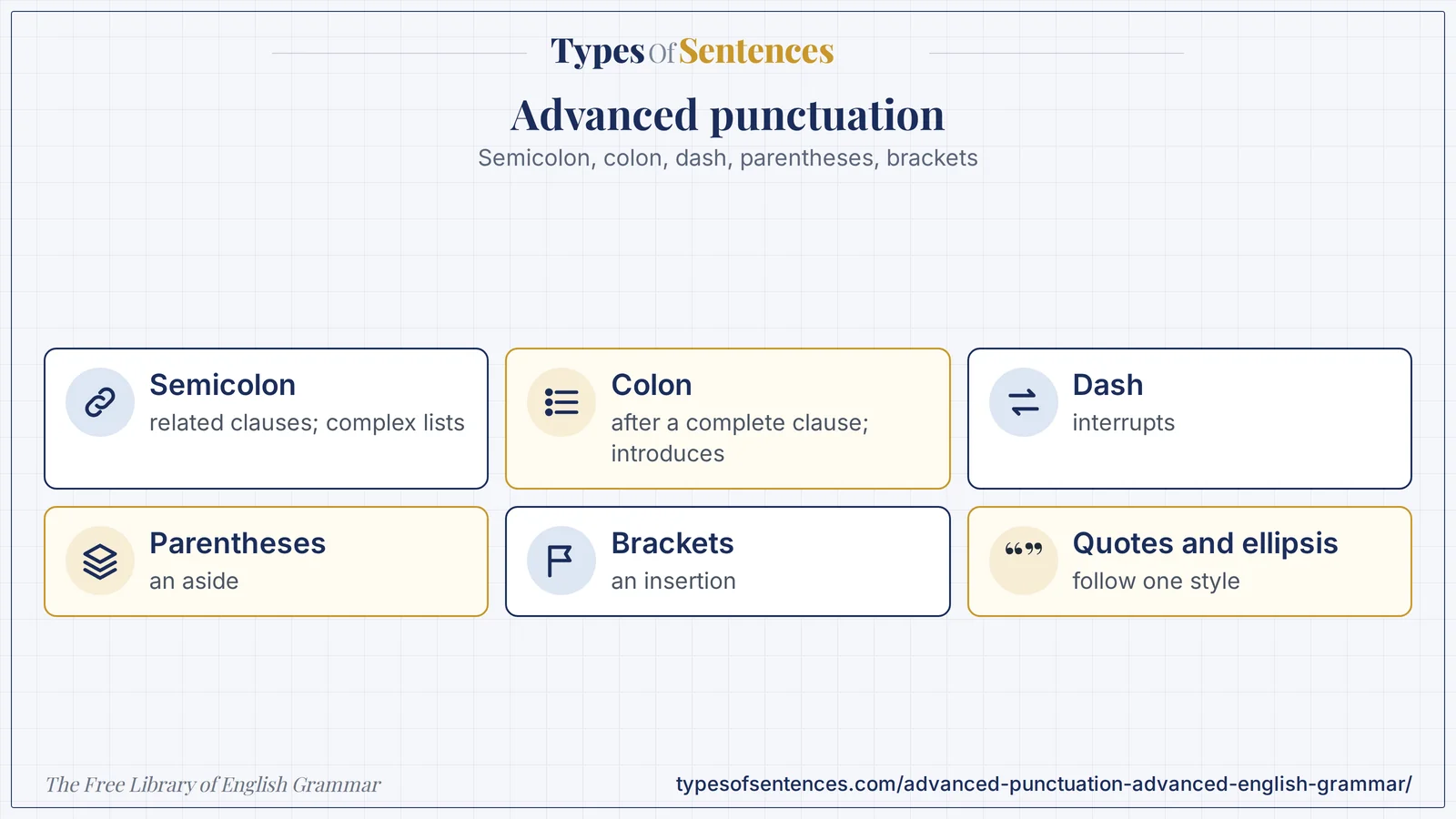
Each mark has a job. A semicolon joins two sentences that belong together. A colon says “here comes what I promised.” A dash makes a sharp break or sets off something for emphasis. Parentheses tuck in an aside. Brackets mark your own words inside someone else’s. Quotation marks show someone’s exact words or mark a word as a word. An ellipsis shows that something has been left out.
Why it matters: Use the simplest mark that does the job, follow one style consistently, and remember that punctuation is for the reader: it shows how the sentence is built.
Summary: The semicolon joins closely related independent clauses and separates the items of a series that contain commas; it is not used before a dependent clause or to introduce a list. The colon follows a complete clause and introduces a list, explanation, quotation, or emphatic appositive; it does not follow such as, including, or a verb. The em dash sets off interruptions, appositives with commas, and summaries; the en dash marks ranges and some compounds; the hyphen joins words. Parentheses enclose supplementary information; brackets mark editorial insertions in quotations and nested parenthetical material. Quotation marks show direct speech, titles of short works, words as words, and scare quotes; American style places commas and periods inside closing quotation marks, British style places them according to logic. The ellipsis (three dots) marks omissions or trailing off. Marks may be combined by order rules, and style guides differ on details.
- Semicolon: related clauses; complex lists.
- Colon: after a complete clause; introduces.
- Dash, parentheses, brackets: interrupt, aside, insert.
- Quotes and ellipsis: follow one style.
What You’ll Learn
- 1. Advanced Punctuation: The Semicolon
- 2. Advanced Punctuation: The Colon
- 3. Advanced Punctuation: The Dash (Em Dash, En Dash, and Hyphen)
- 4. Advanced Punctuation: Parentheses and Brackets
- 5. Advanced Punctuation: Quotation Marks
- 6. Advanced Punctuation: The Ellipsis
- 7. Combining Punctuation: Multiple Marks and Order Rules
- 8. Common Errors and a Worked Example
- 9. Exercises
- 10. Test Your Knowledge
- 11. Frequently Asked Questions
- 12. Conclusion
1. Advanced Punctuation: The Semicolon
| Use | Rule | Example |
|---|---|---|
| between related independent clauses | joins two complete sentences that are closely connected in meaning, without a conjunction | The plan failed; the cost was too high. |
| with a conjunctive adverb | a semicolon before however, therefore, moreover, nevertheless, thus, consequently, followed by a comma | The plan failed; therefore, the council canceled it. |
| with a transitional phrase | before for example, in fact, that is, on the other hand | Many fields use it; for example, law and medicine. |
| in a series with internal commas | separates items that themselves contain commas | The committee met in Pune, India; Austin, Texas; and Leeds, England. |
| before a coordinating conjunction in a long compound sentence | used where the clauses are long or contain commas, to prevent confusion | The council, which met on Tuesday, approved the plan; but the mayor, who had objected, refused to sign. |
| for contrast or balance | balanced clauses | Some like tea; others, coffee. |
| for elaboration or explanation | the second clause explains the first | The plan was sound; it had been tested twice. |
| for consequence or cause | — | She was late; the bus had broken down. |
| in citations | separating several sources in a parenthetical citation | (Smith 2019; Jones 2021) |
| in bibliographies and lists | separating items that contain commas | — |
| gapping | a semicolon where a repeated verb is omitted | Priya ate rice; Raj, bread. |
| Incorrect use | Example | Correction |
|---|---|---|
| before a dependent clause | *Although it rained; we went. | Although it rained, we went. |
| between a subject and its verb | *The committee; which met on Tuesday; approved it. | The committee, which met on Tuesday, approved it. |
| to introduce a list | *She bought; milk, eggs, and bread. | She bought milk, eggs, and bread. / She bought three things: milk, eggs, and bread. |
| between a clause and a phrase | *The plan failed; because of the cost. | The plan failed because of the cost. |
| between unequal parts | *She came; and he left. | She came, and he left. / She came; he left. |
| after a salutation | *Dear Dr. Rao; | Dear Dr. Rao: |
| with a fragment | *Having finished the work; she left. | Having finished the work, she left. |
| overuse | a paragraph of semicolons | vary with periods and commas |
| splicing unrelated clauses | *It rained; the museum is closed on Mondays. | Use a period unless the relation is clear. |
| semicolon where a colon is needed | *The plan had one flaw; the cost. | The plan had one flaw: the cost. |
| Semicolon, period, or comma? | Choice |
|---|---|
| two sentences closely related in thought | semicolon (or period) |
| two sentences with a clear logical link | semicolon + transitional word, or period + transitional word |
| two sentences joined by and, but, or, so, yet | comma before the conjunction |
| two short parallel clauses | semicolon or comma (in a series of three or more) |
| two unrelated sentences | period |
| items in a list with internal commas | semicolon |
| a long compound sentence with internal commas | semicolon before the conjunction |
The semicolon is a mark of subtle relationship: it suggests that two sentences are two halves of one thought, and the reader supplies the relation (contrast, cause, elaboration). Because it signals a close link, it is a precision tool, and it should not be overused. The use of semicolons to repair comma splices and run-on sentences is discussed in the chapters on complex sentence architecture and on the intermediate punctuation chapter.
2. Advanced Punctuation: The Colon
| Use | Rule | Example |
|---|---|---|
| introducing a list | after a complete independent clause | She bought three things: milk, eggs, and bread. |
| introducing a formal list or the words the following | after a complete clause | Please bring the following: your passport, two photographs, and the fee. |
| introducing an explanation or elaboration | the second part explains or illustrates the first | The plan had one flaw: the cost. |
| introducing an emphatic appositive | a single noun phrase for emphasis | She wanted one thing: justice. |
| introducing a quotation | a formal introduction, especially a block quotation | The report concluded: “The plan is not feasible.” |
| introducing a question or a statement of a principle | — | The question is this: what do we do now? |
| between a title and a subtitle | — | Grammar: A Short Introduction |
| in a time of day | — | 3:30 p.m.; 14:45 |
| in ratios and scores | — | a ratio of 3:1; a score of 21:14 |
| after a formal salutation | — | Dear Dr. Rao:; To whom it may concern: |
| in citations | — | Journal of Linguistics 12(3): 45–67; Genesis 1:1 |
| between a speaker and a speech (script) | — | HAMLET: To be or not to be. |
| in memo headings | — | To: Priya; From: Raj; Date: 4 March 2024 |
| between independent clauses where the second explains the first | — | Some things are certain: we will win. |
| Do not use a colon | Example (incorrect) | Correction |
|---|---|---|
| after such as, including, like | *She likes fruits such as: mangoes and apples. | She likes fruits such as mangoes and apples. |
| after a verb or a preposition that needs its complement | *The ingredients are: flour and eggs. | The ingredients are flour and eggs. / The ingredients are as follows: flour and eggs. |
| after is, are, was, were when the list completes the clause | *My favorite colors are: red, blue, and green. | My favorite colors are red, blue, and green. |
| after an incomplete lead-in | *Her skills include: writing, editing. | Her skills include writing and editing. |
| between a preposition and its object | *She is interested in: music. | She is interested in music. |
| before a vertical list that completes the sentence | — | use a list with a complete lead-in clause |
| more than one colon in a sentence (usually) | *The plan: cost: high. | Rewrite. |
| after namely, for example, or that is (use a comma or dash) | *namely: the cost | namely, the cost |
| Capitalization after a colon | Chicago and many others | APA | Notes |
|---|---|---|---|
| one complete sentence follows | lowercase unless a proper noun | capitalize the first word of a complete sentence | style guides differ |
| two or more sentences follow | capitalize the first word | capitalize | — |
| a list or fragment follows | lowercase | lowercase | — |
| a quotation follows | capitalize if the quotation is capitalized in the original | — | — |
| a title with a subtitle | capitalize the first word of the subtitle (title case) | capitalize | — |
The test for a colon is that the words before it could stand as a complete sentence. If they cannot (such as, including, is), the colon cuts the sentence in two, and it should be removed. A colon also creates anticipation: it says that what follows will explain, illustrate, or complete. Used well, it gives emphasis, as in She wanted one thing: justice.
3. Advanced Punctuation: The Dash (Em Dash, En Dash, and Hyphen)
| Mark | Length and key | Main uses |
|---|---|---|
| hyphen (-) | shortest | joins words and parts of words (well-known, mother-in-law); breaks words at line ends |
| en dash (–) | about the width of the letter n | ranges (1990–2000, pages 10–20); connections (New York–London flight); some compounds; sometimes a minus sign |
| em dash (—) | about the width of the letter m | interruptions, appositives, summaries, emphasis |
| two-em and three-em dashes | two or three times the em dash | omitted words or repeated names in a bibliography (in some styles) |
| Use of the em dash | Example | Alternative |
|---|---|---|
| sudden break in thought | I thought I knew the answer—but I was wrong. | comma or period |
| parenthetical interruption (emphatic) | The plan—costly, slow, and unpopular—failed. | commas or parentheses |
| appositive that contains commas | Three people—Priya, Raj, and Kumar—agreed. | commas would be confusing |
| summary after a list | Money, time, and patience—these are what we need. | colon |
| introducing an explanation (emphatic) | She wanted one thing—justice. | colon |
| unfinished speech or an interruption | “If you ever—” she began. | — |
| attribution after a quotation | —Alexander Pope | — |
| a pair of dashes setting off a nonessential element | The result—as everyone expected—was a failure. | commas or parentheses |
| emphatic contrast | It was not a defeat—it was a lesson. | semicolon or comma |
| stuttering or halting speech | I—I don’t know. | — |
| introducing an afterthought | We will go—if it stops raining. | comma |
| Use of the en dash | Example | Note |
|---|---|---|
| ranges of numbers, dates, and pages | 1990–2000; pp. 10–20; Monday–Friday | use from … to or between … and in running text (not from 1990–2000) |
| connecting places or people | the Pune–Mumbai expressway; the Smith–Jones agreement | conflict, direction, or connection |
| compound adjectives with an open compound (Chicago) | the post–World War II period | joins a prefix and an open compound |
| scores and results | a 21–14 win | — |
| minus sign (in typesetting) | 5–3 | — |
| no use as a hyphen | *well–known | well-known |
| Dash spacing and style | Chicago and APA | AP style | British style |
|---|---|---|---|
| em dash | closed (no spaces): word—word | spaced: word — word | often a spaced en dash: word – word |
| en dash | closed | — | used for ranges |
| hyphen | — | — | — |
| Dash, comma, or parentheses? | Choice |
|---|---|
| an interruption that you want to emphasize | dashes |
| an interruption that is routine | commas |
| an aside that is incidental | parentheses |
| an element that contains commas | dashes |
| a summary or explanation to be emphasized | a single dash or a colon |
| formal writing | prefer commas and colons; use dashes sparingly |
| informal and creative writing | dashes are common |
- Do not overuse dashes. A text full of dashes loses emphasis.
- Use a pair of dashes for a parenthetical element; do not mix a dash with a comma for the same element.
- Do not put other punctuation next to a dash (in Chicago style, no comma, semicolon, or period before or after it); a question mark or an exclamation mark may precede a dash.
- Use the right dash: hyphen for words, en dash for ranges, em dash for breaks.
- Keep to one spacing style within a document.
4. Advanced Punctuation: Parentheses and Brackets
| Use of parentheses | Example | Note |
|---|---|---|
| supplementary or incidental information | The council (which met on Tuesday) approved the plan. | the sentence must make sense without it |
| an explanation or an example | Several countries (for example, India and Brazil) agreed. | — |
| numbering items in a sentence | The plan has three parts: (1) design, (2) cost, and (3) timing. | — |
| abbreviations at first mention | the World Health Organization (WHO) | — |
| dates, references, and page numbers | (Smith 2019, 45); (1990–2000) | — |
| translations or alternatives | the lakh (100,000) | — |
| an aside of a full sentence | (This was a mistake.) | the period goes inside when the parenthesis stands alone |
| plural forms | book(s) | avoid in formal writing |
| stage directions and notes | — | — |
| an optional element | (non-)smokers | — |
| Punctuation with parentheses | Rule | Example |
|---|---|---|
| punctuation inside a parenthetical sentence | a period, question mark, or exclamation mark goes inside if the parenthetical is a complete sentence standing alone | He left. (He had no choice.) |
| punctuation after a parenthesis within a sentence | a comma, semicolon, or period goes outside the closing parenthesis | He left (he had no choice), and she stayed. |
| a parenthetical at the end of a sentence | the period goes after the parenthesis | He left (without a word). |
| no comma before an opening parenthesis | the comma comes after the closing parenthesis | When it rained (as usual), we stayed in. |
| capitalization inside | do not capitalize the first word of a parenthesis inside a sentence unless it is a proper noun | — |
| a question mark inside | if the parenthetical itself is a question | He left (why?), and we stayed. |
| parentheses within parentheses | use brackets inside parentheses in American style | (The report [published in 2019] was the first.) |
| Use of brackets | Example | Purpose |
|---|---|---|
| editorial insertion in a quotation | “They [the council] approved it.” | clarification added by the quoting writer |
| alteration of a letter or word to fit a sentence | “[T]he plan failed.” | a change of capitalization |
| sic | “The plan was aproved [sic].” | shows that the error is in the original |
| emphasis added | “The plan was never approved” [emphasis added]. | shows that the emphasis is the writer’s |
| omission of words | “The council […] approved the plan.” | an ellipsis in brackets (used by MLA and others) |
| nested parentheses | (The report [published in 2019] was the first.) | alternate brackets and parentheses |
| translated titles (APA) | Le Petit Prince [The Little Prince] | — |
| phonetic transcription | [kæt] | a phonetic transcription |
| stage directions or comments in a transcript | [laughter] | — |
| missing or reconstructed text | [illegible] | — |
| a comment in dialogue | — | — |
Parentheses are for the writer’s own asides; brackets are for words that are not the quoted author’s. A frequent error is to use parentheses for an editorial insertion inside a quotation (the reader cannot tell whose words they are). Another is to overuse parenthetical asides, which interrupts the reader; if the information matters, put it in a sentence, and if it does not, delete it.
5. Advanced Punctuation: Quotation Marks
| Use | Example | Note |
|---|---|---|
| direct speech and quotation | “We will go,” she said. | double quotation marks in American style |
| titles of short works | “The Road Not Taken”; “Chapter 3” | long works in italics |
| words used as words (mention) | The word “literally” is often misused. | italics are more usual in many style guides: The word literally … |
| definitions and glosses | Bank means “the side of a river.” | single quotation marks in linguistics: bank ‘the side of a river’ |
| scare quotes | The “improvement” made it worse. | shows that the writer doubts or distances themselves from the word |
| irony and quoted terms | — | use sparingly |
| quoted technical terms at first use | a so-called “smart” device | — |
| nicknames | Robert “Bob” Smith | — |
| quotation within a quotation | “She said, ‘We will go,’ and left.” | single inside double in American style |
| block quotations | set off by indentation, with no quotation marks | used for long quotations (for example 40 words or more in APA; four lines or more in Chicago and MLA) |
| indirect speech | She said that they would go. | no quotation marks |
| paraphrase | — | no quotation marks |
| Placement of other marks | American style | British style (logical) |
|---|---|---|
| period and comma | always inside the closing quotation mark: “We will go,” she said. She called it “fine.” | inside only if part of the quoted matter: ‘We will go’, she said. She called it ‘fine’. |
| colon and semicolon | outside: She said “fine”; he left. | outside |
| question mark and exclamation mark | inside if part of the quotation; outside if part of the whole sentence: Did she say “fine”? | same logic |
| quotation marks | double first, single inside | single first, double inside |
| dash | outside, unless part of the quotation | — |
| Scare quotes: when to use and when to avoid | Example | Advice |
|---|---|---|
| to signal that a word is used with doubt | the “experts” disagreed | acceptable but can look sarcastic |
| to signal a term used by others | what the report calls “soft skills” | useful |
| to signal that a word is nonstandard or slang | a “cool” idea | avoid in formal writing |
| for emphasis | *the “best” price | avoid; use italics or rewrite |
| for a coined term | a so-called “data lake” | use at first mention |
| overuse | a paragraph full of scare quotes | suggests distrust of the reader |
| Mistake | Example | Correction |
|---|---|---|
| quotation marks for emphasis | *We “guarantee” quality. | We guarantee quality. |
| quotation marks around indirect speech | *She said that “they would go.” | She said that they would go. |
| period outside in American style | *She said “fine”. | She said “fine.” |
| unmatched marks | *“We will go,” she said.” | “We will go,” she said. |
| wrong nesting | *“She said “we will go.”” | “She said, ‘We will go.’” |
| no capital at the start of a quoted sentence | *She said, “we will go.” | She said, “We will go.” |
| capital in the middle of a sentence when the quote is a fragment | *She called it “The Best”. | She called it “the best.” |
| comma before a quote that is part of the sentence’s structure | *She said that, “they would go.” | She said that they would go. |
| quotation marks around a block quotation | — | indent; remove the marks |
| quoting too much | — | quote only what you need; paraphrase the rest |
| changing a quotation silently | — | use brackets and ellipses |
| curly versus straight quotation marks (typography) | mixed forms | use typographic (curly) quotation marks consistently |
The most important difference is the placement of commas and periods, which follows a fixed rule in American style and a logical rule in British style. Within a document, consistency matters more than the choice. The treatment of quotations in citation is covered in the chapter on citing sources, and the differences in British and American conventions in the chapter on British vs American English.
6. Advanced Punctuation: The Ellipsis
| Use | Rule | Example |
|---|---|---|
| omission within a quotation | three dots with spaces (Chicago: spaced periods; others use the ellipsis character) replace omitted words | “The council … approved the plan.” |
| omission at the end of a quoted sentence | a period followed by three dots (four in all) if the quoted material before is a complete sentence (Chicago) | “The council approved the plan. …” |
| omission at the start of a quotation | usually not needed | — |
| omission of a whole sentence or more | a period plus three dots at the end of the sentence before the omission | — |
| omission of a paragraph or lines of poetry | a full line of dots (in poetry) | — |
| trailing off (informal) | three dots at the end of an unfinished thought | “I thought we might …” |
| hesitation or pause (informal, fiction) | three dots inside speech | “Well … I don’t know.” |
| suspense | — | used sparingly |
| bracketed ellipsis (MLA) | […] to distinguish the writer’s omission from the author’s own ellipsis | — |
| ellipsis character (…) | a single typographic character | used in digital typography |
| omission in a list or sequence | 1, 2, 3, …, 10 | mathematics |
| Combining the ellipsis with other marks | Rule | Example |
|---|---|---|
| with a question mark or an exclamation mark | the mark stays, with the ellipsis after or before as needed | “What did he mean …?” |
| with a comma | a comma may be kept or omitted depending on style | “If we go …, we will be late.” |
| with a quotation mark | the ellipsis comes before the closing quotation mark | “We will see …” |
| with a period at the end of a sentence | four dots (period plus ellipsis) in Chicago style | — |
| at the end of a trailing sentence in fiction | three dots only | — |
- Do not change the meaning of a quotation by omitting words.
- Do not use an ellipsis for dramatic effect in formal writing.
- Use three dots, not two or four (except the four-dot sentence-end convention).
- Keep spacing consistent (spaced dots or the single character).
- Do not use an ellipsis where a dash or a period will do.
7. Combining Punctuation: Multiple Marks and Order Rules
| Combination | Rule | Example |
|---|---|---|
| quotation mark with a comma or period (American) | inside | “We will go,” she said. |
| quotation mark with a question mark | inside if the question is part of the quotation | She asked, “Are you coming?” |
| quotation mark with a question mark (whole sentence) | outside | Did she say “fine”? |
| quotation mark with a colon or semicolon | outside | She said “fine”; I did not agree. |
| quotation mark with a dash | outside, unless part of the quotation | — |
| parentheses with a period | inside if a complete sentence on its own; outside if inside a sentence | See above. |
| abbreviation period with the sentence period | one period only | We arrived at 5 p.m. |
| abbreviation period with a question mark | both appear | Did you arrive at 5 p.m.? |
| question mark with an exclamation mark | generally avoid both | “What?!” (informal; the interrobang is rare) |
| comma with a dash | no comma next to a dash (Chicago) | — |
| colon with a parenthesis | — | — |
| two marks at the end of a sentence with a quotation | one mark inside the quotation | He asked, “Why?” |
| footnote reference number with punctuation | after the punctuation (except a dash) | …as shown.¹ |
| brackets inside parentheses | alternate | (a [b] c) |
| a comma after a quotation that ends in a question mark | omit the comma | “Are you coming?” she asked. |
| a semicolon in a series with a quotation | — | — |
| an ellipsis at the end with a quotation mark | before the closing mark | “We will see …” |
| a parenthesis and a dash | avoid adjacent use | — |
| a colon and a quotation | a colon may introduce a formal quotation | — |
| a title in quotation marks with a comma | comma inside (American) | “The Raven,” which … |
| General order of closing marks (American style) | Order |
|---|---|
| at the end of a quotation within a sentence | period or comma, then the closing quotation mark |
| at the end of a parenthetical sentence | period, then the closing parenthesis (when the parenthetical stands alone) |
| at the end of a sentence ending in a parenthesis | closing parenthesis, then the period (when inside a sentence) |
| at the end of a sentence ending with a quotation and a footnote | punctuation, closing quotation mark, then the footnote number |
| with a question mark | inside the quotation if the quotation is a question; otherwise outside |
| Differences among style guides | Chicago | APA | MLA | AP |
|---|---|---|---|---|
| serial comma | yes | yes | yes | no (except to prevent confusion) |
| em dash spacing | closed | closed | closed | spaced |
| quotation marks, commas and periods | inside | inside | inside | inside |
| capital after a colon | lowercase (unless two sentences) | capital if a complete sentence follows | lowercase | capital if a complete sentence follows |
| ellipsis | spaced three dots; four at sentence end | spaced three dots | bracketed or unbracketed | three dots with spaces |
| block quotation | five or more lines (or 100 words) | 40 or more words | four or more lines | — |
| numbers in ranges | en dash | en dash | en dash | hyphen or to |
| brackets in quotation | editorial insertions | same | same | same |
The rules above are conventions, and style guides differ in detail; the guide for your publication decides. The main principle is consistency, and the main reason for the rules is clarity. For the references that settle such points, see the chapter on transition words and connectors for the punctuation of connectors and the earlier chapter on grammar resources.
8. Common Errors and a Worked Example
| Error | Example | Correction |
|---|---|---|
| semicolon before a dependent clause | *Although it rained; we went. | Although it rained, we went. |
| colon after such as | *fruits such as: apples | fruits such as apples |
| dash overuse | *The plan—it was costly—and slow—and unpopular—failed. | The plan, which was costly, slow, and unpopular, failed. |
| hyphen for a range | *pages 10-20 | pages 10–20 |
| em dash with spaces in a Chicago text | *word — word | word—word |
| comma outside the quotation (American) | *She said “fine”, and left. | She said “fine,” and left. |
| quotation marks for emphasis | *the “best” price | the best price |
| ellipsis with two or four dots | *Well.. I do not know…. | Well … I do not know. |
| parentheses for an editorial insertion in a quotation | *“They (the council) approved it.” | “They [the council] approved it.” |
| missing closing parenthesis or bracket | *(see the note | (see the note) |
| punctuation next to a dash | *The plan,—costly—failed. | The plan—costly—failed. |
| wrong nesting of quotation marks | *“She said “go.”” | “She said, ‘Go.’” |
| semicolon in a list without internal commas | *apples; pears; plums | apples, pears, plums |
| comma instead of a semicolon in a complex list | *Pune, India, Austin, Texas, Leeds, England | Pune, India; Austin, Texas; Leeds, England |
| colon between a verb and its object | *She bought: milk. | She bought milk. |
| unnecessary punctuation after a title | *“The Raven”, by Poe, … | “The Raven,” by Poe, … |
| mixed straight and curly marks | a straight mark opening and a curly mark closing | one consistent typographic style |
Edit: The committee met in Pune, India, Austin, Texas, and Leeds, England; although it rained; the work went on—the plan—which was costly—was approved (the vote was 7–2.) The chairman said “we will begin in March”, and added: “that the cost is high”… She wanted three things: a budget, a schedule, and; a team, and the minister (who is “very” busy) agreed [sic].
- Pune, India, Austin, Texas, and Leeds, England: a complex list needs semicolons: Pune, India; Austin, Texas; and Leeds, England.
- ; although it rained; the work went on: a semicolon before a dependent clause: although it rained, the work went on.
- the plan—which was costly—was approved: dashes and a relative clause: the plan, which was costly, was approved (or keep the dashes for emphasis, but not both).
- (the vote was 7–2.): the period belongs after the parenthesis in a sentence: (the vote was 7–2).
- said “we will begin in March”, and added:: capitalization, comma placement, and a stray colon: said, “We will begin in March,” and added that the cost is high.
- “that the cost is high”…: quotation marks around indirect speech and a wrong ellipsis: delete the marks.
- three things: a budget, a schedule, and; a team: a stray semicolon: three things: a budget, a schedule, and a team.
- (who is “very” busy): scare quotes for emphasis: (who is very busy).
- agreed [sic]: [sic] is for an error in a quoted source; remove.
- Result: The committee met in Pune, India; Austin, Texas; and Leeds, England. Although it rained, the work went on. The plan, which was costly, was approved (the vote was 7–2). The chairman said, “We will begin in March,” and added that the cost is high. She wanted three things: a budget, a schedule, and a team. The minister, who is very busy, agreed. (the passage is invented)
Recap in 12 seconds
Watch the lesson build itself: The semicolon, colon, dash, parentheses, brackets, quotation marks, and ellipsis each have a defined use. The video has no sound.
Exercises
Part A: Semicolon (Exercises 1–6)
Exercise 1: Correct: *Although it rained; we went.
Show Answer
Answer: Although it rained, we went.
Exercise 2: Correct: *She bought; milk, eggs, and bread.
Show Answer
Answer: She bought milk, eggs, and bread.
Exercise 3: Punctuate: The plan failed therefore the council canceled it.
Show Answer
Answer: The plan failed; therefore, the council canceled it.
Exercise 4: Punctuate the list: Pune India Austin Texas and Leeds England
Show Answer
Answer: Pune, India; Austin, Texas; and Leeds, England.
Exercise 5: Name a mistake with semicolons.
Show Answer
Answer: Before a dependent clause; to introduce a list; between a subject and its verb.
Exercise 6: Semicolon or period? Two unrelated sentences.
Show Answer
Answer: A period.
Part B: Colon (Exercises 7–12)
Exercise 7: Correct: *She likes fruits such as: apples.
Show Answer
Answer: She likes fruits such as apples.
Exercise 8: Correct: *My favorite colors are: red and blue.
Show Answer
Answer: My favorite colors are red and blue.
Exercise 9: Add a colon: She wanted one thing justice.
Show Answer
Answer: She wanted one thing: justice.
Exercise 10: What must precede a colon?
Show Answer
Answer: A complete independent clause.
Exercise 11: Name two other uses of a colon.
Show Answer
Answer: Times, ratios, salutations, titles and subtitles.
Exercise 12: Capital after a colon in APA style?
Show Answer
Answer: Yes, if a complete sentence follows.
Part C: Dash and Hyphen (Exercises 13–18)
Exercise 13: Which mark: pages 10 to 20 as a range?
Show Answer
Answer: An en dash (10–20).
Exercise 14: Which mark: an emphatic interruption?
Show Answer
Answer: An em dash.
Exercise 15: Fix the spacing in Chicago style: word — word
Show Answer
Answer: word—word.
Exercise 16: Name an alternative to a pair of dashes.
Show Answer
Answer: Commas or parentheses.
Exercise 17: Hyphen or en dash: well-known?
Show Answer
Answer: Hyphen.
Exercise 18: Why not overuse dashes?
Show Answer
Answer: They lose emphasis.
Part D: Parentheses, Brackets, and Quotation Marks (Exercises 19–25)
Exercise 19: What do brackets show in a quotation?
Show Answer
Answer: An editorial insertion by the writer who is quoting.
Exercise 20: Correct: “They (the council) approved it.”
Show Answer
Answer: “They [the council] approved it.”
Exercise 21: Correct (American): She said “fine”.
Show Answer
Answer: She said “fine.”
Exercise 22: What is a scare quote?
Show Answer
Answer: Quotation marks that distance the writer from a word.
Exercise 23: Nest quotations in American style.
Show Answer
Answer: Single quotation marks inside double.
Exercise 24: Where does the period go: He left. (He had no choice.)
Show Answer
Answer: Inside the parenthesis because the parenthetical is a whole sentence on its own.
Exercise 25: Name a difference between British and American quotation style.
Show Answer
Answer: Placement of commas and periods; single versus double quotation marks.
Part E: Ellipsis and Combining Marks (Exercises 26–30)
Exercise 26: How many dots in an ellipsis?
Show Answer
Answer: Three.
Exercise 27: Add an ellipsis for an omission: “The council approved the plan.” (omit approved)
Show Answer
Answer: “The council … the plan.”
Exercise 28: Correct: She asked, “Are you coming”?
Show Answer
Answer: She asked, “Are you coming?”
Exercise 29: Where does a footnote number go?
Show Answer
Answer: After the punctuation (except a dash).
Exercise 30: Does AP style use the serial comma?
Show Answer
Answer: No, except to prevent confusion.
Test Your Knowledge
Ready to check what you learned? Answer all 10 questions, then submit. You need 80% (8 of 10) to pass. Your answers are not stored.
View correct answers and explanations
Question 1: Which mark joins two related independent clauses without a conjunction?
✓ Correct Answer: A – semicolon
Semicolon.
Question 2: A colon should usually follow
✓ Correct Answer: B – a complete independent clause
A complete clause.
Question 3: Which mark is used for ranges such as 1990–2000?
✓ Correct Answer: C – en dash
En dash.
Question 4: What do brackets show in a quotation?
✓ Correct Answer: D – an editorial insertion by the writer who is quoting
Editorial insertion.
Question 5: In American style, commas and periods go
✓ Correct Answer: C – inside the closing quotation mark
Inside.
Question 6: What is a scare quote?
✓ Correct Answer: A – a quotation mark that distances the writer from a word
Distancing.
Question 7: How many dots does an ellipsis have?
✓ Correct Answer: D – three
Three.
Question 8: Which sentence uses the semicolon correctly?
✓ Correct Answer: C – The plan failed; the cost was too high.
Two related clauses.
Question 9: In a list whose items contain commas, what separates the items?
✓ Correct Answer: B – semicolons
Semicolons.
Question 10: A quotation inside double quotation marks (American style) uses
✓ Correct Answer: B – single quotation marks
Single quotes inside.
Frequently Asked Questions
What is advanced punctuation?
Advanced punctuation is the skilled use of marks beyond the comma and period: the semicolon, colon, dash, parentheses, brackets, quotation marks, and ellipsis, with their combinations. Advanced punctuation shows relationships among ideas and the structure of sentences.
What is punctuation mastery?
Punctuation mastery is the ability to choose the right mark for each purpose and to follow a style consistently. Punctuation mastery includes knowing the rules and the reasons behind them.
What is expert punctuation?
Expert punctuation uses the simplest mark that does the job, follows the conventions of the style guide, and serves the reader. Expert punctuation avoids both overuse and error.
What is complex punctuation?
Complex punctuation covers difficult cases: semicolons in complex lists, nested quotations, brackets in quotations, ellipses, and combinations of marks with their order rules. Complex punctuation needs care and a style guide.
What are the punctuation rules advanced writers need?
Semicolons join related independent clauses and separate complex list items; colons follow complete clauses; dashes mark breaks; parentheses and brackets have different roles; quotation marks follow American or British placement; ellipses use three dots. These punctuation rules advanced writers use can differ by style guide.
Where do commas and periods go with quotation marks?
In American style, inside the closing quotation mark. In British style, inside only if they are part of the quoted matter.
Which style guide should I follow?
Follow the guide required by your publication, institution, or field (Chicago, APA, MLA, or AP), and use it consistently.
Conclusion
You now have an expert guide to advanced punctuation: the semicolon, colon, dash, parentheses and brackets, quotation marks, ellipsis, combinations, style differences, and common errors. You can punctuate with precision.
When you punctuate, ask what job the mark does and which style you follow. Next, you will study typography and grammar.
- The Chicago Manual of Style. University of Chicago Press. (check the current edition): the punctuation chapters.
- Publication Manual of the American Psychological Association. 7th ed. American Psychological Association, 2020.: punctuation and style in APA.
- MLA Handbook. 9th ed. Modern Language Association, 2021.: punctuation and quotation in MLA.
- Truss, Lynne. Eats, Shoots and Leaves. Profile Books, 2003.: a popular and debated book on punctuation; read with care.
- Merriam-Webster Dictionary: punctuation: the dictionary entry.
Last reviewed: October 29, 2026. How it was made: drafted with AI assistance, then checked with automated tests (structure, links, answer keys, spelling) and against the sources above. A person has not yet read this chapter line by line. Found a mistake? Report it.