What is a comma splice? A comma splice is an error in which two independent clauses are joined by only a comma: It was raining, we stayed home. Each half could stand alone as a sentence, and a comma is too weak to join them. The comma splice meaning is in the name: the writer has spliced (joined) two sentences with a comma. It is one of the most common errors in student writing, and it is easy to fix once you can see it.
This page explains the comma splice sentence in full: the definition, the test for finding one, many comma splice examples with corrections, the four main ways to fix it and two further ways, how it differs from the run-on sentence and from the fragment, the words that cause it most often (however, therefore, then), the cases in which it is acceptable, and the mistakes to avoid when fixing it. It ends with 30 exercises and a 10-question quiz.
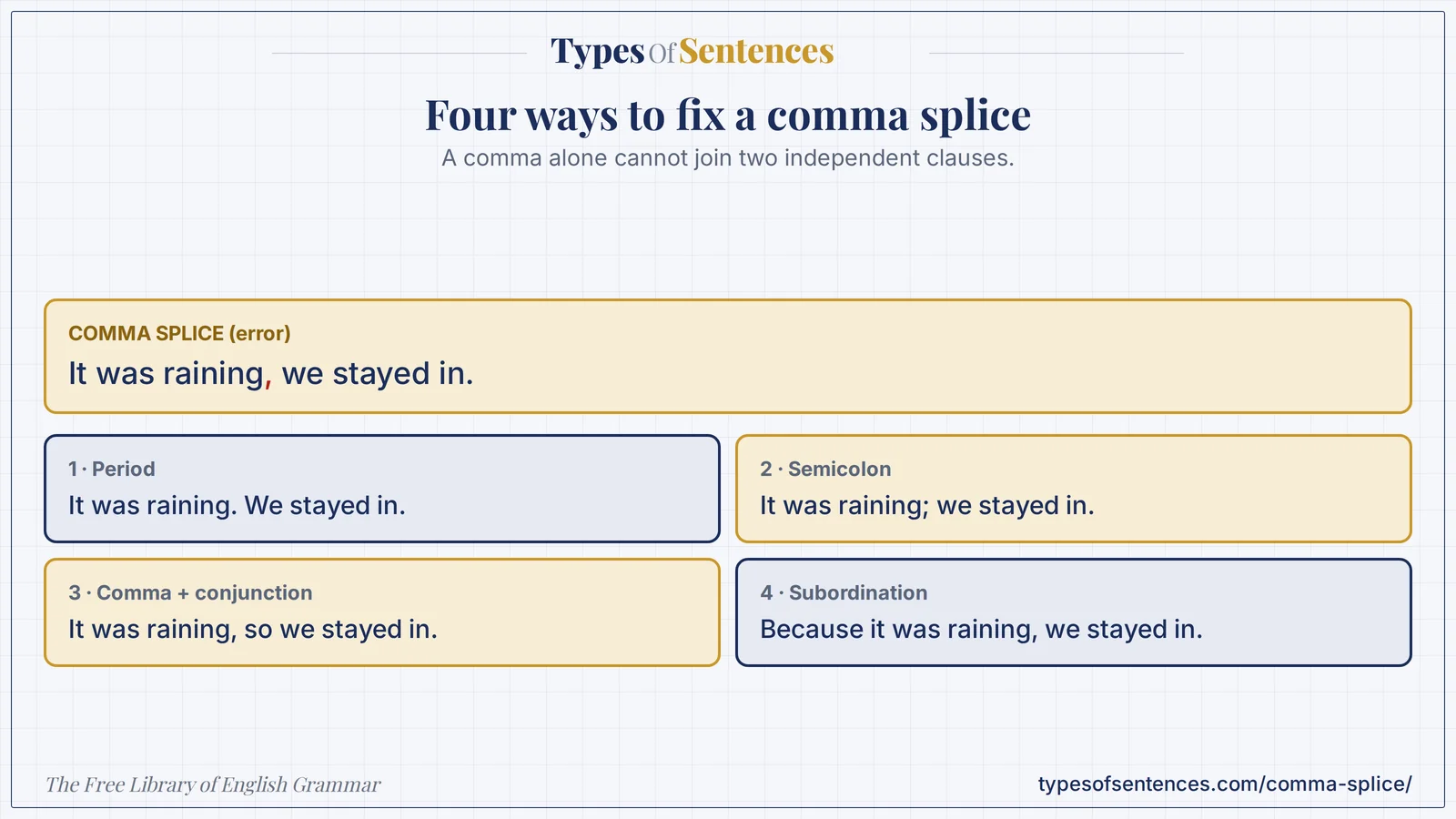
A comma splice happens when you put only a comma between two complete sentences. I like tea, she likes coffee. Both halves can stand alone, so a comma cannot join them.
Why it matters: You can fix it in four easy ways: use a period, use a semicolon, add a conjunction after the comma, or turn one half into a dependent clause.
Summary: A comma splice joins two independent clauses with only a comma. To find one, split the sentence at the comma and see whether each half can stand alone. There are four main fixes: (1) a period or other end mark; (2) a semicolon; (3) a comma plus a coordinating conjunction (for, and, nor, but, or, yet, so); (4) subordination, making one clause dependent (because, although, when). A colon or dash and a conjunctive adverb after a semicolon are two more. A comma splice is different from a run-on (fused) sentence, which has no punctuation at all. In very short parallel clauses (I came, I saw, I conquered), and in some informal and literary writing, the comma is acceptable.
- Two independent clauses + only a comma = a comma splice.
- Four fixes: period, semicolon, comma + conjunction, subordination.
- Conjunctive adverbs (however, therefore) need a semicolon, not a comma alone.
- Short parallel clauses and some informal styles allow the comma.
What You’ll Learn
- 1. What Is a Comma Splice? The Comma Splice Meaning
- 2. Comma Splice Examples and Their Corrections
- 3. Four Ways to Fix a Comma Splice
- 4. Comma Splice vs Run-On Sentence vs Fragment
- 5. Why Comma Splices Happen: The Common Triggers
- 6. When Is a Comma Splice Acceptable?
- 7. How to Find and Avoid Comma Splices in Your Writing
- 8. Common Mistakes When Fixing a Comma Splice
- 9. Exercises
- 10. Test Your Knowledge
- 11. Frequently Asked Questions
- 12. Conclusion
1. What Is a Comma Splice? The Comma Splice Meaning
| Feature | Comma splice | Correct sentence |
|---|---|---|
| clauses | two independent clauses | two independent clauses |
| joined by | a comma only | a period, a semicolon, a comma + conjunction, or subordination |
| example | It rained, we stayed in. | It rained, so we stayed in. |
| why it is wrong | a comma is not a strong enough mark between sentences | the joiner is strong enough |
| other names | comma fault; comma error | — |
| Test: is it a comma splice? | Step | Example |
|---|---|---|
| 1 find the comma | mark it | It rained, we stayed in. |
| 2 read each half alone | can each half stand as a sentence? | It rained. / We stayed in.: yes, both |
| 3 look for a conjunction after the comma | is there and, but, so, or? | no |
| 4 decide | two sentences + a comma alone = a comma splice | a comma splice |
| not a comma splice | a conjunction follows the comma, or one half is a dependent clause | It rained, so we stayed in. Because it rained, we stayed in. |
The test depends on the idea of the independent clause, which has a subject and a finite verb and can stand alone as a sentence. That idea is described in the page on independent and dependent clauses. The comma splice is one of the three common errors of sentence boundaries, together with the run-on sentence and the fragment.
2. Comma Splice Examples and Their Corrections
| Comma splice sentence | Why it is a splice | Corrected |
|---|---|---|
| I like tea, she likes coffee. | two independent clauses | I like tea; she likes coffee. |
| The road was closed, we turned back. | two independent clauses | The road was closed, so we turned back. |
| He studied hard, he passed the exam. | two independent clauses | He studied hard, and he passed the exam. |
| It was late, we were tired. | two independent clauses | It was late. We were tired. |
| She is clever, she works hard. | two independent clauses | She is clever, and she works hard. |
| The shop was closed, however, we waited. | a conjunctive adverb after a comma | The shop was closed; however, we waited. |
| He was ill, therefore, he stayed home. | a conjunctive adverb after a comma | He was ill; therefore, he stayed home. |
| We ate dinner, then we left. | then does not join clauses | We ate dinner, and then we left. |
| The film was long, it was also dull. | also does not join clauses | The film was long, and it was also dull. |
| I love this city, it has everything. | a pronoun begins the second clause | I love this city because it has everything. |
| My brother lives in Pune, he is a doctor. | a pronoun begins the second clause | My brother, who lives in Pune, is a doctor. |
| The weather was awful, nobody came. | two independent clauses | The weather was awful, so nobody came. |
| You can walk, you can take the bus. | two independent clauses | You can walk, or you can take the bus. |
| This is important, remember it. | a statement and a command | This is important: remember it. |
| The plan failed, nobody had read it. | a result and its reason | The plan failed because nobody had read it. |
| She didn’t call, she didn’t write. | two negative clauses | She didn’t call, nor did she write. |
| He opened the door, he walked in. | one subject, two verbs, but a repeated subject | He opened the door and walked in. |
| It’s a great book, I recommend it. | two independent clauses | It’s a great book; I recommend it. |
| The students were happy, they had passed. | a result and its reason | The students were happy because they had passed. |
| We missed the train, that was a pity. | a clause and a comment | We missed the train, which was a pity. |
| Not a comma splice | Why | Example |
|---|---|---|
| a comma after a dependent clause | the first part is not independent | Because it rained, we stayed in. |
| a comma before a coordinating conjunction | the conjunction joins the clauses | It rained, so we stayed in. |
| a comma in a series of words | no clauses are joined | tea, coffee, and juice |
| a comma after an introductory phrase | the first part is a phrase | In the morning, we left. |
| commas around a nonessential clause | the clause is inside another | The man, who was late, apologized. |
| a comma between a quotation and its tag | the quotation and the tag are not two sentences | “Wait,” she said. |
3. Four Ways to Fix a Comma Splice
| Fix | Method | Example | When to choose it |
|---|---|---|---|
| 1 period (two sentences) | end the first clause with a period and capitalize the next | It was raining. We stayed in. | when the ideas are separate, or each is long |
| 2 semicolon | replace the comma with a semicolon | It was raining; we stayed in. | when the clauses are closely related and balanced |
| 3 comma + coordinating conjunction | add for, and, nor, but, or, yet, so after the comma | It was raining, so we stayed in. | when you want to show the relation (reason, contrast, result) |
| 4 subordination | turn one clause into a dependent clause with a subordinator | Because it was raining, we stayed in. | when one idea is less important than the other |
| More fixes | Method | Example |
|---|---|---|
| 5 colon or dash | a colon introduces an explanation; a dash marks a break | It was raining: we stayed in. It was raining—we stayed in. |
| 6 conjunctive adverb after a semicolon | semicolon + however, therefore, etc. + comma | It was raining; therefore, we stayed in. |
| 7 reduce one clause to a phrase | turn a clause into a participial or other phrase | It was raining, so staying in. (awkward); better Because of the rain, we stayed in. |
| 8 relative clause | turn a clause into a who or which clause | My brother, who lives in Pune, is a doctor. |
| Original comma splice | 1 Period | 2 Semicolon | 3 Comma + conjunction | 4 Subordination |
|---|---|---|---|---|
| He was tired, he kept working. | He was tired. He kept working. | He was tired; he kept working. | He was tired, but he kept working. | Although he was tired, he kept working. |
| The shop was closed, we went home. | The shop was closed. We went home. | The shop was closed; we went home. | The shop was closed, so we went home. | Because the shop was closed, we went home. |
| She sings well, she is shy. | She sings well. She is shy. | She sings well; she is shy. | She sings well, yet she is shy. | Although she sings well, she is shy. |
The four fixes use the tools that are explained in the chapters on coordinating conjunctions and subordinating conjunctions, on the semicolon in punctuation marks, and on compound sentences in compound sentences. The choice among them is a matter of meaning and rhythm: a period for a separation, a semicolon for a close link, a conjunction for a stated relation, and subordination for a ranking of ideas.
4. Comma Splice vs Run-On Sentence vs Fragment
| Error | What happens | Example | Fix |
|---|---|---|---|
| comma splice | two independent clauses with only a comma | *It rained, we stayed in. | period, semicolon, conjunction, or subordination |
| run-on (fused sentence) | two independent clauses with no punctuation | *It rained we stayed in. | the same fixes |
| fragment | a dependent clause or a phrase punctuated as a sentence | *Because it rained. | join it to a main clause |
| correct compound sentence | two independent clauses with a conjunction and a comma | It rained, so we stayed in. | — |
| correct complex sentence | an independent and a dependent clause | Because it rained, we stayed in. | — |
Some writers use run-on sentence for both the comma splice and the fused sentence; others reserve it for the fused sentence. The comma splice is therefore a kind of run-on in the broad sense. The run-on is treated in the next chapter and the fragment in sentence fragments.
5. Why Comma Splices Happen: The Common Triggers
| Trigger | Example | Why it tempts | Fix |
|---|---|---|---|
| conjunctive adverbs (however, therefore, moreover, nevertheless, consequently) | *It was late, however, we stayed. | they sound like conjunctions but are adverbs | It was late; however, we stayed. |
| then, also, instead, otherwise | *We ate, then we left. | they link meaning but not grammar | We ate, and then we left. |
| a pronoun starting the second clause | *I like it, it is great. | the pronoun refers back, so the two feel like one | I like it because it is great. |
| this and that comments | *It rained, this ruined the picnic. | a comment on the first clause | It rained, which ruined the picnic. |
| a short pause in speech | *I came, I was tired. | the voice pauses where a comma goes | I came because I was tired. |
| a list of related clauses | *She cooked, he cleaned, they ate. | a series feels natural | acceptable if very short and parallel; otherwise use semicolons |
| an explanation or an example | *Some fruits are sweet, mangoes are very sweet. | the second clause explains the first | Some fruits are sweet; mangoes are very sweet. |
| dialogue and informal writing | *“I know, I saw it,” she said. | speech runs on | “I know; I saw it,” she said. |
| Word | Type | Can it join two clauses with only a comma before it? |
|---|---|---|
| and, but, or, so, yet, for, nor | coordinating conjunction | yes: , and |
| because, although, if, when, while | subordinating conjunction | yes, in a complex sentence |
| however, therefore, moreover, thus, then | conjunctive adverb | no: use a semicolon or a period |
| this, that, it, she, he, they | pronoun | no: they do not join clauses |
| also, instead, otherwise, still | adverb | no |
6. When Is a Comma Splice Acceptable?
| Situation | Example | Comment |
|---|---|---|
| very short, parallel clauses in a series | I came, I saw, I conquered. | accepted by Chicago and by most usage guides, for rhythm |
| a contrast in a short sentence | I’m not angry, I’m disappointed. | acceptable in informal and literary writing |
| fiction and dialogue | She laughed, he cried. | a stylistic choice |
| advertising and headlines | Fast, easy, cheap. | not clauses |
| poetry | varies | poetic license |
| informal writing, notes, and messages | It’s late, I’m going to bed. | common, but avoid in formal writing |
| academic and professional writing | *The study was small, the results are weak. | avoid: use a semicolon or a conjunction |
| Style guide | Position on the comma between independent clauses |
|---|---|
| The Chicago Manual of Style | a comma may join very short, closely related clauses in a series; otherwise a conjunction, a semicolon, or a period is needed |
| AP Stylebook | avoid the comma splice in news writing |
| APA (7th edition) | treat it as an error in academic writing |
| MLA (9th edition) | treat it as an error in formal writing |
| Garner | accepts it as a stylistic device in some short constructions; not in formal prose |
The safe rule is to avoid the comma splice in formal writing, and to use it, if at all, only for short parallel clauses and for a deliberate effect, as the chapter on stylistic grammar choices discusses. The wider conventions of punctuation are in the chapter on advanced punctuation.
7. How to Find and Avoid Comma Splices in Your Writing
| Method | How | Example |
|---|---|---|
| read aloud and listen for the pause | a comma where the voice drops fully may be a splice | It rained, [pause] we stayed in. |
| circle every comma and test both sides | each side alone: two sentences means a splice | — |
| search for , however, , therefore, , then, , this | these commands find many splices | — |
| check the first word after the comma | a pronoun or an adverb is a warning sign | , it …, , she … |
| count the clauses in long sentences | list the subject and the verb of each | — |
| use a checklist when you proofread | run it for each paragraph | — |
| read the paragraph backwards, sentence by sentence | you see each sentence on its own | — |
| ask a reader to mark places where they breathe | a fresh pair of eyes | — |
| Habit | Effect |
|---|---|
| write shorter sentences | fewer chances to splice |
| learn the seven coordinating conjunctions (FANBOYS) | a quick fix |
| use a semicolon only between related independent clauses | avoids misuse |
| decide the relation first (reason, contrast, result) | chooses the conjunction |
| proofread for this error separately | a one-purpose pass |
8. Common Mistakes When Fixing a Comma Splice
| Mistake | Example | Correction |
|---|---|---|
| a conjunction without the comma | *It rained so we stayed in. (acceptable if short) | It rained, so we stayed in. |
| a semicolon before a conjunction | *It rained; so we stayed in. | It rained, so we stayed in. or It rained; therefore, we stayed in. |
| a semicolon before a dependent clause | *We stayed in; because it rained. | We stayed in because it rained. |
| a comma before however with no semicolon | *It rained, however, we went. | It rained; however, we went. |
| no comma after however | *It rained; however we went. | It rained; however, we went. |
| two conjunctions | *Although it rained, but we went. | Although it rained, we went. |
| a period that creates a fragment | *It rained. Because we stayed in. | It rained, so we stayed in. |
| an overused semicolon | a paragraph of semicolon sentences | mix the fixes |
| a dash used for every splice | *It rained—we stayed—we slept. | use periods or conjunctions |
| a comma between a subject and its verb (another error) | *The plan, failed. | The plan failed. |
Fix the comma splices: The report was late, however, the board accepted it, it was thorough, we were relieved, then we celebrated.
- late, however, the board accepted it: a conjunctive adverb after a comma: The report was late; however, the board accepted it.
- accepted it, it was thorough: a reason: because it was thorough.
- thorough, we were relieved: a result: so we were relieved.
- relieved, then we celebrated: and then we celebrated.
- Result: The report was late; however, the board accepted it because it was thorough. We were relieved, and then we celebrated. (the passage is invented)
Recap in 12 seconds
Watch the lesson build itself: A comma splice and the four standard ways to fix it. The video has no sound.
Exercises
Part A: Recognizing Comma Splices (Exercises 1–8)
Exercise 1: Is this a comma splice? It rained, we stayed in.
Show Answer
Answer: Yes.
Exercise 2: Is this a comma splice? It rained, so we stayed in.
Show Answer
Answer: No; a conjunction follows the comma.
Exercise 3: Is this a comma splice? Because it rained, we stayed in.
Show Answer
Answer: No; the first clause is dependent.
Exercise 4: Is this a comma splice? She opened the door, and he walked in.
Show Answer
Answer: No; a conjunction joins the clauses.
Exercise 5: Is this a comma splice? It was late, however, we stayed.
Show Answer
Answer: Yes; a conjunctive adverb needs a semicolon.
Exercise 6: Is this a comma splice? tea, coffee, and juice
Show Answer
Answer: No; no clauses are joined.
Exercise 7: Is this a comma splice? We ate, then we left.
Show Answer
Answer: Yes.
Exercise 8: What two things does a comma splice join?
Show Answer
Answer: Two independent clauses.
Part B: Fixing With a Period or a Semicolon (Exercises 9–14)
Exercise 9: Fix with a period: I like tea, she likes coffee.
Show Answer
Answer: I like tea. She likes coffee.
Exercise 10: Fix with a semicolon: I like tea, she likes coffee.
Show Answer
Answer: I like tea; she likes coffee.
Exercise 11: Fix with a semicolon and a conjunctive adverb: It was late, we stayed.
Show Answer
Answer: It was late; nevertheless, we stayed.
Exercise 12: Fix: He was ill, therefore, he stayed home.
Show Answer
Answer: He was ill; therefore, he stayed home.
Exercise 13: Fix with a colon: This is important, remember it.
Show Answer
Answer: This is important: remember it.
Exercise 14: Fix with a dash: It rained, we stayed in.
Show Answer
Answer: It rained—we stayed in.
Part C: Fixing With a Conjunction (Exercises 15–20)
Exercise 15: Fix with so: The road was closed, we turned back.
Show Answer
Answer: The road was closed, so we turned back.
Exercise 16: Fix with but: He was tired, he kept working.
Show Answer
Answer: He was tired, but he kept working.
Exercise 17: Fix with and: She is clever, she works hard.
Show Answer
Answer: She is clever, and she works hard.
Exercise 18: Fix with or: You can walk, you can take the bus.
Show Answer
Answer: You can walk, or you can take the bus.
Exercise 19: Fix with nor: She didn’t call, she didn’t write.
Show Answer
Answer: She didn’t call, nor did she write.
Exercise 20: Fix with yet: It was cheap, it was good.
Show Answer
Answer: It was cheap, yet it was good.
Part D: Fixing With Subordination (Exercises 21–25)
Exercise 21: Fix with because: We stayed in, it rained.
Show Answer
Answer: We stayed in because it rained.
Exercise 22: Fix with although: He was tired, he kept working.
Show Answer
Answer: Although he was tired, he kept working.
Exercise 23: Fix with when: The bell rang, the students left.
Show Answer
Answer: When the bell rang, the students left.
Exercise 24: Fix with who: My brother lives in Pune, he is a doctor.
Show Answer
Answer: My brother, who lives in Pune, is a doctor.
Exercise 25: Fix with which: It rained, this ruined the picnic.
Show Answer
Answer: It rained, which ruined the picnic.
Part E: Judgment (Exercises 26–30)
Exercise 26: Is I came, I saw, I conquered acceptable?
Show Answer
Answer: Yes, as a short parallel series for rhythm; avoid in formal writing.
Exercise 27: Name the difference between a comma splice and a run-on.
Show Answer
Answer: A comma splice has a comma between the clauses; a run-on has no punctuation.
Exercise 28: Correct: *It rained; so we stayed in.
Show Answer
Answer: It rained, so we stayed in.
Exercise 29: Correct: *We stayed in; because it rained.
Show Answer
Answer: We stayed in because it rained.
Exercise 30: Correct: *It rained; however we went.
Show Answer
Answer: It rained; however, we went.
Test Your Knowledge
Ready to check what you learned? Answer all 10 questions, then submit. You need 80% (8 of 10) to pass. Your answers are not stored.
View correct answers and explanations
Question 1: A comma splice joins
✓ Correct Answer: B – two independent clauses with only a comma
The definition.
Question 2: Which is a comma splice?
✓ Correct Answer: C – It rained, we stayed in.
No conjunction.
Question 3: Which is correct?
✓ Correct Answer: D – It rained; however, we went.
Semicolon before and comma after.
Question 4: Which fix uses subordination?
✓ Correct Answer: A – Because it rained, we stayed in.
A dependent clause.
Question 5: Which words are the coordinating conjunctions?
✓ Correct Answer: C – for, and, nor, but, or, yet, so
FANBOYS.
Question 6: Which is NOT a way to fix a comma splice?
✓ Correct Answer: B – another comma
Another comma does not help.
Question 7: Is a comma splice acceptable in very short parallel clauses?
✓ Correct Answer: A – sometimes, for rhythm
Chicago allows it.
Question 8: Which word does NOT join clauses with only a comma?
✓ Correct Answer: B – however
However is a conjunctive adverb.
Question 9: A run-on (fused) sentence has
✓ Correct Answer: D – no punctuation between clauses
No punctuation.
Question 10: Which is correct?
✓ Correct Answer: A – We ate; then we left.
Semicolon or comma + and.
Frequently Asked Questions
What is a comma splice?
A comma splice is an error in which two independent clauses are joined by only a comma, such as It rained, we stayed in.
What is the comma splice meaning?
The comma splice meaning is that a writer has joined (spliced) two sentences with a comma, which is too weak a mark for the job. The fix is a period, a semicolon, a conjunction, or subordination.
What are comma splice examples?
I like tea, she likes coffee. The shop was closed, we went home. It was late, however, we stayed. These comma splice examples each join two full sentences with a comma.
What is a comma splice sentence and how do I fix it?
A comma splice sentence has two independent clauses and only a comma between them. Fix it with a period, a semicolon, a comma and a coordinating conjunction, or by making one clause dependent.
How do I know what is a comma splice and what is not?
Split the sentence at the comma: if both halves can stand alone and no conjunction follows the comma, you have found what is a comma splice. A comma after a dependent clause or before and or but is not one.
Is a comma splice the same as a run-on?
They are related. A run-on (fused) sentence has no punctuation between the clauses; a comma splice has a comma. Some writers call both run-ons.
Can I use a comma before however?
Not between two independent clauses. Use a semicolon before however and a comma after it, or start a new sentence.
Conclusion
You now know what a comma splice is, how to find one with a simple test, many examples with corrections, the four main ways to fix it, how it differs from a run-on and a fragment, why it happens, when it is acceptable, and the mistakes to avoid.
Whenever you write a comma between two full clauses, ask whether the comma is doing the work of a conjunction. Next, you will study the run-on sentence.
- Huddleston, Rodney, and Geoffrey K. Pullum. The Cambridge Grammar of the English Language. Cambridge University Press, 2002.: coordination and clause linking.
- The Chicago Manual of Style. University of Chicago Press. (check the current edition): commas and semicolons between independent clauses.
- Garner, Bryan A. Garner’s Modern English Usage. 5th ed. Oxford University Press, 2022.: the entry on comma splice.
- Strunk, William, Jr., and E. B. White. The Elements of Style. 4th ed. Longman, 1999.: the rule on joining independent clauses.
- Merriam-Webster Dictionary: comma splice: the dictionary entry.
Last reviewed: October 29, 2026. How it was made: drafted with AI assistance, then checked with automated tests (structure, links, answer keys, spelling) and against the sources above. A person has not yet read this chapter line by line. Found a mistake? Report it.