What are the SAT punctuation rules? The SAT punctuation rules are the conventions that the digital SAT checks when its answer choices contain the same words but different punctuation. Most of these questions belong to the Boundaries skill of the Standard English Conventions domain, which the College Board describes as about 26 percent of the Reading and Writing section (11 to 15 of its 54 questions). They test one idea: where does a clause begin and end, and which mark joins or separates the parts correctly?
This page lists every punctuation pattern that SAT punctuation questions use: commas, semicolons, colons, dashes, parentheses, and apostrophes, with correct and incorrect examples. It gives a method that works on every digital SAT punctuation question, the traps, and 30 original practice items (not taken from the College Board). It ends with a 10-question quiz.
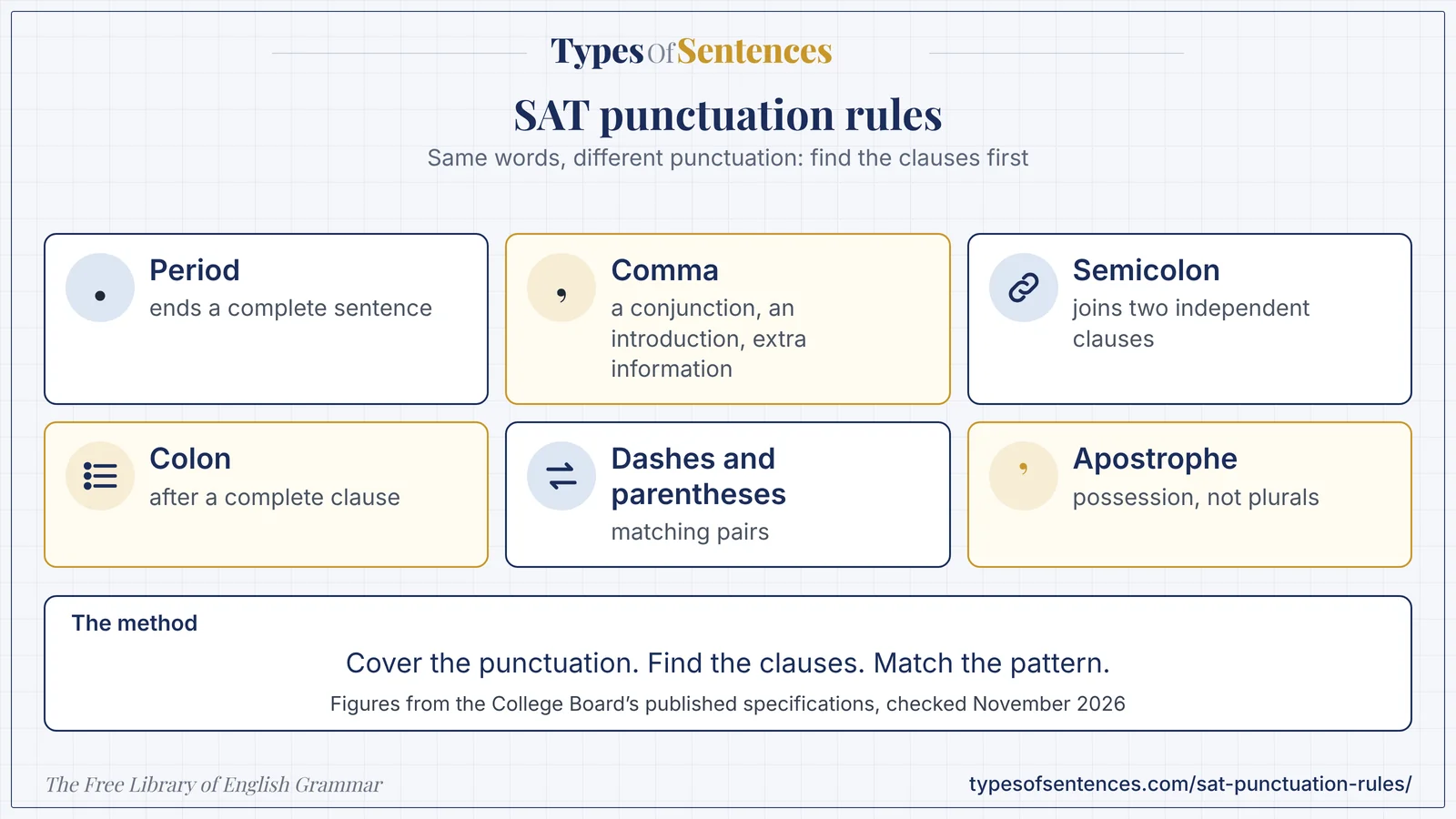
A punctuation mark is a signal about structure. A period ends a complete thought; a comma with and joins two thoughts; a semicolon joins two thoughts without a word; a colon introduces an explanation; a pair of commas, dashes, or parentheses wraps extra information.
Why it matters: The SAT never asks you to name a mark. It asks you to choose the one that matches the structure of the sentence, so the skill is to find the clauses first.
Summary: Digital SAT punctuation questions show four choices with the same words and different punctuation. The patterns tested are: two independent clauses need a period, a semicolon, or a comma with a coordinating conjunction; a comma never separates a subject from its verb or a verb from its complement; nonessential information needs matching marks on both sides (two commas, two dashes, or two parentheses); a colon must follow a complete clause; a semicolon joins independent clauses (or separates list items that contain commas); an introductory element is followed by a comma; and apostrophes show possession, not plurals. The method is to cover the punctuation and identify the clauses.
- Same words, different punctuation.
- Find the clauses first.
- Nonessential: matching pairs.
- Colon: complete clause before it.
What You’ll Learn
- 1. SAT Punctuation Rules: The Short Answer
- 2. A Cover-the-Punctuation Method for Digital SAT Punctuation
- 3. SAT Comma Rules: The Seven Patterns
- 4. SAT Colon and Semicolon Rules
- 5. Dashes and Parentheses on the SAT
- 6. Apostrophes on the SAT: Possessives, Plurals, and Contractions
- 7. Traps and Common Mistakes in SAT Punctuation Questions
- 8. Exercises
- 9. Test Your Knowledge
- 10. Frequently Asked Questions
- 11. Conclusion
1. SAT Punctuation Rules: The Short Answer
| Fact | Detail |
|---|---|
| where | the Standard English Conventions domain of the digital SAT Reading and Writing section |
| skill | Boundaries (how clauses are joined and separated); some items also test apostrophes under Form, Structure, and Sense |
| share | Standard English Conventions is about 26 percent of the section, or 11 to 15 of 54 questions |
| format | a short text with a blank or an underlined part, and four choices |
| clue | the choices have the same words and different punctuation |
| official practice | the College Board’s Bluebook app and Student Question Bank |
| Mark | Main job on the SAT | Example |
|---|---|---|
| period | ends a complete sentence | The rain stopped. We went outside. |
| comma | separates items, sets off extra information, or joins clauses with a conjunction | The rain stopped, and we went outside. |
| semicolon | joins two independent clauses | The rain stopped; we went outside. |
| colon | introduces an explanation or a list after a complete clause | She packed three things: a map, a compass, and water. |
| dash (pair or single) | sets off extra information or a final addition | My brother — who lives in Denver — called. |
| parentheses | enclose extra information | My brother (who lives in Denver) called. |
| apostrophe | shows possession or a contraction | the dogs’ bowls · it’s late |
The College Board figures were taken from its published specifications and checked in November 2026; the College Board can change the test, so check satsuite.collegeboard.org before you rely on them. The wider set of rules is in the companion guide to the SAT grammar rules.
2. A Cover-the-Punctuation Method for Digital SAT Punctuation
| Step | Do this | Why |
|---|---|---|
| 1 cover | look at the sentence with the punctuation removed | the words are the same in every choice |
| 2 find | mark where each independent clause starts and ends (a subject and a finite verb that can stand alone) | boundaries decide the mark |
| 3 identify | is there extra information in the middle? is there a list or an explanation? | nonessential and list patterns have their own marks |
| 4 choose | match the structure to the pattern in the tables below | each pattern has one correct mark |
| 5 check | read the sentence with your choice in place | one stray comma can survive steps 1 to 4 |
| If the structure is… | Use… | Not… |
|---|---|---|
| independent clause + independent clause | a period, a semicolon, or a comma + and/but/or/so | a comma alone |
| independent clause + dependent clause (dependent last) | no punctuation | a comma or a semicolon |
| dependent clause + independent clause | a comma after the dependent clause | a semicolon |
| independent clause : explanation | a colon | a semicolon unless the explanation is a clause |
| extra information in the middle | two commas, two dashes, or two parentheses | one of each |
| a subject and its verb | nothing between them | a comma |
3. SAT Comma Rules: The Seven Patterns
| Pattern | Rule | Correct example | Error |
|---|---|---|---|
| joining clauses | a comma before a coordinating conjunction that joins two independent clauses | The test was long, but she finished. | *The test was long but, she finished. |
| compound predicate | no comma when the second part has no new subject | She opened the door and walked in. | *She opened the door, and walked in. |
| introductory element | a comma after an introductory phrase or clause | After the storm, we cleaned up. | *After the storm we cleaned up. (acceptable only if very short; the SAT choices will differ in other ways) |
| series | commas between three or more items | maps, charts, and graphs | *maps charts and graphs |
| coordinate adjectives | a comma between adjectives that can be reordered or joined by and | a long, difficult exam | *a bright, red car (bright red is one idea) |
| nonessential information | a comma before and after | My cousin, who lives in Denver, called. | *My cousin, who lives in Denver called. |
| transitions | a comma after a transition word at the start; commas around it inside | However, we left. · We, however, left. | *However we left. |
| Never use a comma… | Example of the error | Correct |
|---|---|---|
| between a subject and its verb | *The girl in the red coat, won. | The girl in the red coat won. |
| between a verb and its complement or object | *She gave, the book to Tom. | She gave the book to Tom. |
| after a coordinating conjunction | *The test was long but, she finished. | The test was long, but she finished. |
| before that in a restrictive clause | *The book, that I read, was long. | The book that I read was long. |
| between a noun and a restrictive modifier | *The student, who studied, passed. (if only that student is meant) | The student who studied passed. |
| to join two independent clauses alone | *It rained, we stayed in. | It rained, so we stayed in. |
The full set of comma rules is in the Basic chapter on the comma; the sentence-boundary errors are in the chapter on the comma splice.
4. SAT Colon and Semicolon Rules
| Mark | Rule | Correct example | Error |
|---|---|---|---|
| semicolon | joins two independent clauses | The rain stopped; we went outside. | *The rain stopped; and we went outside. |
| semicolon | before a conjunctive adverb that joins two clauses, with a comma after | The rain stopped; therefore, we went outside. | *The rain stopped, therefore we went outside. |
| semicolon | separates list items that contain commas | We visited Denver, Colorado; Austin, Texas; and Miami, Florida. | *We visited Denver, Colorado, Austin, Texas, and Miami, Florida. |
| semicolon | never before a dependent clause or a fragment | We went outside when the rain stopped. | *We went outside; when the rain stopped. |
| colon | follows a complete clause and introduces a list, explanation, or quotation | She packed three things: a map, a compass, and water. | *She packed: a map and water. |
| colon | never after a preposition, a verb, or such as or including | She packed a map, a compass, and water. | *She packed such as: a map. |
| colon | can introduce a one-word or phrase explanation | He had one goal: victory. | *He had: one goal. |
| Semicolon or colon? | Test | Example |
|---|---|---|
| the second part explains or lists | use a colon if the first part is a complete clause | The plan was simple: wait and watch. |
| the second part is a related, equal clause | use a semicolon | The plan was simple; the execution was hard. |
| the second part is a fragment | use a colon, a dash, or no mark; not a semicolon | The plan had one goal: speed. |
5. Dashes and Parentheses on the SAT
| Pattern | Rule | Correct example | Error |
|---|---|---|---|
| pair of dashes | set off extra information; the dashes must match | My brother — who lives in Denver — called. | *My brother — who lives in Denver, called. |
| pair of commas | set off extra information; the commas must match | My brother, who lives in Denver, called. | *My brother, who lives in Denver — called. |
| pair of parentheses | enclose extra information | My brother (who lives in Denver) called. | *My brother (who lives in Denver, called. |
| single dash | introduces a final addition or explanation after a complete clause | She wanted one thing — peace. | *She wanted — peace. |
| dash after a complete clause | a dash can also act like a colon | The result was clear — the plan failed. | *The result was clear — the plan failed —. |
The marks in a pair must be the same kind. If a choice starts with a comma and ends with a dash, it is wrong. The detailed rules for the other marks are in the advanced chapter on advanced punctuation.
6. Apostrophes on the SAT: Possessives, Plurals, and Contractions
| Pattern | Rule | Correct example | Error |
|---|---|---|---|
| singular possessive | add ’s | the dog’s bowl | *the dogs bowl |
| plural possessive (ends in s) | add an apostrophe | the dogs’ bowls | *the dog’s bowls (several dogs) |
| plain plural | no apostrophe | two dogs | *two dog’s |
| its and it’s | its is possessive; it’s is a contraction | The dog wagged its tail. It’s late. | *The dog wagged it’s tail. |
| possessive pronouns | no apostrophe | hers, theirs, yours | *her’s |
| irregular plural possessive | add ’s | the children’s toys | *the childrens’ toys |
Possessives are explained in the guide to possessive nouns, and the commonest apostrophe confusion is covered in the guide to its and it’s.
7. Traps and Common Mistakes in SAT Punctuation Questions
| Trap | What it looks like | The cure |
|---|---|---|
| the comfortable comma | a choice with “one more comma” that sounds natural | test the comma: is it between a subject and a verb? |
| the half-pair | a nonessential phrase with a comma at one end and a dash at the other | match the marks |
| the colon after a fragment | The ingredients are: flour, eggs, and milk. | a colon needs a complete clause before it |
| the semicolon with a conjunction | …; but … | a semicolon replaces the conjunction |
| the comma before a dependent clause at the end | We left, because it rained. | no comma is needed |
| the long subject | a long phrase before the verb tempts a comma | cross out the phrase and test the subject-verb pair |
| the missing second comma | The report, which was late was short. | extra information needs both marks |
| the transition without a comma | However we left. | a comma after the transition |
Which choice is correct? The committee, after weeks of debate ___ voted to approve the plan. (A) , (B) ; (C) — (D) no punctuation
- Find the clauses: the main clause is The committee voted to approve the plan; after weeks of debate is extra information in the middle.
- The extra information opened with a comma after committee, so it must close with a matching mark before the verb.
- Test the choices: (A) a comma matches the opening comma; (B) a semicolon cannot close extra information; (C) a dash does not match a comma; (D) leaves the phrase half-open.
- Answer: (A) ,. (The item is an original practice item, not taken from the College Board.)
Recap in 12 seconds
Watch the lesson build itself: The digital SAT punctuation patterns: period, comma, semicolon, colon, dashes and parentheses, and apostrophes, with a method that starts by finding the clauses. The video has no sound.
Exercises
Part A: Commas (Exercises 1–10)
Exercise 1: Choose: The test was long ___ but she finished. (A) , (B) no comma
Show Answer
Answer: (A): a comma comes before the conjunction that joins two independent clauses.
Exercise 2: Choose: She opened the door ___ and walked in. (A) , (B) no comma
Show Answer
Answer: (B): a compound predicate takes no comma.
Exercise 3: Choose: After the storm ___ we cleaned up. (A) , (B) no comma
Show Answer
Answer: (A): a comma follows an introductory phrase.
Exercise 4: Choose: a long ___ difficult exam (A) , (B) no comma
Show Answer
Answer: (A): coordinate adjectives (long and difficult).
Exercise 5: Choose: a bright ___ red car (A) , (B) no comma
Show Answer
Answer: (B): bright red is one idea.
Exercise 6: Which is correct? (A) My cousin, who lives in Denver, called. (B) My cousin, who lives in Denver called.
Show Answer
Answer: (A): both commas.
Exercise 7: Choose: The girl in the red coat ___ won. (A) , (B) no comma
Show Answer
Answer: (B): no comma between a subject and its verb.
Exercise 8: Choose: The book ___ that I read ___ was long. (A) commas (B) no commas
Show Answer
Answer: (B): that clauses are restrictive.
Exercise 9: Choose: However ___ we left. (A) , (B) no comma
Show Answer
Answer: (A): a comma after the transition.
Exercise 10: Choose: maps ___ charts, and graphs (A) , (B) no comma
Show Answer
Answer: (A): commas separate the items.
Part B: Semicolons and Colons (Exercises 11–20)
Exercise 11: Choose: It rained ___ we stayed in. (A) , (B) ;
Show Answer
Answer: (B): a semicolon joins the clauses; a comma alone cannot.
Exercise 12: Choose: It rained ___ therefore, we stayed in. (A) , (B) ;
Show Answer
Answer: (B).
Exercise 13: Choose: We went outside ___ when it stopped. (A) ; (B) no mark
Show Answer
Answer: (B): no semicolon before a dependent clause.
Exercise 14: Choose: She packed three things ___ a map, a compass, and water. (A) ; (B) :
Show Answer
Answer: (B).
Exercise 15: Choose: She packed ___ a map and water. (A) : (B) no mark
Show Answer
Answer: (B): a colon cannot follow an incomplete clause.
Exercise 16: Choose: He had one goal ___ victory. (A) : (B) ;
Show Answer
Answer: (A).
Exercise 17: Choose: The plan was simple ___ the execution was hard. (A) ; (B) :
Show Answer
Answer: (A): two related independent clauses.
Exercise 18: Which is correct? (A) We visited Denver, Colorado, Austin, Texas, and Miami. (B) We visited Denver, Colorado; Austin, Texas; and Miami.
Show Answer
Answer: (B): semicolons separate items that contain commas.
Exercise 19: Which is correct? (A) She wanted; peace. (B) She wanted one thing: peace.
Show Answer
Answer: (B).
Exercise 20: Which is correct? (A) The ingredients are: flour, eggs, and milk. (B) The ingredients are flour, eggs, and milk.
Show Answer
Answer: (B): no colon after a verb.
Part C: Dashes, Parentheses, and Apostrophes (Exercises 21–26)
Exercise 21: Which is correct? (A) My brother — who lives in Denver, called. (B) My brother — who lives in Denver — called.
Show Answer
Answer: (B): matching dashes.
Exercise 22: Which is correct? (A) My brother (who lives in Denver called. (B) My brother (who lives in Denver) called.
Show Answer
Answer: (B).
Exercise 23: Choose: The ___ bowls were empty. (three dogs) (A) dog’s (B) dogs’
Show Answer
Answer: (B).
Exercise 24: Choose: The dog wagged ___ tail. (A) its (B) it’s
Show Answer
Answer: (A).
Exercise 25: Choose: She bought two ___. (A) apple’s (B) apples
Show Answer
Answer: (B).
Exercise 26: Choose: The ___ toys were on the floor. (A) children’s (B) childrens’
Show Answer
Answer: (A).
Part D: Correct the Errors (Exercises 27–30)
Exercise 27: Correct: *The rain stopped, we went outside.
Show Answer
Answer: The rain stopped, and we went outside. (or a semicolon or a period)
Exercise 28: Correct: *She packed: a map and water.
Show Answer
Answer: She packed a map and water.
Exercise 29: Correct: *My cousin, who lives in Denver called.
Show Answer
Answer: My cousin, who lives in Denver, called.
Exercise 30: Correct: *The test was long but, she finished.
Show Answer
Answer: The test was long, but she finished.
Test Your Knowledge
Ready to check what you learned? Answer all 10 questions, then submit. You need 80% (8 of 10) to pass. Your answers are not stored.
View correct answers and explanations
Question 1: A colon must follow
✓ Correct Answer: A – a complete clause
A complete clause.
Question 2: A semicolon can join
✓ Correct Answer: B – two independent clauses
Two independent clauses.
Question 3: Nonessential information needs
✓ Correct Answer: C – matching marks on both sides
Matching pairs.
Question 4: A comma should NOT separate
✓ Correct Answer: D – a subject from its verb
A basic rule.
Question 5: Which is a plain plural?
✓ Correct Answer: A – dogs
No apostrophe.
Question 6: The dog wagged ___ tail.
✓ Correct Answer: B – its
Possessive.
Question 7: Which is correct?
✓ Correct Answer: C – The test was long, but she finished.
Comma before the conjunction.
Question 8: The digital SAT punctuation questions mainly test
✓ Correct Answer: D – clause boundaries
Boundaries.
Question 9: A dash and a comma used as a pair are
✓ Correct Answer: A – mismatched
Marks must match.
Question 10: Official digital SAT practice is available in
✓ Correct Answer: B – the Bluebook app
College Board’s app.
Frequently Asked Questions
What are the SAT punctuation rules?
They are the conventions of punctuation that the digital SAT tests, mainly in its Boundaries skill: joining clauses with a period, a semicolon, or a comma and a conjunction; using colons only after complete clauses; using matching marks around nonessential information; avoiding commas between a subject and its verb; and using apostrophes only for possession and contractions.
How many SAT punctuation questions are there?
The College Board describes Standard English Conventions as about 26 percent of the Reading and Writing section, or 11 to 15 of its 54 questions. Punctuation items are a large part of that domain, but the College Board does not publish a separate count for punctuation. Check satsuite.collegeboard.org for current figures.
What are the SAT comma rules?
Use a comma before a coordinating conjunction that joins two independent clauses, after an introductory element, between items in a series, between coordinate adjectives, and in pairs around nonessential information. Do not use a comma between a subject and its verb or between a verb and its object.
What are the SAT colon and semicolon rules?
A colon follows a complete clause and introduces a list, an explanation, or a quotation. A semicolon joins two independent clauses or separates list items that contain commas. Neither may follow an incomplete clause (colon) or precede a dependent clause (semicolon).
How do I answer digital SAT punctuation questions quickly?
Cover the punctuation, find the clauses, name the pattern, and test the choices. The College Board’s Bluebook app has practice questions in the real format.
Does the SAT test the serial comma?
The questions focus on whether items are separated correctly and on boundaries, not on a preference for the comma before and. If the choices differ only in that comma, follow the pattern used elsewhere in the passage. This is general advice, not a College Board statement.
Are the practice items on this page from the College Board?
No. They are original items written for this page. For official practice use the College Board’s Bluebook app and Student Question Bank.
Conclusion
You now know the SAT punctuation rules: how the digital SAT builds its punctuation questions, the seven comma patterns, the colon and semicolon rules, the dash and parenthesis pairs, the apostrophe patterns, and the common traps. You have also practiced with original items.
Cover the punctuation, find the clauses, and match the structure to the pattern. Next, study the SAT subject-verb agreement rules, the other large group of Standard English Conventions questions.
- College Board. Digital SAT Suite of Assessments: Reading and Writing Content Specifications. satsuite.collegeboard.org.: the domains, the skills, and the question counts (checked November 2026; the College Board can change them).
- College Board. Bluebook app and Student Question Bank. satsuite.collegeboard.org.: official practice for the digital SAT.
- Garner, Bryan A. Garner’s Modern English Usage. 5th ed. Oxford University Press, 2022.: the entries on the comma, the semicolon, the colon, and the dash.
- Strunk, William, Jr., and E. B. White. The Elements of Style. 4th ed. Longman, 1999.: the rules on commas, semicolons, colons, and the apostrophe.
Last reviewed: October 29, 2026. How it was made: drafted with AI assistance, then checked with automated tests (structure, links, answer keys, spelling) and against the sources above. A person has not yet read this chapter line by line. Found a mistake? Report it.