What is grammar? Grammar is the system of rules and patterns by which words are combined into phrases, clauses, and sentences to express meaning. It tells us that The dog chased the cat and The cat chased the dog mean different things, that She go to school is not standard English, and that a question usually puts the verb before the subject. Every language has a grammar, and the English grammar that you learn here is the grammar of standard written and spoken English as it is used today.
This page answers the question what is English grammar in plain language. It gives the grammar definition, shows how grammar differs from vocabulary, syntax, usage, and style, explains how many kinds of English grammar there are, introduces the core components and the English grammar rules that learners need first, and shows why grammar matters in speaking, writing, and reading. It lists the common mistakes and misconceptions, and gives strategies for learning. It ends with 30 exercises and a 10-question quiz.
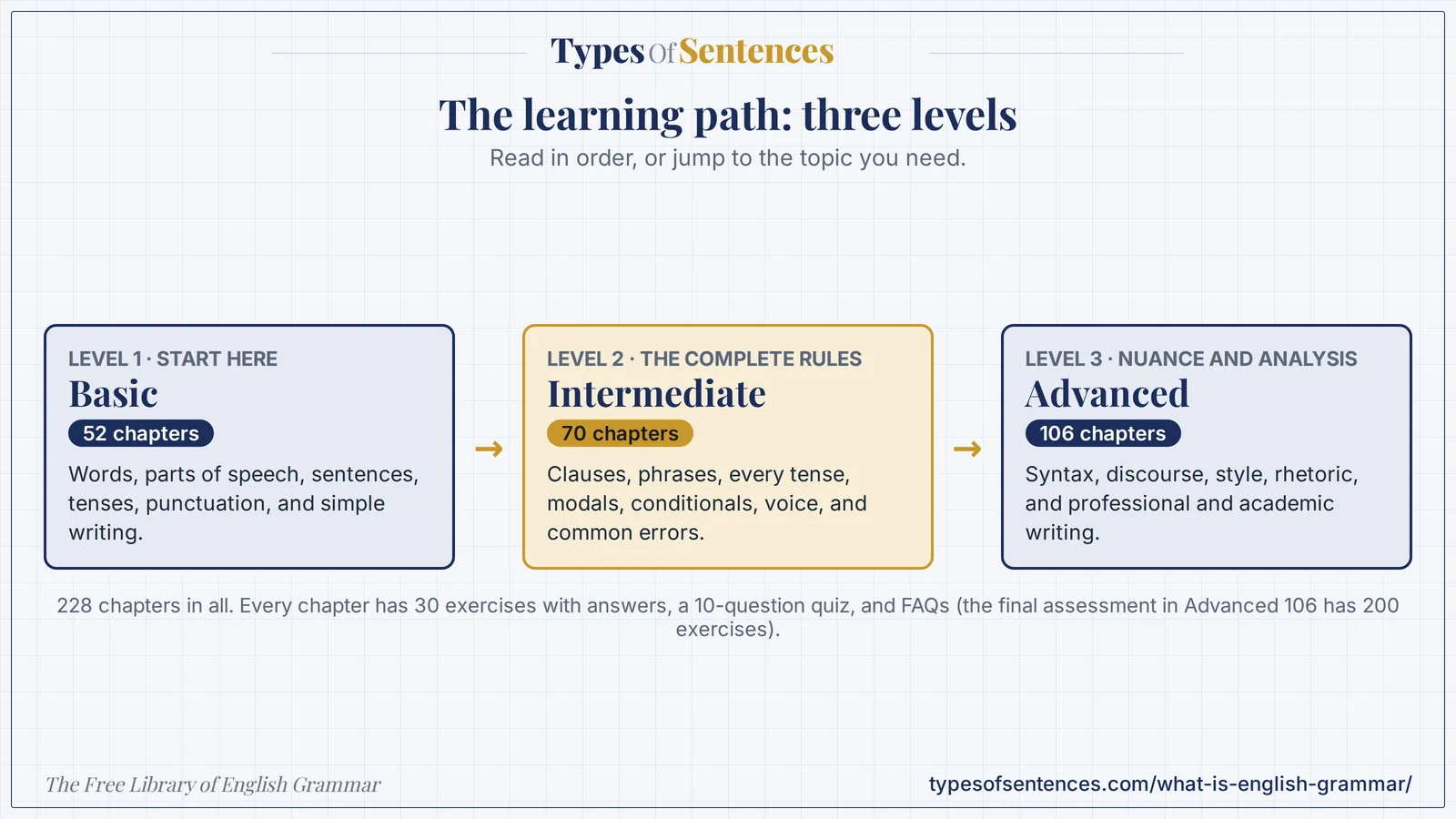
Grammar is how words fit together. You already use it every time you speak: you know without thinking that big red balloon sounds right and red big balloon sounds wrong. Learning grammar means making that knowledge conscious, so that you can use it on purpose and fix it when it fails.
Why it matters: You do not need to memorize everything. Learn the eight parts of speech, how a sentence is built, and the main tenses and punctuation marks, and add the finer points as you need them.
Summary: Grammar is the system of rules and patterns for combining words into phrases, clauses, and sentences. It includes morphology (the form of words) and syntax (the order and structure of sentences). Grammar is not the same as vocabulary (the words), usage (what is standard in a community), or style (choices of expression). Linguists distinguish descriptive grammar (how people actually use the language) from prescriptive grammar (how some think they should); school and traditional grammar, structural, generative, and functional grammars are other approaches. The core components for a learner are the parts of speech, sentence structure, word order, verb tenses, agreement, and punctuation. Grammar gives clarity, credibility, and accuracy in speaking, writing, and reading. This site teaches it at three levels: Basic, Intermediate, and Advanced.
- Grammar = the rules and patterns that combine words into sentences.
- Morphology (word form) + syntax (sentence structure).
- Descriptive vs prescriptive; several theories of grammar.
- Core: parts of speech, sentences, tenses, agreement, punctuation.
What You’ll Learn
- 1. What Is Grammar? The Grammar Definition
- 2. Grammar vs Vocabulary, Syntax, Usage, and Style
- 3. How Many Kinds of English Grammar Are There?
- 4. A Short History of English Grammar
- 5. The Core Components of English Grammar and the Main English Grammar Rules
- 6. Why English Grammar Matters
- 7. How Grammar Works in Real Communication: Speaking, Writing, and Reading
- 8. A Worked Example: Analyzing One Sentence
- 9. Essential Grammar Concepts Every Learner Should Know
- 10. Common Grammar Mistakes to Avoid
- 11. Common Misconceptions About Grammar
- 12. Effective Strategies for Learning English Grammar
- 13. Exercises
- 14. Test Your Knowledge
- 15. Frequently Asked Questions
- 16. Conclusion
1. What Is Grammar? The Grammar Definition
| Part of the definition | Meaning | Example |
|---|---|---|
| a system | a set of rules and patterns, not a list of facts | subject + verb + object |
| of words | the units that are arranged | The / dog / chased / the / cat |
| into phrases, clauses, and sentences | the larger units that words form | the old dog; when it barked |
| to express meaning | the grammar signals who did what to whom | The dog chased the cat. (the dog acts) |
| that speakers share | a community agrees on the patterns | She goes, not She go |
| Dictionary and teaching definitions of grammar | Emphasis |
|---|---|
| the rules of a language for combining words | structure |
| the study of how words and their component parts combine to form sentences | linguistics (morphology and syntax) |
| the set of rules about what is correct usage | correctness (the school sense) |
| a book that describes these rules | a reference grammar |
| the knowledge in a speaker’s mind that lets them produce and understand sentences | internal grammar |
| Example | What grammar explains |
|---|---|
| The dog chased the cat. vs The cat chased the dog. | word order shows the subject and the object |
| She walks. vs They walk. | the verb agrees with the subject |
| I have eaten. vs I ate. | tense and aspect show time and relevance |
| Is it raining? vs It is raining. | the question reverses the order of verb and subject |
| big red balloon, not red big balloon | adjectives follow an order |
| the book vs a book | the article shows what is known or new |
The study of grammar begins with the eight parts of speech, which are the subject of the Basic chapter parts of speech, and the sentence, which is described in what is a sentence.
2. Grammar vs Vocabulary, Syntax, Usage, and Style
| Term | Meaning | Example |
|---|---|---|
| grammar | the rules that combine words (morphology + syntax) | She is going. (not She going.) |
| vocabulary | the words of a language and their meanings | happy, joyful, cheerful |
| morphology | the structure of words: prefixes, suffixes, plurals, tenses | un-happi-ness; walk-ed |
| syntax | the structure of sentences: word order, clauses, phrases | subject + verb + object |
| punctuation and spelling | the conventions of writing | a comma, an apostrophe, and the spelling of receive |
| usage | what is standard or conventional in a community for a disputed point | who or whom; fewer or less |
| style | the choices a writer makes among correct forms | a short or long sentence; active or passive |
| pragmatics | how context shapes meaning | Can you pass the salt? is a request |
| Which is it? | Example | Answer |
|---|---|---|
| She don’t like tea. | a problem with agreement | grammar |
| She enjoys a cup of tay. | a spelling problem | spelling |
| She is a very smart man. | a problem with the choice of a word | vocabulary |
| Whom did you call? vs Who did you call? | a choice that depends on the formality | usage |
| The proposal was rejected by the committee. vs The committee rejected the proposal. | two correct forms | style |
Grammar and vocabulary work together: a sentence needs both the right words and the right pattern. A learner who knows many words but few patterns writes disconnected phrases; a learner who knows the patterns but few words writes simple sentences. Syntax and the structure of sentences are described in detail in the advanced chapter on syntax and in the pages on the types of sentences, starting with the guide to types of sentences.
3. How Many Kinds of English Grammar Are There?
| Kind of grammar | What it does | Example of a view |
|---|---|---|
| descriptive grammar | describes how people actually use the language, based on evidence | Singular they is in use, so it is described. |
| prescriptive grammar | states how people should use the language, according to an authority | Do not split infinitives. (a traditional rule) |
| traditional (school) grammar | the eight parts of speech and the sentence parts taught in schools | nouns, verbs, subjects, predicates |
| structural grammar | describes patterns of form and order in the language | sentence patterns |
| generative grammar | models the knowledge in a speaker’s mind with formal rules | Noam Chomsky’s work (from 1957) |
| functional grammar | describes how grammar serves communication | M. A. K. Halliday’s systemic functional grammar |
| cognitive grammar | links grammar to meaning and mental processes | construction grammar |
| pedagogical grammar | explanations designed for learners and teachers | a learner’s grammar book |
| reference grammar | a full description of the language | The Cambridge Grammar of the English Language |
| Another answer: the levels of this course | Chapters | For |
|---|---|---|
| Basic English Grammar | 52 | beginners: words, sentences, tenses, punctuation |
| Intermediate English Grammar | 70 | clauses, phrases, tenses, modals, conditionals, writing |
| Advanced English Grammar | 106 | syntax, discourse, style, and rhetoric, with contested points |
So there is no single number. By approach, there are several kinds of grammar, and the first two (descriptive and prescriptive) are the ones that matter most for a learner: a good grammar book describes real usage and advises where a choice matters. On this site, the grammar is taught at three levels: Basic English Grammar, Intermediate English Grammar, and Advanced English Grammar. The history behind the rules is told in the Advanced chapters on the history of English grammar.
4. A Short History of English Grammar
| Period | Development |
|---|---|
| about 100 BC | the earliest Greek grammar, the Art of Grammar, traditionally attributed to Dionysius Thrax, names the parts of speech |
| Middle Ages | Latin grammar dominates teaching; grammar means Latin grammar |
| 1586 | William Bullokar publishes the first grammar of English (written in English) |
| 1762 | Robert Lowth’s Short Introduction to English Grammar, an influential prescriptive grammar |
| 1795 | Lindley Murray’s English Grammar becomes the standard school text for decades |
| 20th century | linguists (structural, then generative and functional) describe English as it is used |
| 2002 | The Cambridge Grammar of the English Language gives a modern, evidence-based description |
| today | corpora, large collections of real text, show how people actually write and speak |
The dates are those given in standard histories of the subject; some are traditional attributions, and scholars differ on details. Many of the rules of school grammar come from the eighteenth-century prescriptive tradition, and some of them have no basis in the usage of good writers. The advanced chapter on grammar myths looks at those rules in detail.
5. The Core Components of English Grammar and the Main English Grammar Rules
| Component | What it covers | Example rule |
|---|---|---|
| parts of speech | the eight kinds of word: noun, pronoun, verb, adjective, adverb, preposition, conjunction, interjection | a noun names a person, place, thing, or idea |
| phrases and clauses | groups of words that work as units | a clause has a subject and a predicate |
| sentence structure | the four structures: simple, compound, complex, compound-complex | a sentence needs a subject and a verb |
| sentence function | the four functions: statement, question, command, exclamation | a question ends with a question mark |
| word order | the arrangement of words in a sentence | subject + verb + object in a statement |
| verbs and tenses | time, aspect, voice, mood, and modals | use has with a singular subject in the present perfect |
| agreement | the match of subject and verb, and of pronoun and antecedent | The dogs bark. |
| modifiers | adjectives, adverbs, and phrases that describe | place a modifier next to the word it describes |
| articles and determiners | a, an, the, and the words before nouns | use an before a vowel sound |
| punctuation | the marks that separate and show structure | a comma between items in a list |
| capitalization and spelling | the conventions of the written form | capitalize the first word of a sentence and proper nouns |
| word formation | prefixes, suffixes, and compounds | happy → unhappy |
| The eight parts of speech | Job | Example |
|---|---|---|
| noun | names | teacher, Pune, freedom |
| pronoun | replaces a noun | she, they |
| verb | shows action or state | run, is |
| adjective | describes a noun | red, tall |
| adverb | describes a verb, adjective, or adverb | quickly, very |
| preposition | shows relation | in, on |
| conjunction | joins | and, because |
| interjection | expresses feeling | wow, oh |
The English grammar rules that follow from these components are taught step by step in the chapters of the three levels. The order of this course is designed so that each chapter uses only what the earlier ones have taught.
6. Why English Grammar Matters
| Benefit | Explanation | Example |
|---|---|---|
| clarity | correct grammar removes ambiguity | Let’s eat, Grandma. / Let’s eat Grandma. |
| credibility | accurate writing builds trust with readers | a polished email or a clean report |
| academic success | examiners and teachers expect control of grammar | essays, exams, and theses |
| professional communication | clear language saves time and prevents errors | instructions, reports, and contracts |
| a foundation for learning languages | grammar knowledge transfers to other languages | comparing tenses across languages |
| confidence | knowing the rules reduces hesitation | speaking in meetings |
| better reading | grammar helps you parse long sentences | a legal clause or a long literary sentence |
| better editing | you can find and fix errors in your own writing | a proofreading pass |
| understanding of language | grammar shows how language works | why go becomes went |
| Skill | How grammar helps |
|---|---|
| speaking | chooses the right tense, word order, and politeness form on the spot |
| writing | builds clear sentences and paragraphs; allows revision with reasons |
| reading | lets you see the structure of a difficult sentence |
| listening | predicts what comes next and follows meaning in real time |
| translation | shows which structures differ between languages |
7. How Grammar Works in Real Communication: Speaking, Writing, and Reading
| Skill | What grammar does | Example | Common problem |
|---|---|---|---|
| speaking | chooses the tense, the word order, and the politeness form in real time | Could you tell me where the station is? (a polite indirect question) | hesitation; dropping endings such as -s and -ed |
| speaking | signals questions with word order and intonation together | Are you coming? (the verb comes first) | a statement order for a question: You are coming? in careful writing |
| writing | builds sentences and paragraphs that a reader can follow without the writer present | Although the plan was cheap, it failed because nobody tested it. | run-ons, fragments, and unclear pronouns |
| writing | allows revision for a reason: you can say why a sentence is wrong | changing Walking home, the rain started to Walking home, I felt the rain start | a dangling modifier left in |
| reading | lets you see the structure of a long sentence and find its main clause | finding the plan failed in the sentence above | losing the thread of a sentence with many clauses |
| listening | helps you predict what comes next and follow meaning at speed | after If I had known …, expect I would have … | missing small words such as auxiliaries and articles |
| Situation | Grammar choice | Effect |
|---|---|---|
| an email to a manager | full sentences; polite modals; no slang | professional and clear |
| a text to a friend | short clauses; contractions; ellipsis | natural and quick |
| an academic essay | complete sentences; hedged claims; consistent tense | credible |
| instructions | imperatives in order | easy to follow |
| a story | past tenses; varied sentence length | a clear sequence and rhythm |
| a speech | repetition and parallel structure | memorable |
Grammar is therefore not only a set of rules to check in an essay; it is the working equipment of all four skills. A reader who can find the main clause of a long sentence reads faster, and a writer who knows why a sentence works can fix one that does not.
8. A Worked Example: Analyzing One Sentence
Analyze the sentence: The old teacher who lives next door gave my brother a book because he had passed the exam.
- Find the clauses. Main clause: The old teacher gave my brother a book. Two dependent clauses: who lives next door (a relative clause) and because he had passed the exam (an adverb clause).
- Identify the structure. One independent clause and two dependent clauses: a complex sentence.
- Identify the function. It makes a statement: a declarative sentence.
- Subject and predicate. Subject: The old teacher who lives next door. Predicate: gave my brother a book because he had passed the exam.
- Parts of speech. old (adjective), teacher (noun), who (relative pronoun), lives (verb), next door (adverb), gave (verb), my (determiner), brother (noun), a (article), book (noun), because (subordinating conjunction), he (pronoun), had passed (past perfect: an earlier event), the (article), exam (noun).
- Objects. my brother is the indirect object and a book the direct object of gave.
- Punctuation. The relative clause is essential (it identifies the teacher), so it takes no commas; the adverb clause follows the main clause, so it takes no comma.
- Why it works. The past perfect had passed shows that the exam came before the gift; the word order puts the actor first and the reason last.
The skill of analyzing a sentence in this way is built step by step in the chapters of the course, from the parts of speech to the types of sentences, and it is the foundation of both good reading and good editing.
9. Essential Grammar Concepts Every Learner Should Know
| Concept | What to know | Example |
|---|---|---|
| subject and predicate | the subject is who or what; the predicate says something about it | The dog / barked loudly. |
| verb tenses | the present, past, and future, each in simple, progressive, perfect, and perfect progressive aspects | I walk. I walked. I will walk. I have walked. |
| subject-verb agreement | the verb matches the subject in number and person | The students are ready. |
| modifiers | a modifier should be next to the word it describes | She almost drove 200 miles. vs She drove almost 200 miles. |
| pronouns | use the right case and the right antecedent | She and I went. (not Her and me) |
| sentence boundaries | avoid fragments, run-ons, and comma splices | Because it rained, we stayed in. |
| punctuation | commas, periods, apostrophes, and quotation marks follow rules | the dog’s bone |
| articles | a, an, the | I saw a dog. The dog was big. |
| prepositions | small words with fixed uses | at five, on Monday, in May |
| conditionals | if-sentences for real and unreal situations | If it rains, we stay. If I were you, I would go. |
These concepts have chapters of their own. The verb tenses are introduced in the Basic chapter introduction to verb tenses, agreement in subject-verb agreement, and the marks of punctuation in introduction to punctuation.
10. Common Grammar Mistakes to Avoid
| Kind of mistake | Example | Correction |
|---|---|---|
| subject-verb agreement | *The list of items are long. | The list of items is long. |
| subject-verb agreement | *She don’t like tea. | She doesn’t like tea. |
| pronoun case | *Me and him went home. | He and I went home. |
| pronoun agreement | *Everyone brought their own book (in a strict style) | Everyone brought a book. (or accept singular they) |
| verb form | *She has went home. | She has gone home. |
| verb form | *I seen it. | I saw it. |
| confused words | *Its raining. *Your late. | It’s raining. You’re late. |
| confused words | *I could of gone. | I could have gone. |
| punctuation | *Lets eat grandma. | Let’s eat, Grandma. |
| comma splice | *It rained, we stayed in. | It rained, so we stayed in. |
| fragment | *Because it rained. | Because it rained, we stayed in. |
| dangling modifier | *Walking home, the rain started. | Walking home, I felt the rain start. |
| faulty parallelism | *She likes swimming and to run. | She likes swimming and running. |
| double negative | *I don’t know nothing. | I don’t know anything. |
The most common errors, and the reasons for them, are collected in the Intermediate chapter common grammar errors.
11. Common Misconceptions About Grammar
| Misconception | Reality |
|---|---|
| Grammar is just a list of rules to memorize. | Grammar is a system; patterns and reasons help you remember. |
| Native speakers do not need to study grammar. | Native speakers know the patterns, but not always the names, and writing has extra conventions. |
| Good grammar means complex sentences. | Clear, correct sentences are better than complex ones. |
| You must never end a sentence with a preposition. | This is a myth; the usage guides accept it. |
| You must never split an infinitive. | A myth; split infinitives are grammatical. |
| You must never start a sentence with and or but. | A myth; good writers do it. |
| Grammar is the same in all English-speaking countries. | The core is shared; there are differences of vocabulary, spelling, and some forms. |
| Informal English is bad grammar. | Informal English has its own grammar, suited to its setting. |
| Learning grammar is boring. | Grammar explains how language works, and practice with real texts makes it interesting. |
| Rules never change. | Grammar changes slowly; usage guides are revised. |
Some of these ideas are the subject of the advanced chapter on advanced grammar myths, which gives the evidence on seventy-nine common rules.
12. Effective Strategies for Learning English Grammar
| Strategy | How | Example |
|---|---|---|
| learn in order | start with the parts of speech, then sentences, then tenses | follow the Basic level first |
| use real texts | read and notice grammar in context | underline the verbs in a news article |
| practice little and often | short regular sessions beat long rare ones | 20 minutes a day |
| write and get feedback | use rules in your own sentences and have them checked | a weekly paragraph |
| keep an error log | record and review your errors | a notebook |
| use a good reference | a learner’s grammar and a dictionary | look up doubts |
| test yourself | quizzes and exercises | the quiz at the end of each chapter |
| teach someone | explaining helps you understand | explain a rule to a friend |
| review at intervals | spaced review fixes the rules in memory | after a day, a week, a month |
| enjoy the language | read widely | stories, essays, and speeches |
A learning path for different goals is described in the Advanced chapter on the future of English grammar, and the chapters of this course are listed on the contents page. Start where you are, and move on when you are ready.
Recap in 12 seconds
Watch the lesson build itself: The three levels of the course and what each covers. The video has no sound.
Exercises
Part A: Understanding Grammar (Exercises 1–7)
Exercise 1: Define grammar in one sentence.
Show Answer
Answer: The system of rules and patterns for combining words into phrases, clauses, and sentences.
Exercise 2: Name two parts of grammar.
Show Answer
Answer: Morphology (word form) and syntax (sentence structure).
Exercise 3: Is spelling part of grammar?
Show Answer
Answer: No; it is a convention of writing.
Exercise 4: Is vocabulary part of grammar?
Show Answer
Answer: No; vocabulary is the words, and grammar is the patterns.
Exercise 5: What is descriptive grammar?
Show Answer
Answer: A description of how people actually use the language.
Exercise 6: What is prescriptive grammar?
Show Answer
Answer: Rules about how people should use the language.
Exercise 7: Name the three levels of this course.
Show Answer
Answer: Basic, Intermediate, Advanced.
Part B: Parts of Speech (Exercises 8–13)
Exercise 8: Name the eight parts of speech.
Show Answer
Answer: Noun, pronoun, verb, adjective, adverb, preposition, conjunction, interjection.
Exercise 9: Part of speech of quickly in She ran quickly.
Show Answer
Answer: Adverb.
Exercise 10: Part of speech of teacher.
Show Answer
Answer: Noun.
Exercise 11: Part of speech of and.
Show Answer
Answer: Conjunction.
Exercise 12: Part of speech of wow.
Show Answer
Answer: Interjection.
Exercise 13: Part of speech of in in in the box.
Show Answer
Answer: Preposition.
Part C: Sentence Basics (Exercises 14–19)
Exercise 14: Find the subject: The dog barked loudly.
Show Answer
Answer: The dog.
Exercise 15: Find the predicate: The dog barked loudly.
Show Answer
Answer: barked loudly.
Exercise 16: Classify by function: Close the door.
Show Answer
Answer: Imperative.
Exercise 17: Classify by function: Is it raining?
Show Answer
Answer: Interrogative.
Exercise 18: Classify by structure: It rained, so we stayed in.
Show Answer
Answer: Compound.
Exercise 19: Complete or fragment: Because it rained.
Show Answer
Answer: Fragment.
Part D: Agreement and Tenses (Exercises 20–25)
Exercise 20: Choose: The students (is/are) ready.
Show Answer
Answer: are.
Exercise 21: Choose: She (don’t/doesn’t) like tea.
Show Answer
Answer: doesn’t.
Exercise 22: Choose the tense: I (have/has) finished.
Show Answer
Answer: have.
Exercise 23: Choose: She has (went/gone).
Show Answer
Answer: gone.
Exercise 24: Choose the pronoun: (Me and him/He and I) went home.
Show Answer
Answer: He and I.
Exercise 25: Choose: (Its/It’s) raining.
Show Answer
Answer: It’s.
Part E: Correcting Errors (Exercises 26–30)
Exercise 26: Correct: *It rained, we stayed in.
Show Answer
Answer: It rained, so we stayed in.
Exercise 27: Correct: *Walking home, the rain started.
Show Answer
Answer: Walking home, I felt the rain start.
Exercise 28: Correct: *I could of gone.
Show Answer
Answer: I could have gone.
Exercise 29: Correct: *She likes swimming and to run.
Show Answer
Answer: She likes swimming and running.
Exercise 30: Correct: *I don’t know nothing.
Show Answer
Answer: I don’t know anything.
Test Your Knowledge
Ready to check what you learned? Answer all 10 questions, then submit. You need 80% (8 of 10) to pass. Your answers are not stored.
View correct answers and explanations
Question 1: Grammar is
✓ Correct Answer: B – the system of rules that combines words into sentences
The definition.
Question 2: Which is part of grammar?
✓ Correct Answer: A – word order
Syntax.
Question 3: Descriptive grammar
✓ Correct Answer: C – describes how people actually use the language
Based on evidence.
Question 4: How many parts of speech are in traditional grammar?
✓ Correct Answer: D – eight
Eight.
Question 5: Which is a sentence?
✓ Correct Answer: B – The dog barked.
A subject and a finite verb.
Question 6: Which is correct?
✓ Correct Answer: C – She doesn’t like tea.
Agreement.
Question 7: Which is a myth?
✓ Correct Answer: A – You must never split an infinitive.
A myth.
Question 8: Grammar helps in
✓ Correct Answer: D – speaking, writing, and reading
All skills.
Question 9: The three levels on this site are
✓ Correct Answer: B – Basic, Intermediate, Advanced
Basic, Intermediate, Advanced.
Question 10: Usage means
✓ Correct Answer: C – what is standard in a community for a disputed point
Usage.
Frequently Asked Questions
What is grammar?
Grammar is the system of rules and patterns by which words are combined into phrases, clauses, and sentences to express meaning.
What is English grammar?
English grammar is the grammar of the English language: the rules for the forms of words (morphology) and the structure of sentences (syntax) in standard English, including the parts of speech, tenses, agreement, and punctuation.
What is the difference between grammar and syntax?
Grammar covers both the form of words (morphology) and the structure of sentences (syntax). Syntax is the part of grammar that deals with the arrangement of words into phrases, clauses, and sentences.
Do I need to memorize all the English grammar rules?
No. Learn the patterns and the reasons, practice with real texts, and look up the rules you meet less often. Understanding the system is more useful than a list.
Why does English grammar have so many exceptions?
English has borrowed words and rules from many languages and changed over time, so older forms survive (for example, irregular verbs). The exceptions are usually common words that kept their old forms.
Is grammar the same in all English-speaking countries?
The core is the same. American, British, Indian, and other varieties differ in vocabulary, spelling, and some forms (for example, gotten and got), and the standard varieties are all correct in their own regions.
How long does it take to master English grammar?
There is no fixed time. Most learners gain a working command of the basics in months with regular practice, and mastery is a lifelong process of reading, writing, and feedback.
Should I focus on grammar or vocabulary first?
Both, in balance. Learn the basic grammar patterns and a core vocabulary together, and use real texts so that each supports the other.
Conclusion
You now know what grammar is, how it differs from vocabulary, usage, and style, how many kinds of English grammar there are, the core components and rules, why grammar matters, the common mistakes and myths, and how to learn.
Start with the first chapter, or with the topic that you need most. The course is free, and every chapter has exercises and a quiz.
- Huddleston, Rodney, and Geoffrey K. Pullum. The Cambridge Grammar of the English Language. Cambridge University Press, 2002.: a modern description of English grammar.
- Huddleston, Rodney, Geoffrey K. Pullum, and Brett Reynolds. A Student’s Introduction to English Grammar. 2nd ed. Cambridge University Press, 2022.: an introduction for students.
- Crystal, David. A Dictionary of Linguistics and Phonetics. 6th ed. Blackwell, 2008.: definitions of grammar, syntax, and morphology.
- Swan, Michael. Practical English Usage. 4th ed. Oxford University Press, 2016.: a guide to usage.
- Merriam-Webster Dictionary: grammar: the dictionary entry.
Last reviewed: October 29, 2026. How it was made: drafted with AI assistance, then checked with automated tests (structure, links, answer keys, spelling) and against the sources above. A person has not yet read this chapter line by line. Found a mistake? Report it.