The parts of speech are the eight kinds of words in English: noun, pronoun, verb, adjective, adverb, preposition, conjunction, and interjection. Every word you use belongs to one of these groups, and the group depends on the job the word does in a sentence.
This chapter explains the eight parts of speech with easy examples, shows how one word can change its class, and gives you a quick way to identify any word. These word categories are the foundation for the next 15 chapters, so take your time here.
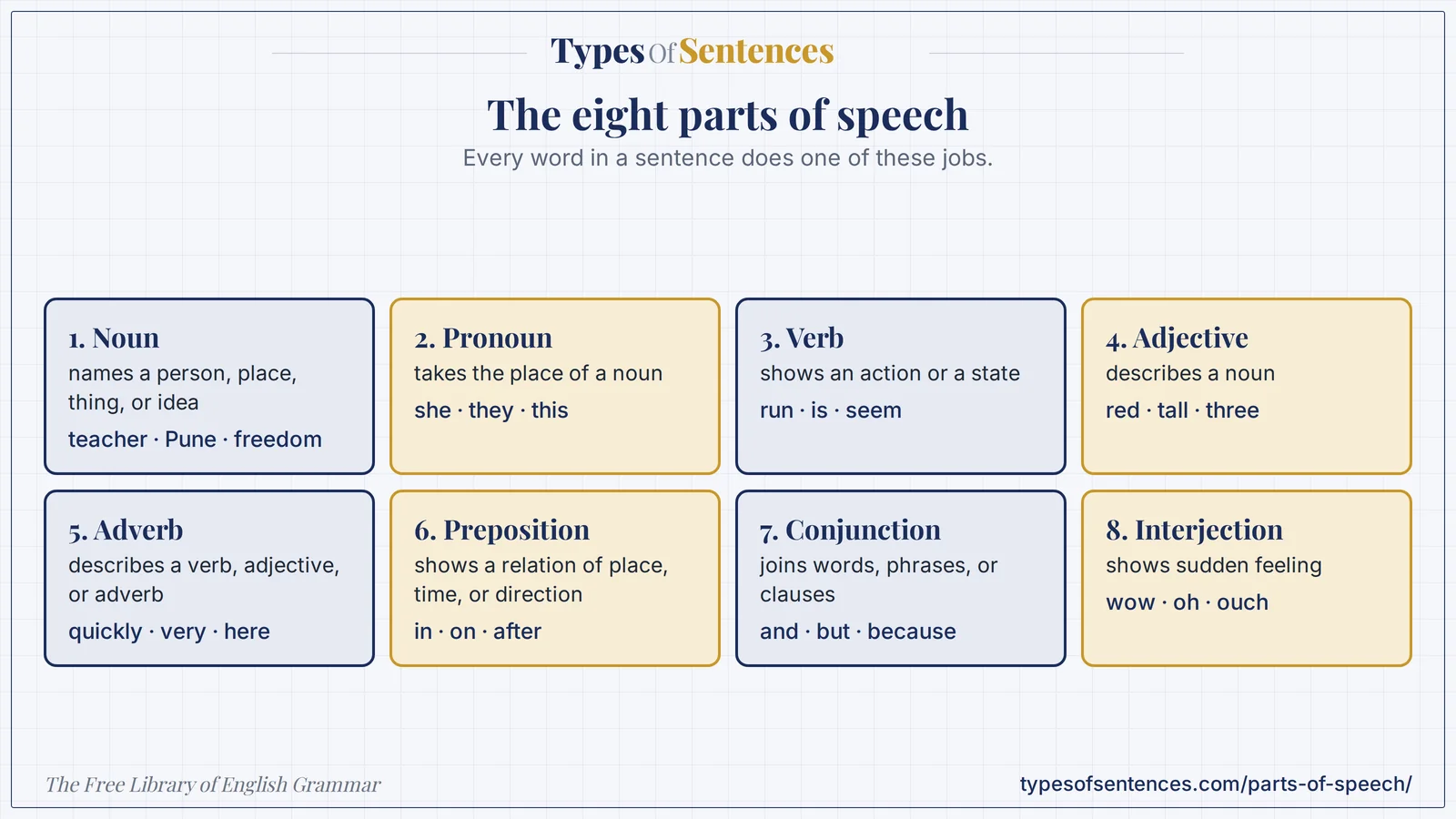
Words are sorted into groups, like tools in a toolbox. A hammer and a saw do different jobs, and so do a noun and a verb. The groups are called the parts of speech.
Why it matters: Once you know a word’s class, you know how it can be used, where it can go in a sentence, and what rules apply to it.
Summary: English has eight parts of speech. Nouns name, pronouns replace nouns, verbs show action or being, adjectives and adverbs describe, prepositions show relationships, conjunctions join, and interjections show feeling.
- The eight parts of speech: noun, pronoun, verb, adjective, adverb, preposition, conjunction, interjection.
- A word’s class depends on its job in the sentence, not on the word alone.
- Modern grammars often add a ninth class, the determiner (the, my, this).
- To find the class, ask what job the word is doing.
What You’ll Learn
1. Parts of Speech: The Eight Categories
Traditional grammar divides English words into eight classes. Learn the names first; the rest of the Basic level teaches each one in its own chapter.
| Part of speech | Its job | Examples | Learn more |
|---|---|---|---|
| Noun | names a person, place, thing, or idea | teacher, Paris, book, joy | next chapter |
| Pronoun | takes the place of a noun | she, they, it, who | chapter on pronouns |
| Verb | shows action or being | run, is, think | chapter on verbs |
| Adjective | describes a noun | tall, red, happy | chapter on adjectives |
| Adverb | describes a verb, adjective, or adverb | quickly, very, here | chapter on adverbs |
| Preposition | shows a relationship in place or time | on, in, at, before | chapter on prepositions |
| Conjunction | joins words, phrases, or clauses | and, but, because | chapter on conjunctions |
| Interjection | shows sudden feeling | Wow! Oh! Ouch! | chapter on interjections |
Some grammars also list articles (a, an, the) separately. Traditional grammar counts them as adjectives; many modern grammars put them in a ninth class called determiners. Either way, you will study them in the chapter on articles.
2. How Words Function in Sentences
A word does not belong to one class forever. Its class depends on how it is used in a sentence. To find the part of speech, ask: What job is this word doing here?
| Word | In this sentence | Part of speech |
|---|---|---|
| light | The light is bright. | noun |
| light | Please light the candle. | verb |
| light | She wore a light jacket. | adjective |
| fast | He is a fast runner. | adjective |
| fast | He runs fast. | adverb |
| water | We need water. | noun |
| water | Please water the plants. | verb |
The tired students quickly ate lunch.
- Find the action: ate. It is a verb.
- Find who did it: students. It is a noun.
- Find the word that describes the students: tired. It is an adjective.
- Find the word that tells how they ate: quickly. It is an adverb.
- Find what they ate: lunch. It is a noun.
3. A Quick Tour: Parts of Speech Examples in One Sentence
Here is a sentence that uses all eight word categories at once. Read it, then look at how each word is labeled.
Wow! My sister quickly painted the old fence, and then she rested under a tree.
| Word | Part of speech | Why |
|---|---|---|
| Wow | interjection | shows sudden feeling |
| My | determiner (possessive) | shows whose sister |
| sister | noun | names a person |
| quickly | adverb | tells how she painted |
| painted | verb | shows the action |
| the | determiner (article) | points to a specific fence |
| old | adjective | describes the fence |
| fence | noun | names a thing |
| and | conjunction | joins two clauses |
| then | adverb | tells when |
| she | pronoun | replaces sister |
| rested | verb | shows the action |
| under | preposition | shows where she rested |
| a | determiner (article) | introduces a tree |
| tree | noun | names a thing |
These parts of speech examples show how the groups cooperate. Nouns and verbs carry the main idea; the other words tell more about them or link them.
4. Why the Parts of Speech Matter
Knowing the grammar parts does practical work for you:
- Dictionaries label each entry with its class (n., v., adj.), so you can find the right meaning.
- Writing rules depend on word class. Adjectives describe nouns; adverbs describe verbs. Mixing them up is a common error.
- Sentences need the right mix: at least a noun or pronoun and a verb.
- Learning a language is faster when you can name what you are studying.
Runs is a verb, so the describing word must be an adverb (quickly), not an adjective (quick).
5. How to Identify the Part of Speech
Follow these steps for any word in a sentence.
- Ask what the word does in the sentence.
- If it names something, it is a noun. If it replaces a noun, it is a pronoun.
- If it shows action or being, it is a verb.
- If it describes a noun, it is an adjective. If it describes a verb, adjective, or another adverb, it is an adverb.
- If it shows where or when something is in relation to another word, it is a preposition.
- If it joins words or clauses, it is a conjunction. If it expresses sudden feeling, it is an interjection.
What part of speech is happily in The children played happily?
Reveal answer
Adverb. It describes the verb played and tells how the children played.
Some words are tricky. In She looked up the word, the word up is part of the verb phrase look up, not a simple preposition. Basic lessons keep to clear examples; you will meet tricky cases at the Intermediate level.
Recap in 12 seconds
Watch the lesson build itself: The eight parts of speech and the job of each. The video has no sound.
Exercises
Part A: Name the Part of Speech (Exercises 1–6)
Exercise 1: What part of speech is quickly in She quickly left?
Show Answer
Answer: Adverb. It tells how she left.
Exercise 2: What part of speech is beautiful in a beautiful garden?
Show Answer
Answer: Adjective. It describes the garden.
Exercise 3: What part of speech is under in under the table?
Show Answer
Answer: Preposition. It shows where.
Exercise 4: What part of speech is and in tea and coffee?
Show Answer
Answer: Conjunction. It joins two words.
Exercise 5: What part of speech is Wow in Wow! That is huge!?
Show Answer
Answer: Interjection. It shows sudden feeling.
Exercise 6: What part of speech is they in They are late?
Show Answer
Answer: Pronoun. It takes the place of a noun.
Part B: One Word, Different Jobs (Exercises 7–12)
Exercise 7: Name the part of speech of light: The light is bright.
Show Answer
Answer: Noun.
Exercise 8: Name the part of speech of light: Please light the candle.
Show Answer
Answer: Verb.
Exercise 9: Name the part of speech of light: a light jacket
Show Answer
Answer: Adjective.
Exercise 10: Name the part of speech of fast: He is fast.
Show Answer
Answer: Adjective. It describes he after the verb is.
Exercise 11: Name the part of speech of fast: He runs fast.
Show Answer
Answer: Adverb. It tells how he runs.
Exercise 12: Name the part of speech of water: Please water the plants.
Show Answer
Answer: Verb.
Part C: Find Them in a Sentence (Exercises 13–18)
Exercise 13: Find the nouns: The brave firefighter quickly climbed the tall ladder.
Show Answer
Answer: firefighter, ladder.
Exercise 14: Find the adjectives: The brave firefighter quickly climbed the tall ladder.
Show Answer
Answer: brave, tall.
Exercise 15: Find the verb: The brave firefighter quickly climbed the tall ladder.
Show Answer
Answer: climbed.
Exercise 16: Find the adverb: The brave firefighter quickly climbed the tall ladder.
Show Answer
Answer: quickly.
Exercise 17: Find the conjunction: She sings and he dances.
Show Answer
Answer: and.
Exercise 18: Find the preposition: The cat sleeps on the sofa.
Show Answer
Answer: on.
Part D: Sort the Words (Exercises 19–24)
Exercise 19: Name the part of speech: happy
Show Answer
Answer: Adjective.
Exercise 20: Name the part of speech: run (in They run daily.)
Show Answer
Answer: Verb.
Exercise 21: Name the part of speech: table
Show Answer
Answer: Noun.
Exercise 22: Name the part of speech: because
Show Answer
Answer: Conjunction.
Exercise 23: Name the part of speech: she
Show Answer
Answer: Pronoun.
Exercise 24: Name the part of speech: over (in over the bridge)
Show Answer
Answer: Preposition.
Part E: Adjective or Adverb? (Exercises 25–28)
Exercise 25: Fix it: He runs quick.
Show Answer
Answer: He runs quickly.
Exercise 26: Fix it: She drives careful.
Show Answer
Answer: She drives carefully.
Exercise 27: Fix it: He speaks slow.
Show Answer
Answer: He speaks slowly.
Exercise 28: Choose: The soup tastes (good/well).
Show Answer
Answer: good. After a linking verb such as tastes, use an adjective.
Part F: Review (Exercises 29–30)
Exercise 29: Review (Chapter 3, words): what are three jobs a word can do?
Show Answer
Answer: Name, act, and describe.
Exercise 30: Review (Chapter 2, alphabet): how many letters are in the English alphabet?
Show Answer
Answer: 26.
Test Your Knowledge
Ready to check what you learned? Answer all 10 questions, then submit. You need 80% (8 of 10) to pass. Your answers are not stored.
View correct answers and explanations
Question 1: How many parts of speech does traditional grammar list?
✓ Correct Answer: D – Eight
Traditional grammar lists eight: noun, pronoun, verb, adjective, adverb, preposition, conjunction, and interjection.
Question 2: Which part of speech names a person, place, thing, or idea?
✓ Correct Answer: B – Noun
A noun names. A verb shows action, an adverb describes, and a conjunction joins.
Question 3: Which part of speech shows action or being?
✓ Correct Answer: A – Verb
A verb shows what someone does or is. Nouns name, adjectives describe, and prepositions show relationships.
Question 4: Which part of speech tells how an action is done?
✓ Correct Answer: C – Adverb
An adverb often tells how, when, or where. It describes verbs, adjectives, and other adverbs.
Question 5: Which part of speech joins words or clauses?
✓ Correct Answer: D – Conjunction
Conjunctions such as and, but, and because join words, phrases, and clauses.
Question 6: What part of speech is light in Please light the candle?
✓ Correct Answer: B – Verb
Here light tells what someone should do, so it is a verb. In a light jacket it is an adjective.
Question 7: Which is an interjection?
✓ Correct Answer: C – Wow
Wow shows sudden feeling. Quickly is an adverb, under is a preposition, and because is a conjunction.
Question 8: Which part of speech shows a relationship in place or time?
✓ Correct Answer: A – Preposition
Prepositions such as on, in, and before show where or when something is in relation to another word.
Question 9: Which word is a pronoun?
✓ Correct Answer: B – she
She takes the place of a noun. The other words are a noun, a verb, and an adjective.
Question 10: What part of speech is quickly in She ran quickly?
✓ Correct Answer: C – Adverb
Quickly describes the verb ran and tells how she ran, so it is an adverb.
Frequently Asked Questions
What are the parts of speech?
The parts of speech are the eight kinds of words in English: noun, pronoun, verb, adjective, adverb, preposition, conjunction, and interjection. Each class has a job in the sentence.
How many parts of speech are there?
Traditional grammar lists eight. Some modern grammars list nine, adding the determiner for words such as the, my, and this. Either way, the eight classic classes cover all English words.
Are a, an, and the parts of speech?
Yes. They are called articles. Traditional grammar counts them as adjectives, and modern grammar puts them in the determiner class. The chapter on articles explains how to use them.
Can a word be more than one part of speech?
Yes. The word light is a noun in The light is bright, a verb in Light the candle, and an adjective in a light jacket. The part of speech depends on the job the word does in the sentence.
What is the easiest way to find a part of speech?
Ask what the word does in the sentence: does it name, replace a name, show action, describe, show a relationship, join, or exclaim? The job tells you the class.
Why are the parts of speech important?
They give you names for the pieces of a sentence, so you can follow grammar rules, use a dictionary, and talk about writing. Learning them also makes every later chapter easier.
Which part of speech is the most important?
Nouns and verbs are the core of most sentences, because a sentence needs something to talk about and something to say about it. The other word categories add detail and connect ideas.
Conclusion
You now know the eight parts of speech and how to tell them apart by their job in a sentence. You also saw that one word can change its class, so always ask what the word is doing.
In the next chapters you will study each class in turn, beginning with the noun, the word that names.
- Purdue Online Writing Lab: Grammar: reference section on the parts of speech.
- Quirk, Randolph, et al. A Comprehensive Grammar of the English Language. Longman, 1985.: the standard description of word classes.
- Huddleston, Rodney, and Geoffrey K. Pullum. The Cambridge Grammar of the English Language. Cambridge University Press, 2002.: the case for determiners as a separate class.
Last reviewed: October 29, 2026. How it was made: drafted with AI assistance, then checked with automated tests (structure, links, answer keys, spelling) and against the sources above. A person has not yet read this chapter line by line. Found a mistake? Report it.