The future of English grammar cannot be known, but it can be studied, because the changes that will shape the language are already under way, and some of them have been measured. Corpus linguists have shown that some modal verbs have declined in writing over recent decades, that contractions and other features of speech have entered written English, and that new forms such as be like for reported speech have spread from the young to everyone. The history of English, from the Old English of Beowulf to the English of the internet, is a record of constant change, and no stage of the language has ever been final. A reader of this course in a century will find the grammar of today as readable and as different as a modern reader finds Shakespeare.
This chapter surveys the evidence for change and its likely directions. It describes the trends in current usage, the influence of technology (including digital communication, grammar tools, and large language models), the effects of globalization and English as a lingua franca, youth language and the question of what lasts, and a set of possible changes labeled by how well they are supported. It also describes what is unlikely to change, and why English has always adapted. Any prediction of grammar evolution future (that is, of how grammar will evolve) is uncertain, and where the chapter makes one it says so: the point is not to forecast but to understand how language changes, so that writers, teachers, and learners can meet the changes with judgment. Changing grammar is normal, and future language will be built from the same processes as past language. Thirty exercises and a quiz follow.
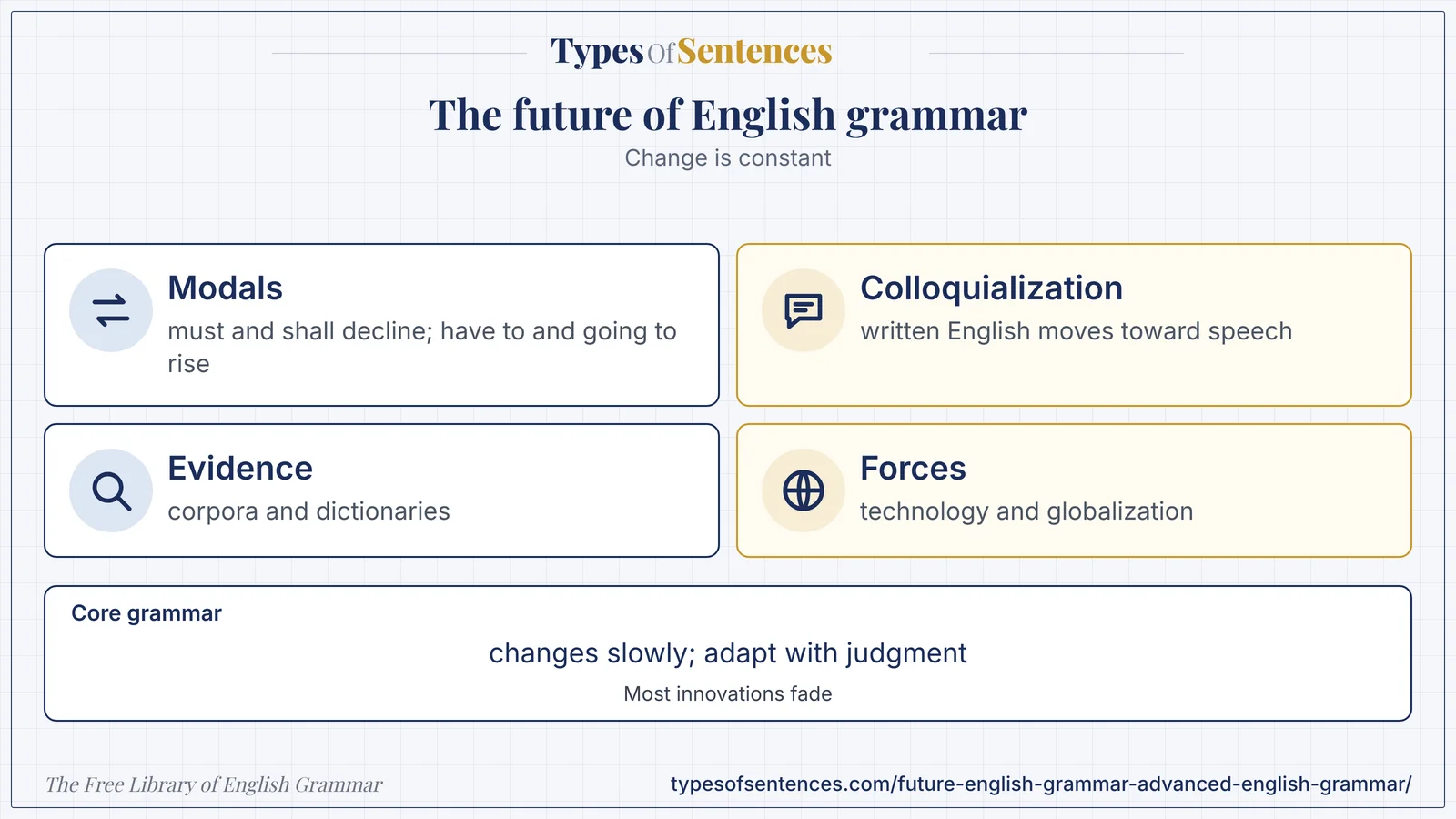
Languages change all the time, and English is no exception. Some changes happen so slowly that only large collections of texts can show them; others, such as new slang, move fast. Most new forms disappear, and a few become part of the standard language.
Why it matters: You cannot predict exactly which changes will last, but you can watch the evidence, think about your readers, and adopt new usage when it is clear and your readers accept it. Grammar rules that you learned are a snapshot of a language that is still moving.
Summary: Corpus studies document change in contemporary English: a decline of some modals (such as must and shall) and the rise of semi-modals (have to, going to), colloquialization (written English taking on features of speech), the spread of American forms to other varieties (Americanization), the decline of whom, the spread of singular they, new quotatives (be like), and cycles of intensifiers. Technology affects usage through digital communication, autocomplete and grammar tools, machine translation, and large language models, which have been shown to change the frequency of certain style words in scientific abstracts. Globalization increases the number of non-native users and the importance of intelligibility. Youth language produces many short-lived words and a few lasting grammatical changes. Core features such as basic word order, auxiliaries, and function words are unlikely to change quickly. English has repeatedly adapted through contact and borrowing. Predictions are uncertain; writers should follow evidence and their readers’ expectations.
- Change is constant; most innovations fade.
- Evidence: corpora and dictionaries.
- Technology and globalization shape usage.
- Core grammar changes slowly; adapt with judgment.
What You’ll Learn
- 1. Future of English Grammar: Current Trends and Changes Under Way
- 2. Technology’s Influence: Digital Communication and AI
- 3. Globalization: English as a Lingua Franca and Simplification
- 4. Youth Language: Innovations and What Might Stick
- 5. Predicted Changes: Possibilities Based on Current Trends
- 6. What Won’t Change: Core Features Likely to Be Stable
- 7. Adaptability of English: Historical Resilience
- 8. Embracing Change: A Framework for Deciding About New Usage
- 9. Common Misunderstandings and a Worked Example
- 10. Exercises
- 11. Test Your Knowledge
- 12. Frequently Asked Questions
- 13. Conclusion
1. Future of English Grammar: Current Trends and Changes Under Way
| Trend | Evidence or description | Status |
|---|---|---|
| decline of some modal verbs in written English | corpus studies (for example Leech, Hundt, Mair, and Smith, Change in Contemporary English, 2009) found declines in core modals such as must, shall, ought to, and need in the second half of the twentieth century | documented |
| rise of semi-modals | have to, want to, be going to became more frequent relative to modals | documented |
| colloquialization | written English has taken on features of speech: contractions, shorter sentences, informal vocabulary, phrasal verbs | documented (Mair and others) |
| Americanization | American forms spreading into British and other varieties (for example gotten, some spellings, vocabulary) | documented in many studies; varies by feature |
| democratization | the avoidance of forms that mark social hierarchy (for example less use of titles, generic he) | documented as a trend |
| mandative subjunctive revival in British English | I insist that he be increasingly used in British English under American influence | documented |
| decline of whom | who used for the object in speech and informal writing; whom persists in formal writing and after prepositions | documented over a long period |
| singular they | accepted by major dictionaries and in most style guides; its use is widespread | documented |
| get-passive | get + participle (got promoted) used more in informal speech and writing | documented |
| progressive passive | is being built established in the nineteenth century and continues to spread | documented history |
| growth of the progressive | more uses of the progressive in recent corpora, including with some stative verbs | documented in some studies |
| noun-phrase compression in written registers | heavier noun phrases and nominal style in academic and news writing | documented (Biber and others) |
| going to to gonna | the reduced form in speech and informal writing | ongoing |
| less with countables | less people in speech and informal writing | ongoing; resisted in formal writing |
| fewer/less distinction | weakening in speech | ongoing |
| lie/lay merging | lay used intransitively | long-standing |
| between you and I | hypercorrection | long-standing |
| me and him as subjects | nonstandard but frequent in speech | long-standing |
| regularization of irregular verbs | dived alongside dove; sneaked versus snuck | ongoing for some verbs |
| new quotatives | be like (I was like, no way) spread from young speakers since the 1980s | documented; now widespread |
| like as a discourse marker | — | documented (Tagliamonte and others) |
| so as a sentence opener | So, what happened? | widespread in speech |
| because + noun | because science | recent; the American Dialect Society’s 2013 Word of the Year |
| intensifier cycles | very → really → so → totally; fashions change | documented for several generations |
| literally as an intensifier | — | long attested; dictionaries record it |
| hopefully as a sentence adverb | — | widespread |
| contraction of negation (ain’t, wasn’t) | — | stable in varieties |
| reduction in the use of shall | — | documented |
| conversion of nouns to verbs | to google, to text | ongoing |
| new compounds and blends | smartphone, podcast | ongoing |
| abbreviations and initialisms | FOMO, TBH | ongoing; many are short-lived |
| emoji and punctuation as tone markers | — | emerging |
| tone indicators (/s) | — | emerging in some communities |
| loss of the third-person -s in some varieties | — | a feature of several varieties and of some ELF use |
| they as a pronoun for a known person who uses it | — | established in current style guides |
| neopronouns | xe, ze, and others used by some people | emerging; style guides vary |
| expansion of ing complements | stop doing, begin doing alongside begin to do | the “Great Complement Shift” described by linguists |
| do-support in negatives and questions | stable since the sixteenth century | stable |
| increasing use of that-omission | — | documented in some registers |
| sentence fragments in writing | — | increasing in informal and some journalistic writing |
| shorter sentences in written English | average sentence length has declined over the last two centuries | documented in corpus studies |
| rise of second-person address in writing | — | observed in web writing |
| global spread of Indian, Nigerian, and other Englishes | more users and more varieties | documented |
| code-mixing in writing and online | — | widespread |
| spelling changes | thru, nite in informal use; standard spelling is slow to change | slow |
| capitalization of internet and web | lowercase in current style guides | changed in the 2010s |
The status labels reflect how well each trend is documented: “documented” means that corpus or historical studies have measured it; “ongoing” means that it is observed but may not be fully measured; “emerging” means that it is recent and its path is uncertain. The ground for these statements is the study of change described in the chapters on the history of English grammar and on language change in modern English; the most useful tool for tracking change is a corpus, described in the chapter on corpus linguistics.
2. Technology’s Influence: Digital Communication and AI
| Technology | Possible influence on grammar and usage | Evidence or status |
|---|---|---|
| email and messaging | informality in writing; shorter sentences; new abbreviations | documented in studies of digital communication (Crystal; McCulloch) |
| social media | new slang, hashtags, tone markers; faster spread of new words | documented |
| texting and abbreviations | letter-number forms; abbreviated style | documented; effects on literacy are debated, with studies finding mixed results |
| autocomplete and predictive text | suggestions can steer wording toward common phrases | plausible; limited evidence of long-term effects on grammar |
| spell checkers and grammar checkers | standardize spelling and encourage the rules built into the tools (including some myths) | plausible; documented in anecdote; research is limited |
| speech recognition and voice assistants | a style of speech aimed at machines (short, explicit commands) | observed |
| machine translation | pressure for clear, translatable source text; some influence on global English | plausible; see the chapter on translation |
| large language models (LLMs) and text generators | these systems generate fluent text from patterns in huge corpora and are widely used to draft and revise text | an active area of research |
| effects of LLM use on vocabulary | a 2024–2025 study of millions of biomedical abstracts (Kobak and colleagues, Science Advances, 2025) found an abrupt increase after 2022 in the frequency of certain style words (such as delves, showcasing, and underscores) and estimated that at least about one in eight 2024 abstracts had been processed with LLMs | documented for scientific abstracts; the study measures vocabulary, not grammar |
| possible standardization of style | AI-assisted text may converge on a common, polished style | hypothesis |
| possible feedback into human usage | people may adopt words and patterns they see in AI-generated text | hypothesis; some evidence for vocabulary |
| AI and language learning | tools for practice, feedback, and translation | widespread |
| AI and error correction | instant corrections; may reduce attention to rules | debated |
| AI and style guides | tools that apply style rules | growing |
| AI and plain language | tools that simplify text | growing; need checking |
| detection of machine text | difficult and unreliable | debated |
| search engines and keyword writing | headlines and phrases shaped for search | documented in web writing |
| emoji and images in messages | — | documented |
| short-form video | spoken grammar in captions; trends and templates | documented |
| wearables and voice interfaces | — | emerging |
| augmented and virtual reality | new forms of spatial and interactive language | speculative |
| programming languages and English | English-like commands; code as a kind of writing | documented |
| standardization by software defaults | a default language or spelling in software spreads one variety | documented |
| digital archives | more evidence of change over time | documented |
| corpora of social media | new sources for studying change | growing |
| automatic translation of social media | faster global spread of slang and memes | observed |
| AI-generated voices and text-to-speech | — | emerging |
| plagiarism and authorship questions | — | active debate |
| Question for writers about technology | Advice |
|---|---|
| Should I trust a grammar tool? | use it as a prompt; check against a reference; many tools flag myths and miss real errors |
| Should I use AI to draft or edit? | follow the rules of your institution or publisher; check facts and wording; the writer remains responsible |
| Will AI make human writing sound the same? | it is possible that some patterns will become more common; keep your own voice and choose words deliberately |
| Will technology destroy grammar? | there is no evidence of this; each new medium has produced fears and new conventions |
| How do I keep up? | read widely, follow corpus-based descriptions, and notice what your readers expect |
Concern about technology and language is old: telegraphy, the telephone, and mass printing were all said to damage English. The evidence from past technologies is that they produce new registers and conventions without destroying the core of the language. The newest of these technologies, large language models, are recent enough that their long-term effects are not yet known; the study cited above shows a measurable effect on vocabulary in one genre, and the extent of effects on grammar and style in everyday writing is a matter for continuing research. The effects of digital media on writing are also discussed in the chapters on grammar and technology.
3. Globalization: English as a Lingua Franca and Simplification
| Factor | Effect on English | Comment |
|---|---|---|
| more non-native than native users | the number of people who use English as an additional language exceeds the number of first-language users (the exact figures vary by source) | most conversations in English may now have at least one non-native speaker |
| English as a lingua franca (ELF) | speakers negotiate meaning and often prefer clarity to native-like forms | see the chapter on global Englishes |
| simplification (debated) | some ELF research reports regularization (for example the omission of third-person -s or the use of invariant tags) that does not affect intelligibility | whether such features will spread into standard varieties is uncertain |
| nativization of Outer Circle varieties | Indian, Nigerian, Singaporean, and other Englishes develop local norms | documented |
| code-mixing and translanguaging | mixing languages in one conversation | increasingly recognized as a normal practice |
| multiple standards | several national standards (American, British, Indian, and others) coexist | a pluricentric language |
| influence of American media | spread of American forms | documented |
| influence of Indian, Nigerian, and other media | growing global audiences for non-Western Englishes | emerging |
| machine translation and AI | pressure for clear text; global access to information | see above |
| education and exams | international exams set standards | — |
| workplace English in multinational companies | plain, explicit, global English | documented |
| online communities | English used by people who share no other language | documented |
| loanwords from many languages | vocabulary from Hindi, Arabic, Japanese, Spanish, and others continues to enter English | documented |
| language policy | governments choose English or other languages for education | varies |
| migration and diasporas | new varieties in cities (for example multicultural London English) | documented |
| language endangerment | the spread of English may affect other languages | a concern raised by linguists |
| attitudes to accent and variety | growing recognition of legitimacy | uneven |
| teaching approaches | from native-speaker models to ELF-aware teaching | debated |
| intelligibility as a goal | — | see the chapter on global Englishes |
| legal and technical English | controlled language and plain language | documented |
Predictions about global English include the possibility that it will fragment into mutually unintelligible varieties (as Latin did), the possibility that it will converge on a simplified international form, and the possibility that it will remain a family of varieties with a shared written standard. Linguists disagree, and the evidence of the past (for example the survival of a common written standard across the varieties of English) suggests that the third is at least as likely as the others. The study of varieties is in the chapter on global Englishes.
4. Youth Language: Innovations and What Might Stick
| Kind of innovation | Typical life | Examples (past and present) |
|---|---|---|
| slang words | often short-lived; a few last | cool and awesome lasted; many others did not; recent examples may be dated soon |
| intensifiers | cycle in fashion over generations | very, really, so, totally, hella (regional), lowkey |
| quotatives (verbs that introduce speech) | a few established forms from successive generations | say → go → be like |
| discourse markers | several have lasted | like, you know, I mean |
| tag and sentence-final particles | — | innit (in some varieties), though, tho |
| grammatical innovations | rarer, but those that spread can become standard | because + noun; be like |
| spelling and abbreviation play | mostly informal | u, r, thx |
| word-formation patterns | suffixes and combining forms can be productive | -core, -gate, -ify |
| borrowing from other languages and varieties | a major source of new words | from Hindi, Spanish, Japanese, and varieties of English |
| in-group codes | may be deliberately opaque to adults | — |
| the role of social media | speeds up spread and also fading | — |
| the role of adult adoption | a form that spreads to older speakers is more likely to last | — |
| What might make an innovation last (hypotheses from research on language change) | Explanation |
|---|---|
| it fills a gap | it expresses something that the language lacked (for example a gender-neutral singular pronoun, or a quotative that covers thought and speech) |
| it is useful and economical | shorter, simpler, or clearer than the alternative |
| it fits the grammar | it uses existing patterns (conversion, compounding) |
| it spreads across age groups | not only among the young |
| it spreads across regions and social groups | — |
| it is used in writing and in the media | — |
| it is frequent | frequent forms are entrenched |
| it carries prestige or identity value | — |
| it is not stigmatized for long | forms associated with groups that are stigmatized may be resisted |
| it is accepted by gatekeepers (editors, teachers, dictionaries) over time | — |
The sociolinguist Sali Tagliamonte (for example in Teen Talk, 2016) has studied the language of young speakers over time and found that adolescents often lead change in discourse markers, intensifiers, and quotatives, while most of their slang is short-lived. The practical conclusion is that a writer cannot tell in advance which new word will last, but can notice which forms have already spread beyond one group and one year.
5. Predicted Changes: Possibilities Based on Current Trends
The following are possibilities, not forecasts. Each is based on a documented trend, and each is labeled by how well the trend is supported. Language history contains many failed predictions, including predictions of the disappearance of whom that have been made for more than a century.
| Possible change | Basis in current trends | Confidence (low, medium, high that the trend continues) |
|---|---|---|
| whom continues to retreat from speech and informal writing | long-term decline; stable in formal writing | high for speech; medium for formal writing |
| singular they continues to spread and becomes unremarkable in formal writing | dictionaries, style guides, and use | high |
| they are with a singular reference stays standard | — | high |
| the get-passive increases in more registers | documented growth | medium |
| some modals (shall, ought to) continue to decline | documented decline | medium |
| semi-modals (gonna, wanna) appear more in writing | colloquialization | medium |
| written English continues to become more informal | colloquialization | medium |
| average sentence length in writing continues to decrease in some genres | long-term decline | medium |
| more fragments and one-word sentences in writing | online writing | medium |
| less with countable nouns becomes standard in more contexts | spread in speech | medium |
| lie/lay distinctions weaken further | long-standing | medium |
| more irregular verbs regularize (the study by Lieberman and colleagues, 2007, predicted that frequency determines which irregular verbs regularize; rarer verbs go first) | quantitative study of irregular verbs over a thousand years | medium |
| because + noun and similar patterns become more standard | recent spread | low to medium |
| new quotatives replace be like in the next generations | cycle of quotatives | low |
| emoji and tone markers become a stable part of informal punctuation | current use | medium |
| new pronouns beyond they become established in standard usage | emerging among some groups | low |
| the mandative subjunctive spreads further in British English | documented | medium |
| spelling reforms (such as thru) are adopted in standard writing | recurring attempts have mostly failed | low |
| English fragments into mutually unintelligible varieties | history of Latin | low |
| English simplifies in its core grammar because of global use | ELF research suggests regularization in some features, but standard varieties resist | low to medium |
| the written standard becomes more international (fewer national markers) | global publishing and the web | medium |
| AI-assisted writing homogenizes some genres | early evidence on vocabulary | medium (for vocabulary); low for grammar |
| machine translation and global English favor plain structure | — | medium |
| more mixing of languages in writing | online practice | medium |
| some contractions and abbreviations enter formal writing | colloquialization | medium |
| that/which and similar editorial conventions loosen | evidence-based guides | low to medium |
| more use of the second person and the first person in formal writing | changes in style guides | medium |
| title and heading styles move toward sentence case | digital style | medium |
| more speech-like punctuation (dashes, ellipses) | informal writing | low to medium |
| the Oxford comma debate continues without resolution | — | high |
The labels are judgments, and the reader should treat them as such. The history of English contains changes that were predicted and did not happen, and changes that nobody predicted. The most reliable prediction is the weakest one: English will change, and the pace and direction will be shaped by social factors that cannot be forecast.
6. What Won’t Change: Core Features Likely to Be Stable
| Feature | Why it is likely stable | Evidence |
|---|---|---|
| basic word order (subject–verb–object) | a fundamental pattern since the Middle English period | stable for several centuries |
| the auxiliary system and do-support | established since about the sixteenth century | stable |
| the article system (a, the) | present since Old English in some form | stable in all standard varieties |
| the personal pronoun system (I, you, he, she, it, we, they) | function words are among the most stable items in a language | persists with additions (singular they) |
| the most frequent function words (the, of, and, to, in) | high-frequency items resist change | some date to Old English |
| basic tenses and aspects | — | stable |
| the plural -s and the past -ed | productive rules | stable |
| question formation with inversion | — | stable |
| negation with not and n’t | — | stable |
| relative clauses and subordination | — | stable |
| the basic vocabulary of family, body, numbers | core vocabulary changes slowly | stable |
| the alphabet and the main spelling system | inertia; reforms rarely succeed | stable |
| punctuation conventions | change slowly | — |
| mutual intelligibility among educated speakers | the pressure of communication | — |
| the idea of a written standard | institutional support | — |
| derivational morphology (-ness, -ly, un-) | productive | stable |
| the passive voice | — | stable |
| conditionals | — | stable |
| modals as a category (even if individual modals decline) | — | stable |
| the verb be | — | stable |
| discourse structure (topic, comment) | — | stable |
| the distinction between countable and uncountable nouns | — | stable |
| the ability of speakers to coin new words by existing rules | — | stable |
The rate of change of the core is slow. Shakespeare’s grammar (c. 1600) differs from ours in details (thou, doth, do-less questions), but readers can follow it with help; the English of Beowulf (c. 1000) is a different language to a modern reader without special study. The changes of the next century are likely to be of the scale of the changes of the last: noticeable at the edges, slight at the core. The reason is social: a language must remain usable by people of every age at the same time.
7. Adaptability of English: Historical Resilience
| Period or event | Change | Effect |
|---|---|---|
| Old English (c. 450–1100) | Germanic base; rich inflection | — |
| Viking contact (from the eighth century) | Norse words and the pronoun they, them, their; simplification of inflection in contact | core words borrowed |
| Norman Conquest (1066) | French became the language of the elite; many French words entered English | a huge influx of vocabulary |
| Middle English (c. 1100–1500) | loss of most inflections; more fixed word order | analytic structure |
| Great Vowel Shift (c. 1400–1700) | a series of changes in the pronunciation of long vowels | spelling and pronunciation diverged |
| printing (from 1476) | spread of a written standard | standardization |
| Renaissance borrowing | Latin and Greek words added | learned vocabulary |
| Early Modern English (c. 1500–1700) | do-support; the loss of thou; the King James Bible and Shakespeare | — |
| eighteenth century | prescriptive grammars and dictionaries (Johnson, 1755; Lowth, 1762) | rules and standards |
| colonial expansion and trade (from the seventeenth century) | English spread; contact with many languages; new varieties | loanwords from Indian languages and many others |
| nineteenth century | industrial vocabulary; progressive passive; mass education | — |
| twentieth century | mass media; American influence; new technologies | colloquialization |
| digital age (from the 1990s) | email, the web, social media | new registers |
| AI-assisted writing (from the 2020s) | new tools for drafting and revising | effects under study |
| borrowing at every stage | English has borrowed from French, Latin, Greek, Norse, Dutch, Hindi, Arabic, Japanese, and many others | — |
| dialect contact | varieties influence each other | — |
| loss of inflection | a systematic change from synthetic to analytic | — |
| standardization and its limits | a written standard persisted across change | — |
| resilience to prescription | many prescriptive rules were ignored | see the chapter on grammar myths |
| resilience to fear | repeated fears of decay did not stop change | — |
The history of English is a history of adaptation: the language has absorbed conquest, contact, printing, empire, and mass media without losing its identity, and has become a global language by being flexible. This resilience suggests that the technologies and social changes of the present will be absorbed in the same way. The detailed history is in the chapter on the history of English grammar.
8. Embracing Change: A Framework for Deciding About New Usage
- Observe the evidence. Check a current dictionary, a corpus, and recent style guides.
- Ask who your readers are. Will they accept the new form, or will it distract them?
- Ask what is at stake. A job application, a legal text, a poem, and a chat differ.
- Ask whether the new form is clear. Does it help or hinder understanding?
- Ask whether an established alternative exists that serves as well.
- Decide. Adopt, avoid, or use with care.
- Be consistent within a text.
- Revisit as usage changes.
| Situation | Suggested approach |
|---|---|
| a new word you want to use | check that readers will know it; define it if needed |
| a new grammatical pattern in speech | use it in speech and informal writing; in formal writing follow your guide |
| a style guide that has changed its position | follow the current edition |
| an old rule that you have been taught | test it against the evidence |
| teaching students | teach the standard, show variation, and explain that change is normal |
| editing others’ work | follow the house style; do not impose myths; query when unsure |
| writing for an international readership | prefer plain, widely understood forms |
| writing creatively | use new and old forms deliberately |
| using AI tools | check output and keep your own judgment |
| reading usage that surprises you | ask whether it is an error, a variety feature, or a change |
| Attitude | Description |
|---|---|
| prescriptive | focuses on how language should be used according to rules |
| descriptive | records how language is used, with attention to register and context |
| reasonable middle | know the conventions of your readers, follow them where required, and respect evidence about change |
The central lesson of this course is that grammar is a system of patterns in use, and that use changes. Knowledge of the patterns, their history, and their variation is the best preparation for change: it lets a writer tell a passing fashion from a lasting shift, an error from a variety feature, and a rule from a convention. The tools for following change are described in the chapter on corpus linguistics.
9. Common Misunderstandings and a Worked Example
| Misunderstanding | Reality |
|---|---|
| Language change is decay. | Change is normal; it is not by itself decline. |
| Technology is ruining English. | Each new medium creates new registers; the core is stable. |
| Young people are destroying the language. | They innovate, as every generation has; most innovations fade. |
| I can predict which words will last. | Nobody can reliably do so. |
| If everybody says it, it is automatically correct everywhere. | Appropriateness depends on context and register. |
| Change happens only in speech. | It also affects writing, more slowly. |
| A language needs an authority to stop change. | Authorities (academies, style guides) have little power over long-term change. |
| Global English will simplify completely. | Evidence is mixed; standard varieties are resilient. |
| AI will replace human writing norms. | Effects are being studied; they are not yet known. |
| Rules never change. | Many rules of earlier centuries are no longer rules. |
| Style guides have the last word. | They state conventions and update them. |
| If a form is new, it is an error. | It may be a change in progress. |
| The future of English is American English. | American English is influential, but many varieties matter. |
| Prescriptivists are always wrong. | Conventions have value for clarity and consistency. |
Evaluate a possible change using the framework (invented scenario). Question: should a writer for an international company use they for an unknown individual in a formal policy document (for example, If an employee is late, they must inform their manager)?
- Observe the evidence: singular they is recorded by major dictionaries, has a history of centuries, and is accepted by several major style guides (with qualifications in some); check the current edition of the guide that your company uses.
- Ask who the readers are: an international staff; many are non-native readers. Singular they is widely understood; alternatives (he or she, the plural) are also clear.
- Ask what is at stake: a policy document is formal and may be reviewed by lawyers; clarity and consistency matter more than novelty.
- Ask whether the form is clear: yes, if the antecedent is clear.
- Consider established alternatives: a plural (If employees are late, they must inform their managers) avoids the question and is accepted everywhere.
- Decide: follow the company’s style guide; where none exists, prefer the plural rewrite, or use singular they if the company’s readers and guidance accept it.
- Result: a reasoned choice, not a rule: If employees are late, they must inform their managers. (the scenario is invented)
- Note: the same method applies to any disputed usage: evidence, readers, stakes, clarity, alternatives, decision.
Recap in 12 seconds
Watch the lesson build itself: Corpus studies document change in modals and written style, and technology and globalization shape usage while core grammar changes slowly. The video has no sound.
Exercises
Part A: Trends (Exercises 1–7)
Exercise 1: What is colloquialization?
Show Answer
Answer: Written English taking on features of speech.
Exercise 2: Name a modal verb that has declined in writing.
Show Answer
Answer: must, shall, ought to, need.
Exercise 3: Name a semi-modal that has increased.
Show Answer
Answer: have to, want to, be going to.
Exercise 4: What is Americanization in this context?
Show Answer
Answer: The spread of American forms into other varieties.
Exercise 5: Name a new quotative.
Show Answer
Answer: be like.
Exercise 6: What new use of because was the American Dialect Society’s 2013 Word of the Year?
Show Answer
Answer: Because + noun (because science).
Exercise 7: Which pronoun is retreating from speech?
Show Answer
Answer: whom.
Part B: Technology and Globalization (Exercises 8–14)
Exercise 8: Name a technology that affects usage.
Show Answer
Answer: Email, social media, autocomplete, grammar checkers, machine translation, LLMs.
Exercise 9: What did Kobak and colleagues find?
Show Answer
Answer: An abrupt rise in certain style words in scientific abstracts after LLMs.
Exercise 10: Does that study measure vocabulary or grammar?
Show Answer
Answer: Vocabulary (style words).
Exercise 11: What is ELF?
Show Answer
Answer: English as a lingua franca.
Exercise 12: Name a possible effect of globalization on English.
Show Answer
Answer: More non-native users; nativization of varieties; code-mixing; pressure for intelligibility.
Exercise 13: Is it certain that English will simplify?
Show Answer
Answer: No; the evidence is mixed.
Exercise 14: What is a pluricentric language?
Show Answer
Answer: A language with several national standards.
Part C: Youth Language and Predictions (Exercises 15–21)
Exercise 15: Do most slang words last?
Show Answer
Answer: No; most are short-lived.
Exercise 16: Name a youth innovation that lasted.
Show Answer
Answer: cool, awesome, be like, like as a discourse marker.
Exercise 17: What makes an innovation more likely to last?
Show Answer
Answer: It fills a gap, is useful, spreads across ages, and is frequent.
Exercise 18: Who studied teen language (Teen Talk, 2016)?
Show Answer
Answer: Sali Tagliamonte.
Exercise 19: What did Lieberman and colleagues (2007) study?
Show Answer
Answer: How irregular verbs regularize over time, depending on frequency.
Exercise 20: Are predictions about language reliable?
Show Answer
Answer: No; they are uncertain.
Exercise 21: Give a failed prediction about English.
Show Answer
Answer: That whom would disappear soon.
Part D: Stable Core and Adaptation (Exercises 22–26)
Exercise 22: Name a stable core feature.
Show Answer
Answer: Basic word order; the auxiliary system; the article system; frequent function words.
Exercise 23: Why are function words stable?
Show Answer
Answer: High-frequency items resist change.
Exercise 24: What contact brought they into English?
Show Answer
Answer: Contact with Old Norse (Viking).
Exercise 25: Name a major event that changed English vocabulary.
Show Answer
Answer: The Norman Conquest (1066).
Exercise 26: Name a period of standardization.
Show Answer
Answer: The age of printing and the eighteenth century.
Part E: Framework (Exercises 27–30)
Exercise 27: Name three questions of the decision framework.
Show Answer
Answer: What does the evidence show? Who are my readers? What is at stake? Is it clear?
Exercise 28: Descriptive or prescriptive: recording how people use language.
Show Answer
Answer: Descriptive.
Exercise 29: What should you do when a style guide changes its position?
Show Answer
Answer: Follow the current edition.
Exercise 30: What is the most reliable prediction about English?
Show Answer
Answer: That it will keep changing.
Test Your Knowledge
Ready to check what you learned? Answer all 10 questions, then submit. You need 80% (8 of 10) to pass. Your answers are not stored.
View correct answers and explanations
Question 1: What is colloquialization?
✓ Correct Answer: A – written English becoming more like speech
Written English becoming speech-like.
Question 2: Which change have corpus linguists documented in modal verbs?
✓ Correct Answer: B – the decline of some core modals such as must and shall in written English
Decline of some modals.
Question 3: What did Kobak and colleagues study?
✓ Correct Answer: C – changes in word frequency in scientific abstracts after LLM tools
Vocabulary in abstracts.
Question 4: Which part of English is most stable?
✓ Correct Answer: D – core function words and basic word order
Core features.
Question 5: Which is a likely route for a youth innovation to last?
✓ Correct Answer: C – spreading across ages and filling a useful function
Wide spread and usefulness.
Question 6: What is a quotative?
✓ Correct Answer: A – a verb or phrase that introduces reported speech, such as be like
Introduces speech.
Question 7: In studying language change, a corpus is useful because it
✓ Correct Answer: D – gives evidence of real usage over time
Evidence of usage.
Question 8: Why do predictions about language change need caution?
✓ Correct Answer: C – change depends on unpredictable social factors
Social factors are unpredictable.
Question 9: What did Lieberman and colleagues (2007) study?
✓ Correct Answer: B – how irregular verbs regularize over time
Irregular verbs.
Question 10: A sensible attitude to change is
✓ Correct Answer: B – to observe evidence, consider the reader, and adapt
Evidence, readers, adaptation.
Frequently Asked Questions
What is the future of English grammar?
The future of English grammar is a matter of continued gradual change: the decline of some modals and of whom, more informal writing, the spread of singular they, and the effects of technology and globalization. The future of English grammar cannot be predicted exactly.
What does grammar evolution future research say?
Grammar evolution future research says that change will follow the same processes as in the past: innovation, spread, and the loss of other forms, with social factors deciding which changes last. Grammar evolution is slow at the core and faster at the edges.
What is changing grammar in English now?
Documented changes include a decline of some modals, colloquialization of written English, the retreat of whom, new quotatives such as be like, and the spread of singular they. Changing grammar is studied with corpora.
What will future language look like?
Probably recognizable to us: the core grammar is stable, with changes at the margins in vocabulary, style, and informal usage. Future language will include more varieties and more mixing of languages.
What are current grammar trends?
Trends include more informal writing, shorter sentences, new discourse markers and intensifiers, global varieties, and the influence of digital media. Grammar trends are measured in corpora.
Will AI change how we write?
It already affects vocabulary in some genres, as a study of scientific abstracts showed; its effect on grammar and everyday writing is still being studied.
Should I worry that grammar is declining?
No. Change is normal; the core is stable, and most innovations fade. Follow the conventions your readers expect, and judge new usage by evidence and clarity.
Conclusion
You now have a study of the future of English grammar: the documented trends, the influence of technology and AI, globalization, youth language, labeled possibilities, the stable core, the long history of adaptation, and a framework for deciding about new usage. You can meet change with evidence and judgment.
When you meet a new usage, ask what the evidence is and what your readers expect. Next, you will study how to integrate the skills of the course in grammar mastery.
- Leech, Geoffrey, Marianne Hundt, Christian Mair, and Nicholas Smith. Change in Contemporary English: A Grammatical Study. Cambridge University Press, 2009.: documented changes in the grammar of recent English.
- Kobak, Dmitry, Rita González-Márquez, Emőke-Ágnes Horvát, and Jan Lause. “Delving into LLM-Assisted Writing in Biomedical Publications through Excess Vocabulary.” Science Advances 11, no. 27 (2025).: a study of vocabulary changes after the spread of large language models.
- Lieberman, Erez, Jean-Baptiste Michel, Joe Jackson, Tina Tang, and Martin A. Nowak. “Quantifying the Evolutionary Dynamics of Language.” Nature 449 (2007): 713–716.: the regularization of irregular verbs.
- Tagliamonte, Sali A. Teen Talk: The Language of Adolescents. Cambridge University Press, 2016.: the language of young speakers and change.
- Merriam-Webster Dictionary: future: the dictionary entry.
Last reviewed: October 29, 2026. How it was made: drafted with AI assistance, then checked with automated tests (structure, links, answer keys, spelling) and against the sources above. A person has not yet read this chapter line by line. Found a mistake? Report it.