Common grammar errors are the mistakes that appear again and again in student and everyday writing. Most of them come from a small number of causes: confusing similar forms (its and it’s), losing track of the subject in a long sentence, translating from another language, or writing as we speak. Once you can recognize the pattern, you can fix the error and avoid it next time.
This chapter is a field guide to the most common English grammar errors. For each group, it shows the mistake, the correction, and the rule: subject-verb agreement, pronouns, verb tenses, adjectives and adverbs, double negatives, misplaced modifiers, sentence fragments and run-ons, word choice, apostrophes, commas, and prepositions. It ends with a method for proofreading. Thirty exercises and a quiz follow.
Everyone makes grammar mistakes, including careful writers. The skill is not to avoid every error in the first draft but to know the usual ones and to check for them when you revise.
Why it matters: A useful trick is to read your writing aloud. Your ear catches many errors that your eye skips.
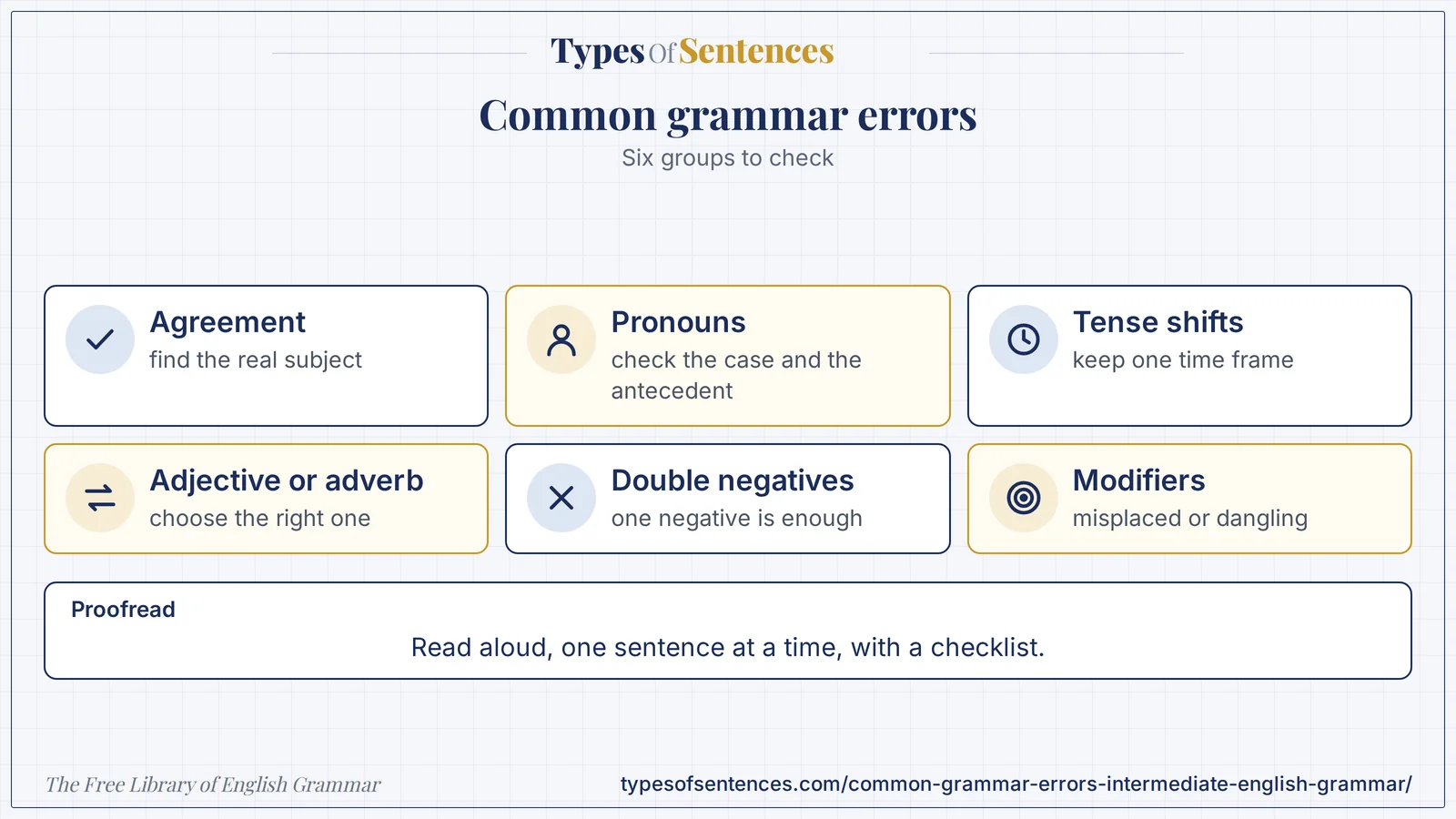
Summary: The most common grammar errors fall into a few groups: agreement (the verb does not match the subject), pronouns (wrong case or unclear reference), tense shifts, adjective/adverb confusion, double negatives, misplaced or dangling modifiers, fragments and run-ons, confusable words, apostrophe and comma errors, and wrong prepositions. Learn the pattern, then proofread for it.
- Agreement: find the real subject.
- Pronouns: check the case and the antecedent.
- Tenses: keep one time frame unless the meaning changes.
- Proofread: read aloud, one sentence at a time, with a checklist.
What You’ll Learn
- 1. Common Grammar Errors: How to Use This Chapter
- 2. Subject-Verb Agreement Errors
- 3. Pronoun Errors
- 4. Verb Tense Errors
- 5. Adjective and Adverb Confusion
- 6. Double Negatives
- 7. Misplaced and Dangling Modifiers
- 8. Sentence Fragments, Run-ons, and Comma Splices
- 9. Incorrect Word Choice: Confusable Words
- 10. Apostrophe Errors
- 11. Comma Errors
- 12. Preposition Errors
- 13. Other Common Errors
- 14. A Proofreading Method
- 15. Exercises
- 16. Test Your Knowledge
- 17. Frequently Asked Questions
- 18. Conclusion
1. Common Grammar Errors: How to Use This Chapter
Each section has a table of errors with the correction and the reason. Read the error, cover the correction, and try to fix it. Then keep a personal error log: the five mistakes you make most often. Fixing a few frequent errors improves your writing more than learning many rare rules. These are the common errors English learners make, and native writers make most of them too.
| Group | Typical problem |
|---|---|
| agreement | the verb does not match the subject |
| pronouns | wrong form or unclear reference |
| verb tenses | shifts and wrong forms |
| adjectives and adverbs | using one for the other |
| negatives | two negatives in one clause |
| modifiers | a phrase attached to the wrong word |
| sentence boundaries | fragments, run-ons, and comma splices |
| word choice | confusable and wrong words |
| apostrophes and commas | missing, extra, or misplaced marks |
| prepositions | the wrong preposition after a word |
2. Subject-Verb Agreement Errors
The verb must agree in number with its subject. Most errors happen when the subject is far from the verb or is not clearly singular or plural.
| Error | Correction | Rule |
|---|---|---|
| The list of items are long. | The list of items is long. | the subject is list, not items |
| Each of the students have a book. | Each of the students has a book. | each is singular |
| Neither of them are coming. | Neither of them is coming. | neither is singular (informal speech often accepts a plural) |
| There is two reasons. | There are two reasons. | the verb agrees with the noun after there |
| My friend and colleague, Tom, are here. | My friend and colleague, Tom, is here. | one person |
| Tom and Maria is late. | Tom and Maria are late. | a compound subject with and is plural |
| Either the manager or the workers is responsible. | Either the manager or the workers are responsible. | with or/nor, agree with the nearer subject |
| The team are winning. (US) | The team is winning. | collective nouns are usually singular in American English |
| Ten dollars are a lot. | Ten dollars is a lot. | an amount as one unit is singular |
| Everyone have a seat. | Everyone has a seat. | indefinite pronouns such as everyone are singular |
| The news are bad. | The news is bad. | news is singular |
| One of my friends are a doctor. | One of my friends is a doctor. | the subject is one |
Agreement is also reviewed in the chapter on the present tenses. A good habit is to find the real subject by crossing out phrases that begin with a preposition: The list (of items) is long.
3. Pronoun Errors
| Error | Correction | Rule |
|---|---|---|
| Me and Tom went home. | Tom and I went home. | subject form I; name the other person first |
| She gave it to Tom and I. | She gave it to Tom and me. | object form after a preposition |
| Between you and I, … | Between you and me, … | object of the preposition |
| Who did you meet? / To who did you speak? | Whom did you meet? / To whom did you speak? | formal: whom as an object (informal speech prefers who) |
| Each student must bring their book. | Each student must bring his or her book. / Students must bring their books. | pronoun-antecedent agreement; their with a singular noun is increasingly accepted |
| The dog wagged it’s tail. | The dog wagged its tail. | possessive its |
| Tom told Bill that he was wrong. | Tom told Bill, “You are wrong.” | ambiguous reference: who is he? |
| Please send it to myself. | Please send it to me. | myself only reflexively or for emphasis |
| The man which called … | The man who called … | who for people; which for things |
| This is the book who I like. | This is the book that I like. | that or which for things |
| Her and me are friends. | She and I are friends. | subject forms |
| The team lost their game. (US, singular) | The team lost its game. | a collective noun taken as one unit |
The case and types of pronouns are in the chapter on types of pronouns. A quick test for I and me in a pair: drop the other person and see which one sounds right (She gave it to I is wrong, so to me).
4. Verb Tense Errors
| Error | Correction | Rule |
|---|---|---|
| Yesterday I go to the market. | Yesterday I went to the market. | past time word, past tense |
| I seen him yesterday. | I saw him yesterday. | simple past, not the past participle |
| I have saw him. | I have seen him. | past participle after have |
| She has went home. | She has gone home. | past participle |
| I have lived there in 2010. | I lived there in 2010. | a finished time uses the simple past |
| I am here since Monday. | I have been here since Monday. | present perfect for a period up to now |
| If I would have known, I would have called. | If I had known, I would have called. | past perfect in the if clause |
| I should of called. | I should have called. | have, not of |
| He said he will come. | He said he would come. | backshift after a past reporting verb |
| When I will arrive, I will call. | When I arrive, I will call. | present simple in a time clause |
| She walks in and sat down. | She walked in and sat down. / She walks in and sits down. | keep one time frame |
| He didn’t went. | He didn’t go. | base form after did not |
Tense consistency and sequence are described in the chapter on tense consistency and sequence. Tense shifts are fine when the time really changes: She lives in Paris now, but she grew up in Delhi.
5. Adjective and Adverb Confusion
| Error | Correction | Rule |
|---|---|---|
| He runs quick. | He runs quickly. | an adverb modifies a verb |
| She speaks good. | She speaks well. | well is the adverb of good |
| I feel badly. (about illness) | I feel bad. | linking verb + adjective |
| It is real good. | It is really good. | an adverb modifies an adjective |
| This is more better. | This is better. | no double comparative |
| the most best player | the best player | no double superlative |
| less people | fewer people | fewer with countable nouns |
| He is taller than me. (formal) | He is taller than I (am). | formal comparison |
| Drive careful. | Drive carefully. | adverb after a verb |
| The soup smells badly. | The soup smells bad. | linking verb + adjective |
| She is the most tallest girl. | She is the tallest girl. | one superlative marker |
| I can hardly not see it. | I can hardly see it. | hardly is already negative |
The difference between adjectives and adverbs is in the chapters on types of adverbs and adjective types. Good is an adjective and well an adverb, but well is also an adjective meaning healthy (I am well).
6. Double Negatives
| Error | Correction | Rule |
|---|---|---|
| I don’t have no money. | I don’t have any money. / I have no money. | one negative per clause |
| She didn’t say nothing. | She didn’t say anything. / She said nothing. | any- after not |
| He never helps nobody. | He never helps anybody. | one negative |
| I can’t hardly hear. | I can hardly hear. | hardly is negative |
| There isn’t nobody here. | There isn’t anybody here. | one negative |
| I haven’t seen neither of them. | I haven’t seen either of them. | either after a negative |
| Unless you don’t hurry … | Unless you hurry … | unless means if not |
| Nobody never calls. | Nobody ever calls. | ever after a negative |
A double negative is non-standard in formal English because two negatives are read as a logical affirmative (I don’t have no money could mean I have some). In some dialects it is a normal intensifier, but standard writing avoids it.
7. Misplaced and Dangling Modifiers
| Error | Correction | Rule |
|---|---|---|
| I almost ate all the cake. | I ate almost all the cake. | almost next to what it limits |
| She only has two dollars. | She has only two dollars. | only before the word it limits |
| Walking home, the rain started. | Walking home, I felt the rain start. | a dangling participle |
| Having finished the report, the phone rang. | Having finished the report, she answered the phone. | the phrase needs its doer |
| I saw a dog on my way to work with three legs. | On my way to work, I saw a dog with three legs. | keep the modifier near its noun |
| The man was arrested by the police carrying a gun. | The police arrested the man carrying a gun. | who is carrying the gun? |
| To pass the exam, studying is necessary. | To pass the exam, you must study. | the infinitive phrase needs a doer |
| Covered in mud, we washed the car. | Covered in mud, the car needed washing. | who is covered in mud? |
Participial phrases are described in the chapter on participles. Test a modifier by asking, “Who or what is doing this?” The answer must be the noun that is closest to the phrase.
8. Sentence Fragments, Run-ons, and Comma Splices
| Error | Correction | Rule |
|---|---|---|
| Because it was late. | We left because it was late. | a dependent clause alone is a fragment |
| Went to the store. | She went to the store. | a fragment with no subject |
| The reason being that he was tired. | He left because he was tired. | a fragment with being |
| It was late we left. | It was late, so we left. | run-on: join with a comma and a conjunction |
| It was late, we left. | It was late; we left. | comma splice: use a semicolon, or a period |
| I like tea, however I like coffee more. | I like tea; however, I like coffee more. | however needs a semicolon or a period |
| Running down the street. | He was running down the street. | a participial phrase alone is a fragment |
| To make a good impression. | She dressed well to make a good impression. | an infinitive phrase alone is a fragment |
These are described in depth in the chapters on sentence fragments and run-on sentences and in the guide to the comma splice. A sentence needs a subject, a finite verb, and a complete thought.
9. Incorrect Word Choice: Confusable Words
| Confusable words | Meaning and example |
|---|---|
| affect / effect | affect (verb): to influence (It affects me); effect (noun): a result (the effect of rain) |
| then / than | then: time (Then we left); than: comparison (taller than me) |
| their / there / they’re | their: belonging to them; there: place; they’re: they are |
| your / you’re | your: possessive; you’re: you are |
| its / it’s | its: possessive; it’s: it is or it has |
| lose / loose | lose: to misplace; loose: not tight |
| accept / except | accept: to receive; except: but not |
| less / fewer | less: uncountable; fewer: countable |
| between / among | between: two (or specific items); among: a group |
| advice / advise | advice: noun; advise: verb |
| principal / principle | principal: head or main; principle: a rule or belief |
| could of / should of | write could have, should have |
| a lot / alot | a lot is two words; alot is not a word |
| irregardless | use regardless |
| whose / who’s | whose: possessive; who’s: who is |
Use a dictionary when two words look alike. A spell-checker will not catch the wrong word if it is correctly spelled, so proofread for confusables yourself.
10. Apostrophe Errors
| Error | Correction | Rule |
|---|---|---|
| Apple’s are cheap. | Apples are cheap. | no apostrophe in a plural |
| The dogs bowl is empty. | The dog’s bowl is empty. | possession needs an apostrophe |
| The girls’ book. (one girl) | The girl’s book. | singular possessive |
| Its a nice day. | It’s a nice day. | contraction of it is |
| The childrens toys | The children’s toys | irregular plural possessive |
| The 1990’s | The 1990s | no apostrophe in a decade |
| Her’s is better. | Hers is better. | no apostrophe in possessive pronouns |
| Dont go. | Don’t go. | an apostrophe replaces the missing letter |
| Tom and Maria’s houses. (two houses, separate) | Tom’s and Maria’s houses. | separate possession |
| Whos there? | Who’s there? | contraction of who is |
11. Comma Errors
| Error | Correction | Rule |
|---|---|---|
| When the bell rang we left. | When the bell rang, we left. | comma after an introductory clause |
| I was tired but I kept working. | I was tired, but I kept working. | comma before a conjunction joining two clauses |
| We bought apples oranges and bananas. | We bought apples, oranges, and bananas. | commas in a series |
| My sister who lives in Texas called. | My sister, who lives in Texas, called. | nonessential clause |
| The man, who called, is here. (if only one man is meant, essential) | The man who called is here. | no commas around an essential clause |
| She said, that she was late. | She said that she was late. | no comma before that |
| He is tall, and strong. | He is tall and strong. | no comma between two words joined by and |
| On June 5 2025 we met. | On June 5, 2025, we met. | commas in dates |
| Thank you Maria. | Thank you, Maria. | direct address |
The full comma rules are in the chapter on punctuation marks. Do not add a comma every time you pause when speaking; use the rules.
12. Preposition Errors
| Error | Correction | Rule |
|---|---|---|
| I am agree with you. | I agree with you. | agree is a verb, not an adjective |
| She is married with Tom. | She is married to Tom. | married to |
| It depends of the weather. | It depends on the weather. | depend on |
| I listen music. | I listen to music. | listen to |
| We discussed about the plan. | We discussed the plan. | discuss takes no preposition |
| Explain me the rule. | Explain the rule to me. | explain something to someone |
| She is good in math. | She is good at math. | good at |
| I arrived to the station. | I arrived at the station. / I arrived in Delhi. | at a place; in a city |
| I’m interested on art. | I’m interested in art. | interested in |
| different than (formal) | different from | different from is preferred in formal writing |
| on Monday at the morning | on Monday morning | use the natural phrase |
| I look forward to see you. | I look forward to seeing you. | to is a preposition |
Prepositions must be learned with their words. The chapter on prepositions lists the common patterns; keep a record of verbs and adjectives and their prepositions.
13. Other Common Errors
| Error | Correction | Rule |
|---|---|---|
| I need an information. | I need some information. | information is uncountable |
| She gave me many advices. | She gave me a lot of advice. | advice is uncountable |
| I have much friends. | I have many friends. | many with countable nouns |
| She is a engineer. | She is an engineer. | an before a vowel sound |
| I like the music. | I like music. (in general) | no article for a general idea |
| He plays the football. | He plays football. | no article with sports |
| The equipments are old. | The equipment is old. | equipment is uncountable |
| She is more taller. | She is taller. | one comparative |
| The reason is because … | The reason is that … | avoid reason … because |
| She enjoys to swim and dancing. | She enjoys swimming and dancing. | verb pattern and parallel forms |
| I like swimming, to run, and bikes. | I like swimming, running, and biking. | parallel structure |
14. A Proofreading Method
- Put the draft away for a while if you can. Fresh eyes see more.
- Read it aloud, slowly, one sentence at a time. Your ear catches many errors.
- Read backward, from the last sentence to the first, to check each sentence on its own.
- Check one thing at a time. One pass for agreement, one for tenses, one for punctuation, one for spelling and confusable words.
- Use your error log. Look specifically for the mistakes you make most often.
- Use tools carefully. A spell-checker misses correctly spelled wrong words, and a grammar checker is sometimes wrong. Decide for yourself.
- Ask someone else to read it. A reader finds what the writer cannot see.
Proofread: Me and my sister goes to the market yesterday, we buys alot of apple’s and it was real good, so we dont had no money.
- Me and my sister goes: My sister and I went (case, agreement, tense).
- yesterday, we buys: comma splice and tense: yesterday; we bought or a period.
- alot of apple’s: a lot of apples.
- it was real good: they were really good (adverb; agreement with apples).
- we dont had no money: we didn’t have any money.
- Result: My sister and I went to the market yesterday. We bought a lot of apples, and they were really good, so we didn’t have any money left.
Recap in 12 seconds
Watch the lesson build itself: Common errors fall into groups: agreement, pronouns, tense shifts, adjectives and adverbs, double negatives, and modifiers. The video has no sound.
Exercises
Part A: Agreement (Exercises 1–5)
Exercise 1: Choose: The list of items (is/are) long.
Show Answer
Answer: is.
Exercise 2: Choose: Each of the students (has/have) a book.
Show Answer
Answer: has.
Exercise 3: Choose: There (is/are) two reasons.
Show Answer
Answer: are.
Exercise 4: Choose: Tom and Maria (is/are) late.
Show Answer
Answer: are.
Exercise 5: Choose: The news (is/are) bad.
Show Answer
Answer: is.
Part B: Pronouns (Exercises 6–10)
Exercise 6: Fix it: Me and Tom went home.
Show Answer
Answer: Tom and I went home.
Exercise 7: Fix it: She gave it to Tom and I.
Show Answer
Answer: She gave it to Tom and me.
Exercise 8: Choose: The dog wagged (its/it’s) tail.
Show Answer
Answer: its.
Exercise 9: Fix it: Please send it to myself.
Show Answer
Answer: Please send it to me.
Exercise 10: Choose: The man (who/which) called is here.
Show Answer
Answer: who.
Part C: Tenses (Exercises 11–15)
Exercise 11: Fix it: Yesterday I go to the market.
Show Answer
Answer: Yesterday I went to the market.
Exercise 12: Fix it: I have saw him.
Show Answer
Answer: I have seen him.
Exercise 13: Fix it: I should of called.
Show Answer
Answer: I should have called.
Exercise 14: Fix it: If I would have known, I would have called.
Show Answer
Answer: If I had known, I would have called.
Exercise 15: Fix it: When I will arrive, I will call.
Show Answer
Answer: When I arrive, I will call.
Part D: Adjectives, Adverbs, Negatives (Exercises 16–20)
Exercise 16: Fix it: She speaks good.
Show Answer
Answer: She speaks well.
Exercise 17: Fix it: This is more better.
Show Answer
Answer: This is better.
Exercise 18: Choose: I met (less/fewer) people.
Show Answer
Answer: fewer.
Exercise 19: Fix it: I don’t have no money.
Show Answer
Answer: I don’t have any money.
Exercise 20: Fix it: I can’t hardly hear.
Show Answer
Answer: I can hardly hear.
Part E: Modifiers and Boundaries (Exercises 21–24)
Exercise 21: Fix it: I almost ate all the cake.
Show Answer
Answer: I ate almost all the cake.
Exercise 22: Fix it: Walking home, the rain started.
Show Answer
Answer: Walking home, I felt the rain start.
Exercise 23: Fix it: It was late, we left.
Show Answer
Answer: It was late, so we left.
Exercise 24: Fix the fragment: Because it was late.
Show Answer
Answer: We left because it was late.
Part F: Words, Apostrophes, Commas, Prepositions (Exercises 25–30)
Exercise 25: Choose: The (affect/effect) of rain was clear.
Show Answer
Answer: effect.
Exercise 26: Choose: He is taller (then/than) me.
Show Answer
Answer: than.
Exercise 27: Fix it: Apple’s are cheap.
Show Answer
Answer: Apples are cheap.
Exercise 28: Fix it: When the bell rang we left.
Show Answer
Answer: When the bell rang, we left.
Exercise 29: Fix it: It depends of the weather.
Show Answer
Answer: It depends on the weather.
Exercise 30: Fix it: We discussed about the plan.
Show Answer
Answer: We discussed the plan.
Test Your Knowledge
Ready to check what you learned? Answer all 10 questions, then submit. You need 80% (8 of 10) to pass. Your answers are not stored.
View correct answers and explanations
Question 1: Which is correct?
✓ Correct Answer: C – The list of items is long.
The subject is list.
Question 2: Which is correct?
✓ Correct Answer: D – Tom and I went home.
Subject form I.
Question 3: Which is correct?
✓ Correct Answer: A – I saw him.
Simple past saw.
Question 4: Which is correct?
✓ Correct Answer: C – She speaks well.
Well is the adverb.
Question 5: Which is correct?
✓ Correct Answer: D – I don’t have any money.
No double negatives.
Question 6: Which is correct?
✓ Correct Answer: B – I ate almost all the cake.
Keep the modifier close.
Question 7: Which is correct?
✓ Correct Answer: C – It was late, so we left.
Comma and conjunction.
Question 8: Which is correct?
✓ Correct Answer: B – Apples are cheap.
No apostrophe in a plural.
Question 9: Which is correct?
✓ Correct Answer: B – It depends on the weather.
Depend on.
Question 10: Which is a good proofreading step?
✓ Correct Answer: A – Reading aloud
Reading aloud catches many errors.
Frequently Asked Questions
What are common grammar errors?
Common grammar errors are mistakes that learners and writers make often: subject-verb agreement, pronoun case, tense shifts, adjective and adverb confusion, double negatives, misplaced modifiers, fragments, run-ons, confusable words, and punctuation errors.
What are common English grammar errors for learners?
Common English grammar errors for learners include wrong verb forms (I seen), missing articles, wrong prepositions (depend of), uncountable nouns used as countable (informations), and double negatives.
How do I find English grammar errors in my writing?
To find English grammar errors, read your writing aloud, read it backward sentence by sentence, check one type of error at a time, use your list of frequent mistakes, and ask someone else to read it.
Why do I make grammar mistakes in a first draft?
Because you are focusing on ideas. Grammar mistakes in a draft are normal. Revise first for ideas and organization, then proofread for grammar and punctuation.
How can I avoid common errors in English?
To avoid the common errors English writers make, learn the patterns of the most frequent ones, keep an error log, proofread systematically, and use a dictionary and a grammar reference when you are unsure.
Are grammar checkers reliable?
They help, but they miss some errors and sometimes suggest wrong changes. Use them as a second opinion, and decide yourself with the rules in this chapter.
Is every “error” really an error?
Not always. Some rules are debated or vary between formal and informal English, such as who and whom or the singular they. Check the context and the style guide you follow.
Conclusion
You now have a field guide to the common grammar errors: agreement, pronouns, tenses, adjectives and adverbs, double negatives, modifiers, fragments and run-ons, confusable words, apostrophes, commas, prepositions, and other frequent mistakes. You also have a proofreading method.
Start your own error log today: write down the five mistakes you make most often, and check for them each time you revise. Next, the two Intermediate review chapters let you test what you have learned.
- Purdue Online Writing Lab: Grammar: reference sections on common errors.
- Purdue Online Writing Lab: Mechanics: reference sections on apostrophes, capitals, and spelling.
- Strunk, William, Jr., and E. B. White. The Elements of Style. 4th ed. Longman, 2000.: commonly misused words and expressions.
- Quirk, Randolph, et al. A Comprehensive Grammar of the English Language. Longman, 1985.: agreement, negation, and modification.
Last reviewed: October 29, 2026. How it was made: drafted with AI assistance, then checked with automated tests (structure, links, answer keys, spelling) and against the sources above. A person has not yet read this chapter line by line. Found a mistake? Report it.