Accept vs except is a common confusion because the two words look and sound alike. Accept is a verb that means to receive something willingly, to agree to it, or to admit that it is true: I accept your apology. Except usually means “not including”: Everyone came except Maria.
This page treats except vs accept as a meaning test and shows how to choose between the two words, with 20 examples of each. It explains the memory trick, the phrase except for, the related words, and the common mistakes. If you wonder whether to write accept or except, ask one question: is the word an action you do (accept) or a word that leaves something out (except)? The page ends with 30 exercises and a 10-question quiz.
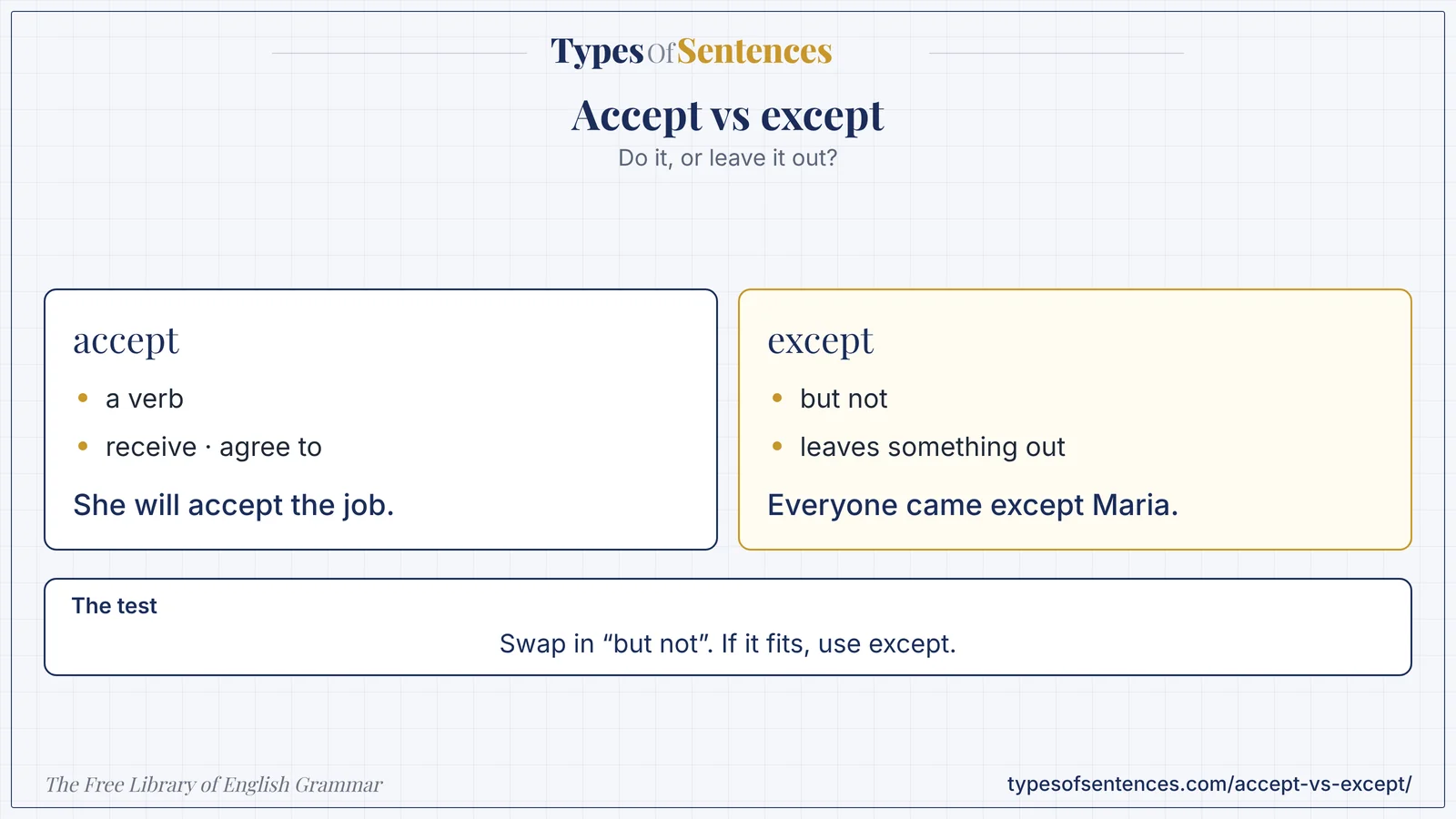
Accept means to take or agree to something. Except means “but not” or “other than”.
Why it matters: If you can replace the word with “but not”, use except. If you can replace it with “receive” or “agree to”, use accept.
Summary: Accept is a verb: to receive willingly, agree to, or admit (She accepted the offer.). Except is mainly a preposition or conjunction meaning “not including” (Everyone came except Maria.). Test: replace the word with receive or agree to for accept; replace it with but not for except. Related words: acceptance, acceptable; exception, exceptional. Except is also a formal verb that means “to leave out”, but this use is rare.
- Accept = receive or agree to.
- Except = but not.
- Test: swap in the meaning.
- Accept is the verb in nearly every case.
What You’ll Learn
- 1. Accept vs Except: The Short Answer
- 2. Accept in a Sentence: 20 Examples
- 3. Except in a Sentence: 20 Examples
- 4. Related Words: Acceptance, Acceptable, Exception, Exceptional
- 5. How to Remember the Difference
- 6. Common Mistakes With Accept and Except
- 7. Exercises
- 8. Test Your Knowledge
- 9. Frequently Asked Questions
- 10. Conclusion
1. Accept vs Except: The Short Answer
| Word | Part of speech | Meaning | Example |
|---|---|---|---|
| accept | verb | receive willingly; agree to; admit as true | I accept your offer. |
| except | preposition | not including; other than | All came except Tom. |
| except | conjunction | but; only that | I would go, except that I am tired. |
| except | verb (formal, rare) | leave out; exclude | Present company excepted. |
| Test | Replace with | Use |
|---|---|---|
| the receive test | receive or agree to | accept |
| the but-not test | but not or other than | except |
| the verb test | change the tense (accepted, accepting) | accept (a normal verb changes form) |
| the for test | except for still makes sense | except |
Accept is a verb. Except is mostly a preposition, as described in the Intermediate chapter on the types of prepositions.
2. Accept in a Sentence: 20 Examples
Accept in a sentence is a verb, so it has tenses (accept, accepts, accepted, accepting) and it usually takes an object, the thing that is accepted, as in the chapter on direct objects.
| # | Sentence |
|---|---|
| 1 | She will accept the job offer. |
| 2 | Please accept my apology. |
| 3 | The shop does not accept credit cards. |
| 4 | He could not accept the loss. |
| 5 | They accepted the invitation to the wedding. |
| 6 | The committee will accept applications until Friday. |
| 7 | I accept your terms. |
| 8 | The school accepted her into the program. |
| 9 | We must accept that things change. |
| 10 | Will you accept a gift from a stranger? |
| 11 | The author accepted the award in person. |
| 12 | The court accepted the evidence. |
| 13 | She accepts criticism well. |
| 14 | He accepted the blame for the mistake. |
| 15 | The machine accepts coins and bills. |
| 16 | They have accepted our proposal. |
| 17 | Do you accept the results? |
| 18 | The team accepted the new coach. |
| 19 | He found it hard to accept help. |
| 20 | I gladly accept the challenge. |
| Meaning of accept | Example |
|---|---|
| to receive willingly | She accepted the gift. |
| to agree to | He accepted the terms. |
| to admit as true | We accept that we were wrong. |
| to take as valid | The shop accepts cards. |
| to let someone join | The club accepted three new members. |
| to put up with | She accepted the delay. |
3. Except in a Sentence: 20 Examples
Except in a sentence is almost always a preposition (or a conjunction). It does not change its form, and it introduces the person or thing that is left out. The preposition is described in the chapter on prepositional phrases, because except for opens a prepositional phrase.
| # | Sentence |
|---|---|
| 1 | Everyone came except Maria. |
| 2 | The store is open every day except Sunday. |
| 3 | I like all fruit except bananas. |
| 4 | She answered all the questions except the last one. |
| 5 | We ate everything except the soup. |
| 6 | No one knew the answer except Sam. |
| 7 | The park is quiet except in summer. |
| 8 | All the lights were off except one. |
| 9 | He has no hobbies except reading. |
| 10 | The room was empty except for a chair. |
| 11 | Except for the rain, the trip was perfect. |
| 12 | Everyone left except for the cleaners. |
| 13 | The twins are alike except for their hair. |
| 14 | I would help you except that I am busy. |
| 15 | The path is safe except when it snows. |
| 16 | The test covers every chapter except chapter nine. |
| 17 | He did nothing all day except sleep. |
| 18 | She trusts nobody except her sister. |
| 19 | The road is open to all vehicles except trucks. |
| 20 | The house was silent except for a ticking clock. |
| Pattern | Example |
|---|---|
| except + noun | Everyone came except Maria. |
| except for + noun | Except for the rain, the trip was perfect. |
| except + clause (that) | I would help, except that I am busy. |
| except + when / if | The path is safe except when it snows. |
| except + bare verb | He did nothing except sleep. |
4. Related Words: Acceptance, Acceptable, Exception, Exceptional
| Word | Part of speech | Meaning | Example |
|---|---|---|---|
| acceptance | noun | the act of accepting | Her acceptance of the job was quick. |
| acceptable | adjective | good enough | The quality is acceptable. |
| unacceptable | adjective | not allowed | That behavior is unacceptable. |
| acceptably | adverb | in a satisfactory way | He behaved acceptably. |
| exception | noun | something left out; a case that does not follow the rule | This rule has one exception. |
| exceptional | adjective | unusual; outstanding | She has exceptional skill. |
| exceptionally | adverb | unusually | The food was exceptionally good. |
| exceptionable | adjective | open to objection (rare) | I found nothing exceptionable. |
Note that exception and exceptional belong to the except family, and acceptance and acceptable belong to accept. A good dictionary lists them as separate entries. The wider topic of choosing exact words is the subject of the Advanced chapter on diction.
5. How to Remember the Difference
| Trick | How it works |
|---|---|
| a for action | accept begins with a, and it is an action you do: you accept an offer |
| ex for exclude | except begins with ex, like exclude, because it leaves something out |
| the swap test | replace the word with but not; if the sentence still works, use except |
| the sound | many dictionaries show a slightly different first syllable (ak- and ik-), but in fast speech the two can sound alike, so rely on meaning |
Because accept and except are not exact synonyms of anything else, nothing in the sentence will help except the meaning. The guide to similar words shows how to separate words of close meaning, and the words here are not synonyms.
6. Common Mistakes With Accept and Except
| Mistake | Example | Correction |
|---|---|---|
| except for accept | *She will except the job. | She will accept the job. |
| accept for except | *Everyone came accept Maria. | Everyone came except Maria. |
| accept for except in “all but” | *I like all fruit accept pears. | I like all fruit except pears. |
| except for accept in a result | *We except your apology. | We accept your apology. |
| wrong noun | *His exceptance was quick. | His acceptance was quick. |
| wrong adjective | *The result is exceptable. | The result is acceptable. |
| wrong participle | *She has excepted the offer. | She has accepted the offer. |
| accept in a phrase | *Everyone accept the cat was asleep. | Everyone except the cat was asleep. |
| too many words | *Except for the exception of Tom, all came. | Except for Tom, all came. |
| mixing up exception | *The rule has no acception. | The rule has no exception. |
Fix: I accept for the last question, I will except all the answers, and the exception of the rule is that I can not accept any late work.
- I accept for the last question: the meaning is “not including”, so use except.
- I will except all the answers: the meaning is “receive”, so use accept.
- the exception of the rule: exception is a noun that means “a case outside the rule”; the sentence works, but the clause is wordy.
- I can not accept any late work: accept is correct (and cannot is the usual spelling).
- Result: Except for the last question, I will accept all the answers, but I cannot accept any late work. (the sentence is invented)
Recap in 12 seconds
Watch the lesson build itself: Accept is a verb that means to receive or agree to; except usually means but not. The video has no sound.
Exercises
Part A: Choose Accept or Except (Exercises 1–10)
Exercise 1: Everyone came ___ Maria.
Show Answer
Answer: except.
Exercise 2: Please ___ my apology.
Show Answer
Answer: accept.
Exercise 3: The shop is open every day ___ Monday.
Show Answer
Answer: except.
Exercise 4: She decided to ___ the offer.
Show Answer
Answer: accept.
Exercise 5: I like all sports ___ golf.
Show Answer
Answer: except.
Exercise 6: He could not ___ the loss.
Show Answer
Answer: accept.
Exercise 7: All the doors were locked ___ one.
Show Answer
Answer: except.
Exercise 8: They will ___ new members in May.
Show Answer
Answer: accept.
Exercise 9: The room was empty ___ for a table.
Show Answer
Answer: except.
Exercise 10: Do you ___ credit cards?
Show Answer
Answer: accept.
Part B: Which Word and Why? (Exercises 11–20)
Exercise 11: The store ___ cash only.
Show Answer
Answer: accepts: the verb has the -s ending.
Exercise 12: Everyone ___ the cat left.
Show Answer
Answer: except: it means “but not”.
Exercise 13: She ___ the award with a smile.
Show Answer
Answer: accepted: past tense of the verb.
Exercise 14: I would go, ___ that I am tired.
Show Answer
Answer: except: a conjunction.
Exercise 15: We are ___ ing new applications.
Show Answer
Answer: accepting: the -ing form of the verb.
Exercise 16: He did nothing ___ sleep.
Show Answer
Answer: except: it means “other than”.
Exercise 17: She found the plan ___able.
Show Answer
Answer: acceptable: an adjective from accept.
Exercise 18: This rule has one ___.
Show Answer
Answer: exception: a noun from except.
Exercise 19: Her ___ of the job was quick.
Show Answer
Answer: acceptance: a noun from accept.
Exercise 20: The skill is ___ional.
Show Answer
Answer: exceptional: an adjective from except.
Part C: Correct the Errors (Exercises 21–25)
Exercise 21: Correct: *She will except the job.
Show Answer
Answer: She will accept the job.
Exercise 22: Correct: *Everyone came accept Maria.
Show Answer
Answer: Everyone came except Maria.
Exercise 23: Correct: *The result is exceptable.
Show Answer
Answer: The result is acceptable.
Exercise 24: Correct: *We except your apology.
Show Answer
Answer: We accept your apology.
Exercise 25: Correct: *I like all fruit accept pears.
Show Answer
Answer: I like all fruit except pears.
Part D: Write Your Own (Exercises 26–30)
Exercise 26: Use accept in a sentence about a gift.
Show Answer
Answer: Sample: I gladly accepted the gift.
Exercise 27: Use except in a sentence about a day.
Show Answer
Answer: Sample: The shop opens every day except Sunday.
Exercise 28: Use except for in a sentence about the weather.
Show Answer
Answer: Sample: Except for the rain, the day was perfect.
Exercise 29: Use acceptable in a sentence.
Show Answer
Answer: Sample: The quality is acceptable.
Exercise 30: Use exception in a sentence.
Show Answer
Answer: Sample: There is one exception to this rule.
Test Your Knowledge
Ready to check what you learned? Answer all 10 questions, then submit. You need 80% (8 of 10) to pass. Your answers are not stored.
View correct answers and explanations
Question 1: Which word is a verb that means to receive?
✓ Correct Answer: C – accept
Accept.
Question 2: Everyone was there ___ Tom.
✓ Correct Answer: A – except
But not.
Question 3: She ___ the offer yesterday.
✓ Correct Answer: B – accepted
Past tense.
Question 4: Except for introduces
✓ Correct Answer: D – something left out
Left out.
Question 5: The noun for the act of accepting is
✓ Correct Answer: C – acceptance
Acceptance.
Question 6: The adjective that means “good enough” is
✓ Correct Answer: A – acceptable
Acceptable.
Question 7: Which sentence is correct?
✓ Correct Answer: B – I like all fruit except pears.
Except.
Question 8: Which is correct?
✓ Correct Answer: D – The shop accepts cards.
Accepts.
Question 9: A case that does not follow a rule is an
✓ Correct Answer: C – exception
Exception.
Question 10: The swap test for except is
✓ Correct Answer: A – but not
But not.
Frequently Asked Questions
What is the difference between accept and except?
Accept is a verb that means to receive willingly or agree to. Except is mainly a preposition or conjunction that means “not including”.
How do I know whether to write accept or except?
Replace the word with receive or agree to: if it fits, use accept. Replace it with but not: if it fits, use except.
Can except be a verb?
Yes, but it is formal and rare. To except something means to leave it out, as in present company excepted. In nearly every case the verb you want is accept.
What is an example of accept in a sentence?
She will accept the job offer. Here accept is a verb with an object.
What is an example of except in a sentence?
The store is open every day except Sunday. Here except is a preposition that introduces what is left out.
Is it “except for” or just “except”?
Both are correct. Except for often starts a sentence (Except for the rain, the trip was perfect.); plain except is common in the middle (Everyone came except Maria.).
Do accept and except sound the same?
They are very close. Dictionaries usually give a different vowel in the first syllable, but many speakers say them alike, so use the meaning, not the sound, to choose.
Conclusion
You now know how to tell accept vs except: accept is the verb that means to receive or agree to, and except means “not including”. You have seen 20 examples of each word and the related forms.
In any except vs accept choice, use the swap test: receive or agree to for accept, and but not for except. Next, study the other confusable pairs in this series, such as the pair that comes after this one.
- Garner, Bryan A. Garner’s Modern English Usage. 5th ed. Oxford University Press, 2022.: the entries on accept and except.
- Huddleston, Rodney, and Geoffrey K. Pullum. The Cambridge Grammar of the English Language. Cambridge University Press, 2002.: the account of prepositions, including except.
- Merriam-Webster Dictionary: except: the dictionary entry (not opened when this page was written). All examples and exercises were written for this page.
Last reviewed: October 29, 2026. How it was made: drafted with AI assistance, then checked with automated tests (structure, links, answer keys, spelling) and against the sources above. A person has not yet read this chapter line by line. Found a mistake? Report it.