The types of prepositions are grouped by form and by meaning. By form, a preposition can be a single word (in), a compound (into), or a group of words (in front of). By meaning, it can show place, time, direction, or other relationships such as cause, purpose, and possession. Prepositions are few in number but very frequent, and a wrong one is one of the most noticeable errors in English.
This chapter gives you a list of prepositions, then studies prepositions of place, time, and direction in detail. You will learn how prepositions work with objects, how prepositional phrases are built, which prepositions go with certain verbs, adjectives, and nouns, how to tell a preposition from an adverb, and whether you may end a sentence with one. Thirty exercises and a quiz follow.
A preposition links a noun, pronoun, or gerund (its object) to the rest of the sentence and shows how they relate: where, when, by what means, for what reason.
Why it matters: You cannot learn prepositions from their translations. You learn them in patterns and phrases. This chapter gives you the patterns.
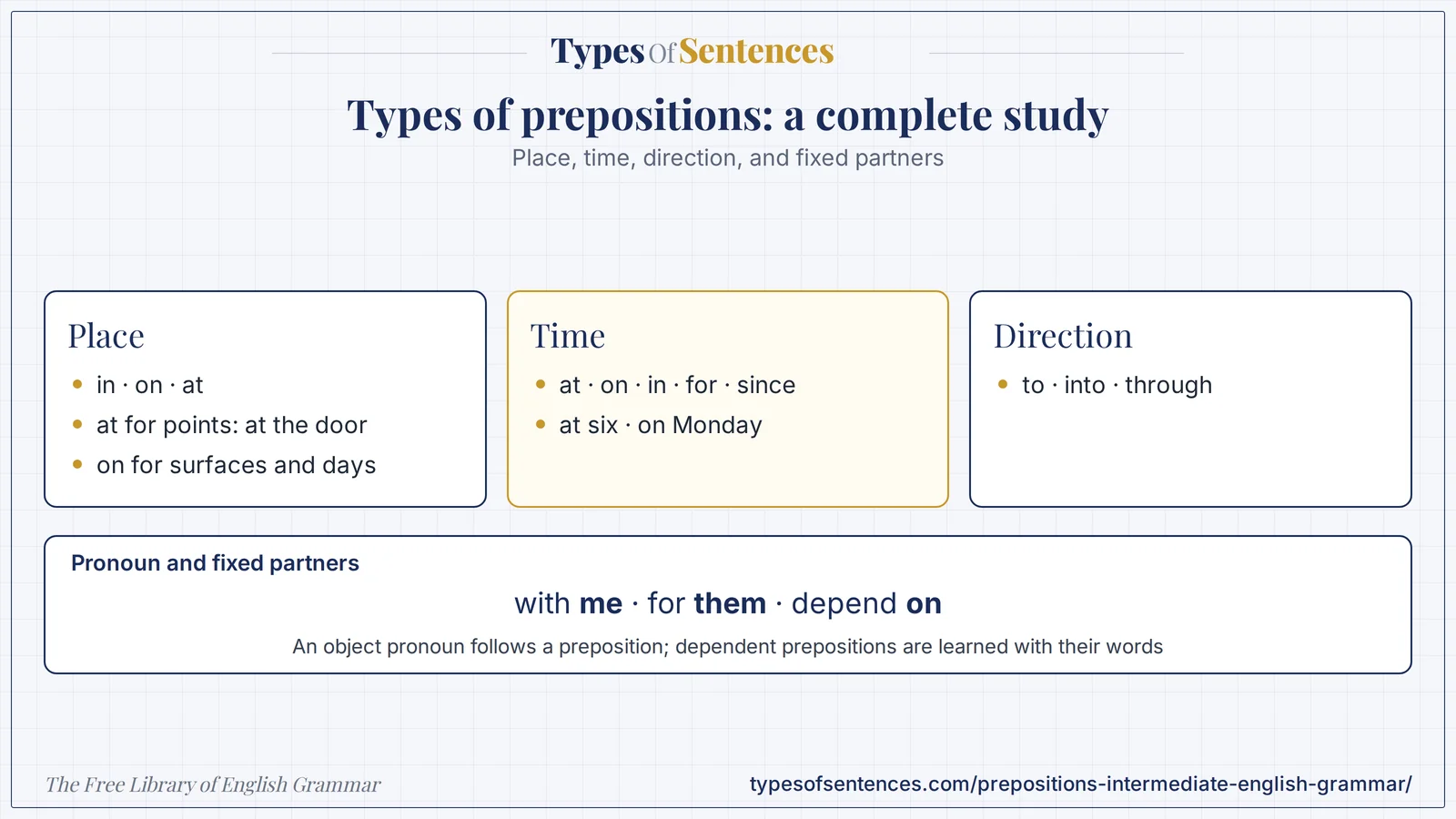
Summary: A preposition has an object, and together they form a prepositional phrase. The main uses are place (in, on, at), time (at, on, in, for, since), and direction (to, into, through). Many verbs, adjectives, and nouns take a particular preposition (depend on, afraid of).
- At for points: at six, at the door. On for surfaces and days: on the table, on Monday. In for spaces and longer periods: in the box, in June.
- An object pronoun follows a preposition: with me, for them.
- Dependent prepositions are learned with their words: depend on, good at.
- A sentence may end with a preposition when that sounds natural.
What You’ll Learn
- 1. Types of Prepositions: What Is a Preposition? A Review
- 2. A List of Prepositions
- 3. Prepositions of Time in Detail
- 4. Prepositions of Place in Detail
- 5. Prepositions of Movement and Direction
- 6. Prepositional Phrases
- 7. Dependent Prepositions
- 8. Preposition or Adverb?
- 9. Ending Sentences with Prepositions
- 10. Common Preposition Errors
- 11. Exercises
- 12. Test Your Knowledge
- 13. Frequently Asked Questions
- 14. Conclusion
1. Types of Prepositions: What Is a Preposition? A Review
A preposition shows the relationship between its object (a noun, pronoun, or gerund) and another word in the sentence. The preposition and its object, with any modifiers, form a prepositional phrase.
| Part | Example |
|---|---|
| Preposition | in |
| Object | the garden (noun phrase) |
| Prepositional phrase | in the garden |
| With a pronoun object | with me; for them (object form) |
| With a gerund object | good at drawing; before leaving |
Prepositions with objects follow one pattern. Pronouns after a preposition take the object form (between you and me; see the chapter on types of pronouns). A gerund can be the object of a preposition (good at drawing; see gerunds), but an infinitive cannot (good at to draw is wrong).
I. Types by form
| Form | Examples |
|---|---|
| Simple (one word) | in, on, at, by, for, with, from, of, to, under |
| Compound (two joined words) | into, onto, within, without, upon, throughout, inside, outside |
| Complex (a group of words) | in front of, because of, according to, in spite of, on behalf of, instead of, next to |
| Participial (from verbs) | during, including, regarding, concerning, considering |
2. A List of Prepositions
This list of prepositions covers the ones you will meet most often. The sections below treat the groups in detail.
| Group | Prepositions |
|---|---|
| Place and position | at, in, on, above, below, over, under, beneath, underneath, beside, between, among, behind, in front of, next to, near, opposite, inside, outside, beyond |
| Time | at, on, in, before, after, during, for, since, until, till, by, within, throughout, from, to |
| Direction and movement | to, toward, into, onto, out of, off, from, through, across, along, around, past, up, down, over, under |
| Other relationships | of (belonging), with (accompaniment, instrument), without, by (agent, means), for (purpose, benefit), about (topic), like, unlike, against, except, despite, as |
Many prepositions have more than one use: for shows duration (for an hour), purpose (a tool for cutting), and benefit (a gift for you). Learn each in its patterns.
3. Prepositions of Time in Detail
The three most common prepositions of time are at, on, and in. Think of them as moving from specific to general.
| Preposition | Use | Examples |
|---|---|---|
| at | clock times, mealtimes, short points, night, noon | at six, at lunch, at noon, at night, at the moment |
| on | days and dates; days with parts of a day | on Monday, on June 5, on Friday evening, on Christmas Day |
| in | months, seasons, years, centuries; parts of the day; time to completion | in June, in winter, in 2025, in the 1990s, in the morning, in an hour |
| Other time prepositions | Meaning and example |
|---|---|
| for | duration: She studied for two hours. |
| since | from a starting point until now: They have lived here since 2020. |
| during | within a period: She slept during the movie. |
| by | not later than: Finish by Friday. |
| until / till | up to a point: Wait until noon. |
| before / after | earlier or later than: before dinner, after school |
| within | inside a time limit: within a week |
Some pairs differ in meaning: in time (early enough) and on time (exactly at the planned time); at the end (the last point) and in the end (finally). American English says on the weekend; British English says at the weekend.
Days and dates take on, not in.
4. Prepositions of Place in Detail
Use at for a point, on for a surface or a line, and in for an enclosed space or area. The memory trick is the box, the table, and the door.
| Preposition | Use | Examples |
|---|---|---|
| at | a point or a place used for its purpose | at the door, at the station, at school, at the library, at a concert |
| on | a surface, a line, or a floor | on the table, on the wall, on the street, on the third floor, on the left |
| in | an enclosed space or area | in the box, in the room, in Paris, in a car, in the garden |
| Other prepositions of place | Example |
|---|---|
| above / over | A lamp hangs over the table. The flag is above the door. |
| below / under / beneath / underneath | The cat is under the chair. The cellar is below the house. |
| between / among | The shop is between the bank and the café. She stood among the crowd. |
| in front of / behind / next to / beside / by | A bus stopped in front of us. He sat next to me. |
| near / opposite / across from | The park is opposite the school. |
5. Prepositions of Movement and Direction
Prepositions of direction show movement toward, away from, or through a place.
| Preposition | Meaning | Example |
|---|---|---|
| to | toward a destination | We walked to school. |
| toward | in the direction of (American: toward) | She turned toward me. |
| into | from outside to inside | He ran into the house. |
| onto | from one surface to the top of another | The cat jumped onto the table. |
| out of / off | away from the inside / the surface | She stepped out of the car. He fell off the ladder. |
| through | from one side to the other, inside | The train goes through a tunnel. |
| across | from one side to the other, on the surface | They swam across the river. |
| along | in a line beside | We walked along the beach. |
| around | in a circle or on all sides | They walked around the lake. |
| past | beyond | The bus drove past the station. |
- She is in the room. position
- She walked into the room. movement
- The cat is on the table. position
- The cat jumped onto the table. movement
6. Prepositional Phrases
A prepositional phrase can work as an adjective (modifying a noun) or as an adverb (modifying a verb, adjective, or adverb). The chapter on prepositional phrases studies them fully; here is the main idea.
| Job | Example | What it modifies |
|---|---|---|
| Adjective phrase | the book on the table | the noun book |
| Adverb phrase | We met in June. | the verb met |
| Adverb phrase | She is good at math. | the adjective good |
The basic idea of the phrase is in the chapter on introduction to phrases. Notice that a prepositional phrase never contains the subject of the sentence: in One of the boys is late, the subject is one, not boys.
7. Dependent Prepositions
Many verbs, adjectives, and nouns are followed by a fixed preposition. These are called dependent prepositions, and they must be learned with the word.
| Verb + preposition | Adjective + preposition | Noun + preposition |
|---|---|---|
| depend on | afraid of | reason for |
| listen to | good at | increase in |
| believe in | interested in | solution to |
| wait for | proud of | cause of |
| laugh at | responsible for | difference between |
| apologize for | different from | example of |
| consist of | tired of | demand for |
The verb depend always takes on.
Some of these pairs vary. Different from is standard everywhere; different than is common in American English, especially before a clause (It was different than I expected); and different to is mainly British. When in doubt, check a learner’s dictionary, which shows the preposition in the entry.
8. Preposition or Adverb?
Many words (in, on, up, down, out, over, around) are prepositions when they have an object and adverbs when they stand alone. In a phrasal verb the word is an adverb particle.
| Preposition (has an object) | Adverb (stands alone) |
|---|---|
| She walked up the stairs. | She looked up. |
| He came in the house. | He came in. |
| The cat jumped over the fence. | The game is over. |
| They ran down the street. | Please sit down. |
A test: ask what? or whom? after the word. If an object answers, it is a preposition. If nothing follows, or if it forms a phrasal verb (give up, turn on), it is an adverb.
9. Ending Sentences with Prepositions
An old rule says never to end a sentence with a preposition. It comes from the idea that English should follow Latin, and most modern usage guides say that the rule is unnecessary. Ending a sentence with a preposition is natural and often clearer.
| Natural | Stiff |
|---|---|
| Who did you talk to? | To whom did you talk? |
| This is the book I told you about. | This is the book about which I told you. |
| What are you looking for? | For what are you looking? |
In formal writing, a different structure is sometimes smoother, but forcing the preposition forward can make a sentence awkward. Use whichever reads better, and avoid adding an unneeded final preposition, as in Where is the station at?
10. Common Preposition Errors
| Error | Correct | Rule |
|---|---|---|
| in Monday | on Monday | days take on |
| arrived to the station | arrived at the station | arrive at a place, in a city |
| depend of | depend on | fixed verb + preposition |
| discuss about the plan | discuss the plan | discuss takes a direct object |
| between you and I | between you and me | object form after a preposition |
| enter into the room | enter the room | enter takes a direct object |
| married with Tom | married to Tom | married takes to |
| listen the radio | listen to the radio | listen takes to |
Correct: We discussed about the problem in Friday.
Reveal answer
We discussed the problem on Friday. Discuss takes a direct object, and days take on.
Recap in 12 seconds
Watch the lesson build itself: Prepositions show place, time, and direction; an object pronoun follows them, and many words take a particular one. The video has no sound.
Exercises
Part A: Types and Objects (Exercises 1–6)
Exercise 1: Name the object of the preposition: in the garden
Show Answer
Answer: the garden.
Exercise 2: Choose: This is for (they/them).
Show Answer
Answer: them. Use the object form after a preposition.
Exercise 3: Choose: She is good at (draw/drawing).
Show Answer
Answer: drawing. A gerund can follow a preposition.
Exercise 4: Simple, compound, or complex: into
Show Answer
Answer: Compound.
Exercise 5: Simple, compound, or complex: in front of
Show Answer
Answer: Complex.
Exercise 6: Fix it: She is good at to swim.
Show Answer
Answer: She is good at swimming.
Part B: Prepositions of Time (Exercises 7–12)
Exercise 7: Choose: The class starts (at/on/in) nine.
Show Answer
Answer: at.
Exercise 8: Choose: My birthday is (at/on/in) June 5.
Show Answer
Answer: on.
Exercise 9: Choose: We travel (at/on/in) July.
Show Answer
Answer: in.
Exercise 10: Choose: She studied (for/since) two hours.
Show Answer
Answer: for.
Exercise 11: Choose: They have lived here (for/since) 2020.
Show Answer
Answer: since.
Exercise 12: Explain the difference: in time and on time.
Show Answer
Answer: In time means early enough; on time means exactly at the planned time.
Part C: Prepositions of Place (Exercises 13–18)
Exercise 13: Choose: The milk is (in/on/at) the fridge.
Show Answer
Answer: in.
Exercise 14: Choose: The book is (in/on/at) the desk.
Show Answer
Answer: on.
Exercise 15: Choose: We met (in/on/at) the station.
Show Answer
Answer: at.
Exercise 16: Choose: She stood (between/among) the crowd.
Show Answer
Answer: among.
Exercise 17: Choose: We came (on/in) the bus.
Show Answer
Answer: on.
Exercise 18: Choose: We came (on/in) the taxi.
Show Answer
Answer: in.
Part D: Direction (Exercises 19–22)
Exercise 19: Choose: He ran (in/into) the house.
Show Answer
Answer: into.
Exercise 20: Choose: The cat jumped (on/onto) the table.
Show Answer
Answer: onto.
Exercise 21: Choose: The train goes (through/across) a tunnel.
Show Answer
Answer: through.
Exercise 22: Fix it: We arrived to the station.
Show Answer
Answer: We arrived at the station.
Part E: Dependent Prepositions and Adverbs (Exercises 23–27)
Exercise 23: Complete: It depends ___ the weather.
Show Answer
Answer: on.
Exercise 24: Complete: She is afraid ___ dogs.
Show Answer
Answer: of.
Exercise 25: Complete: He is interested ___ music.
Show Answer
Answer: in.
Exercise 26: Preposition or adverb: She looked up the street.
Show Answer
Answer: Preposition (the object is the street).
Exercise 27: Preposition or adverb: Please sit down.
Show Answer
Answer: Adverb.
Part F: Style and Errors (Exercises 28–30)
Exercise 28: Is Who did you talk to? acceptable?
Show Answer
Answer: Yes. Most modern usage guides accept ending a sentence with a preposition.
Exercise 29: Fix it: We discussed about the problem.
Show Answer
Answer: We discussed the problem.
Exercise 30: Fix it: She is married with Tom.
Show Answer
Answer: She is married to Tom.
Test Your Knowledge
Ready to check what you learned? Answer all 10 questions, then submit. You need 80% (8 of 10) to pass. Your answers are not stored.
View correct answers and explanations
Question 1: What does a preposition link?
✓ Correct Answer: B – Its object and another word
A preposition links its object to another word in the sentence.
Question 2: Which is correct?
✓ Correct Answer: C – The meeting is on Monday.
Days take on.
Question 3: Which is correct?
✓ Correct Answer: D – We travel in July.
Months take in.
Question 4: Which is correct?
✓ Correct Answer: A – He ran into the house.
Into shows movement from outside to inside.
Question 5: Which preposition goes with depend?
✓ Correct Answer: C – on
Depend on is the fixed pattern.
Question 6: Which is correct?
✓ Correct Answer: D – She arrived at the station.
Arrive at a place.
Question 7: Which is correct?
✓ Correct Answer: C – between you and me
Use the object form after a preposition.
Question 8: Which is a prepositional phrase?
✓ Correct Answer: A – in the garden
In the garden begins with a preposition and has an object.
Question 9: Which is correct?
✓ Correct Answer: D – We discussed the plan.
Discuss takes a direct object.
Question 10: Is it correct to end a sentence with a preposition?
✓ Correct Answer: B – Yes, when it sounds natural
Modern usage guides accept it.
Frequently Asked Questions
What are the types of prepositions?
The types of prepositions are simple (in), compound (into), complex (in front of), and participial (during, regarding). By meaning they are prepositions of place, time, direction, and other relationships.
What is a list of prepositions?
A list of prepositions includes about, above, across, after, against, along, among, around, at, before, behind, below, beside, between, by, during, for, from, in, into, near, of, off, on, over, since, through, to, toward, under, until, up, with, within, without.
What are prepositions of place?
Prepositions of place tell where something is: at for a point, on for a surface, in for an enclosed space, and words such as above, under, between, and next to.
What are prepositions of direction?
Prepositions of direction show movement: to, toward, into, onto, through, across, along, around, and past. They answer Where to?
What are prepositions with objects?
Every preposition takes an object: a noun, a pronoun in the object form, or a gerund. The preposition and its object make a prepositional phrase, such as with me or at the station.
What are dependent prepositions?
Dependent prepositions are fixed prepositions that follow certain verbs, adjectives, and nouns, such as depend on, afraid of, and reason for. Learn them as units.
Can I end a sentence with a preposition?
Yes. The old rule against it is not required by modern usage guides, and Who did you talk to? is natural. In formal writing, use whichever form reads more smoothly.
Conclusion
You now know the types of prepositions by form and by meaning, with a list of prepositions and detailed rules for place, time, and direction. You can build prepositional phrases, use dependent prepositions, tell a preposition from an adverb, and avoid the common errors.
Practice by noticing the prepositions in what you read and asking what each one relates. Next, you will study the types of conjunctions.
- Merriam-Webster Dictionary: preposition: the dictionary definition of a preposition.
- Purdue Online Writing Lab: Grammar: reference section on prepositions.
- Quirk, Randolph, et al. A Comprehensive Grammar of the English Language. Longman, 1985.: prepositions by form and meaning.
- Huddleston, Rodney, and Geoffrey K. Pullum. The Cambridge Grammar of the English Language. Cambridge University Press, 2002.: the analysis of prepositions and their objects.
Last reviewed: October 29, 2026. How it was made: drafted with AI assistance, then checked with automated tests (structure, links, answer keys, spelling) and against the sources above. A person has not yet read this chapter line by line. Found a mistake? Report it.