What is the difference between lose vs loose? Lose is a verb: it means to misplace something, to fail to win, or to have less of something (I lose my keys, We lost the game). Loose is usually an adjective: it means not tight, not fixed, or not tied (a loose screw, a loose shirt). The two words look alike, but they are different parts of speech and they rhyme with different words: lose rhymes with choose, and loose rhymes with goose.
Whether the question is lose or loose, or loose vs lose, the same tests apply. This page shows lose in a sentence 20 times and loose in a sentence 20 times, explains the forms (lose, lost, lost, losing), the rare verb loose, the word loosen, and the common mistakes. It ends with 30 exercises and a 10-question quiz.
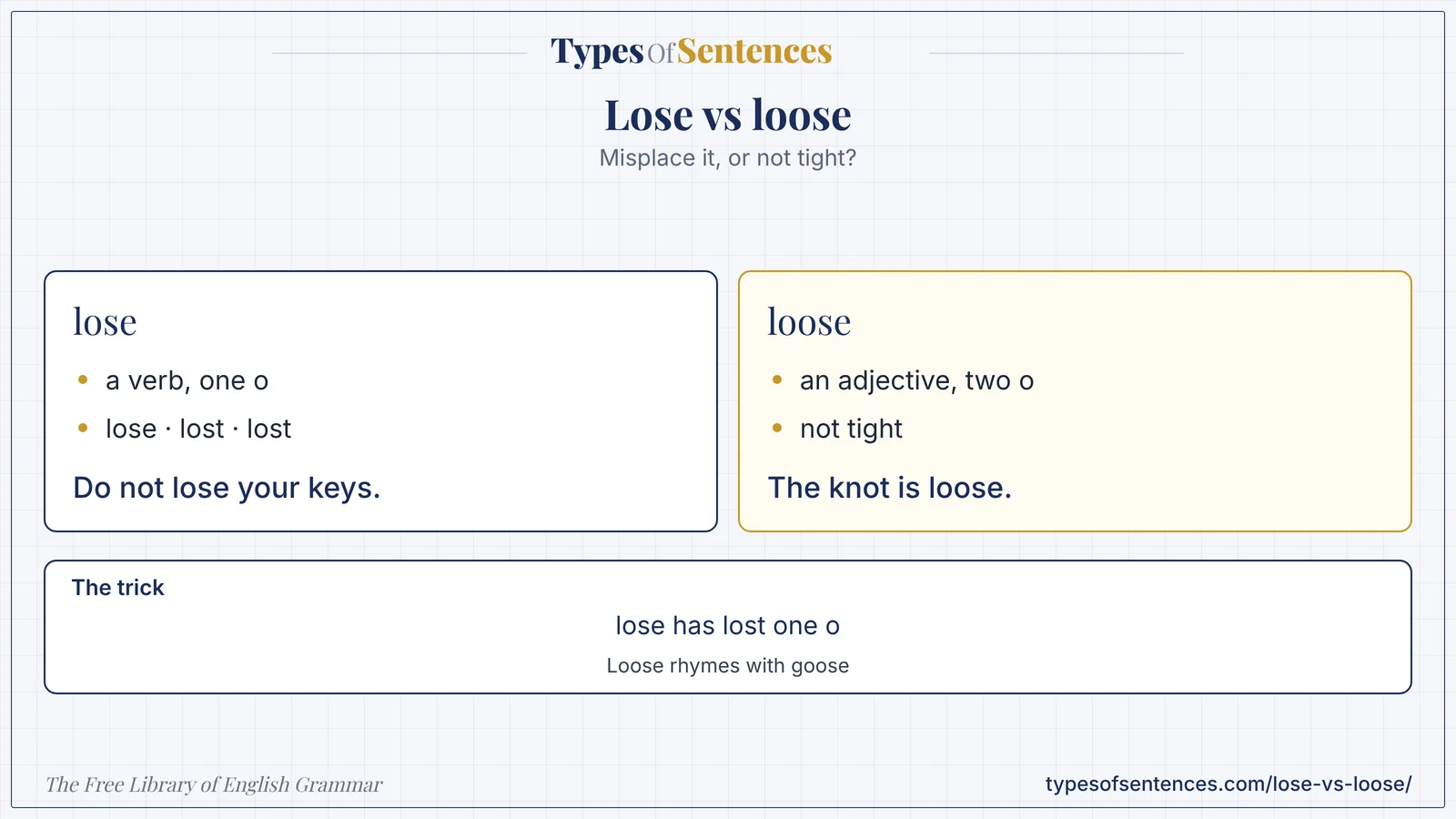
Lose is what you do to keys, games, weight, and patience. Loose is how a screw, a shirt, or a tooth can be when it is not tight.
Why it matters: If you can say misplace or fail to keep, use lose. If you can say not tight, use loose.
Summary: Lose /luz/ is a verb: lose, loses, lost, lost, losing. It means to misplace, to fail to win, or to have less. Loose /lus/ is mainly an adjective meaning not tight, not fixed, or free. It is also a noun in on the loose and a rare verb meaning to release (loose, loosed, loosed, loosing). Loosen is the common verb meaning to make less tight. A common error is loosing weight; the correct word is losing weight. Memory aid: loose has extra room, so it has an extra o.
- Lose = a verb: lose, lost, lost.
- Loose = not tight.
- Losing weight (one o).
- Loosen = make less tight.
What You’ll Learn
1. Lose vs Loose: The Short Answer
| Word | Part of speech | Meaning | Sounds like | Example |
|---|---|---|---|---|
| lose | verb | to misplace; to fail to win; to have less | choose (/luz/) | I lose my keys. |
| loose | adjective (also noun, rare verb) | not tight; not fixed; free | goose (/lus/) | The screw is loose. |
| Test | How it works | Example |
|---|---|---|
| the misplace test | replace with misplace or fail to win; if it fits, use lose | I (lose / loose) my keys. → misplace ✓ → lose |
| the tight test | replace with not tight; if it fits, use loose | The knot is (lose / loose). → not tight ✓ → loose |
| the verb test | after to, will, can, or do not, a verb is needed | Do not (lose / loose) hope. → lose |
| the sound test | say it aloud: /luz/ is lose, /lus/ is loose | choose rhymes with lose |
The verb has irregular forms, listed in the chapter on irregular verbs and in the list of verbs. The same kind of confusion between two verbs of similar spelling is explained in the guide to lay vs lie.
2. Lose in a Sentence: 20 Examples
In each example, lose (or lost, loses, losing) is a verb. It can be replaced with misplace, fail to win, or have less of. The forms are lose, loses, lost, lost, and losing.
| Lose in a sentence | Form |
|---|---|
| I always lose my keys. | present |
| She does not want to lose the game. | infinitive |
| We lost our way in the fog. | past |
| He has lost his wallet. | past participle |
| They are losing patience. | present participle |
| Don’t lose hope. | imperative |
| The team lost by one point. | past |
| I will lose five pounds this year. | future |
| You might lose your place in line. | present |
| She lost her temper. | past |
| We cannot afford to lose time. | infinitive |
| The company is losing money. | present participle |
| He never loses his cool. | present, third person |
| The phone lost its signal. | past |
| I hate to lose an argument. | infinitive |
| Many people lose sleep over exams. | present |
| She has lost interest in the project. | past participle |
| Do not lose track of the time. | imperative |
| The market lost value last year. | past |
| If you lose the receipt, you cannot return it. | present |
Notice that the past tense is lost, with one o and a t: He lost his wallet. The spelling *losed does not exist, and *loosed is a different word.
3. Loose in a Sentence: 20 Examples
In each example, loose is an adjective that describes a noun (a loose tooth), or it follows a linking verb (The knot is loose). It means not tight, not fixed, or free. One example uses loose as a noun phrase and one as a rare verb.
| Loose in a sentence | Use |
|---|---|
| The screw is loose. | adjective |
| She wore a loose shirt. | adjective |
| A loose tooth hurt him. | adjective |
| The dog is loose in the yard. | adjective |
| He gave me a few loose coins. | adjective |
| The knot came loose. | adjective |
| The rules are rather loose. | adjective |
| Her hair hung loose. | adjective |
| The lid is too loose. | adjective |
| We found a loose end in the plan. | adjective |
| The jeans fit loose around the waist. | adjective |
| A loose thread hung from the sleeve. | adjective |
| The loose soil washed away. | adjective |
| Tea is sold loose or in bags. | adjective |
| The loose pages fell from the binder. | adjective |
| He gave a loose translation. | adjective |
| The prisoner is on the loose. | noun phrase |
| The farmer loosed the cattle into the field. | verb (rare) |
| Cut the rope loose. | adjective |
| Keep the bolts loose until the end. | adjective |
The verb loosen is the usual way to say make less tight: Loosen the screw. The verb loose (to set free) is formal or literary, and the form is loose, loosed, loosed, loosing.
4. The Forms of Lose, Loose, and Loosen
| Verb | Present | Third person | Past | Past participle | -ing form |
|---|---|---|---|---|---|
| lose | lose | loses | lost | lost | losing |
| loose (rare) | loose | looses | loosed | loosed | loosing |
| loosen | loosen | loosens | loosened | loosened | loosening |
| Related word | Part of speech | Example |
|---|---|---|
| loser | noun | The loser shook hands. |
| loss | noun | The company reported a loss. |
| lost | adjective | a lost child |
| loosely | adverb | The rope was tied loosely. |
| looseness | noun | the looseness of the screw |
| loosen | verb | She loosened her tie. |
The past tense of lose is lost, not *losed or *loosed. The participle is covered in the chapter on the past participle.
5. Idioms With Lose and Loose
| Idiom | Word | Meaning | Example |
|---|---|---|---|
| lose track | lose | forget where something is or how long | I lost track of time. |
| lose weight | lose | become lighter | He lost ten pounds. |
| lose face | lose | suffer a loss of respect | He did not want to lose face. |
| lose heart | lose | become discouraged | Do not lose heart. |
| lose your temper | lose | become angry | She lost her temper. |
| lose sleep over | lose | worry about | Do not lose sleep over it. |
| lose your mind | lose | become mad (informal) | I am losing my mind. |
| on the loose | loose | free and dangerous | A tiger is on the loose. |
| loose ends | loose | unfinished details | We must tie up the loose ends. |
| loose change | loose | coins in a pocket | I have some loose change. |
| let loose | loose | release | The children were let loose in the garden. |
| a loose cannon | loose | an unpredictable person | He is a loose cannon. |
| loose-leaf | loose | separate pages in a binder | a loose-leaf notebook |
| play fast and loose | loose | act carelessly | She played fast and loose with the facts. |
6. Common Mistakes With Lose and Loose
| Mistake | Example | Correction |
|---|---|---|
| loose for the verb | *I always loose my keys. | I always lose my keys. |
| lose for the adjective | *The screw is lose. | The screw is loose. |
| loosing for losing | *He is loosing weight. | He is losing weight. |
| losed as a past tense | *We losed the game. | We lost the game. |
| loosed for lost | *We loosed the game. | We lost the game. |
| lose before a noun | *a lose shirt | a loose shirt |
| loose after to | *Do not want to loose. | Do not want to lose. |
| loose for loss | *a big loose | a big loss |
Fix: I am afraid I will loose my keys, so I loosed them once, and my belt is lose because I am loosing weight.
- I will loose my keys: a verb is needed (misplace), so I will lose my keys.
- I loosed them: the past of lose is lost.
- my belt is lose: an adjective (not tight), so loose.
- I am loosing weight: the verb lose with -ing, so losing.
- Result: I am afraid I will lose my keys, so I lost them once, and my belt is loose because I am losing weight. (the sentence is invented)
Recap in 12 seconds
Watch the lesson build itself: Lose is a verb that means to misplace or fail to win; loose is an adjective that means not tight. The video has no sound.
Exercises
Part A: Choose Lose or Loose (Exercises 1–10)
Exercise 1: I always ___ my keys.
Show Answer
Answer: lose.
Exercise 2: The screw is ___.
Show Answer
Answer: loose.
Exercise 3: Do not ___ hope.
Show Answer
Answer: lose.
Exercise 4: She wore a ___ shirt.
Show Answer
Answer: loose.
Exercise 5: We do not want to ___ the game.
Show Answer
Answer: lose.
Exercise 6: A ___ tooth hurt him.
Show Answer
Answer: loose.
Exercise 7: He is ___ weight.
Show Answer
Answer: losing.
Exercise 8: The dog is ___ in the yard.
Show Answer
Answer: loose.
Exercise 9: Many people ___ sleep over exams.
Show Answer
Answer: lose.
Exercise 10: The knot came ___.
Show Answer
Answer: loose.
Part B: Choose the Right Form (Exercises 11–20)
Exercise 11: Past of lose: We ___ the game.
Show Answer
Answer: lost.
Exercise 12: Past participle of lose: He has ___ his wallet.
Show Answer
Answer: lost.
Exercise 13: -ing of lose: They are ___ patience.
Show Answer
Answer: losing.
Exercise 14: Third person of lose: He never ___ his cool.
Show Answer
Answer: loses.
Exercise 15: Adjective: The lid is too ___.
Show Answer
Answer: loose.
Exercise 16: Verb meaning to make less tight: She ___ her tie.
Show Answer
Answer: loosened.
Exercise 17: Noun for a failure to win: The team took a ___.
Show Answer
Answer: loss.
Exercise 18: Adverb: The rope was tied ___.
Show Answer
Answer: loosely.
Exercise 19: A person who does not win: The ___ shook hands.
Show Answer
Answer: loser.
Exercise 20: Adjective meaning mislaid: a ___ child.
Show Answer
Answer: lost.
Part C: Tests and Idioms (Exercises 21–25)
Exercise 21: Which test replaces the word with misplace?
Show Answer
Answer: the misplace test → lose.
Exercise 22: Which word fits on the ___?
Show Answer
Answer: loose.
Exercise 23: Which word fits ___ track of time?
Show Answer
Answer: lose.
Exercise 24: Which word fits tie up the ___ ends?
Show Answer
Answer: loose.
Exercise 25: Which word rhymes with choose?
Show Answer
Answer: lose.
Part D: Correct the Errors (Exercises 26–30)
Exercise 26: Correct: *I always loose my keys.
Show Answer
Answer: I always lose my keys.
Exercise 27: Correct: *The screw is lose.
Show Answer
Answer: The screw is loose.
Exercise 28: Correct: *He is loosing weight.
Show Answer
Answer: He is losing weight.
Exercise 29: Correct: *We losed the game.
Show Answer
Answer: We lost the game.
Exercise 30: Correct: *a lose shirt
Show Answer
Answer: a loose shirt
Test Your Knowledge
Ready to check what you learned? Answer all 10 questions, then submit. You need 80% (8 of 10) to pass. Your answers are not stored.
View correct answers and explanations
Question 1: Which word is a verb?
✓ Correct Answer: C – lose
Lose.
Question 2: The screw is ___.
✓ Correct Answer: A – loose
Not tight.
Question 3: The past tense of lose is
✓ Correct Answer: B – lost
Lost.
Question 4: He is ___ weight.
✓ Correct Answer: D – losing
The verb lose.
Question 5: Lose rhymes with
✓ Correct Answer: C – choose
Choose.
Question 6: Do not ___ hope.
✓ Correct Answer: A – lose
A verb.
Question 7: A ___ tooth hurt him.
✓ Correct Answer: B – loose
Not fixed.
Question 8: Which word means to make less tight?
✓ Correct Answer: D – loosen
Loosen.
Question 9: The noun for a failure to win is
✓ Correct Answer: C – loss
Loss.
Question 10: on the ___
✓ Correct Answer: A – loose
On the loose.
Frequently Asked Questions
What is the difference between lose vs loose?
Lose is a verb meaning to misplace, to fail to win, or to have less (I lose my keys). Loose is an adjective meaning not tight or not fixed (a loose screw).
How do I choose lose or loose?
If the word must be a verb, or you can replace it with misplace or fail to win, use lose. If you can replace it with not tight, use loose.
Is it loosing or losing weight?
Losing weight is correct. Losing is the -ing form of lose; loosing is the -ing form of the rare verb loose (to set free).
What is the past tense of lose?
The past tense and the past participle of lose are both lost: She lost her keys. She has lost her keys.
Can loose be a verb?
Yes, but it is rare and formal: loose means to set free (He loosed the arrow). The usual verb for making something less tight is loosen.
How do I remember which is which?
Loose has an extra o, like the extra room in something that is not tight. Also, lose rhymes with choose, and loose rhymes with goose.
Why do people confuse them?
The spellings differ by one letter, and English spelling does not show the difference in sound: lose is said /luz/ and loose is said /lus/. Both words are common, so the slip is easy to make when typing fast.
Conclusion
You now know the rule for lose vs loose: lose is a verb (lose, lost, lost, losing) and loose is an adjective meaning not tight. You have seen lose in a sentence and loose in a sentence, the forms, the idioms, and the common mistakes.
Say the word aloud and test it with misplace and not tight; that settles loose vs lose every time. Next, study the other confusable words in this series.
- Garner, Bryan A. Garner’s Modern English Usage. 5th ed. Oxford University Press, 2022.: the entries on lose and loose.
- Swan, Michael. Practical English Usage. 4th ed. Oxford University Press, 2016.: the entries on spelling and pronunciation.
- Strunk, William, Jr., and E. B. White. The Elements of Style. 4th ed. Longman, 1999.: the list of words commonly misused.
- Merriam-Webster Dictionary: lose and loose: the dictionary entries (not opened when this page was written).
Last reviewed: October 29, 2026. How it was made: drafted with AI assistance, then checked with automated tests (structure, links, answer keys, spelling) and against the sources above. A person has not yet read this chapter line by line. Found a mistake? Report it.