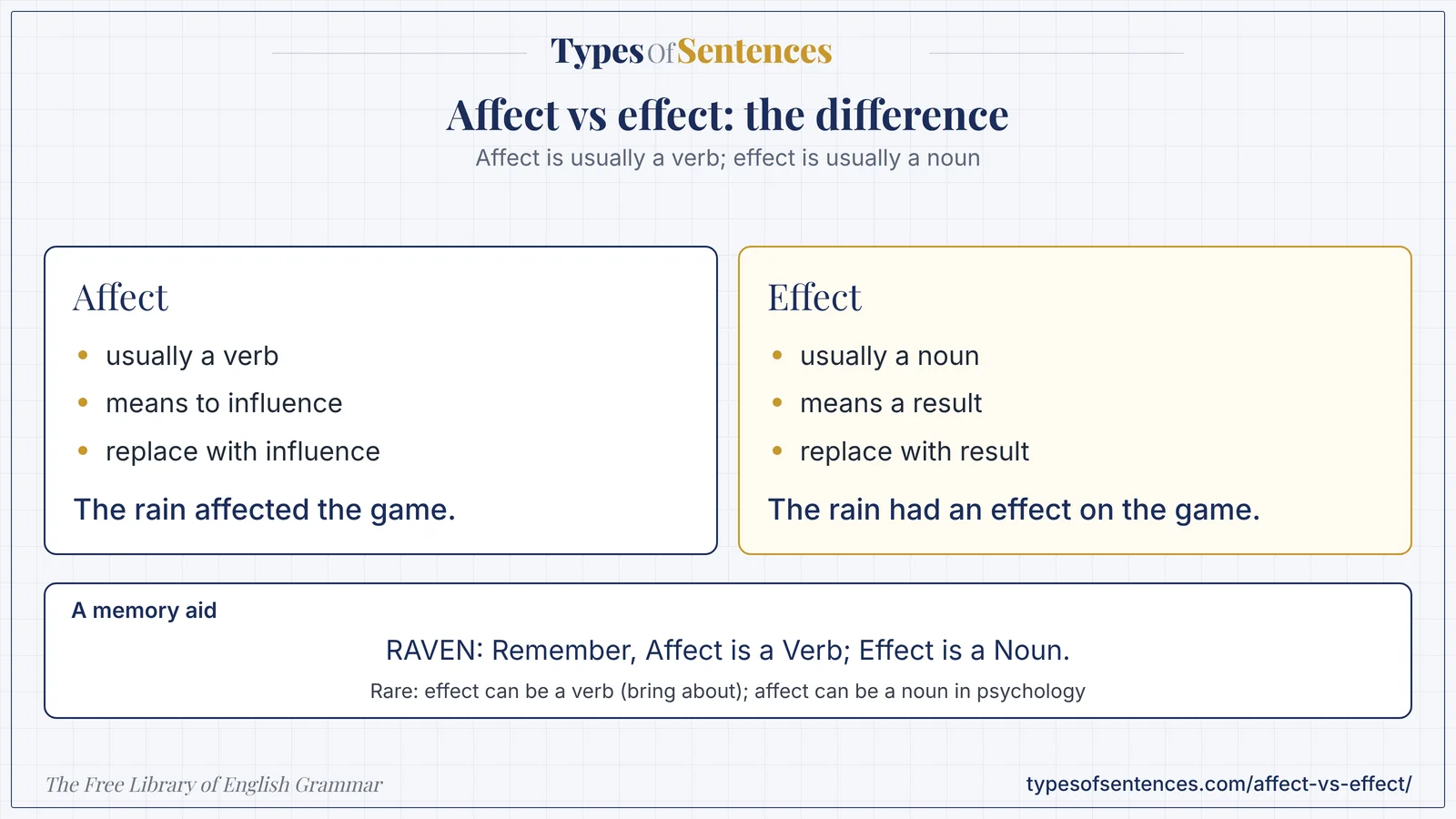
What is the difference between affect vs effect? Affect is usually a verb that means “to influence or change”: The weather affects my mood. Effect is usually a noun that means “a result”: The weather has an effect on my mood. If you can say “influence” in place of the word, use affect. If you can say “result”, use effect. The two words look and sound almost the same, which is why they are among the most confused words in English.
This page gives the short answer, then shows affect in a sentence and effect in a sentence with 25 examples of each. It explains the rare uses (effect as a verb and affect as a noun), the fixed phrases (take effect, side effect, in effect), five tests for choosing the right word, every verb form, and the mistakes writers make most often. It ends with 30 exercises and a 10-question quiz.
Think of an arrow and an echo. Affect is the arrow: it is an action that hits something (a verb). Effect is the echo: it is what is left afterward (a noun). The action comes first, and the result comes after.
Why it matters: Writers who mix the two up look careless, and the error is easy to avoid with one test: replace the word with influence or with result and see which one fits.
Summary: Affect is usually a verb meaning “to influence”; effect is usually a noun meaning “a result”. The memory aid RAVEN says: Remember, Affect is a Verb; Effect is a Noun. Use the replacement test (influence for affect; result for effect) and the article test (an effect, the effect). The rare uses are effect as a verb (to effect change means to bring it about) and affect as a noun (in psychology, a person’s displayed emotion). Fixed phrases use effect: take effect, in effect, side effect, special effects, cause and effect.
- Affect = verb = influence.
- Effect = noun = result.
- Rare: effect as a verb = bring about; affect as a noun = displayed emotion.
- Test: influence or result?
What You’ll Learn
- 1. Affect vs Effect: The Short Answer
- 2. Affect in a Sentence: 25 Examples
- 3. Effect in a Sentence: 25 Examples
- 4. Five Tests to Choose Between Affect and Effect
- 5. Effect as a Verb and Affect as a Noun: The Rare Uses
- 6. Fixed Phrases With Effect, and One With Affect
- 7. All the Forms of Affect and Effect
- 8. Common Mistakes With Affect and Effect
- 9. Why These Two Words Are So Easy to Confuse
- 10. Exercises
- 11. Test Your Knowledge
- 12. Frequently Asked Questions
- 13. Conclusion
1. Affect vs Effect: The Short Answer
| Affect | Effect | |
|---|---|---|
| usual part of speech | verb | noun |
| usual meaning | to influence or change | a result or consequence |
| replace with | influence | result |
| takes an article? | no: an affect is almost always wrong | yes: an effect, the effect |
| example | The rain affected the game. | The rain had an effect on the game. |
| pronunciation (verb or noun) | /əˈfɛkt/ | /ɪˈfɛkt/ or /əˈfɛkt/ |
| plural or -s form | affects (verb: he affects) | effects (noun plural) |
| Rare use | Word | Meaning | Example |
|---|---|---|---|
| effect as a verb | effect | to bring about | The new manager effected real change. |
| affect as a verb (a second meaning) | affect | to pretend to have or feel | She affected an accent. |
| affect as a noun | affect /ˈæfɛkt/ | the emotion a person shows (psychology) | The patient showed a flat affect. |
The two words come from different Latin roots (afficere, “to act on”, and efficere, “to bring about”), which is why their meanings differ but overlap in the idea of change. A verb names an action and a noun names a thing or result, so the choice between the two words is really a choice between two parts of speech.
2. Affect in a Sentence: 25 Examples
In all of these examples, affect is a verb. Each one can be rewritten with influence, change, or have an impact on.
| Affect in a sentence | Meaning of affect here |
|---|---|
| The cold weather affects my mood. | influences |
| Pollution affects the health of children. | harms or changes |
| The new rule will affect every student. | apply to and change |
| Her words deeply affected him. | moved him emotionally |
| How does sleep affect memory? | influence |
| The storm did not affect our plans. | change |
| Tourism is affected by the exchange rate. | influenced (passive) |
| The disease affects the lungs. | attacks or harms |
| Prices will affect what people buy. | influence |
| Nothing she said affected my decision. | changed |
| The film affected us all. | moved |
| Late buses are affecting attendance. | influencing |
| He was affected by the news. | emotionally touched |
| Noise can affect concentration. | influence |
| The tax changes affect small businesses most. | impact |
| Does caffeine affect your sleep? | change |
| The drought has affected the harvest. | reduced or changed |
| Her decision affected the whole team. | had a consequence for |
| Stress affects people differently. | influences |
| Poor lighting affects your eyes. | harms or strains |
| The ruling affects only new contracts. | applies to |
| Distance did not affect their friendship. | weaken or change |
| Music affects the way we feel. | influences |
| The delay will affect the schedule. | change |
| How badly were you affected? | harmed |
The affect verb works like any other transitive verb: it needs an object (the lungs, my mood) or becomes passive (was affected by). The chapter on types of verbs explains transitive verbs.
3. Effect in a Sentence: 25 Examples
In all of these examples, effect is a noun. Each one can be rewritten with result, influence, or impression, and each one can take an or the.
| Effect in a sentence | Meaning of effect here |
|---|---|
| The effect of the medicine was immediate. | a result |
| Sleep has a strong effect on memory. | an influence |
| The new law will take effect in January. | become active |
| One side effect is drowsiness. | an unintended result |
| The film’s special effects were amazing. | visual or sound tricks |
| Smoking has a harmful effect on health. | a result |
| The speech had little effect on the crowd. | an influence |
| We studied the cause and effect of the war. | result |
| The rule is in effect until June. | in force |
| Her tears had the desired effect. | intended result |
| The greenhouse effect warms the planet. | a scientific term |
| The effects of the storm were felt for weeks. | results |
| The ad had no effect on sales. | influence |
| The lighting created a dramatic effect. | impression |
| Please gather your personal effects. | belongings |
| The medicine takes effect in an hour. | starts to work |
| He spoke to that effect. | with that meaning |
| The effect on prices was small. | result |
| An echo effect filled the hall. | sound quality |
| What was the effect of the change? | result |
| The policy went into effect last week. | became active |
| The long-term effects are unknown. | results |
| She tried to no effect. | without result |
| The cumulative effect was dramatic. | total result |
| A calming effect spread through the room. | influence |
4. Five Tests to Choose Between Affect and Effect
| Test | How it works | Example |
|---|---|---|
| 1 the replacement test | replace the word with influence (affect) or result (effect); the one that fits is right | The noise ___ my sleep. “Influenced” fits, so use affected. |
| 2 the article test | if a, an, the, or this comes before the word, it is a noun: effect | The ___ was dramatic. The marks a noun, so use effect. |
| 3 RAVEN | Remember, Affect is a Verb; Effect is a Noun | Heat can affect plastic. (verb) · Heat has an effect on plastic. (noun) |
| 4 the verb-form test | a word ending in -ed or -ing after a helper is almost always affected or affecting | Sales were affected. |
| 5 the preposition test | effect on or effect of is the usual noun pattern; the verb takes a direct object with no on | an effect on sales · to affect sales |
Choose the right word: The new policy will (affect/effect) every employee, and its (affect/effect) will be felt next year.
- First blank: the word is the verb of the sentence (will ___ every employee). Replace with influence: it fits. So the answer is affect.
- Second blank: the word follows its and is the subject (its ___ will be felt). A possessive before it marks a noun. Replace with result: it fits. So the answer is effect.
- Result: The new policy will affect every employee, and its effect will be felt next year. (the sentence is invented)
5. Effect as a Verb and Affect as a Noun: The Rare Uses
| Use | Meaning | Examples | Note |
|---|---|---|---|
| effect as a verb | to bring about; to cause to happen | The union effected a change in policy. · to effect a transfer | formal; it almost always has change, a transfer, a settlement, or a cure as its object |
| effect as a verb: compare with affect | effect change = make it happen; affect change = influence a change that already exists | The law effected change. · The law affected change. | the difference is real but subtle |
| affect as a verb (pretend) | to put on or fake | He affected surprise. · an affected manner | affected as an adjective also means artificial |
| affect as a noun (psychology) | a visible emotional state | flat affect · blunted affect · inappropriate affect | pronounced /ˈæfɛkt/ with stress on the first syllable |
These rare uses are the reason that no rule such as “affect is always a verb” is entirely safe. Dictionaries and usage guides list them; Garner’s usage guide and Merriam-Webster both describe them. In ordinary writing, treat affect as a verb and effect as a noun, and use the rare forms only when you mean them. When effect is a verb, look for an object such as change.
| Related word | Meaning | Example |
|---|---|---|
| effective | producing the intended result | an effective teacher |
| affective | relating to emotions | affective disorders |
| affectation | artificial behavior | a literary affectation |
| effectual | producing a result (formal) | an effectual remedy |
| effectively | in effect; with good results | He effectively resigned. |
6. Fixed Phrases With Effect, and One With Affect
| Phrase | Meaning | Example |
|---|---|---|
| take effect | begin to apply or work | The law takes effect on Monday. |
| in effect | in force; or in practice | The ban is in effect. · In effect, she quit. |
| put (something) into effect | make it apply | The council put the plan into effect. |
| go into effect | begin to apply | The new fee goes into effect in May. |
| side effect | an unintended result | Dizziness is a common side effect. |
| special effects | film and sound tricks | The special effects won an award. |
| cause and effect | the link between a cause and its result | a clear cause and effect |
| to that effect | with that meaning | He said something to that effect. |
| to no effect | without result | She argued to no effect. |
| personal effects | belongings | He collected his personal effects. |
| greenhouse effect | the warming of the atmosphere by trapped heat | the greenhouse effect |
| to affect an accent | to put on a way of speaking | He affected a British accent. |
7. All the Forms of Affect and Effect
| Word | Base | Third person | Past | Present participle | Noun plural |
|---|---|---|---|---|---|
| affect (verb) | affect | affects | affected | affecting | — |
| effect (verb) | effect | effects | effected | effecting | — |
| effect (noun) | effect | — | — | — | effects |
| affect (noun, psychology) | affect | — | — | — | affects |
| Mix-up | Why it happens | Right form |
|---|---|---|
| effected for affected | the two verbs look alike | The delay affected us. (effected would mean “brought about”) |
| affects for effects (noun) | the plural noun ends in -s, like the verb form | The effects were large. · It affects us. |
8. Common Mistakes With Affect and Effect
| Mistake | Example | Correction |
|---|---|---|
| noun use of the verb | *The affect of the storm was severe. | The effect of the storm was severe. |
| verb use of the noun | *The storm effected the town. | The storm affected the town. |
| side affect | *a side affect of the drug | a side effect of the drug |
| take affect | *The rule takes affect today. | The rule takes effect today. |
| an affect outside psychology | *It had no affect. | It had no effect. |
| effect where influence is meant | *Prices effect sales. | Prices affect sales. |
| effects as a verb form | *It effects everyone. | It affects everyone. |
| in affect | *In affect, he left. | In effect, he left. |
| cause and affect | *cause and affect | cause and effect |
| special affects | *great special affects | great special effects |
Fix: The new rule takes affect on Monday, and its side affects will effect everyone who drives.
- takes affect: the fixed phrase is takes effect.
- side affects: a result is a noun, so side effects.
- will effect everyone: the sense is “will influence”, so the verb is will affect.
- Result: The new rule takes effect on Monday, and its side effects will affect everyone who drives. (the sentence is invented)
9. Why These Two Words Are So Easy to Confuse
| Reason | Explanation |
|---|---|
| spelling | the two words differ in one letter, the first |
| sound | the first syllable is often unstressed, so both sound like /əˈfɛkt/ or /ɪˈfɛkt/ |
| meaning | both are about change: one is the act, the other the outcome |
| roots | both come from Latin verbs that mean doing something to something |
| rare uses | effect can be a verb and affect can be a noun, so no rule is perfect |
| autocorrect | spell checkers accept both words and do not check the meaning |
Because the two words are homophones in many accents, a speaker rarely hears the difference; the choice is made in writing. For other pairs of confusable words, see the chapter on common grammar errors and the guide to precise word choice. The term for words that sound alike is explained in the grammar glossary.
Recap in 12 seconds
Watch the lesson build itself: Affect is usually a verb meaning to influence and effect is usually a noun meaning a result. The video has no sound.
Exercises
Part A: Choose Affect or Effect (Exercises 1–10)
Exercise 1: The weather will ___ our plans.
Show Answer
Answer: affect (a verb: influence).
Exercise 2: The ___ of the new law was immediate.
Show Answer
Answer: effect (a noun after the).
Exercise 3: Sleep can ___ your memory.
Show Answer
Answer: affect.
Exercise 4: The medicine had no ___ on his cough.
Show Answer
Answer: effect (effect on).
Exercise 5: Loud noise ___ concentration.
Show Answer
Answer: affects (third person verb).
Exercise 6: The ___ of the storm lasted for weeks.
Show Answer
Answer: effects or effect: a noun; effects is more natural for many results.
Exercise 7: How will the price rise ___ sales?
Show Answer
Answer: affect.
Exercise 8: One side ___ of the drug is sleepiness.
Show Answer
Answer: effect.
Exercise 9: The new rule takes ___ in March.
Show Answer
Answer: effect (take effect).
Exercise 10: Her speech deeply ___ the audience.
Show Answer
Answer: affected.
Part B: Choose the Right Form (Exercises 11–18)
Exercise 11: The decision was (affected/effected) by the budget.
Show Answer
Answer: affected.
Exercise 12: The manager (affected/effected) a change in policy.
Show Answer
Answer: effected (brought about).
Exercise 13: The (affects/effects) of the flood were serious.
Show Answer
Answer: effects (a plural noun).
Exercise 14: This law (affects/effects) small shops.
Show Answer
Answer: affects.
Exercise 15: Stress is (affecting/effecting) her health.
Show Answer
Answer: affecting.
Exercise 16: Several (affects/effects) were used in the film.
Show Answer
Answer: effects (special effects).
Exercise 17: He (affected/effected) a calm manner he did not feel.
Show Answer
Answer: affected (pretended).
Exercise 18: It had a calming (affect/effect) on the class.
Show Answer
Answer: effect.
Part C: Name the Part of Speech (Exercises 19–24)
Exercise 19: In The rain affected the game, what is affected?
Show Answer
Answer: a verb.
Exercise 20: In The rain had an effect, what is effect?
Show Answer
Answer: a noun.
Exercise 21: In She effected a change, what is effected?
Show Answer
Answer: a verb (rare: brought about).
Exercise 22: In a flat affect, what is affect?
Show Answer
Answer: a noun (psychology).
Exercise 23: Which word can follow an: affect or effect?
Show Answer
Answer: effect (an effect).
Exercise 24: Which means “to pretend”: affect or effect?
Show Answer
Answer: affect.
Part D: Correct the Errors (Exercises 25–30)
Exercise 25: Correct: *The affect of the rain was bad.
Show Answer
Answer: The effect of the rain was bad.
Exercise 26: Correct: *It effects everyone.
Show Answer
Answer: It affects everyone.
Exercise 27: Correct: *a side affect
Show Answer
Answer: a side effect
Exercise 28: Correct: *The law takes affect today.
Show Answer
Answer: The law takes effect today.
Exercise 29: Correct: *cause and affect
Show Answer
Answer: cause and effect
Exercise 30: Correct: *In affect, he quit.
Show Answer
Answer: In effect, he quit.
Test Your Knowledge
Ready to check what you learned? Answer all 10 questions, then submit. You need 80% (8 of 10) to pass. Your answers are not stored.
View correct answers and explanations
Question 1: Which word is usually a verb?
✓ Correct Answer: B – affect
Affect.
Question 2: The film had a strong ___ on me.
✓ Correct Answer: B – effect
A noun after a.
Question 3: RAVEN stands for
✓ Correct Answer: A – Remember, Affect is a Verb; Effect is a Noun
The memory aid.
Question 4: Which is correct?
✓ Correct Answer: D – The effect was bad.
A noun is needed.
Question 5: The law ___ effect on Monday.
✓ Correct Answer: C – takes
Take effect.
Question 6: She ___ change in the company. (brought about)
✓ Correct Answer: C – effected
The rare verb.
Question 7: Which is a side result of a drug?
✓ Correct Answer: B – side effect
A noun.
Question 8: Heat can ___ plastic.
✓ Correct Answer: D – affect
A verb.
Question 9: Flat affect is a term from
✓ Correct Answer: A – psychology
A noun in psychology.
Question 10: Which can follow the article an?
✓ Correct Answer: C – effect
An effect.
Frequently Asked Questions
What is the difference between affect vs effect?
Affect is usually a verb meaning to influence or change; effect is usually a noun meaning a result. The rain affected the game, and the rain had an effect on the game.
How do you use affect in a sentence?
Use affect as a verb with an object: Noise affects concentration. The news affected her deeply. The easy test is to replace it with influence.
How do you use effect in a sentence?
Use effect as a noun after a, an, the, or this: The effect was immediate. The easy test is to replace it with result.
Can effect be a verb?
Yes, but rarely. Effect as a verb means to bring about, and it usually has an object such as change: The union effected a change in the rules. In everyday writing you will almost always need affect.
Can affect be a noun?
Yes, in psychology, where affect means the emotion a person shows, as in flat affect. It is pronounced with the stress on the first syllable. Outside that field, use effect for the noun.
Is it side effect or side affect?
It is side effect. A side effect is a result, so it is a noun, and the noun is effect.
What is the difference between affected and effected?
Affected means influenced (The delay affected us) or pretended (He affected a calm manner). Effected means brought about (The law effected a change), and it is rare.
Conclusion
You now know the difference between affect vs effect: affect is usually a verb meaning influence, and effect is usually a noun meaning result. You have seen affect in a sentence and effect in a sentence, effect as a verb, affect as a noun, the fixed phrases, all the verb forms, and the common mistakes.
Use the replacement test (influence or result) and the article test (an effect) whenever you are unsure. Next, study another famous trio of confusable words: their, there, and they’re.
- Garner, Bryan A. Garner’s Modern English Usage. 5th ed. Oxford University Press, 2022.: the entry on affect and effect, including the rare uses.
- Strunk, William, Jr., and E. B. White. The Elements of Style. 4th ed. Longman, 1999.: the entry on affect and effect among the words commonly misused.
- Huddleston, Rodney, and Geoffrey K. Pullum. The Cambridge Grammar of the English Language. Cambridge University Press, 2002.: the forms and functions of verbs and nouns.
- Merriam-Webster Dictionary: affect and effect: the dictionary entries (not opened when this page was written).
Last reviewed: October 29, 2026. How it was made: drafted with AI assistance, then checked with automated tests (structure, links, answer keys, spelling) and against the sources above. A person has not yet read this chapter line by line. Found a mistake? Report it.