A prepositional phrase is a preposition, its object, and any words that modify the object: in the garden, with great care, after a long day. It is often called a prep phrase for short. A prepositional phrase never stands alone as a sentence, and it always works as a modifier, either of a noun (an adjective phrase) or of a verb, adjective, or adverb (an adverb phrase).
This chapter covers the structure of prepositional phrases, with prepositional phrase examples of each type. You will learn how preposition phrases work as adjectives and adverbs, which common phrases to learn as units, how to handle several in a row, how they affect subject-verb agreement, and how to punctuate them. Thirty exercises and a quiz follow.
A prepositional phrase adds detail: where, when, how, why, which one, whose. It is a small package that starts with a preposition and ends with a noun phrase.
Why it matters: Because the phrase comes between the main words of a sentence, it can mislead you about the subject or the verb. This chapter shows how to see through it.
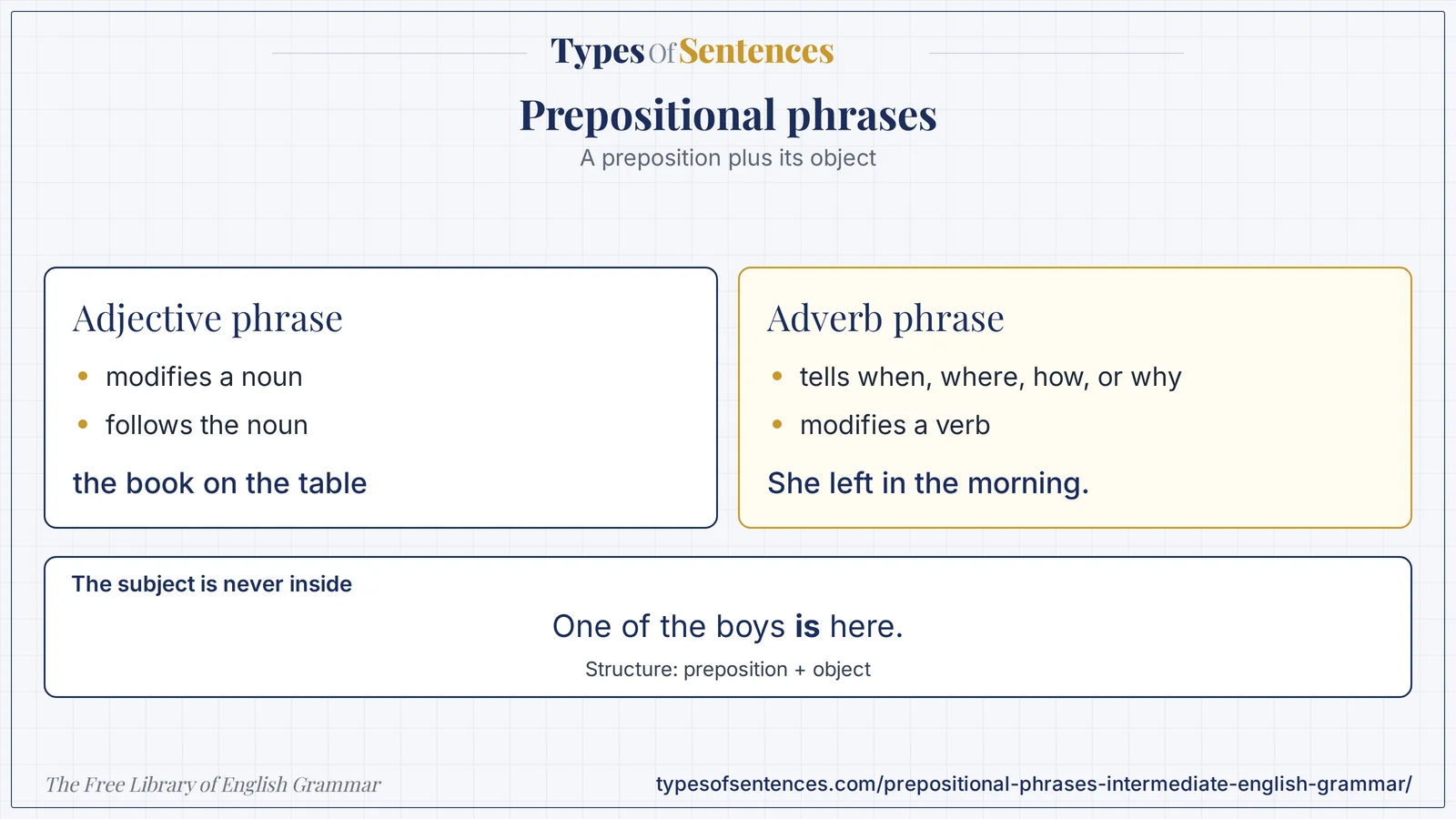
Summary: A prepositional phrase = preposition + object (a noun phrase, an object pronoun, a gerund phrase, or a noun clause). As an adjective phrase it modifies a noun and follows it. As an adverb phrase it tells when, where, how, why, or how much. A prepositional phrase never contains the subject of a sentence.
- Structure: preposition + object (+ modifiers of the object).
- Adjective phrase: the book on the table (modifies a noun).
- Adverb phrase: She left in the morning (modifies a verb).
- The subject is never inside a prepositional phrase: One of the boys is late.
What You’ll Learn
- 1. What Is a Prepositional Phrase?
- 2. Structure of a Prepositional Phrase
- 3. Adjective Phrases
- 4. Adverb Phrases
- 5. Common Prepositional Phrases
- 6. Multiple Prepositional Phrases
- 7. Prepositional Phrases and Subject-Verb Agreement
- 8. Punctuating Prepositional Phrases
- 9. What Relationships Do These Phrases Show?
- 10. Common Errors with Prepositional Phrases
- 11. Exercises
- 12. Test Your Knowledge
- 13. Frequently Asked Questions
- 14. Conclusion
1. What Is a Prepositional Phrase?
A prepositional phrase begins with a preposition and ends with its object. The prepositions themselves are studied in the chapter on types of prepositions; here the focus is the whole phrase.
| Prepositional phrase | Preposition | Object |
|---|---|---|
| in the garden | in | the garden |
| with great care | with | great care |
| after a long day | after | a long day |
| between you and me | between | you and me |
| by working hard | by | working hard |
| about what he said | about | what he said |
A prepositional phrase does one of two jobs: it works as an adjective (modifying a noun) or as an adverb (modifying a verb, an adjective, or another adverb). It is also used to complete certain verbs and adjectives, as in depends on the weather and good at math.
2. Structure of a Prepositional Phrase
The object of the preposition can be any of these.
| Object | Example |
|---|---|
| noun phrase | in the old house |
| pronoun (object form) | with her, for them, between you and me |
| gerund phrase | by studying every day, after finishing the report |
| noun clause | about what he said, of how she got there |
| adverb (some phrases) | until now, from here, since then |
After a preposition, use the object form, even in a pair. See the chapter on types of pronouns.
An infinitive cannot be the object of a preposition: good at swimming, not good at to swim. The gerund is the correct form; see the chapter on gerunds.
3. Adjective Phrases
A prepositional phrase that modifies a noun or pronoun is an adjective phrase. It follows the noun and answers Which one? or What kind?.
| Sentence | Phrase | Noun modified |
|---|---|---|
| The book on the table is mine. | on the table | book |
| She is a woman of great courage. | of great courage | woman |
| The girl in red is my sister. | in red | girl |
| I bought a cup of tea. | of tea | cup |
| The road to the village is closed. | to the village | road |
- The preposition of is the most common in adjective phrases: a cup of tea, the end of the road, a friend of mine.
- Two or more adjective phrases can follow one noun: the book on the table by the window.
- Test: if you can move the phrase or replace it with an adjective (a woman of courage → a courageous woman), it is an adjective phrase.
4. Adverb Phrases
A prepositional phrase that modifies a verb, an adjective, or another adverb is an adverb phrase. It tells when, where, how, why, or to what degree.
| Question | Example | Meaning |
|---|---|---|
| When? | She left in the morning. | time |
| Where? | They live in Mumbai. | place |
| How? | He spoke with great care. | manner |
| Why? | We stayed home because of the rain. | cause |
| For what purpose? | She runs for exercise. | purpose |
| By what means? | They traveled by train. | means |
| With whom? | He went with his friends. | accompaniment |
| To what degree? (with an adjective) | She is good at math. | modifies the adjective good |
An adverb phrase can come at the end, at the beginning, or in the middle of a sentence. When it comes first, a comma often follows it: In the morning, she left. The adverbs they replace are in the chapter on types of adverbs.
5. Common Prepositional Phrases
Many prepositional phrases are used so often that you should learn them as units.
| Group | Examples |
|---|---|
| time | in the morning, at noon, on Monday, for a week, during the war, until midnight |
| place | in the garden, on the table, at the station, near the door, under the bridge |
| manner | with care, in a hurry, by hand, in silence, at once |
| cause and purpose | because of the rain, due to illness, for fun, in order to, on account of |
| means and instrument | by car, with a pen, through hard work, by email |
| fixed expressions | in fact, at least, on the other hand, in spite of, by the way, for example, in addition, as a result |
The fixed expressions at the end of the table often work as transitions between sentences: On the other hand, the plan is risky. Learn them with their prepositions, because changing the preposition changes or breaks the phrase.
6. Multiple Prepositional Phrases
Prepositional phrases can follow each other, either each modifying the previous object or all modifying the same word.
| Chain | What each phrase modifies |
|---|---|
| the key to the door of the house in the village | to the door modifies key; of the house modifies door; in the village modifies house |
| She sang beautifully in the hall last night. | all modify the verb sang (manner, place, time) |
A long string of phrases can be ambiguous or tiring. In I saw the man with the telescope, with the telescope could modify man or saw. If the meaning is unclear, rewrite: I saw the man who had a telescope, or Using a telescope, I saw the man.
7. Prepositional Phrases and Subject-Verb Agreement
The subject of a sentence is never inside a prepositional phrase, so the verb does not agree with the object of the preposition.
| Sentence | Subject | Verb |
|---|---|---|
| One of the boys is late. | one | is |
| The cost of the repairs is high. | cost | is |
| The students in the class are late. | students | are |
| The box of apples is heavy. | box | is |
| The teacher, along with the students, is late. | teacher | is |
The subject is box. Cross out the prepositional phrase to find it: The box … is heavy.
8. Punctuating Prepositional Phrases
| Situation | Comma? | Example |
|---|---|---|
| Long introductory phrase | comma after | After a long and difficult day at work, she went home. |
| Short introductory phrase | comma optional | In May we leave. / In May, we leave. |
| Two or more introductory phrases | comma after the last | In the morning, at the station, we met. |
| Phrase at the end, essential | no comma | She left in the morning. |
| Non-essential interrupter | commas around it | Maria, in my opinion, is right. |
| Transitional expression | comma | On the other hand, the plan is risky. |
Style guides differ on short introductory phrases. Many writers use a comma for clarity when the phrase has four or more words, and leave it out when it is short and the sentence is easy to read. Be consistent.
9. What Relationships Do These Phrases Show?
The small words that start these phrases express many kinds of relationship, not just place. Knowing the relationships helps you choose the right word and understand what a phrase adds to its sentence.
| Relationship | Examples | Question answered |
|---|---|---|
| place | in the garden, on the table, at the station | where? |
| time | after dinner, during the film, before noon | when? |
| direction | to the market, toward the door, into the room | which way? |
| cause or reason | because of the rain, owing to the delay | why? |
| purpose | for exercise, for your benefit | what for? |
| means or instrument | by bus, with a knife, through hard work | how? |
| accompaniment | with Tom, along with the others | with whom? |
| possession or relation | the roof of the house, a friend of mine | whose? of what? |
| subject matter | a book about birds, a talk on grammar | about what? |
| concession | despite the noise, in spite of the rain | although what? |
The same preposition can show different relationships: by shows place (by the window), time (by noon), means (by bus), and agent (written by Maria). The meaning comes from the whole phrase, which is why prepositions are learned in context and not as isolated words.
10. Common Errors with Prepositional Phrases
| Error | Correction | Rule |
|---|---|---|
| between you and I | between you and me | object form after a preposition |
| The box of apples are heavy. | The box of apples is heavy. | agree with the subject, not the object of the preposition |
| I saw a dog in the park with a long tail. | In the park, I saw a dog with a long tail. | keep the phrase next to the word it modifies |
| She is good at to swim. | She is good at swimming. | a gerund follows a preposition |
| Where is it at? | Where is it? | do not add a final preposition |
| Walking down the street. (alone) | Walking down the street, she found a wallet. | a phrase is not a sentence |
| The teacher, along with the students, are late. | The teacher, along with the students, is late. | along with does not make the subject plural |
Fix: The manager of the stores in the city are meeting with he and I on Monday in the afternoon.
- The subject is manager, not stores or city: is meeting.
- After with, use the object forms: him and me.
- Reorder the time phrases: on Monday afternoon is smoother.
- Result: The manager of the stores in the city is meeting with him and me on Monday afternoon.
Recap in 12 seconds
Watch the lesson build itself: A prepositional phrase works as an adjective or an adverb, and the subject is never inside one. The video has no sound.
Exercises
Part A: Find the Prepositional Phrase (Exercises 1–6)
Exercise 1: Find the phrase: The book on the table is mine.
Show Answer
Answer: on the table.
Exercise 2: Find the object: with great care
Show Answer
Answer: great care.
Exercise 3: Find the preposition and the object: by working hard
Show Answer
Answer: by; working hard (a gerund phrase).
Exercise 4: Find the phrase: She spoke with great care.
Show Answer
Answer: with great care.
Exercise 5: Is after he left a prepositional phrase?
Show Answer
Answer: No. It is a clause, because he left has a subject and a verb.
Exercise 6: Is after the meeting a prepositional phrase?
Show Answer
Answer: Yes.
Part B: Adjective or Adverb? (Exercises 7–12)
Exercise 7: Job: the girl in red
Show Answer
Answer: Adjective phrase.
Exercise 8: Job: She left in the morning.
Show Answer
Answer: Adverb phrase.
Exercise 9: Job: a cup of tea
Show Answer
Answer: Adjective phrase.
Exercise 10: Job: She is good at math.
Show Answer
Answer: Adverb phrase modifying the adjective good (or a complement of it).
Exercise 11: Job: the road to the village
Show Answer
Answer: Adjective phrase.
Exercise 12: Job: They traveled by train.
Show Answer
Answer: Adverb phrase (means).
Part C: Objects (Exercises 13–17)
Exercise 13: Choose: She gave it to John and (I/me).
Show Answer
Answer: me.
Exercise 14: Choose: Between you and (I/me), it is true.
Show Answer
Answer: me.
Exercise 15: Choose: She is good at (swim/swimming).
Show Answer
Answer: swimming.
Exercise 16: Name the object type: about what he said
Show Answer
Answer: Noun clause.
Exercise 17: Fix it: She is good at to swim.
Show Answer
Answer: She is good at swimming.
Part D: Agreement (Exercises 18–23)
Exercise 18: Choose: One of the boys (is/are) late.
Show Answer
Answer: is.
Exercise 19: Choose: The cost of the repairs (is/are) high.
Show Answer
Answer: is.
Exercise 20: Choose: The students in the class (is/are) late.
Show Answer
Answer: are.
Exercise 21: Choose: The teacher, along with the students, (is/are) late.
Show Answer
Answer: is.
Exercise 22: Fix it: The box of apples are heavy.
Show Answer
Answer: The box of apples is heavy.
Exercise 23: Name the subject: The manager of the stores is meeting us.
Show Answer
Answer: manager.
Part E: Punctuation (Exercises 24–27)
Exercise 24: Punctuate: After a long and difficult day at work she went home.
Show Answer
Answer: After a long and difficult day at work, she went home.
Exercise 25: Punctuate: She left in the morning.
Show Answer
Answer: No comma.
Exercise 26: Punctuate: On the other hand the plan is risky.
Show Answer
Answer: On the other hand, the plan is risky.
Exercise 27: Punctuate: Maria in my opinion is right.
Show Answer
Answer: Maria, in my opinion, is right.
Part F: Errors and Style (Exercises 28–30)
Exercise 28: Move the phrase: I saw a dog in the park with a long tail.
Show Answer
Answer: In the park, I saw a dog with a long tail.
Exercise 29: Fix it: Where is it at?
Show Answer
Answer: Where is it?
Exercise 30: Make the meaning clear: I saw the man with the telescope. (the man had it)
Show Answer
Answer: I saw the man who had a telescope.
Test Your Knowledge
Ready to check what you learned? Answer all 10 questions, then submit. You need 80% (8 of 10) to pass. Your answers are not stored.
View correct answers and explanations
Question 1: What does a prepositional phrase begin with?
✓ Correct Answer: C – A preposition
A prepositional phrase begins with a preposition and ends with its object.
Question 2: Which is a prepositional phrase?
✓ Correct Answer: B – in the garden
In the garden begins with the preposition in.
Question 3: Which job does on the table do in the book on the table?
✓ Correct Answer: C – Adjective
It modifies the noun book.
Question 4: Which job does in the morning do in She left in the morning?
✓ Correct Answer: A – Adverb
It tells when she left.
Question 5: Which is correct?
✓ Correct Answer: B – between you and me
Use the object form after a preposition.
Question 6: Which is correct?
✓ Correct Answer: D – The box of apples is heavy.
The subject is box.
Question 7: Which can be the object of a preposition?
✓ Correct Answer: A – A gerund phrase
A gerund can follow a preposition; an infinitive cannot.
Question 8: Which is correct?
✓ Correct Answer: D – The teacher, along with the students, is late.
Along with does not make the subject plural.
Question 9: Which is a transitional prepositional phrase?
✓ Correct Answer: A – on the other hand
On the other hand links ideas.
Question 10: Which is a fragment?
✓ Correct Answer: C – Walking down the street.
A phrase alone is a fragment.
Frequently Asked Questions
What is a prepositional phrase?
A prepositional phrase is a group of words that begins with a preposition and ends with its object, such as in the garden or with great care. It works as an adjective or an adverb.
What are prepositional phrases?
Prepositional phrases are the phrases that give details of time, place, manner, cause, and more. They can modify nouns (adjective phrases) or verbs, adjectives, and adverbs (adverb phrases).
What are prepositional phrase examples?
On the table, in the morning, with great care, because of the rain, by train, and after a long day are prepositional phrase examples.
What is a prep phrase?
A prep phrase is short for prepositional phrase. Teachers often use the abbreviation when marking up sentences.
What are preposition phrases used for?
Preposition phrases are used to add information. They answer questions such as Which one?, When?, Where?, How?, and Why?, and they link ideas in transitions such as in addition.
Can a prepositional phrase be the subject of a sentence?
No. The subject of a sentence is never inside a prepositional phrase. In One of the boys is late, the subject is one, not boys.
Do I need a comma after a prepositional phrase?
Use a comma after a long introductory prepositional phrase (After a long day at work, she went home). After a short one, the comma is optional. No comma is needed when the phrase comes at the end of the sentence.
Conclusion
You now know what a prepositional phrase is, how it is built, and the two jobs it does: adjective and adverb. You can use common phrases, handle several in a row, keep subject-verb agreement across them, punctuate them, and avoid the usual errors.
Practice by finding the prepositional phrases in a paragraph and naming the word each one modifies. Next, you will study participial phrases.
- Merriam-Webster Dictionary: prepositional phrase: the dictionary definition of a prepositional phrase.
- Purdue Online Writing Lab: Grammar: reference section on prepositions and phrases.
- Quirk, Randolph, et al. A Comprehensive Grammar of the English Language. Longman, 1985.: the prepositional phrase and its functions.
- Huddleston, Rodney, and Geoffrey K. Pullum. The Cambridge Grammar of the English Language. Cambridge University Press, 2002.: prepositions and their complements.
Last reviewed: October 29, 2026. How it was made: drafted with AI assistance, then checked with automated tests (structure, links, answer keys, spelling) and against the sources above. A person has not yet read this chapter line by line. Found a mistake? Report it.