ACT English rhetorical skills are the skills the test uses to ask whether a passage is clear, concise, well organized, and suited to its purpose, as opposed to whether a sentence follows a grammar rule. The questions ask you to remove a repeated idea, choose a more exact word, match a tone, add a transition, or decide where a sentence belongs.
The ACT rhetorical skills fall into two reporting categories, Production of Writing and Knowledge of Language, and the third category, Conventions of Standard English, covers grammar and punctuation. This page explains the ACT production of writing questions and the ACT knowledge of language questions, shows how to handle ACT English style questions, and ends with 30 exercises and a 10-question quiz. Check act.org for the current test format before you test.
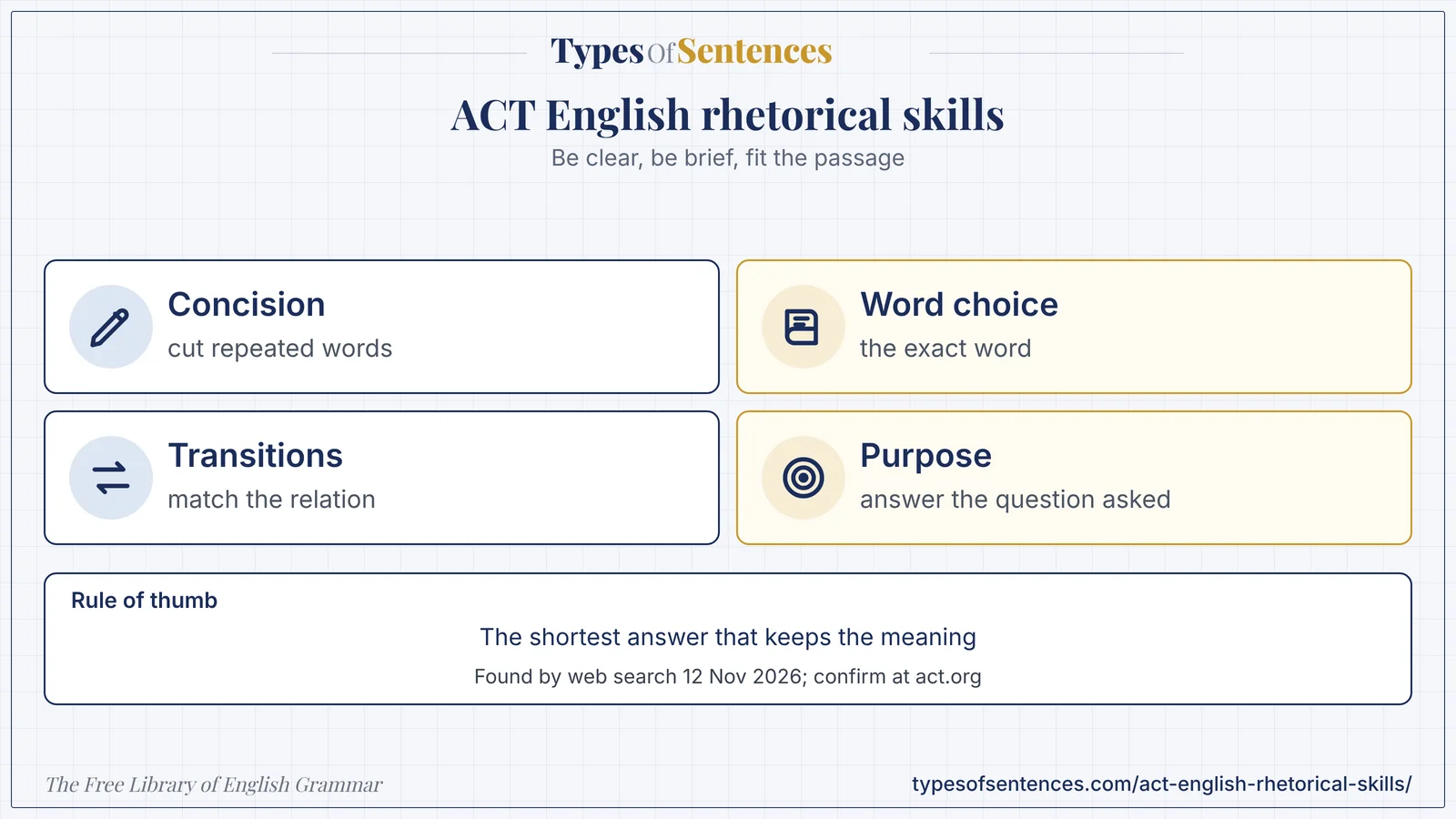
Rhetorical skills are about how well a passage works, not only whether it is correct.
Why it matters: The shortest answer that keeps the meaning, fits the tone, and does not repeat an idea is usually the best answer.
Summary: On the Enhanced ACT, English has 50 questions in 35 minutes, reported in three categories: Conventions of Standard English, Production of Writing, and Knowledge of Language. The rhetorical questions test concision (cut repeated words and wordy phrases), word choice (choose the exact word), style and tone (keep one register), transitions (match the relation between ideas), organization (put sentences and paragraphs in logical order), and purpose (add, delete, or revise to meet the writer’s goal). Test the answer against the passage, not against your taste. “NO CHANGE” is correct if the passage already works.
- Concision: the shortest answer that keeps the meaning.
- Style: keep one tone.
- Transitions: match the relation.
- Purpose: answer the question that is asked.
What You’ll Learn
- 1. ACT English Rhetorical Skills: The Short Answer
- 2. Concision: Redundancy and Wordy Phrases
- 3. Word Choice, Style, and Tone
- 4. Transitions: Match the Relation
- 5. Organization, Purpose, and “Which Choice Best” Questions
- 6. A Four-Step Method
- 7. Common Traps in ACT Rhetorical Questions
- 8. Exercises
- 9. Test Your Knowledge
- 10. Frequently Asked Questions
- 11. Conclusion
1. ACT English Rhetorical Skills: The Short Answer
| Category | What it tests | Typical question |
|---|---|---|
| Production of Writing | topic development, purpose, organization, unity, and cohesion | Which choice best introduces the paragraph? |
| Knowledge of Language | word choice, style, tone, and concision | Which choice is the most concise? |
| Conventions of Standard English | grammar, usage, and punctuation | Which choice is a complete sentence? |
| Step | Action |
|---|---|
| 1 | read the sentence before and after the underlined part |
| 2 | read the question: it often says “best”, “most concise”, or “most consistent” |
| 3 | eliminate answers that repeat an idea, change the tone, or add new facts |
| 4 | choose NO CHANGE if the original works |
The reporting categories above were found by a web search in November 2026 and not on act.org itself, so confirm them there. The name rhetorical skills is also the older ACT name for questions about strategy, organization, and style, which is why many books still use it.
2. Concision: Redundancy and Wordy Phrases
The most common rhetorical question asks for the most concise choice. The test treats a repeated idea as an error even when every word is correct.
| Redundant phrase | Better |
|---|---|
| free gift | gift |
| past history | history |
| end result | result |
| final outcome | outcome |
| each and every | each |
| close proximity | proximity |
| advance planning | planning |
| revert back | revert |
| repeat again | repeat |
| join together | join |
| unexpected surprise | surprise |
| basic fundamentals | fundamentals |
| circle around | circle |
| added bonus | bonus |
| completely finished | finished |
| future plans | plans |
| absolutely essential | essential |
| merge together | merge |
| return back | return |
| very unique | unique |
| Wordy phrase | Better |
|---|---|
| due to the fact that | because |
| in order to | to |
| at this point in time | now |
| in the event that | if |
| has the ability to | can |
| a large number of | many |
| in spite of the fact that | although |
| for the purpose of | for |
| it is important to note that | (delete) |
| with regard to | about |
| on a daily basis | daily |
| in the near future | soon |
| is able to | can |
| make a decision | decide |
| give consideration to | consider |
| the reason why is that | because |
| Rule | Example | Why |
|---|---|---|
| do not say the same thing twice | *The reason is because … | reason and because repeat |
| do not use a long phrase for a short word | *in order to for to | same meaning, more words |
| keep a needed word | *She gave a talk, said. | the shortest choice must still be complete |
| shortest is not always best | a choice that drops needed information is wrong | meaning comes first |
Concise writing also depends on exact words, as shown in the Advanced chapter on diction. A passive or empty verb phrase often hides a better single verb, as in the chapter on verb phrases: make a decision becomes decide.
3. Word Choice, Style, and Tone
| Question type | What to check | Example |
|---|---|---|
| exact word | the word fits the meaning | The coach was (famous/notorious) for her kindness. → famous |
| tone | a formal passage should not use slang | The results were (significant/pretty huge). → significant |
| register | keep the same level throughout | The author (examines/looks at) the data. → either, matching the passage |
| figurative language | avoid mixed images | *a storm of silence in a plain report |
| pronoun clarity | the reader must know who | When Ana met Beth, she smiled. → unclear |
The ACT English style questions often have four answers with similar meanings. In that case, choose the answer that matches the passage’s tone and sounds like the sentences near it. The guide to similar words explains how near-synonyms differ in strength and tone.
4. Transitions: Match the Relation
| Relation | Transition words | Example |
|---|---|---|
| addition | also, moreover, in addition, furthermore | The park is large. Moreover, it is free. |
| contrast | however, but, yet, still, on the other hand | The test was long. However, it was fair. |
| cause and result | therefore, as a result, so, thus, consequently | It rained. As a result, the game ended. |
| example | for example, for instance, such as | Many birds migrate. For example, geese fly south. |
| sequence | first, next, then, finally, afterward | First, mix the flour. |
| time | meanwhile, later, earlier, at the same time | Meanwhile, the crowd waited. |
| concession | although, even though, despite | Although it was late, we stayed. |
Choose the transition by the relation between the two ideas, not by how the word sounds. The punctuation of these words is covered in the guide to conjunctive adverbs, and the clause markers are listed in the guide to subordinating conjunctions.
Choose: The town has a small museum. (Moreover/However), it has a large library that draws visitors from other cities.
- The first sentence says the museum is small; the second says the library is large.
- The ideas are in contrast, so the transition should signal contrast.
- Moreover adds a similar idea, so it does not fit; However fits.
- Result: The town has a small museum. However, it has a large library that draws visitors from other cities. (the passage is invented)
5. Organization, Purpose, and “Which Choice Best” Questions
| Question | What to do |
|---|---|
| Where should this sentence go? | find the sentence that mentions the same noun or idea; the new sentence must follow from the one before it |
| Should the writer add this sentence? | ask whether it supports the paragraph’s main idea; if it adds an off-topic detail, do not add it |
| Should the writer delete the underlined sentence? | delete it if it repeats an idea or drifts from the topic; keep it if it is needed for the point |
| Which choice best introduces the paragraph? | choose the sentence that states the paragraph’s main idea without adding a new topic |
| Which choice best concludes the passage? | choose the sentence that ties back to the main idea of the passage |
| Which choice would best accomplish the writer’s goal? | read the goal in the question, and pick the answer that does exactly that |
| Trap | Why it is wrong |
|---|---|
| a true but irrelevant fact | correct information does not fit the goal |
| a sentence that repeats the previous one | repeats an idea |
| a sentence that changes the tone | does not match the passage |
| an answer that is long and detailed | the best answer is not the longest |
| an answer that answers a different question | read the question again |
A sentence is a complete thought, and a paragraph is a group of sentences about one idea. When two answers are both correct, the question usually tests purpose: which one does what the question asks.
6. A Four-Step Method
| Step | Action | Example |
|---|---|---|
| 1 | read the question stem first and find the key word (concise, best, most consistent, purpose) | Which choice is the most concise? |
| 2 | read the whole paragraph around the underlined part | context decides tone and relation |
| 3 | test each answer in the passage | insert it and read aloud |
| 4 | eliminate answers that repeat, add facts, or change the tone | three wrong, one right |
The test does not need outside knowledge. Every answer can be decided from the passage and the question. If you have two answers left, choose the one that answers the question stem exactly.
7. Common Traps in ACT Rhetorical Questions
| Trap | Example | What to do |
|---|---|---|
| choosing the longest answer | a detailed answer that repeats an idea | choose the shortest that keeps the meaning |
| ignoring the question stem | answering “most concise” with “best-sounding” | answer the stem |
| changing the tone | pretty huge in a formal passage | keep one register |
| wrong transition | moreover for a contrast | name the relation first |
| adding a fact | a true fact that does not support the main idea | check relevance |
| leaving NO CHANGE out | the original is correct | keep NO CHANGE in play |
| ignoring the sentence before | a pronoun with no clear noun | read the previous sentence |
| overreading a style question | two answers both fit | pick the one nearest the tone |
Recap in 12 seconds
Watch the lesson build itself: ACT English rhetorical skills cover concision, word choice, style and tone, transitions, organization, and purpose. The video has no sound.
Exercises
Part A: Concision (Exercises 1–10)
Exercise 1: Shorten: the end result
Show Answer
Answer: the result.
Exercise 2: Shorten: in order to win
Show Answer
Answer: to win.
Exercise 3: Shorten: due to the fact that
Show Answer
Answer: because.
Exercise 4: Shorten: revert back
Show Answer
Answer: revert.
Exercise 5: Shorten: a free gift
Show Answer
Answer: a gift.
Exercise 6: Shorten: at this point in time
Show Answer
Answer: now.
Exercise 7: Shorten: has the ability to
Show Answer
Answer: can.
Exercise 8: Shorten: join together
Show Answer
Answer: join.
Exercise 9: Shorten: make a decision
Show Answer
Answer: decide.
Exercise 10: Shorten: the reason why is that
Show Answer
Answer: because.
Part B: Word Choice and Tone (Exercises 11–15)
Exercise 11: Choose: The report was (significant/pretty huge). (formal)
Show Answer
Answer: significant.
Exercise 12: Choose: The chef was (famous/notorious) for her kindness.
Show Answer
Answer: famous.
Exercise 13: Choose the more formal: The plan (failed/went belly up).
Show Answer
Answer: failed.
Exercise 14: Choose: The author (examines/hangs out with) the data.
Show Answer
Answer: examines.
Exercise 15: Is the pronoun clear? When Ana met Beth, she smiled.
Show Answer
Answer: No: she could be Ana or Beth.
Part C: Transitions (Exercises 16–25)
Exercise 16: Choose: It rained. ___, the game ended. (result)
Show Answer
Answer: As a result.
Exercise 17: Choose: The test was long. ___, it was fair. (contrast)
Show Answer
Answer: However.
Exercise 18: Choose: The park is large. ___, it is free. (addition)
Show Answer
Answer: Moreover.
Exercise 19: Choose: Many birds migrate. ___, geese fly south. (example)
Show Answer
Answer: For example.
Exercise 20: Choose: ___, mix the flour. (sequence)
Show Answer
Answer: First.
Exercise 21: Choose: ___ it was late, we stayed. (concession)
Show Answer
Answer: Although.
Exercise 22: Choose: The crowd waited. ___, the band set up. (time)
Show Answer
Answer: Meanwhile.
Exercise 23: Choose: She studied hard. ___, she passed. (result)
Show Answer
Answer: Therefore.
Exercise 24: Choose: He was tired. ___, he kept working. (contrast)
Show Answer
Answer: Still.
Exercise 25: Choose: Many fruits are sweet, ___ mangoes. (example)
Show Answer
Answer: such as.
Part D: Organization and Purpose (Exercises 26–30)
Exercise 26: Should an off-topic fact be added to a paragraph about one idea?
Show Answer
Answer: No.
Exercise 27: A sentence repeats the previous one. Keep or delete?
Show Answer
Answer: Delete.
Exercise 28: What is the main job of a paragraph’s first sentence?
Show Answer
Answer: To state the main idea.
Exercise 29: The passage is correct as written. What do you choose?
Show Answer
Answer: NO CHANGE.
Exercise 30: Which answer is best: the longest, or the one that answers the question?
Show Answer
Answer: The one that answers the question.
Test Your Knowledge
Ready to check what you learned? Answer all 10 questions, then submit. You need 80% (8 of 10) to pass. Your answers are not stored.
View correct answers and explanations
Question 1: The most concise choice is usually
✓ Correct Answer: B – the shortest that keeps the meaning
Keep the meaning.
Question 2: Revert back is
✓ Correct Answer: C – redundant
Revert means go back.
Question 3: Which transition shows contrast?
✓ Correct Answer: D – however
However.
Question 4: Which transition shows result?
✓ Correct Answer: A – as a result
As a result.
Question 5: A formal passage should
✓ Correct Answer: B – keep a formal tone
One register.
Question 6: If the passage is correct as written, choose
✓ Correct Answer: C – NO CHANGE
No change.
Question 7: A true fact that does not support the paragraph’s idea should be
✓ Correct Answer: D – left out
Irrelevant.
Question 8: Due to the fact that can be replaced by
✓ Correct Answer: A – because
Because.
Question 9: The first thing to read in a rhetorical question is
✓ Correct Answer: B – the question stem
The stem.
Question 10: A transition should match
✓ Correct Answer: C – the relation between ideas
The relation.
Frequently Asked Questions
What are the ACT English rhetorical skills?
The ACT English rhetorical skills are the skills used to judge how well a passage works: concision, word choice, style and tone, transitions, organization, and purpose. They are tested alongside grammar and punctuation.
What are ACT production of writing questions?
ACT production of writing questions ask about the purpose of the passage, how an idea is developed, and how sentences and paragraphs are organized. They include questions about adding, deleting, or moving a sentence.
What are ACT knowledge of language questions?
ACT knowledge of language questions ask you to choose clear, precise, concise words and to keep a consistent style and tone. Many ask for “the most concise” or “the most consistent” choice.
How do I answer ACT English style questions?
Read the sentences near the underlined part, name the tone of the passage, and choose the answer that matches it. If two answers fit, choose the more concise one.
Is “most concise” the shortest answer?
Usually, but the shortest answer must keep the meaning and be grammatically complete. An answer that drops needed information is wrong.
Are rhetorical skills still on the ACT?
The test now reports Production of Writing and Knowledge of Language, which are the successors of the older rhetorical skills groups. Check act.org for the current structure.
How can I practice ACT rhetorical skills?
Practice with released ACT English tests and name the skill for each question you miss. For concision, learn the common redundant and wordy phrases; for transitions, name the relation first.
Conclusion
You now know the ACT English rhetorical skills: concision, word choice, style and tone, transitions, organization, and purpose. You have seen a four-step method, the common traps, and 36 redundant and wordy phrases.
Read the question stem, test each answer in the passage, and choose the shortest answer that keeps the meaning and fits the tone. Next, review the punctuation rules and the sentence-boundary rules that the test also covers.
- ACT, Inc. Preparing for the ACT and the ACT English test description.: the format and reporting categories (check act.org for the current figures; the site was not opened when this page was written).
- Strunk, William, Jr., and E. B. White. The Elements of Style. 4th ed. Longman, 2000.: the advice on omitting needless words.
- Garner, Bryan A. Garner’s Modern English Usage. 5th ed. Oxford University Press, 2022.: the entries on wordiness, redundancy, and transitions.
- Merriam-Webster Dictionary: redundant: the dictionary entry (not opened when this page was written). All examples and exercises were written for this page and are not real ACT questions.
Last reviewed: October 29, 2026. How it was made: drafted with AI assistance, then checked with automated tests (structure, links, answer keys, spelling) and against the sources above. A person has not yet read this chapter line by line. Found a mistake? Report it.