ACT English punctuation rules are a small set of rules that decide most of the punctuation questions on the test. Commas separate items and set off extra information, a semicolon joins two complete sentences, a colon introduces what a complete sentence announces, and an apostrophe shows possession or a contraction. A writer who knows these rules can answer most punctuation questions without guessing.
This page explains the ACT punctuation rules in the order the questions use them: the ACT comma rules, the ACT semicolon rules, the colon, dashes, and apostrophes. It lists the common traps, gives a four-step method for ACT punctuation questions, and ends with 30 exercises and a 10-question quiz. The test format changes from time to time, so check the current guide at act.org before you test.
Punctuation is a set of signs that show where one idea stops and the next one starts. The ACT asks you to choose the sign that fits.
Why it matters: Find the complete sentences first. Then decide whether the punctuation joins them, separates them, or sets off extra information.
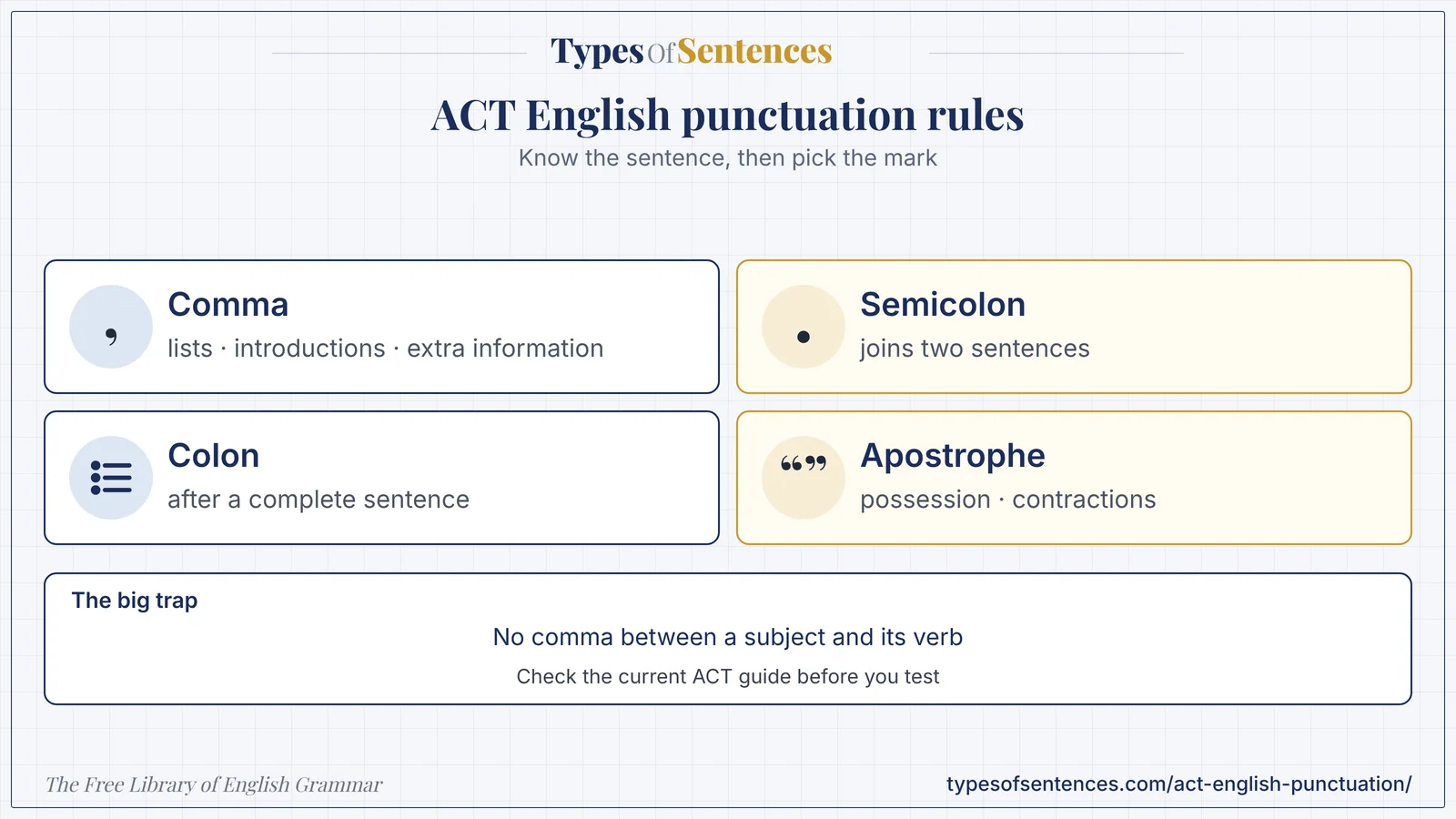
Summary: The ACT English test checks punctuation as part of Conventions of Standard English. The main rules: use a comma after an introductory phrase, between items in a list, and before a coordinating conjunction that joins two complete sentences; use a pair of commas, dashes, or parentheses around extra information; use a semicolon only between two complete sentences; use a colon only after a complete sentence; use an apostrophe for possession (the dog’s bone) and contractions (it’s), never for plurals. Do not put a comma between a subject and its verb.
- Comma: lists, introductions, extra information.
- Semicolon: between two complete sentences.
- Colon: after a complete sentence.
- Apostrophe: possession and contractions.
What You’ll Learn
- 1. ACT English Punctuation Rules: The Short Answer
- 2. ACT Comma Rules
- 3. ACT Semicolon Rules
- 4. Colons, Dashes, and Parentheses
- 5. Apostrophes: Possession and Contractions
- 6. The Five Most Common Traps
- 7. A Four-Step Method for ACT Punctuation Questions
- 8. ACT Punctuation in Sentences: 20 Examples
- 9. Exercises
- 10. Test Your Knowledge
- 11. Frequently Asked Questions
- 12. Conclusion
1. ACT English Punctuation Rules: The Short Answer
| Mark | Use it to | Example |
|---|---|---|
| comma | separate list items; set off an introduction; set off extra information; join sentences with a conjunction | We bought apples, pears, and plums. |
| semicolon | join two complete sentences | The bus was late; we missed the film. |
| colon | introduce a list, an example, or an explanation after a complete sentence | She packed three things: a map, a hat, and water. |
| dash or parentheses | set off extra information | The ending—a surprise to everyone—won praise. |
| apostrophe | show possession or a contraction | the teacher’s desk; it’s late |
| period or question mark | end a sentence | Where is the library? |
| Check | Question to ask |
|---|---|
| 1 | What is on each side of the mark? A complete sentence, or a part of one? |
| 2 | Is the information extra (could be removed) or essential? |
| 3 | Does the mark separate a subject from its verb? If so, remove it. |
| 4 | Does the answer choice use the same mark in the same way as the rules above? |
The test also asks about sentence boundaries (fragments and run-ons). The SAT article that precedes this one uses the same rules.
2. ACT Comma Rules
The ACT comma rules cause most of the errors. There are five uses of the comma and two places where a comma must not be used.
| Rule | Explanation | Example |
|---|---|---|
| 1. items in a list | put a comma between three or more items; the comma before and is optional in some style guides, so choose the option the answer choices keep consistent | She studies math, history, and art. |
| 2. introductory element | put a comma after a word, phrase, or clause that opens the sentence | After the game, we ate dinner. |
| 3. nonessential element | put commas around extra information that can be removed | My cousin, who lives in Ohio, is visiting. |
| 4. coordinating conjunction | use a comma before for, and, nor, but, or, yet, so when it joins two complete sentences | The rain stopped, and we went outside. |
| 5. adjectives | use a comma between adjectives that each describe the noun alone (swap them or insert and) | a long, quiet road |
| not 6. subject and verb | no comma between a subject and its verb | The girl in the red coat is my sister. |
| not 7. verb and object | no comma between a verb and what it needs | I know that you will win. |
The coordinating conjunctions are explained in the guide to coordinating conjunctions. Essential and nonessential elements depend on the clause, as described in the guide to independent and dependent clauses. Commas are a form of what the test calls Conventions of Standard English.
| Test | How to apply it | Example |
|---|---|---|
| remove-it test | if the sentence still makes sense and keeps its meaning without the phrase, the phrase is nonessential and takes commas | The report, written in May, was late. |
| and-test | if you can put and between two adjectives, add a comma | a kind and gentle teacher becomes a kind, gentle teacher |
| sentence test | if both sides of the comma could stand as sentences and no conjunction joins them, a comma is not enough | We left early; it was late. (not a comma alone) |
Choose: The students, who had studied all week(,) passed the exam(,) and they celebrated.
- who had studied all week is extra information, but it sits between the subject and the verb, so it needs a comma on both sides: The students, who had studied all week, passed.
- After exam, and they celebrated is a second complete sentence joined by and, so a comma goes before the conjunction: passed the exam, and they celebrated.
- Result: The students, who had studied all week, passed the exam, and they celebrated.
3. ACT Semicolon Rules
The ACT semicolon rules are simple. A semicolon joins two complete sentences that are closely related. It is used the way a period is used, so both sides must be able to stand alone.
| Rule | Example | Comment |
|---|---|---|
| between two complete sentences | The store was closed; we went home. | both sides are complete |
| before a conjunctive adverb that joins two sentences | The store was closed; therefore, we went home. | semicolon before, comma after |
| in a list whose items contain commas | We visited Austin, Texas; Denver, Colorado; and Boise, Idaho. | the semicolon separates the larger items |
| not before a dependent clause | *We went home; because it was late. | use a comma, or no mark |
| not before a list | *She needs three things; a map, a hat, and water. | use a colon |
If you can replace the semicolon with a period and both parts are complete sentences, the semicolon is correct. The conjunctive adverbs that follow a semicolon (however, therefore, moreover) are listed in the guide to conjunctive adverbs.
4. Colons, Dashes, and Parentheses
| Mark | Rule | Example | Do not |
|---|---|---|---|
| colon | a complete sentence, then a colon, then a list, an example, or an explanation | He had one goal: to win. | *He wanted: to win. |
| dash | a pair of dashes sets off an interruption; a single dash sets off an added idea at the end | My brother—the tall one—plays guitar. | *My brother—the tall one, plays guitar. |
| parentheses | a pair sets off extra information | The museum (founded in 1901) is free. | *The museum (founded in 1901, is free. |
Two rules cover most questions. First, a colon must follow a complete sentence, so no colon after a verb or a preposition. Second, the punctuation before and after extra information must match: two commas, two dashes, or two parentheses, never a mix. A pair of dashes and a pair of commas are both correct if the choices do not mix them.
5. Apostrophes: Possession and Contractions
| Use | Rule | Example |
|---|---|---|
| singular possessive | add ’s | the dog’s bone |
| plural possessive ending in -s | add only an apostrophe | the dogs’ bones |
| irregular plural possessive | add ’s | the children’s toys |
| contraction | the apostrophe replaces the missing letters | it’s = it is; they’re = they are |
| plural noun | no apostrophe | two dogs, not *two dog’s |
| Pair | Meaning | Example |
|---|---|---|
| its / it’s | its is possessive; it’s is it is or it has | The cat licked its paw. It’s clean. |
| their / there / they’re | possessive / place / they are | They’re putting their coats over there. |
| whose / who’s | possessive / who is | Who’s the girl whose bag is red? |
| your / you’re | possessive / you are | You’re sure it is your key? |
The full possessive rules are in the guide to possessive nouns.
6. The Five Most Common Traps
| Trap | Wrong | Right |
|---|---|---|
| a comma between a subject and its verb | *The man in the car, was late. | The man in the car was late. |
| a comma splice | *It rained, we stayed in. | It rained, so we stayed in. or It rained; we stayed in. |
| a colon after a verb | *My favorites are: red, blue, and green. | My favorites are red, blue, and green. |
| mismatched pair | *Her car—a red one, was parked outside. | Her car—a red one—was parked outside. |
| an apostrophe in a plural | *The twin’s arrived. | The twins arrived. |
A comma splice joins two sentences with only a comma. The fixes are in the guide to the comma splice and in the Intermediate chapter on run-on sentences. When two answer choices differ only in punctuation, ACT punctuation questions are almost always about one of these traps.
7. A Four-Step Method for ACT Punctuation Questions
| Step | Action | Example |
|---|---|---|
| 1 | read the whole sentence, not only the underlined part | The coach, who was tired(,) left early. |
| 2 | find the subject and the verb; they must not be separated by a single comma | coach … left |
| 3 | mark the complete sentences and the extra information | who was tired is extra |
| 4 | choose the answer that fits the rule; if two answers are the same, eliminate both | pair of commas: The coach, who was tired, left early. |
Most ACT punctuation questions have a choice of NO CHANGE. If the sentence is correct as written, choose it. Do not change a correct sentence because an answer looks more complex.
8. ACT Punctuation in Sentences: 20 Examples
| Sentence | Rule |
|---|---|
| She packed a tent, a stove, and a lantern. | list |
| Before the storm, we closed the windows. | introductory phrase |
| Our teacher, Ms. Lee, is retiring. | nonessential appositive |
| The road was icy, so we drove slowly. | comma + conjunction |
| The road was icy; we drove slowly. | semicolon |
| The road was icy; therefore, we drove slowly. | semicolon + conjunctive adverb |
| He needed one thing: sleep. | colon after a complete sentence |
| The result—a surprise—made news. | pair of dashes |
| The theater (built in 1920) is closed. | parentheses |
| The student’s book is on the desk. | singular possessive |
| The students’ books are on the desk. | plural possessive |
| The men’s coats are here. | irregular plural possessive |
| It’s late, and the cat wants its dinner. | contraction and possessive |
| A tall, dark figure appeared. | coordinate adjectives |
| The old wooden door creaked. | cumulative adjectives: no comma |
| Everyone who finished the test left early. | essential clause: no commas |
| My brother, who finished the test, left early. | nonessential clause: commas |
| I think that we should go. | no comma after a verb |
| The key to the problem is practice. | no comma between subject and verb |
| Did you hear the news? | question mark |
Recap in 12 seconds
Watch the lesson build itself: ACT English punctuation rules cover commas, semicolons, colons, dashes, and apostrophes; the most common trap is a comma between a subject and its verb. The video has no sound.
Exercises
Part A: Commas (Exercises 1–10)
Exercise 1: Add commas: We needed eggs milk and flour.
Show Answer
Answer: eggs, milk, and flour.
Exercise 2: Add a comma: After the show we went home.
Show Answer
Answer: After the show, we went home.
Exercise 3: Add commas: My aunt who lives in Maine called.
Show Answer
Answer: My aunt, who lives in Maine, called.
Exercise 4: Add a comma: It was cold so we wore coats.
Show Answer
Answer: It was cold, so we wore coats.
Exercise 5: Remove the error: The boy in the hat, is my cousin.
Show Answer
Answer: The boy in the hat is my cousin.
Exercise 6: Add a comma: She is a smart talented player.
Show Answer
Answer: a smart, talented player.
Exercise 7: Remove the error: I know, that you tried.
Show Answer
Answer: I know that you tried.
Exercise 8: Add commas: Paris the capital of France is large.
Show Answer
Answer: Paris, the capital of France, is large.
Exercise 9: Add a comma: When the bell rang the class ended.
Show Answer
Answer: When the bell rang, the class ended.
Exercise 10: Fix the splice: It was late, we left.
Show Answer
Answer: It was late, so we left. (or a semicolon)
Part B: Semicolons and Colons (Exercises 11–20)
Exercise 11: Add a mark: The test was hard we passed.
Show Answer
Answer: hard; we passed.
Exercise 12: Add a mark: She had one wish to travel.
Show Answer
Answer: one wish: to travel.
Exercise 13: Choose: I like fruit; apples, pears, and figs.
Show Answer
Answer: I like fruit: apples, pears, and figs.
Exercise 14: Choose: We left early; because it rained.
Show Answer
Answer: We left early because it rained.
Exercise 15: Add a mark: The shop was closed therefore we left.
Show Answer
Answer: closed; therefore, we left.
Exercise 16: Remove the colon: The colors are: red and blue.
Show Answer
Answer: The colors are red and blue.
Exercise 17: Add a mark: He needed three things a pen, paper, and time.
Show Answer
Answer: three things: a pen, paper, and time.
Exercise 18: Choose: It rained; the game was canceled.
Show Answer
Answer: correct as written.
Exercise 19: Fix: My goal; to win.
Show Answer
Answer: My goal: to win.
Exercise 20: Add a mark: The shop opens at nine it closes at five.
Show Answer
Answer: opens at nine; it closes at five.
Part C: Dashes and Parentheses (Exercises 21–25)
Exercise 21: Fix: My sister—a nurse, works nights.
Show Answer
Answer: My sister—a nurse—works nights.
Exercise 22: Fix: The book (published in 1999, is old.
Show Answer
Answer: The book (published in 1999) is old.
Exercise 23: Match: The park, a gift from the city—is open.
Show Answer
Answer: The park, a gift from the city, is open.
Exercise 24: Add dashes: The answer a clear yes pleased us.
Show Answer
Answer: The answer—a clear yes—pleased us.
Exercise 25: Is this correct? The film (a comedy) won.
Show Answer
Answer: Yes.
Part D: Apostrophes (Exercises 26–30)
Exercise 26: Fix: The dog’s barked all night. (more than one dog)
Show Answer
Answer: The dogs barked all night.
Exercise 27: Choose: The cat licked it’s/its paw.
Show Answer
Answer: its.
Exercise 28: Choose: The childrens’/children’s toys.
Show Answer
Answer: children’s.
Exercise 29: Choose: Your/You’re late.
Show Answer
Answer: You’re.
Exercise 30: Choose: The girls’/girl’s coats (three girls)
Show Answer
Answer: girls’.
Test Your Knowledge
Ready to check what you learned? Answer all 10 questions, then submit. You need 80% (8 of 10) to pass. Your answers are not stored.
View correct answers and explanations
Question 1: Which mark joins two complete sentences without a conjunction?
✓ Correct Answer: B – semicolon
A semicolon.
Question 2: A colon must follow
✓ Correct Answer: C – a complete sentence
Complete sentence.
Question 3: Which is correct?
✓ Correct Answer: D – The girl in the red coat is my sister.
No comma between subject and verb.
Question 4: The plural possessive of dogs is
✓ Correct Answer: A – dogs’
Add an apostrophe.
Question 5: Which is a comma splice?
✓ Correct Answer: B – It rained, we stayed in.
Two sentences, one comma.
Question 6: Extra information needs
✓ Correct Answer: C – a matching pair of marks
A pair.
Question 7: Choose: The cat licked ___ paw.
✓ Correct Answer: D – its
Possessive.
Question 8: Which is correct?
✓ Correct Answer: A – She needs three things: a map, a hat, and water.
Colon after a complete sentence.
Question 9: A comma goes before and when it joins
✓ Correct Answer: B – two complete sentences
Two sentences.
Question 10: Which is correct?
✓ Correct Answer: C – My brother—the tall one—plays guitar.
Matching dashes.
Frequently Asked Questions
What are the ACT English punctuation rules?
The main ACT English punctuation rules are: a comma for lists, introductions, extra information, and before a conjunction that joins two sentences; a semicolon between two complete sentences; a colon after a complete sentence; matching marks around extra information; and an apostrophe for possession and contractions.
What are the ACT comma rules?
The ACT comma rules cover items in a list, introductory elements, nonessential elements, a conjunction between two complete sentences, and coordinate adjectives. A comma must not separate a subject from its verb.
What are the ACT semicolon rules?
The ACT semicolon rules say that a semicolon joins two complete sentences, goes before a conjunctive adverb that joins two sentences, and separates items in a list that contain commas. It does not go before a dependent clause or a list.
How many punctuation questions are on the ACT?
The number varies from test to test. The Enhanced ACT English section has 50 questions in 35 minutes, and punctuation is part of the Conventions of Standard English category. Check act.org for the current format.
How do I get better at ACT punctuation questions?
Learn the five rules, then practice with real ACT questions. For each, find the complete sentences first. Review mistakes by naming the rule you missed.
Is the comma before “and” in a list required?
Style guides differ on this comma, so a well-written question should not depend on it. Focus on the rules that all style guides share.
Which punctuation errors appear most on the test?
A comma between a subject and its verb, a comma splice, a colon after a verb, mismatched marks around extra information, and apostrophes in plurals are the most common.
Conclusion
You now know the main ACT English punctuation rules: the comma, the semicolon, the colon, dashes, and apostrophes, the five common traps, and a four-step method. You have practiced them in 30 exercises.
Use these ACT punctuation rules in order: find the complete sentences first, match the marks around extra information, and remove any comma between a subject and its verb. Next, study the rules that decide whether a group of words is a complete sentence, in the ACT rhetorical skills article.
- ACT, Inc. Preparing for the ACT and the ACT English test description.: the test format and the reporting categories (check act.org for the current figures; the site was not opened when this page was written).
- Strunk, William, Jr., and E. B. White. The Elements of Style. 4th ed. Longman, 2000.: the rules for commas, semicolons, and colons.
- Garner, Bryan A. Garner’s Modern English Usage. 5th ed. Oxford University Press, 2022.: the entries on punctuation.
- Merriam-Webster Dictionary: semicolon: the dictionary entry (not opened when this page was written). All examples and exercises were written for this page and are not real ACT questions.
Last reviewed: October 29, 2026. How it was made: drafted with AI assistance, then checked with automated tests (structure, links, answer keys, spelling) and against the sources above. A person has not yet read this chapter line by line. Found a mistake? Report it.