A sentence fragment is a group of words that is punctuated as a sentence but is missing a subject, a finite verb, or a complete thought. Because it rained. and The man in the car. look like sentences because they start with a capital letter and end with a period, but they are incomplete. A fragmented sentence leaves the reader waiting for the rest.
This chapter shows what a fragment is, the types of fragments, how to spot incomplete sentences with simple tests, and how to fix them in four ways. You will also see when a fragment is acceptable as a deliberate choice, how fragments differ from run-ons, the causes of fragment errors, and an editing method. Thirty exercises and a quiz follow.
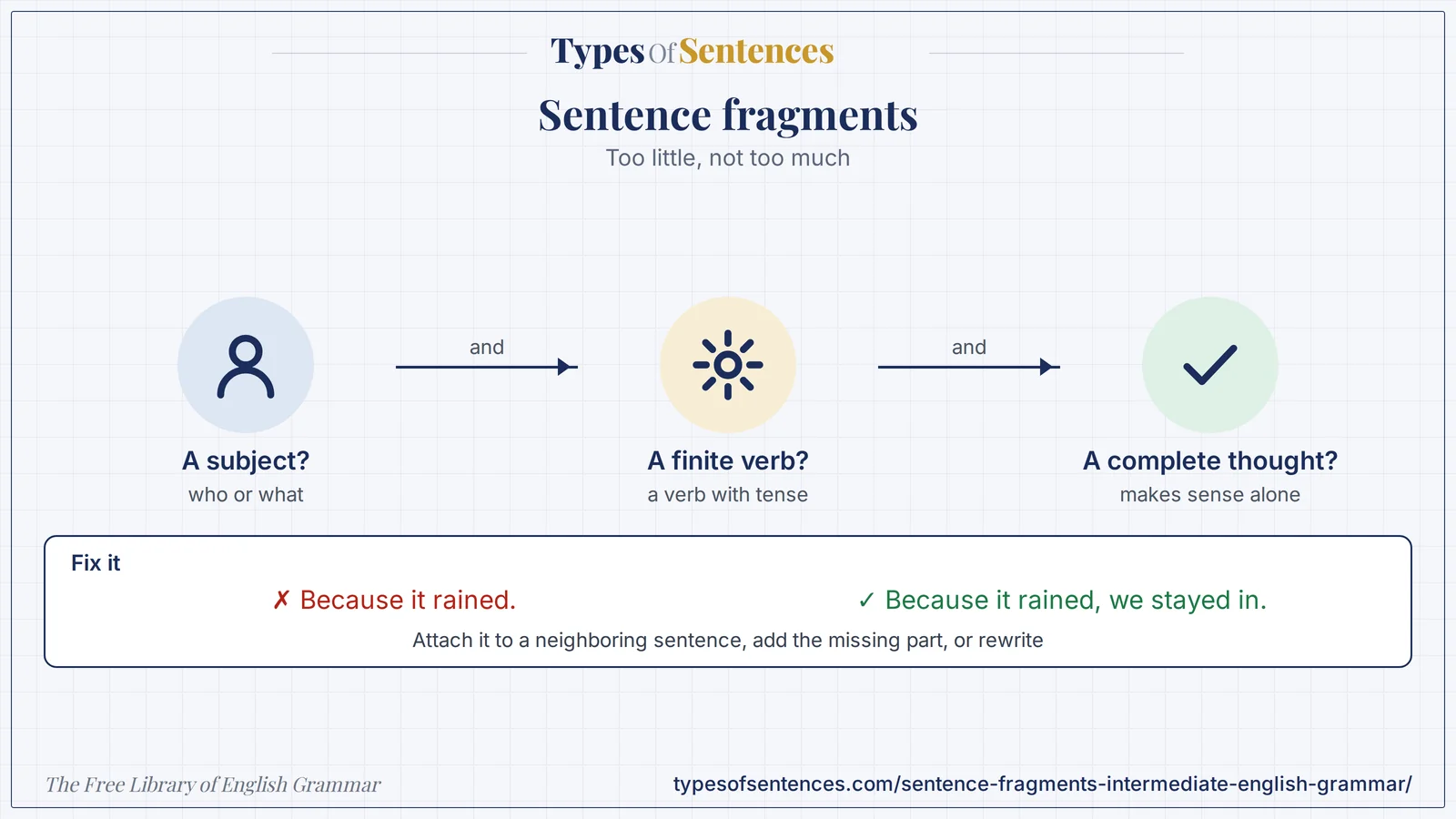
A sentence must say something complete. If a reader finishes the group of words and asks, “And then what?” or “Who did?”, it is a fragment.
Why it matters: Fragments are among the most common writing errors, and they are easy to fix once you can find them. The tests in this chapter help you find them every time.
Summary: A fragment lacks a subject, a finite verb, or a complete thought. The main types are dependent clauses standing alone (Because it rained.), phrases standing alone (Walking down the street.), a missing subject (Went home.), a missing verb (The man in the car.), and list or example fragments (For example, apples.). Fix by attaching, adding the missing element, or rewriting.
- Test: subject? finite verb? complete thought?
- Fix: attach to a neighboring sentence, add the missing part, or rewrite.
- Intentional fragments are allowed in speech, fiction, advertising, and emphasis.
- A fragment is the opposite of a run-on: too little, not too much.
What You’ll Learn
- 1. What Is a Sentence Fragment?
- 2. Types of Fragments
- 3. How to Spot a Fragment
- 4. Fixing Fragments
- 5. Intentional Fragments
- 6. Fragments, Run-Ons, and Comma Splices
- 7. Common Causes of Fragments
- 8. An Editing Method
- 9. Common Fragment Errors
- 10. Exercises
- 11. Test Your Knowledge
- 12. Frequently Asked Questions
- 13. Conclusion
1. What Is a Sentence Fragment?
A complete sentence has three things: a subject, a finite verb, and a complete thought. A sentence fragment is missing at least one of them. The elements of a sentence are explained in the chapter on elements of a sentence.
| Group of words | Subject? | Finite verb? | Complete thought? | Fragment? |
|---|---|---|---|---|
| The dog barked. | yes | yes | yes | no |
| Barked loudly. | no | yes | no | yes (no subject) |
| The dog in the yard. | yes | no | no | yes (no verb) |
| Because the dog barked. | yes | yes | no | yes (dependent clause) |
| Barking loudly. | no | no (non-finite) | no | yes (participial phrase) |
The words incomplete sentences describe fragments well. Notice that a fragment can be long: The old man in the red car who lives near the lake still has no verb for its subject.
2. Types of Fragments
| Type | Fragment | Why it is incomplete |
|---|---|---|
| dependent clause alone | Because it rained. | begins with a subordinator; needs a main clause |
| relative clause alone | Which surprised everyone. | begins with a relative pronoun; needs a noun to modify |
| prepositional phrase | After the long meeting. | no subject, no finite verb |
| participial phrase | Walking down the street. | no subject, no finite verb |
| infinitive phrase | To win the game. | no subject, no finite verb |
| appositive phrase | My brother, a doctor in Dallas. | a noun phrase with no verb |
| missing subject | Went to the store. | no subject |
| missing verb | The man in the car. | no verb |
| example or list fragment | For example, apples and oranges. / Such as apples. | a list that continues a sentence |
| added detail after a conjunction | And then left. | no subject |
The clauses and phrases involved are studied earlier in this level: dependent clauses in the chapter on what clauses are, and the phrases in the chapter on types of phrases.
3. How to Spot a Fragment
- Subject test. Ask Who or what? before the verb. No answer means no subject.
- Verb test. Look for a finite verb (one with a tense). A participle (walking) or an infinitive (to win) is not enough.
- Thought test. Does the group of words make sense alone? Add I know that … in front: I know that because it rained sounds incomplete, so it is a fragment.
- Subordinator test. Does it begin with because, although, if, when, who, which, that? Then it is dependent and needs a main clause.
- Backward reading. Read your paragraph sentence by sentence from the last to the first. Each sentence must stand alone.
Test: Although she studied for hours.
- Subject: she. Finite verb: studied.
- Complete thought? No. The word although makes it dependent: the reader asks, “Although she studied, what happened?”
- Verdict: a dependent clause fragment.
- Fix: Although she studied for hours, she failed the test.
4. Fixing Fragments
There are four ways to repair a fragment. Choose the one that suits the meaning and the rhythm.
| Fix | Fragment | Repaired |
|---|---|---|
| attach to the previous sentence | We stayed home. Because it rained. | We stayed home because it rained. |
| attach to the next sentence | Because it rained. We stayed home. | Because it rained, we stayed home. |
| add the missing subject | Went to the store. | She went to the store. |
| add the missing verb | The man in the car. | The man in the car is my uncle. |
| rewrite the whole thing | Walking down the street. The trees were beautiful. | Walking down the street, I thought the trees were beautiful. |
| join an example list | Many fruits are sweet. For example, mangoes and grapes. | Many fruits are sweet, for example, mangoes and grapes. |
A colon or a comma can join an appositive fragment to the sentence it renames. A dash also works for emphasis. See appositive phrases.
5. Intentional Fragments
Not every fragment is an error. Writers and speakers use fragments on purpose in certain contexts, and the result is called a minor sentence or a deliberate fragment.
| Context | Example | Effect |
|---|---|---|
| everyday speech and dialogue | “Coming?” “Not yet.” | natural, quick |
| fiction | She opened the door. Darkness. Silence. | atmosphere and pace |
| advertising | Fresh. Fast. Fair. | punch and rhythm |
| answers to questions | Why did you leave? Because I was tired. | a natural reply |
| exclamations and greetings | What a day! Thanks. Good morning. | minor sentences |
| emphasis after a full sentence | We tried everything. Everything. | repetition |
Style guides differ on fragments. Many composition teachers treat all fragments as errors in student essays, while many professional writers use them freely for effect. When in doubt, follow the rules of your course or your publication.
6. Fragments, Run-Ons, and Comma Splices
| Problem | Example | What is wrong |
|---|---|---|
| fragment | Because it rained. | too little: incomplete |
| run-on (fused) | It rained we stayed in. | too much: two clauses, no joint |
| comma splice | It rained, we stayed in. | too much: two clauses, a comma alone |
| correct | It rained, so we stayed in. | complete and properly joined |
A fragment gives the reader too little; a run-on gives too much without a joint. The next chapter, on run-on sentences, treats the opposite problem. Both come from not seeing where a sentence begins and ends.
7. Common Causes of Fragments
- Writing as you speak. In speech, we often add afterthoughts such as Because I was tired. that become fragments on the page.
- Long introductory phrases and clauses. By the time you reach the end of a long opener, you may forget to write the main clause.
- Treating a list or example as a new sentence. For example, apples. and Such as mangoes. continue a sentence and should not stand alone.
- Starting a sentence with a relative pronoun. Which made him angry.
- Splitting a compound predicate. She ran home. And locked the door.
- Copying from notes or bullet points and treating each as a sentence.
8. An Editing Method
- Read each sentence alone, from the last to the first.
- For each, find the subject and the finite verb.
- Check for a subordinator at the start. If there is one, make sure a main clause follows.
- Check the opening of each sentence: -ing, to, which, because, for example.
- Fix each fragment by attaching, adding, or rewriting.
Edit: Last week I visited the old library. Which was built in 1890. Walking through the doors. I felt like a visitor from another century. The books, thousands of them. Because nobody had touched them in years.
- Which was built in 1890. A relative clause fragment: attach it. → the old library, which was built in 1890.
- Walking through the doors. A participial phrase fragment: attach it. → Walking through the doors, I felt…
- The books, thousands of them. A noun phrase with no verb: add one. → The books, thousands of them, lay in dust.
- Because nobody had touched them in years. A dependent clause: attach it to the previous sentence.
- Result: Last week I visited the old library, which was built in 1890. Walking through the doors, I felt like a visitor from another century. The books, thousands of them, lay in dust because nobody had touched them in years.
9. Common Fragment Errors
| Fragment error | Correction |
|---|---|
| I failed the test. Because I did not study. | I failed the test because I did not study. |
| He had one goal. To win the championship. | He had one goal: to win the championship. |
| She sat quietly. Reading a book. | She sat quietly, reading a book. |
| My sister is a doctor. Who lives in Texas. | My sister, who lives in Texas, is a doctor. |
| The teacher gave us homework. Such as exercises 1 to 5. | The teacher gave us homework, such as exercises 1 to 5. |
| Went to the market. And bought some bread. | She went to the market and bought some bread. |
| After the long meeting ended. | After the long meeting ended, everyone left. |
Recap in 12 seconds
Watch the lesson build itself: A fragment lacks a subject, a finite verb, or a complete thought; test for all three and fix it. The video has no sound.
Exercises
Part A: Sentence or Fragment? (Exercises 1–8)
Exercise 1: Sentence or fragment: The dog barked.
Show Answer
Answer: Sentence.
Exercise 2: Sentence or fragment: Because it rained.
Show Answer
Answer: Fragment (dependent clause).
Exercise 3: Sentence or fragment: The man in the car.
Show Answer
Answer: Fragment (no verb).
Exercise 4: Sentence or fragment: Went home.
Show Answer
Answer: Fragment (no subject).
Exercise 5: Sentence or fragment: Walking down the street.
Show Answer
Answer: Fragment (participial phrase).
Exercise 6: Sentence or fragment: To win the game.
Show Answer
Answer: Fragment (infinitive phrase).
Exercise 7: Sentence or fragment: Which surprised everyone.
Show Answer
Answer: Fragment (relative clause).
Exercise 8: Sentence or fragment: Close the door.
Show Answer
Answer: Sentence (an imperative with an understood you).
Part B: Name the Type (Exercises 9–14)
Exercise 9: Type: After the long meeting.
Show Answer
Answer: Prepositional phrase fragment.
Exercise 10: Type: My brother, a doctor in Dallas.
Show Answer
Answer: Appositive phrase fragment.
Exercise 11: Type: For example, apples and oranges.
Show Answer
Answer: Example (list) fragment.
Exercise 12: Type: And then left.
Show Answer
Answer: Missing subject.
Exercise 13: Type: Although she studied for hours.
Show Answer
Answer: Dependent clause fragment.
Exercise 14: Which test shows that Barking loudly. is a fragment?
Show Answer
Answer: The verb test: barking is not a finite verb, and there is no subject.
Part C: Fixing (Exercises 15–22)
Exercise 15: Fix: I failed the test. Because I did not study.
Show Answer
Answer: I failed the test because I did not study.
Exercise 16: Fix: He had one goal. To win the championship.
Show Answer
Answer: He had one goal: to win the championship.
Exercise 17: Fix: She sat quietly. Reading a book.
Show Answer
Answer: She sat quietly, reading a book.
Exercise 18: Fix: My sister is a doctor. Who lives in Texas.
Show Answer
Answer: My sister, who lives in Texas, is a doctor.
Exercise 19: Fix: Went to the market. And bought some bread.
Show Answer
Answer: She went to the market and bought some bread.
Exercise 20: Fix: After the long meeting ended.
Show Answer
Answer: After the long meeting ended, everyone left.
Exercise 21: Fix: The man in the car.
Show Answer
Answer: The man in the car is my uncle.
Exercise 22: Fix: Walking down the street. The trees were beautiful.
Show Answer
Answer: Walking down the street, I thought the trees were beautiful.
Part D: Intentional Fragments (Exercises 23–26)
Exercise 23: Is Not yet. in a dialogue acceptable?
Show Answer
Answer: Yes. It is a natural minor sentence.
Exercise 24: Is Fresh. Fast. Fair. acceptable in an advertisement?
Show Answer
Answer: Yes. It is a deliberate fragment for effect.
Exercise 25: Is a fragment acceptable in a formal essay?
Show Answer
Answer: Generally no. Readers expect complete sentences.
Exercise 26: Give one rule for a deliberate fragment.
Show Answer
Answer: Make it short, clear, and intentional, and place it after a full sentence.
Part E: Fragments, Run-Ons, and Editing (Exercises 27–30)
Exercise 27: Which is the opposite of a fragment: a run-on or a comma splice?
Show Answer
Answer: Both are “too much,” the opposite of a fragment’s “too little.”
Exercise 28: Type: It rained we stayed in.
Show Answer
Answer: Run-on (fused sentence).
Exercise 29: Type: It rained, we stayed in.
Show Answer
Answer: Comma splice.
Exercise 30: Name one editing method for finding fragments.
Show Answer
Answer: Read the sentences one at a time, from last to first.
Test Your Knowledge
Ready to check what you learned? Answer all 10 questions, then submit. You need 80% (8 of 10) to pass. Your answers are not stored.
View correct answers and explanations
Question 1: What does a sentence fragment lack?
✓ Correct Answer: C – A subject, a finite verb, or a complete thought
A fragment is missing at least one of the three essentials.
Question 2: Which is a fragment?
✓ Correct Answer: C – Because it rained.
A dependent clause alone is a fragment.
Question 3: Which is a fragment?
✓ Correct Answer: D – The man in the car.
It has no verb.
Question 4: Which is the best fix: He had one goal. To win.
✓ Correct Answer: B – He had one goal: to win.
A colon joins the appositive fragment.
Question 5: Which is a fragment?
✓ Correct Answer: A – Walking down the street.
A participial phrase alone is a fragment.
Question 6: Which is correct?
✓ Correct Answer: B – We stayed home because it rained.
Attach the dependent clause.
Question 7: Which fragment is acceptable in fiction?
✓ Correct Answer: B – Darkness. Silence.
Deliberate fragments create atmosphere in fiction.
Question 8: Which test finds a missing subject?
✓ Correct Answer: A – Ask who or what before the verb
If there is no answer, there is no subject.
Question 9: How many ways are there to fix a fragment in this chapter?
✓ Correct Answer: D – Four
Attach to the previous, attach to the next, add the missing part, or rewrite.
Question 10: Which is a relative clause fragment?
✓ Correct Answer: A – Which surprised everyone.
It begins with a relative pronoun and has no main clause.
Frequently Asked Questions
What is a sentence fragment?
A sentence fragment is a group of words punctuated as a sentence that lacks a subject, a finite verb, or a complete thought. Because it rained. is a fragment.
What is a fragmented sentence?
A fragmented sentence is another name for a sentence fragment. It looks like a sentence but is incomplete, so the reader is left waiting for the rest.
What are sentence fragments and how do I fix them?
Sentence fragments are incomplete sentences. Fix them by attaching them to a neighboring sentence, adding the missing subject or verb, or rewriting the whole sentence.
What are incomplete sentences?
Incomplete sentences are groups of words that do not express a full thought: a dependent clause alone, a phrase alone, or a sentence missing a subject or verb.
What are common fragment errors?
Common fragment errors are a dependent clause alone (Because it rained.), a phrase alone (Walking home.), a missing subject (Went home.), and a list or example standing alone (For example, apples.).
Are fragments ever acceptable?
Yes, as deliberate choices in speech, dialogue, fiction, and advertising, and as minor sentences such as Thanks. They are usually avoided in formal and academic writing.
How do I find fragments in my writing?
Read each sentence alone, from last to first. Check for a subject, a finite verb, and a complete thought, and watch for sentences that begin with because, which, an -ing word, or to.
Conclusion
You now know what a sentence fragment is, the types of fragments, and how to spot and fix them with the subject, verb, thought, subordinator, and backward-reading tests. You also know when a fragment is acceptable and how fragments differ from run-ons.
Edit one paragraph of your own writing by reading it sentence by sentence from the end. Next, you will study run-on sentences.
- Merriam-Webster Dictionary: sentence fragment: the dictionary definition of a sentence fragment.
- Purdue Online Writing Lab: Grammar: reference section on sentence fragments.
- Quirk, Randolph, et al. A Comprehensive Grammar of the English Language. Longman, 1985.: minor and irregular sentences.
- Huddleston, Rodney, and Geoffrey K. Pullum. The Cambridge Grammar of the English Language. Cambridge University Press, 2002.: sentence fragments and non-clausal utterances.
Last reviewed: October 29, 2026. How it was made: drafted with AI assistance, then checked with automated tests (structure, links, answer keys, spelling) and against the sources above. A person has not yet read this chapter line by line. Found a mistake? Report it.