What are SAT transition questions? SAT transition questions are items on the digital SAT Reading and Writing section in which a short text has a blank at the start of a sentence, and you must choose the transition word or phrase that best connects that sentence to the one before it. The four choices are usually transition words such as however, for example, therefore, and similarly. Only one of them expresses the logical relationship between the two ideas.
This page lists the transitions the test uses, grouped by relationship, so that you can learn them as families. It gives a five-step method, shows how to punctuate transitions, and explains the traps. It gives 30 original practice items (not taken from the College Board) and a 10-question quiz. Digital SAT transitions are easier than they look: learning transition words for SAT by relationship is much faster than memorizing them one by one, and SAT transitions of the same family can be learned together.
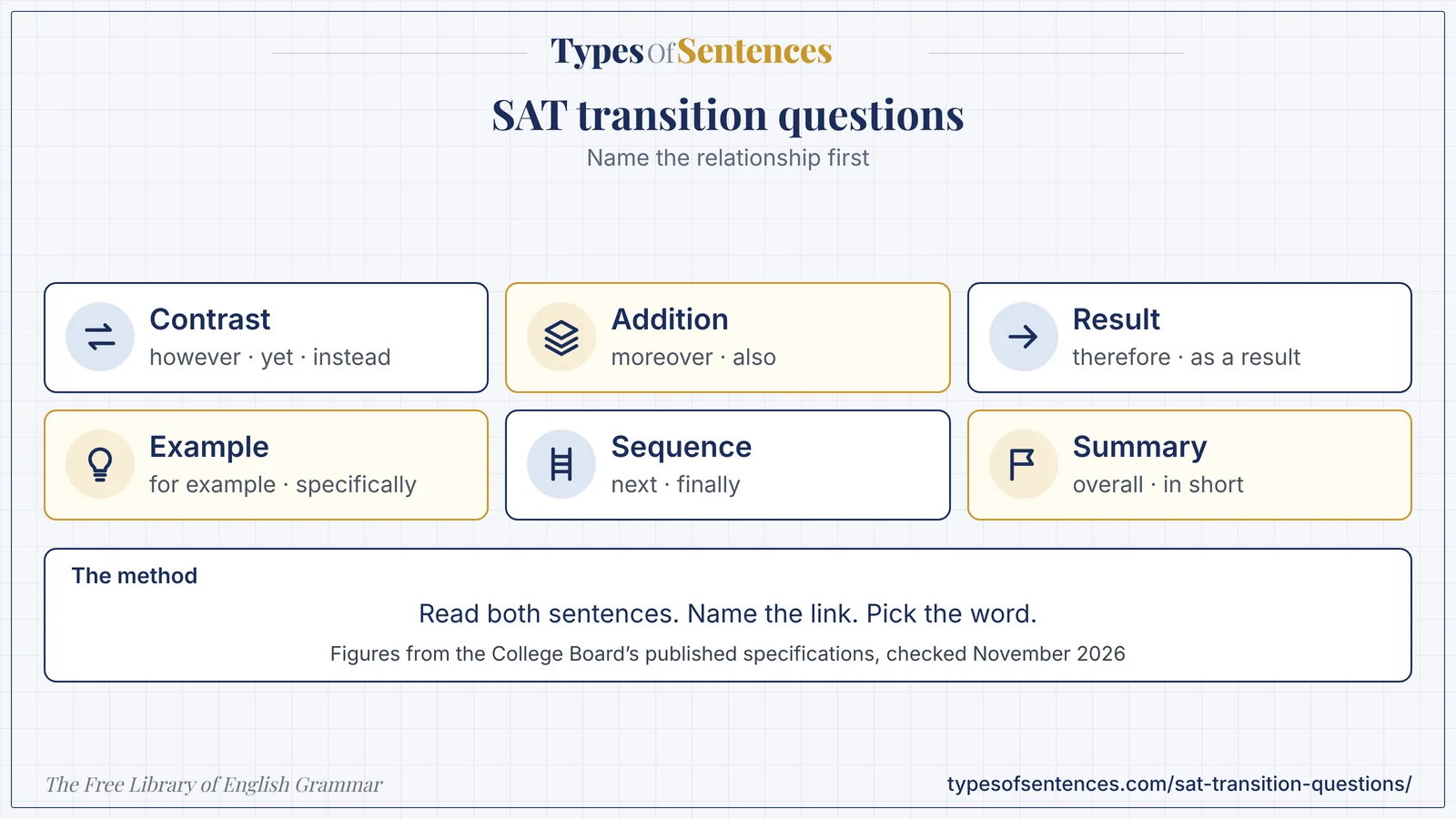
A transition is a signpost between two ideas. It tells the reader whether the next idea agrees, disagrees, gives an example, or follows as a result.
Why it matters: First decide the relationship in your own words (“this is a contrast”). Then find the choice that names it.
Summary: SAT transition questions ask you to choose the word or phrase that logically links two sentences. The digital SAT places them in the Expression of Ideas domain (about 20 percent of the Reading and Writing section). Learn the relationships: contrast (however), addition (moreover), similarity (similarly), cause and result (therefore), example (for example), sequence (next), emphasis (in fact), and summary (overall). Method: read the sentence before and after, name the relationship, predict a transition, and match it to a choice. Trap: two choices from the same family; choose the one that fits the exact meaning.
- Name the relationship first.
- Contrast: however, yet, instead.
- Result: therefore, as a result.
- Example: for example, specifically.
What You’ll Learn
1. SAT Transition Questions: The Short Answer
| Fact | Detail |
|---|---|
| where | the Expression of Ideas domain of the digital SAT Reading and Writing section |
| skill | Transitions: choose the word or phrase that logically connects two sentences or ideas |
| share | Expression of Ideas is about 20 percent of the section |
| format | a short text with a blank at the start of a sentence, and four transition choices |
| how to check | official practice is in the Bluebook app; check satsuite.collegeboard.org for the current format |
Because digital SAT transitions are tested with only four choices, the method below matters more than the list. The College Board figures were taken from its published specifications and checked in November 2026; the test can change, so check satsuite.collegeboard.org before you rely on them. The grammar conventions on the same test are covered in the guide to SAT grammar rules.
2. SAT Transition Words by Relationship
A list of SAT transition words is easier to learn as eight families. Words in one family can often be swapped; words in different families cannot.
| Relationship | Meaning | Transition words | Example |
|---|---|---|---|
| contrast | the second idea differs from or opposes the first | however, but, yet, nevertheless, still, in contrast, on the other hand, instead, rather, conversely | The plan looked sound; however, it failed. |
| addition | the second idea adds to the first | moreover, furthermore, also, in addition, besides, additionally | The plan is cheap. Moreover, it is fast. |
| similarity | the second idea is like the first | similarly, likewise, in the same way, equally | Cats groom themselves. Similarly, dogs lick their paws. |
| cause and result | the second idea is the result of the first | therefore, thus, consequently, as a result, accordingly, hence | The road flooded. As a result, schools closed. |
| example | the second idea gives an instance of the first | for example, for instance, specifically, in particular, namely | Many birds migrate. For example, the Arctic tern flies pole to pole. |
| sequence | the second idea comes after (or at the same time as) the first | first, next, then, finally, afterward, subsequently, meanwhile, previously | She mixed the dough. Next, she let it rise. |
| emphasis and concession | the second idea stresses or grants a point | indeed, in fact, of course, admittedly, granted, certainly | The test was long. In fact, it lasted four hours. |
| summary | the second idea sums up the first | in short, overall, in conclusion, in sum, to summarize | The data were mixed. Overall, the results favor the new method. |
This list is not an official College Board list; it is my grouping of common transitions. The test may use other transitions, and context always decides. Some transitions, such as however and therefore, are conjunctive adverbs, which are described in the guide to conjunctive adverbs.
3. How to Punctuate Transitions
| Position | Example | Rule |
|---|---|---|
| sentence start | The road was icy. However, the bus ran on time. | a transition at the start of a sentence is followed by a comma |
| after a semicolon | The road was icy; however, the bus ran on time. | a semicolon before, a comma after |
| inside a sentence | The bus, however, ran on time. | commas on both sides |
| with but, and, so, yet | The road was icy, but the bus ran on time. | a coordinating conjunction takes a comma before it, not a semicolon |
| with then | She mixed the dough; then she let it rise. | then is usually not followed by a comma |
Punctuation can be tested in the same question, so check the commas and semicolons around the blank. A semicolon joins two complete sentences, and a comma alone does not; the rules are in the guide to SAT punctuation rules. The coordinating conjunctions (for, and, nor, but, or, yet, so) are explained in the guide to the coordinating conjunction.
4. A Five-Step Method for SAT Transition Questions
| Step | Do this | Why |
|---|---|---|
| 1 read the sentence before the blank | know what the first idea says | the transition links back to it |
| 2 read the sentence with the blank | know what the second idea says | the transition links forward to it |
| 3 name the relationship | contrast, addition, result, example, sequence, or another | this is the real answer |
| 4 predict a transition | say a word of your own before you look at the choices | it protects you from smooth wrong choices |
| 5 match and test | choose the match, then read both sentences with it | a wrong word will sound wrong when it is tested |
| Trap | What it looks like | The cure |
|---|---|---|
| two choices from one family | however and nevertheless both appear | one may fit the exact meaning better, or only one is punctuated correctly |
| the familiar word | therefore chosen because it is common | check that the second idea is really a result |
| the opposite relationship | similarly where a contrast is needed | read the meaning, not the tone |
| the hidden contrast | the second sentence seems to agree but corrects | look for a change of direction |
| the hidden result | the second sentence follows from the first without saying so | ask whether it is caused by the first |
| the example in disguise | for example where a general claim follows | an example is specific; a claim is general |
| a punctuation clue | a semicolon before the blank | the choice may need a comma after it |
Which choice completes the text? Many people think that cats sleep all day. ___ studies of domestic cats show that they spend about two-thirds of the day asleep, and are active in short bursts. (A) Similarly, (B) For example, (C) In fact, (D) Instead,
- The first sentence states a belief: cats sleep all day.
- The second sentence agrees and adds figures: two-thirds asleep.
- The relationship is emphasis: the second sentence supports and sharpens the first.
- (C) In fact, fits the relationship; similarly and for example do not.
- Check: In fact, studies show that they spend about two-thirds of the day asleep. The passage is my own and its figure is illustrative.
5. Common Mistakes on SAT Transition Questions
| Mistake | What happens | Better habit |
|---|---|---|
| choosing the choice that sounds smartest | a formal word that does not fit is picked | name the relationship first |
| reading only the sentence with the blank | the link to the first idea is missed | read both sentences |
| memorizing words, not relationships | a new transition is a surprise | learn the eight families |
| ignoring the punctuation | a transition without the right comma or semicolon is chosen | check the punctuation around the blank |
| choosing however for every change | a continuation is wrongly marked as contrast | ask: does the second idea oppose the first? |
| mixing up for example and in fact | an instance is confused with emphasis | an example is one case of the first idea; in fact stresses it |
Recap in 12 seconds
Watch the lesson build itself: SAT transition questions ask for the word that names the relationship between two ideas: contrast, addition, result, example, sequence, or summary. The video has no sound.
Exercises
Part A: Name the Relationship (Exercises 1–10)
Exercise 1: The plan was cheap. ___, it was fast. What relationship?
Show Answer
Answer: addition (moreover).
Exercise 2: The road flooded. ___, schools closed. What relationship?
Show Answer
Answer: cause and result (as a result).
Exercise 3: Many birds migrate. ___, the Arctic tern flies pole to pole. What relationship?
Show Answer
Answer: example (for example).
Exercise 4: The test was hard. ___, most students passed. What relationship?
Show Answer
Answer: contrast (however).
Exercise 5: She mixed the dough. ___, she let it rise. What relationship?
Show Answer
Answer: sequence (next).
Exercise 6: Cats groom themselves. ___, dogs lick their paws. What relationship?
Show Answer
Answer: similarity (similarly).
Exercise 7: The data were mixed. ___, the results favor the new method. What relationship?
Show Answer
Answer: summary (overall).
Exercise 8: He is shy. ___, he spoke for an hour. What relationship?
Show Answer
Answer: contrast (nevertheless).
Exercise 9: The tests were long. ___, they lasted four hours. What relationship?
Show Answer
Answer: emphasis (in fact).
Exercise 10: The soup was cold. ___, she ordered tea. What relationship?
Show Answer
Answer: result (so or therefore).
Part B: Choose the Transition (Exercises 11–20)
Exercise 11: The museum is free on Sundays. ___, it is crowded. (A) For example (B) As a result (C) Similarly (D) Next
Show Answer
Answer: (B) As a result: the crowd follows from the free entry.
Exercise 12: She loves music. ___, she plays three instruments. (A) However (B) In fact (C) Instead (D) Meanwhile
Show Answer
Answer: (B) In fact.
Exercise 13: Cars pollute the air. ___, factories add smoke. (A) Moreover (B) However (C) Instead (D) Finally
Show Answer
Answer: (A) Moreover.
Exercise 14: He studied hard. ___, he failed. (A) Therefore (B) Nevertheless (C) For example (D) Similarly
Show Answer
Answer: (B) Nevertheless.
Exercise 15: Many fruits are rich in vitamins. ___, oranges contain vitamin C. (A) For example (B) However (C) Thus (D) Instead
Show Answer
Answer: (A) For example.
Exercise 16: The bus was late. ___, we walked. (A) Similarly (B) Therefore (C) For instance (D) Still
Show Answer
Answer: (B) Therefore.
Exercise 17: First, wash the rice. ___, boil it for ten minutes. (A) Next (B) However (C) In fact (D) Likewise
Show Answer
Answer: (A) Next.
Exercise 18: She is quiet. ___, her brother is loud. (A) In contrast (B) Therefore (C) Moreover (D) For example
Show Answer
Answer: (A) In contrast.
Exercise 19: The data are complex. ___, the main finding is clear. (A) Even so (B) For example (C) Similarly (D) As a result
Show Answer
Answer: (A) Even so.
Exercise 20: The plan has three parts. ___, it is a good plan. (A) Overall (B) However (C) Instead (D) Previously
Show Answer
Answer: (A) Overall.
Part C: Punctuation (Exercises 21–25)
Exercise 21: Fix: *The road was icy, however, the bus ran on time.
Show Answer
Answer: The road was icy; however, the bus ran on time. (or a period before However)
Exercise 22: Fix: *She mixed the dough, then, she let it rise.
Show Answer
Answer: She mixed the dough; then she let it rise. (or She mixed the dough, then let it rise.)
Exercise 23: Where do commas go? The bus however ran on time.
Show Answer
Answer: The bus, however, ran on time.
Exercise 24: Punctuate: The test was hard however most students passed.
Show Answer
Answer: The test was hard; however, most students passed.
Exercise 25: What joins two complete sentences with a transition word: a comma alone or a semicolon?
Show Answer
Answer: A semicolon (or a period).
Part D: Explain (Exercises 26–30)
Exercise 26: What is the first thing to do in a transition question?
Show Answer
Answer: Name the relationship between the two ideas.
Exercise 27: Name two words in the contrast family.
Show Answer
Answer: For example, however and nevertheless.
Exercise 28: Name two words in the example family.
Show Answer
Answer: For example, for example and specifically.
Exercise 29: Why predict a transition before reading the choices?
Show Answer
Answer: It protects you from smooth wrong choices.
Exercise 30: What do therefore and as a result have in common?
Show Answer
Answer: Both show cause and result.
Test Your Knowledge
Ready to check what you learned? Answer all 10 questions, then submit. You need 80% (8 of 10) to pass. Your answers are not stored.
View correct answers and explanations
Question 1: SAT transition questions ask you to choose
✓ Correct Answer: B – a word that links two ideas
A logical link.
Question 2: However shows
✓ Correct Answer: C – contrast
Contrast.
Question 3: Therefore shows
✓ Correct Answer: D – cause and result
Result.
Question 4: For example introduces
✓ Correct Answer: A – an instance
An instance.
Question 5: Similarly shows
✓ Correct Answer: B – likeness
Likeness.
Question 6: The first step in the method is to
✓ Correct Answer: C – name the relationship
Name it.
Question 7: A transition at the start of a sentence is followed by
✓ Correct Answer: D – a comma
A comma.
Question 8: In fact usually shows
✓ Correct Answer: A – emphasis
Emphasis.
Question 9: Overall and in short show
✓ Correct Answer: B – a summary
A summary.
Question 10: Transitions are tested in the
✓ Correct Answer: C – Expression of Ideas domain
Expression of Ideas.
Frequently Asked Questions
What are SAT transition questions?
They are items on the digital SAT Reading and Writing section that ask you to choose the transition word or phrase that best links a sentence to the one before it. They belong to the Expression of Ideas domain.
What are the most common SAT transition words?
Common ones include however, moreover, therefore, for example, similarly, in fact, instead, as a result, and overall. Learn them by relationship, not one by one.
How do I choose the right transition?
Read the sentence before and after the blank, name the relationship (contrast, addition, result, example, and so on), predict a transition, and choose the match.
What if two choices mean the same thing?
Check the exact meaning and the punctuation. One may fit better, or only one may be punctuated correctly. If two choices are real synonyms, the test normally will not offer both.
Do I need to memorize a transition list?
For SAT transitions, learn the families, not a long list. If you know that however, yet, and nevertheless all show contrast, a new word in the same family is easy.
Is “however” always followed by a comma?
At the start of a sentence, yes: However, it rained. After a semicolon, also yes: It was late; however, we stayed.
Where can I practice real SAT transition questions?
The College Board offers official practice in its Bluebook app. The questions on this page are original and are for practice only.
Conclusion
You now know how SAT transition questions work: name the relationship, predict a transition, and match it. You have seen the eight families of SAT transition words, how to punctuate them, and the traps.
Practice by naming the relationship between every pair of sentences you read; that habit is the core skill behind digital SAT transitions, and the families of transition words for SAT will become automatic. Next, study the other skills the SAT tests, such as sentence boundaries and punctuation.
- College Board. The Digital SAT Suite of Assessments Specifications.: the content domains and the Expression of Ideas skills (figures checked via web search in November 2026; the official page was not opened).
- Garner, Bryan A. Garner’s Modern English Usage. 5th ed. Oxford University Press, 2022.: the entries on however and other transitions.
- Swan, Michael. Practical English Usage. 4th ed. Oxford University Press, 2016.: the entries on linking words.
- Merriam-Webster Dictionary: transition: the dictionary entry (not opened when this page was written).
Last reviewed: October 29, 2026. How it was made: drafted with AI assistance, then checked with automated tests (structure, links, answer keys, spelling) and against the sources above. A person has not yet read this chapter line by line. Found a mistake? Report it.