A verb phrase is the main verb together with its auxiliary (helping) verbs: walks, is walking, has been walking, could have walked. It carries the tense, the aspect, the voice, and the speaker’s attitude, and it is the core of every clause. Understanding its structure explains why She has went is wrong and She has gone is right.
This chapter explains verb phrase structure: the main verb, the helping verbs in verb phrases, and the fixed order in which they appear. You will see simple, compound, and complex verb phrases, how modals fit in, how negatives and questions are formed, and how a verb phrase differs from a predicate. It ends with common errors. Thirty exercises and a quiz follow.
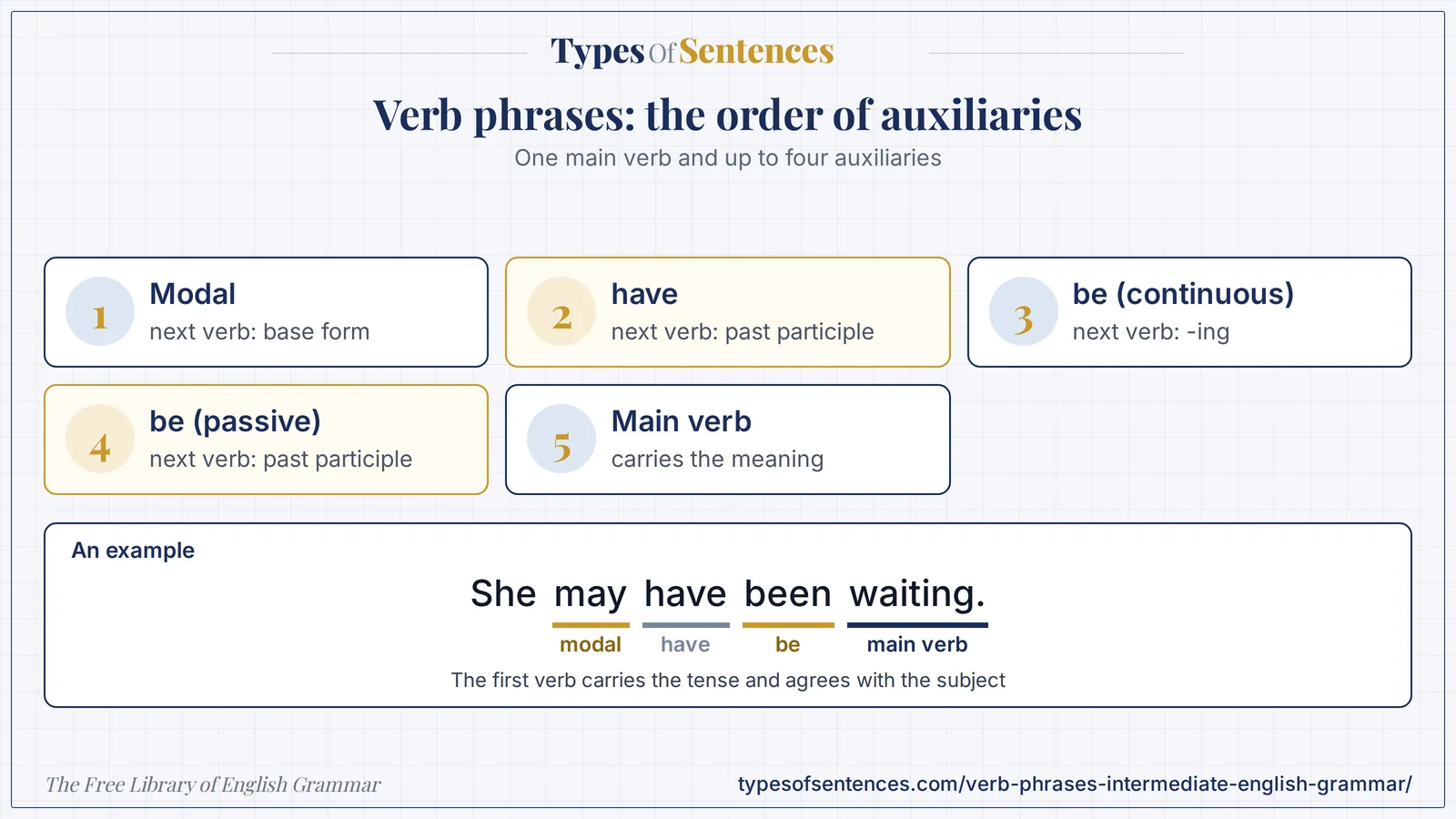
Verbs often travel in groups. The last word in the group, the main verb, carries the meaning; the words before it are helpers that add time, ongoing action, passive, or possibility.
Why it matters: The helpers follow a strict order, and each one decides the form of the next verb. Learn that rule and most verb errors disappear.
Summary: A verb phrase consists of one main verb and up to four auxiliaries in a fixed order: modal, have, be (continuous), be (passive), main verb. The first verb in the phrase carries the tense and agrees with the subject; each verb takes the form that the verb before it requires.
- Order: modal + have + be + be + main verb.
- After a modal: base form. After have: past participle. After be (continuous): -ing form. After be (passive): past participle.
- Negatives and questions use the first auxiliary: She has not left; Has she left?
- A verb phrase is not the same as a predicate; the predicate includes objects and complements.
What You’ll Learn
- 1. What Is a Verb Phrase?
- 2. Verb Phrase Structure
- 3. Simple Verb Phrases
- 4. Compound Verb Phrases
- 5. Complex Verb Phrases
- 6. Modal Verbs in Verb Phrases
- 7. Negatives, Questions, and Adverbs in the Verb Phrase
- 8. Verb Phrase vs. Predicate
- 9. Auxiliary Order and Meaning in Long Verb Phrases
- 10. Common Verb Phrase Errors
- 11. Exercises
- 12. Test Your Knowledge
- 13. Frequently Asked Questions
- 14. Conclusion
1. What Is a Verb Phrase?
A verb phrase is a main verb with any auxiliary verbs that go with it. The main verb carries the meaning, and the auxiliary verbs (also called helping verbs) add tense, aspect, voice, or mood. See the chapter on types of verbs for the types of verb.
| Verb phrase | Main verb | Auxiliaries |
|---|---|---|
| walks | walks | none |
| is walking | walking | is |
| has walked | walked | has |
| will walk | walk | will |
| has been walking | walking | has, been |
| could have walked | walked | could, have |
| may have been walking | walking | may, have, been |
| was written | written | was |
In most school grammars, the verb phrase is just the verb group, as here. In modern reference grammars, a verb phrase can also include the verb’s objects and complements, which this course calls the predicate. Both uses exist; the first is more common in teaching.
2. Verb Phrase Structure
A verb phrase can have up to five parts, always in this order.
| 1. Modal | 2. Perfect (have) | 3. Continuous (be) | 4. Passive (be) | 5. Main verb |
|---|---|---|---|---|
| — | — | — | — | writes |
| will | — | — | — | write |
| will | have | — | — | written |
| will | have | been | — | writing |
| — | — | is | being | written |
| should | have | been | — | sent |
| — | has | been | — | working |
Each auxiliary requires a particular form of the verb that follows it. This is the key rule of verb phrase structure.
| After… | The next verb is… | Example |
|---|---|---|
| a modal (can, will, must) | the base form | will write |
| have (perfect) | the past participle | has written |
| be (continuous) | the -ing form | is writing |
| be (passive) | the past participle | was written |
| do (negatives and questions) | the base form | does not write |
The tenses these phrases make are the subject of Part 6, beginning with the chapter on verb tenses.
3. Simple Verb Phrases
A simple verb phrase is a single main verb with no auxiliary. It carries the present or past tense.
| Verb phrase | Tense | Example |
|---|---|---|
| walks, walk | present | She walks to school. |
| walked | past | She walked to school. |
| is, are, was, were | present or past of be | They were tired. |
Simple verb phrases are the most common, and they are the base of every other phrase. Even here, the verb is the head of the phrase.
4. Compound Verb Phrases
A compound verb phrase joins two or more verb phrases with a conjunction, with a single subject.
| Compound verb phrase | Note |
|---|---|
| She sang and danced. | two main verbs, same tense |
| They will sing and dance. | the auxiliary will is shared |
| She has washed the dishes and put them away. | has is shared (put is a participle) |
| He was laughing and crying. | was is shared |
| She can swim but cannot dive. | each verb has its own modal |
5. Complex Verb Phrases
A complex verb phrase combines a main verb with another verb form, usually an infinitive or an -ing form.
| Pattern | Examples |
|---|---|
| verb + infinitive | wants to leave, decided to stay, is going to rain |
| verb + -ing | keeps trying, enjoys swimming, stopped talking |
| semi-modals | have to go, ought to leave, used to live, be able to swim |
| phrasal verb | look up a word, give in, run out of time |
| verb + object + infinitive | asked him to leave, wants us to stay |
In a phrasal verb, a particle (up, out, in, off) combines with the verb to form a single main verb with its own meaning. Verbs followed by infinitives and gerunds are studied in the chapters on gerunds and infinitives.
6. Modal Verbs in Verb Phrases
A modal verb is the first auxiliary in the phrase. It is followed by the base form, never by to or -s, and it can combine with the perfect or the continuous.
| Pattern | Example | Meaning |
|---|---|---|
| modal + base | She can swim. | ability |
| modal + have + past participle | She should have called. | past obligation not carried out |
| modal + be + -ing | She may be sleeping. | possibility now |
| modal + be + past participle | The work must be finished. | passive obligation |
| modal + have + been + -ing | She must have been waiting. | deduction about the past |
The chapter on modal verbs begins the seven chapters on modals. Standard English does not combine two modals (might could is a regional form); use might be able to instead.
7. Negatives, Questions, and Adverbs in the Verb Phrase
The first auxiliary does the work in negatives and questions. If there is no auxiliary, English adds a form of do.
| Sentence | Negative | Question |
|---|---|---|
| She has left. | She has not left. | Has she left? |
| She is working. | She is not working. | Is she working? |
| She can swim. | She cannot swim. | Can she swim? |
| She will have finished. | She will not have finished. | Will she have finished? |
| She works. | She does not work. | Does she work? |
| She worked. | She did not work. | Did she work? |
Adverbs such as already, always, and never usually go after the first auxiliary: She has already left; She will never forget; She is always late. The positions of adverbs are in the chapter on types of adverbs.
8. Verb Phrase vs. Predicate
The predicate is everything in the clause except the subject. The verb phrase is only the verb group inside it.
| Sentence | Verb phrase | Predicate |
|---|---|---|
| The students are writing a test. | are writing | are writing a test |
| She has been waiting for an hour. | has been waiting | has been waiting for an hour |
| The report should have been sent yesterday. | should have been sent | should have been sent yesterday |
9. Auxiliary Order and Meaning in Long Verb Phrases
When a verb phrase has several auxiliaries, they always come in the same order, and each one decides the form of the word after it. The order is: modal, perfect have, progressive be, passive be, main verb.
| Verb phrase | Elements | Meaning |
|---|---|---|
| will go | modal + main verb | future or willingness |
| has gone | have + past participle | perfect: completed, with present relevance |
| is going | be + -ing | progressive: in progress |
| was seen | be + past participle | passive |
| will have gone | modal + have + past participle | future perfect |
| might have been going | modal + have + been + -ing | possible past progressive |
| should have been done | modal + have + been + past participle | past obligation, passive |
| has been being repaired | have + been + being + past participle | rare; usually rewritten |
| After this word | Use this form | Example |
|---|---|---|
| modal (can, will, must) | base form | She must leave. |
| have | past participle | She has left. |
| be (progressive) | -ing form | She is leaving. |
| be (passive) | past participle | The letter was sent. |
| do | base form | She did not leave. |
| Group of words | Verb phrase? | Reason |
|---|---|---|
| has been waiting | yes | two auxiliaries and a main verb |
| must have known | yes | a modal, have, and a main verb |
| will not go | yes | the word not sits inside it, but the verb group is will go |
| the tall man | no | a noun phrase |
| in the garden | no | a prepositional phrase |
A phrasal verb (give up, turn off) is not the same as a verb phrase. It is a single verb made of a verb and a particle, and it can itself be part of a longer verb phrase: might have given up.
10. Common Verb Phrase Errors
| Error | Correction | Rule |
|---|---|---|
| She has went home. | She has gone home. | after have: past participle |
| She will goes. | She will go. | after a modal: base form |
| She is work. | She is working. / She works. | after be: -ing |
| She can to swim. | She can swim. | no to after a modal |
| She doesn’t likes tea. | She doesn’t like tea. | after do: base form |
| She working now. | She is working now. | the be auxiliary is needed |
| They has been waiting. | They have been waiting. | the first verb agrees with the subject |
| He might could help. | He might be able to help. | no double modals in standard English |
| Does she goes? | Does she go? | after do: base form |
Fix: She have been work since morning, and she don’t finished the report.
- She have: the first verb agrees with she: has.
- been work: after been the continuous needs -ing: working.
- don’t finished: after do use the base form, and use the right auxiliary: hasn’t finished.
- Result: She has been working since morning, and she hasn’t finished the report.
Recap in 12 seconds
Watch the lesson build itself: A verb phrase has the order modal, have, be, be, main verb, and each verb fixes the form of the next. The video has no sound.
Exercises
Part A: Main Verb and Auxiliaries (Exercises 1–6)
Exercise 1: Main verb in has been walking:
Show Answer
Answer: walking.
Exercise 2: Auxiliaries in could have walked:
Show Answer
Answer: could, have.
Exercise 3: Main verb in was written:
Show Answer
Answer: written.
Exercise 4: Count the auxiliaries: may have been walking
Show Answer
Answer: Three (may, have, been).
Exercise 5: Which verb carries the tense in has been waiting?
Show Answer
Answer: has (the first verb).
Exercise 6: Is walks a verb phrase?
Show Answer
Answer: Yes (a simple verb phrase).
Part B: Forms after Auxiliaries (Exercises 7–13)
Exercise 7: Complete: She will (write/written/writing).
Show Answer
Answer: write.
Exercise 8: Complete: She has (write/written/writing).
Show Answer
Answer: written.
Exercise 9: Complete: She is (write/written/writing).
Show Answer
Answer: writing.
Exercise 10: Complete: The letter was (write/written/writing).
Show Answer
Answer: written.
Exercise 11: Complete: She does not (write/written/writes).
Show Answer
Answer: write.
Exercise 12: Fix it: She has went home.
Show Answer
Answer: She has gone home.
Exercise 13: Fix it: She can to swim.
Show Answer
Answer: She can swim.
Part C: Building Verb Phrases (Exercises 14–18)
Exercise 14: Build with will + perfect: write
Show Answer
Answer: will have written.
Exercise 15: Build with should + perfect + passive: send
Show Answer
Answer: should have been sent.
Exercise 16: Build the perfect continuous (present): wait, she
Show Answer
Answer: has been waiting.
Exercise 17: Build the passive continuous (present): repair, the car
Show Answer
Answer: is being repaired.
Exercise 18: Build: must + continuous: sleep
Show Answer
Answer: must be sleeping.
Part D: Compound and Complex (Exercises 19–23)
Exercise 19: Name the kind: She sang and danced.
Show Answer
Answer: Compound verb phrase.
Exercise 20: Fix the parallelism: She has washed the dishes and puts them away.
Show Answer
Answer: She has washed the dishes and put them away.
Exercise 21: Name the kind: She wants to leave.
Show Answer
Answer: Complex verb phrase (verb + infinitive).
Exercise 22: Name the kind: She keeps trying.
Show Answer
Answer: Complex verb phrase (verb + -ing).
Exercise 23: What is the main verb in She looked up the word.
Show Answer
Answer: looked up (a phrasal verb).
Part E: Negatives and Questions (Exercises 24–27)
Exercise 24: Negative: She has left.
Show Answer
Answer: She has not left.
Exercise 25: Question: She will have finished.
Show Answer
Answer: Will she have finished?
Exercise 26: Negative: She works.
Show Answer
Answer: She does not work.
Exercise 27: Place already: She has left.
Show Answer
Answer: She has already left.
Part F: Errors (Exercises 28–30)
Exercise 28: Fix it: They has been waiting.
Show Answer
Answer: They have been waiting.
Exercise 29: Fix it: He might could help.
Show Answer
Answer: He might be able to help.
Exercise 30: Fix it: Does she goes?
Show Answer
Answer: Does she go?
Test Your Knowledge
Ready to check what you learned? Answer all 10 questions, then submit. You need 80% (8 of 10) to pass. Your answers are not stored.
View correct answers and explanations
Question 1: What does the main verb in a verb phrase carry?
✓ Correct Answer: B – The meaning
The main verb carries the meaning; the auxiliaries add tense, aspect, and voice.
Question 2: Which is the correct order of auxiliaries?
✓ Correct Answer: C – modal, have, be
The order is modal, have, be, main verb.
Question 3: Which is correct?
✓ Correct Answer: C – She has gone.
After have, use the past participle.
Question 4: Which form follows a modal?
✓ Correct Answer: A – The base form
Modals are followed by the base form.
Question 5: Which is correct?
✓ Correct Answer: B – She can swim.
Modals take no to and no -s.
Question 6: Which verb carries the tense and agreement?
✓ Correct Answer: D – The first verb
The first verb in the phrase carries them.
Question 7: Which is a compound verb phrase?
✓ Correct Answer: A – She sang and danced.
Two verbs are joined by and.
Question 8: Which is correct?
✓ Correct Answer: D – Does she go?
After do, use the base form.
Question 9: Which is correct?
✓ Correct Answer: C – They have been waiting.
The first verb agrees with they.
Question 10: What is the predicate of The students are writing a test?
✓ Correct Answer: B – are writing a test
The predicate is everything except the subject.
Frequently Asked Questions
What are verb phrases?
Verb phrases are the main verb together with its auxiliary verbs, as in has been walking or could have gone. They carry the tense, aspect, voice, and mood.
What is a main verb?
The main verb is the verb that carries the meaning in a verb phrase. In has been walking, the main verb is walking; the other verbs are auxiliaries.
What is an auxiliary verb phrase?
An auxiliary verb phrase is a verb phrase that includes one or more auxiliaries. The auxiliaries are be, have, do, and the modals, and each one decides the form of the verb that follows it.
What is verb phrase structure?
Verb phrase structure is the fixed order of the parts: modal, have, be (continuous), be (passive), main verb. The first verb carries the tense and agrees with the subject.
What are helping verbs in verb phrases?
Helping verbs in verb phrases are be, have, do, and the modal verbs. They help the main verb show tense, continuous or perfect aspect, passive voice, questions, negatives, and possibility.
What is the difference between a verb phrase and a predicate?
A verb phrase is only the verb group (are writing). The predicate is everything in the clause except the subject (are writing a test).
Can a verb phrase have just one word?
Yes. A single main verb such as walks or was is a simple verb phrase with no auxiliaries.
Conclusion
You now know how verb phrases are built: a main verb with up to four auxiliaries in a fixed order, each requiring a particular form of the next verb. You can build and analyze simple, compound, and complex verb phrases, form negatives and questions with the first auxiliary, and avoid the common errors.
Practice by taking a verb phrase and naming each part. Next, you will study prepositional phrases.
- Merriam-Webster Dictionary: verb phrase: the dictionary definition of a verb phrase.
- Purdue Online Writing Lab: Grammar: reference section on verbs.
- Quirk, Randolph, et al. A Comprehensive Grammar of the English Language. Longman, 1985.: the auxiliary system and the order of verb forms.
- Huddleston, Rodney, and Geoffrey K. Pullum. The Cambridge Grammar of the English Language. Cambridge University Press, 2002.: the verb phrase and the auxiliary verb.
Last reviewed: October 29, 2026. How it was made: drafted with AI assistance, then checked with automated tests (structure, links, answer keys, spelling) and against the sources above. A person has not yet read this chapter line by line. Found a mistake? Report it.