What is a past participle? The past participle is the third main form of a verb. For regular verbs it ends in -ed and is the same as the simple past (walked). For irregular verbs it has its own form (gone, written, broken). It is used with have to form the perfect tenses (She has finished), with be to form the passive (The door was closed), as an adjective (a closed door), and in participial phrases (Closed for repairs, the shop stayed dark).
This page gives the past participle meaning in plain language, the rules for forming regular forms, the patterns of the past participle of irregular verbs, many past participle examples, the five uses, the difference between the present participle and the past participle (the question behind the search present vs past participle), the difference between the third form and the simple past, how -ed is pronounced, and the mistakes to avoid. It ends with 30 exercises and a 10-question quiz.
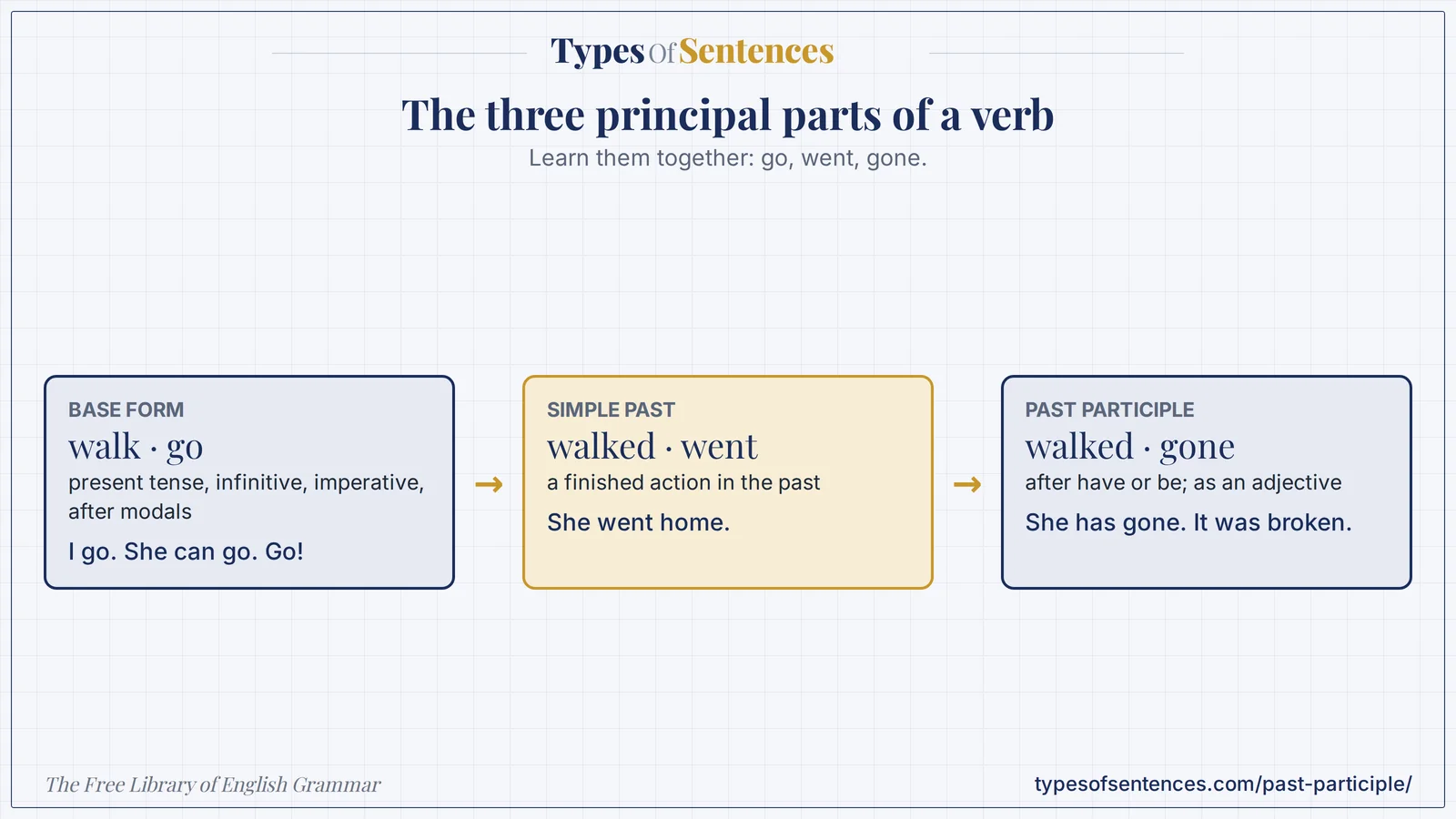
The past participle is the form of the verb that you put after have or be: has gone, was broken. It can also describe a noun: a broken window.
Why it matters: For regular verbs, you add -ed. For irregular verbs, you have to learn the form: write, wrote, written.
Summary: The past participle is the third principal part of a verb. Regular verbs add -ed (walked); irregular verbs have their own forms (gone, seen, broken, cut). It is used in the perfect tenses (has gone), in the passive (was seen), as an adjective (a broken window), in participial phrases (Tired, she slept), and in reduced relative clauses (the letter written yesterday). The present participle (-ing) is active or ongoing (a boring lesson); the past participle is passive or completed (a bored student). For regular verbs, the two forms of the past (simple past and participle) look the same; for irregular verbs they often differ.
- Third form: base, past, past participle.
- Used with have (perfect), be (passive), as an adjective, and in phrases.
- Present participle: boring (active); past participle: bored (passive).
- Do not use the simple past after have (*has went).
What You’ll Learn
- 1. What Is a Past Participle? Meaning and Forms
- 2. Forming Regular Past Participles and Spelling Rules
- 3. The Past Participle of Irregular Verbs
- 4. Uses of the Past Participle With Examples
- 5. Present vs Past Participle: -ing and -ed Adjectives
- 6. Past Participle vs Simple Past
- 7. Common Mistakes With This Verb Form
- 8. Exercises
- 9. Test Your Knowledge
- 10. Frequently Asked Questions
- 11. Conclusion
1. What Is a Past Participle? Meaning and Forms
| Principal part | Regular verb | Irregular verb | Use |
|---|---|---|---|
| base form | walk | write | present, infinitive, imperative |
| simple past | walked | wrote | a finished action |
| past participle | walked | written | perfect tenses, passive, adjectives |
| present participle | walking | writing | progressive tenses, adjectives, gerund (as a noun) |
| Feature | Past participle |
|---|---|
| also called | the third form; the -ed form; the -en form (for many irregular verbs) |
| regular forms | base + -ed (or -d) |
| irregular forms | various: gone, seen, done, taken, written, broken, brought, cut |
| function | non-finite: it shows no tense of its own |
| position | after have or be; before a noun; at the start of a phrase |
| aspect or voice | it carries the perfect aspect and the passive voice |
This form is non-finite: it does not show tense or agree with a subject, and so it cannot be the only verb of a clause. The difference between finite and non-finite verbs is described in the chapter on finite and non-finite verbs.
2. Forming Regular Past Participles and Spelling Rules
| Rule | Base | Past participle |
|---|---|---|
| most verbs: add -ed | walk, play, help | walked, played, helped |
| verbs ending in -e: add -d | love, hope, close | loved, hoped, closed |
| consonant + y: change y to i and add -ed | study, carry, try | studied, carried, tried |
| vowel + y: add -ed | play, enjoy, stay | played, enjoyed, stayed |
| one-syllable verbs ending in consonant–vowel–consonant: double the last consonant | stop, plan, drop | stopped, planned, dropped |
| longer verbs with the stress on the last syllable: double | prefer, admit, occur | preferred, admitted, occurred |
| longer verbs with the stress earlier: do not double (American) | visit, open, travel | visited, opened, traveled |
| verbs ending in -c: add -ked | panic, picnic | panicked, picnicked |
| Pronunciation of -ed | After the sound | Examples |
|---|---|---|
| /t/ | voiceless consonants: p, k, f, s, sh, ch | helped, walked, laughed, missed, washed, watched |
| /d/ | voiced consonants and vowels: b, g, v, z, l, m, n, r | played, loved, called, opened, cleaned |
| /ɪd/ | after t and d | wanted, needed, decided, started |
3. The Past Participle of Irregular Verbs
| Pattern | Base | Simple past | Past participle |
|---|---|---|---|
| all three the same | cut, put, hit, set, let, hurt, shut, cost, quit | cut, put, hit, set, let, hurt, shut, cost, quit | cut, put, hit, set, let, hurt, shut, cost, quit |
| past = participle (-ought) | bring, buy, catch, teach, think | brought, bought, caught, taught, thought | brought, bought, caught, taught, thought |
| past = participle (-t, -d) | build, send, spend, keep, sleep, hold, sell, tell, make, pay, say | built, sent, spent, kept, slept, held, sold, told, made, paid, said | built, sent, spent, kept, slept, held, sold, told, made, paid, said |
| i – a – u | sing, begin, drink, swim, ring, sink | sang, began, drank, swam, rang, sank | sung, begun, drunk, swum, rung, sunk |
| base – -ew – -own | know, grow, throw, blow, fly, draw | knew, grew, threw, blew, flew, drew | known, grown, thrown, blown, flown, drawn |
| -oke / -oken | break, speak, steal, freeze, choose, wake | broke, spoke, stole, froze, chose, woke | broken, spoken, stolen, frozen, chosen, woken |
| -en endings | take, give, see, eat, fall, forget, write, ride, drive, hide, bite | took, gave, saw, ate, fell, forgot, wrote, rode, drove, hid, bit | taken, given, seen, eaten, fallen, forgotten (US), written, ridden, driven, hidden, bitten |
| same as the base | come, run, become | came, ran, became | come, run, become |
| special | go, do, be, have | went, did, was/were, had | gone, done, been, had |
The full list of irregular verbs, with all three forms for 220 verbs, is on the page about irregular verbs, which comes before this one in the series. A few verbs have two forms that differ in use: prove (proved or proven), get (gotten in American English), hang (hung for objects, hanged for executions), and shine (shone, but shined for polishing).
4. Uses of the Past Participle With Examples
| Use | Pattern | Examples |
|---|---|---|
| present perfect | has/have + participle | She has finished the work. They have gone home. |
| past perfect | had + participle | He had eaten before we came. |
| future perfect | will have + participle | By noon, I will have written the report. |
| perfect progressive (with been) | has been + -ing (the participle been) | She has been waiting. |
| passive voice | be + participle | The letter was written yesterday. The doors are locked at night. |
| get-passive | get + participle | He got fired. The vase got broken. |
| attributive adjective | before a noun | a broken window, a closed door, fried rice, a written test |
| predicative adjective | after a linking verb | The door is closed. She seems tired. |
| participial phrase | at the start or after a noun | Tired of waiting, she left. The man, shocked by the news, sat down. |
| reduced relative clause | after a noun, instead of which was | the letter written by Priya (= which was written by Priya) |
| after have or get + object (causative) | have + object + participle | I had my hair cut. She got her car repaired. |
| absolute phrase | a noun + the third form | The work done, we went home. |
| Perfect tense or passive? | Auxiliary | Example | Meaning |
|---|---|---|---|
| perfect | have | She has opened the door. | she did it (active) |
| passive | be | The door was opened. | something happened to the door |
| both (perfect passive) | have been | The door has been opened. | the door was opened (a present result) |
The passive voice is explained in the chapter on active and passive voice, the participial phrase in participial phrases, and the auxiliaries have and be in the chapter on helping verbs. Participles that work as adjectives are treated among the adjectives, in adjective types.
5. Present vs Past Participle: -ing and -ed Adjectives
| Present participle (-ing) | Past participle (-ed) | Difference |
|---|---|---|
| The lesson is boring. | The students are bored. | the -ing word describes what causes the feeling; the -ed word describes who feels it |
| an interesting book | an interested reader | the book interests; the reader is interested |
| a confusing rule | a confused learner | the rule confuses; the learner is confused |
| an exciting game | an excited crowd | the game excites; the crowd is excited |
| a tiring day | a tired child | the day tires; the child is tired |
| a surprising result | a surprised teacher | the result surprises; the teacher is surprised |
| a frightening film | a frightened boy | the film frightens; the boy is frightened |
| a satisfying meal | a satisfied customer | the meal satisfies; the customer is satisfied |
| a worrying sign | a worried mother | the sign worries; the mother is worried |
| an amazing view | an amazed visitor | the view amazes; the visitor is amazed |
| falling leaves | fallen leaves | the leaves are falling; the leaves have fallen |
| a developing country | a developed country | still in progress; completed |
| a sinking ship | a sunken ship | in the act; finished |
| boiling water | boiled water | in the act; finished |
| a running tap | a run-down house | a different meaning, not a pair |
| Feature | Present participle | Past participle |
|---|---|---|
| ending | -ing | -ed, -en, or irregular |
| voice | active | passive or completed |
| aspect | in progress | completed |
| after be | progressive (is working) | passive (is made) |
| after have | — | perfect (has worked) |
| as an adjective | causes or does something | receives or has had something done |
| in a phrase | Walking home, I fell. | Tired, I fell. |
6. Past Participle vs Simple Past
| Verb | Simple past | Past participle | Test |
|---|---|---|---|
| walk | walked | walked | the same for regular verbs |
| go | went | gone | different: She went; She has gone |
| see | saw | seen | different |
| write | wrote | written | different |
| bring | brought | brought | the same |
| cut | cut | cut | the same |
| drink | drank | drunk | different |
| Test | How | Example |
|---|---|---|
| is there have or be before the verb? | yes: the participle | She has written. |
| is the verb alone with a subject? | yes: a simple past | She wrote. |
| does the verb come after a noun and describe it? | yes: the participle | the letter written |
| does a time word such as yesterday appear? | yes: a simple past | She wrote yesterday. |
7. Common Mistakes With This Verb Form
| Mistake | Example | Correction |
|---|---|---|
| simple past after have | *She has went. | She has gone. |
| participle used for the simple past | *I seen him yesterday. | I saw him yesterday. |
| adding -ed to an irregular verb | *He has taked it. | He has taken it. |
| the base form in the passive | *The window was break. | The window was broken. |
| -ing for -ed (feelings) | *I am boring. (meaning I feel bored) | I am bored. |
| -ed for -ing | *The film was bored. | The film was boring. |
| of for have | *I could of gone. | I could have gone. |
| a dangling participle | *Tired, the bed looked good. | Tired, I thought the bed looked good. |
| drunk and drank | *I have drank. | I have drunk. |
| shrunk and shrank in the passive | *The shirt was shrank. | The shirt was shrunk. (or: has shrunk) |
Fix: The students, bore by the lesson, have went home, and the window that was break by the storm had been took away; I seen the boring students leave.
- bore by the lesson: the participle is bored.
- have went: have gone.
- was break: the passive needs broken.
- had been took: had been taken.
- I seen: a simple past: I saw.
- the boring students: the students feel bored: the bored students.
- Result: The students, bored by the lesson, have gone home, and the window that was broken by the storm had been taken away; I saw the bored students leave. (the sentence is invented)
Recap in 12 seconds
Watch the lesson build itself: The base form, the simple past, and the past participle, with the use of each. The video has no sound.
Exercises
Part A: Forming Past Participles (Exercises 1–8)
Exercise 1: Give the third form of walk.
Show Answer
Answer: walked.
Exercise 2: Give the third form of study.
Show Answer
Answer: studied.
Exercise 3: Give the third form of stop.
Show Answer
Answer: stopped.
Exercise 4: Give the third form of love.
Show Answer
Answer: loved.
Exercise 5: Give the third form of go.
Show Answer
Answer: gone.
Exercise 6: Give the third form of write.
Show Answer
Answer: written.
Exercise 7: Give the third form of bring.
Show Answer
Answer: brought.
Exercise 8: Give the third form of cut.
Show Answer
Answer: cut.
Part B: Uses (Exercises 9–16)
Exercise 9: Complete (present perfect): She has ___ the work. (finish)
Show Answer
Answer: finished.
Exercise 10: Complete (passive): The letter was ___ yesterday. (write)
Show Answer
Answer: written.
Exercise 11: Complete (past perfect): He had ___ before we came. (eat)
Show Answer
Answer: eaten.
Exercise 12: Complete (adjective): a ___ window (break)
Show Answer
Answer: broken.
Exercise 13: Complete (adjective): a ___ lake (freeze)
Show Answer
Answer: frozen.
Exercise 14: Complete (causative): I had my hair ___. (cut)
Show Answer
Answer: cut.
Exercise 15: Complete (phrase): ___ of waiting, she left. (tire)
Show Answer
Answer: Tired.
Exercise 16: Complete (reduced clause): the letter ___ by Priya (write)
Show Answer
Answer: written.
Part C: Present vs Past Participle (Exercises 17–22)
Exercise 17: Choose: The lesson is (boring/bored).
Show Answer
Answer: boring.
Exercise 18: Choose: The students are (boring/bored).
Show Answer
Answer: bored.
Exercise 19: Choose: an (exciting/excited) crowd
Show Answer
Answer: excited.
Exercise 20: Choose: an (exciting/excited) game
Show Answer
Answer: exciting.
Exercise 21: Choose: (falling/fallen) leaves (they are on the ground)
Show Answer
Answer: fallen.
Exercise 22: Choose: a (sinking/sunken) ship (it is on the sea floor)
Show Answer
Answer: sunken.
Part D: Simple Past or Past Participle? (Exercises 23–26)
Exercise 23: Choose: She has (went/gone).
Show Answer
Answer: gone.
Exercise 24: Choose: I (saw/seen) him yesterday.
Show Answer
Answer: saw.
Exercise 25: Choose: They have (swam/swum).
Show Answer
Answer: swum.
Exercise 26: Choose: The window was (broke/broken).
Show Answer
Answer: broken.
Part E: Correcting Errors (Exercises 27–30)
Exercise 27: Correct: *She has went home.
Show Answer
Answer: She has gone home.
Exercise 28: Correct: *I am boring. (I feel bored)
Show Answer
Answer: I am bored.
Exercise 29: Correct: *I could of gone.
Show Answer
Answer: I could have gone.
Exercise 30: Correct: *The window was break.
Show Answer
Answer: The window was broken.
Test Your Knowledge
Ready to check what you learned? Answer all 10 questions, then submit. You need 80% (8 of 10) to pass. Your answers are not stored.
View correct answers and explanations
Question 1: What is the past participle of see?
✓ Correct Answer: D – seen
Seen.
Question 2: Which sentence uses the perfect tense?
✓ Correct Answer: B – She has run.
Has run.
Question 3: Which is correct?
✓ Correct Answer: C – She has gone.
Has gone.
Question 4: The window was broken. is
✓ Correct Answer: A – passive voice
Be + participle.
Question 5: Which describes who feels?
✓ Correct Answer: B – bored
Bored.
Question 6: Which describes the cause?
✓ Correct Answer: D – an exciting game
The -ing form.
Question 7: The past participle of a regular verb ends in
✓ Correct Answer: A – -ed
-ed.
Question 8: Which is a participial phrase?
✓ Correct Answer: C – Tired of waiting, she left.
It begins with a participle.
Question 9: Which is the same as the simple past?
✓ Correct Answer: B – walked
Regular verbs.
Question 10: Which is correct?
✓ Correct Answer: C – I have drunk tea.
Drunk.
Frequently Asked Questions
What is a past participle?
A past participle is the third main form of a verb, used after have and be and as an adjective, such as finished, gone, and broken.
What is the past participle meaning in grammar?
The past participle meaning is a non-finite verb form that shows a completed or passive action. It does not show tense by itself and appears in the perfect tenses, the passive, and adjectives.
What are past participle examples?
She has finished (perfect); The door was closed (passive); a broken window (adjective); Tired, she slept (participial phrase). These past participle examples show the main uses.
How do I find the past participle of irregular verbs?
The past participle of irregular verbs must be learned; use the irregular verbs list on the page before this one, and learn the verbs in families such as sing, sang, sung and break, broke, broken.
What is the difference in present vs past participle?
The present participle ends in -ing and is active or in progress (a boring lesson); the past participle ends in -ed or is irregular and is passive or completed (a bored student).
Is the past participle the same as the simple past?
For regular verbs, yes (walked). For many irregular verbs, no (went and gone), so use the third form after have and be only.
How is -ed pronounced?
After voiceless consonants, it is /t/ (helped); after voiced sounds, /d/ (played); after t and d, /ɪd/ (wanted).
Conclusion
You now know what a past participle is, how to form regular and irregular forms, the uses in the perfect tenses, the passive, adjectives, and phrases, the difference between the present participle and the past form, and how to avoid the common mistakes.
When you choose between two forms, check the auxiliary: have and be need the third form. Next, you will study the participles in all their uses.
- Huddleston, Rodney, and Geoffrey K. Pullum. The Cambridge Grammar of the English Language. Cambridge University Press, 2002.: verb inflection and non-finite forms.
- Quirk, Randolph, Sidney Greenbaum, Geoffrey Leech, and Jan Svartvik. A Comprehensive Grammar of the English Language. Longman, 1985.: participles.
- Swan, Michael. Practical English Usage. 4th ed. Oxford University Press, 2016.: participles and -ed pronunciation.
- Garner, Bryan A. Garner’s Modern English Usage. 5th ed. Oxford University Press, 2022.: entries on irregular participles.
- Merriam-Webster Dictionary: past participle: the dictionary entry.
Last reviewed: October 29, 2026. How it was made: drafted with AI assistance, then checked with automated tests (structure, links, answer keys, spelling) and against the sources above. A person has not yet read this chapter line by line. Found a mistake? Report it.