The types of verbs in English are sorted by what the verb needs after it and by what it does in the sentence. A verb can be transitive or intransitive, an action verb or a stative verb, a linking verb, an auxiliary verb, or a modal. Knowing the type tells you what can follow the verb, whether it can take -ing, and whether the sentence can be made passive.
This chapter reviews the verb you know from the Basic level, shows the five forms every verb has, and then works through each type with tests you can apply to any sentence. You will see how to tell linking verbs from action verbs, how to choose between a transitive, intransitive verbs pattern, and how regular and irregular verbs differ. Thirty exercises and a quiz follow.
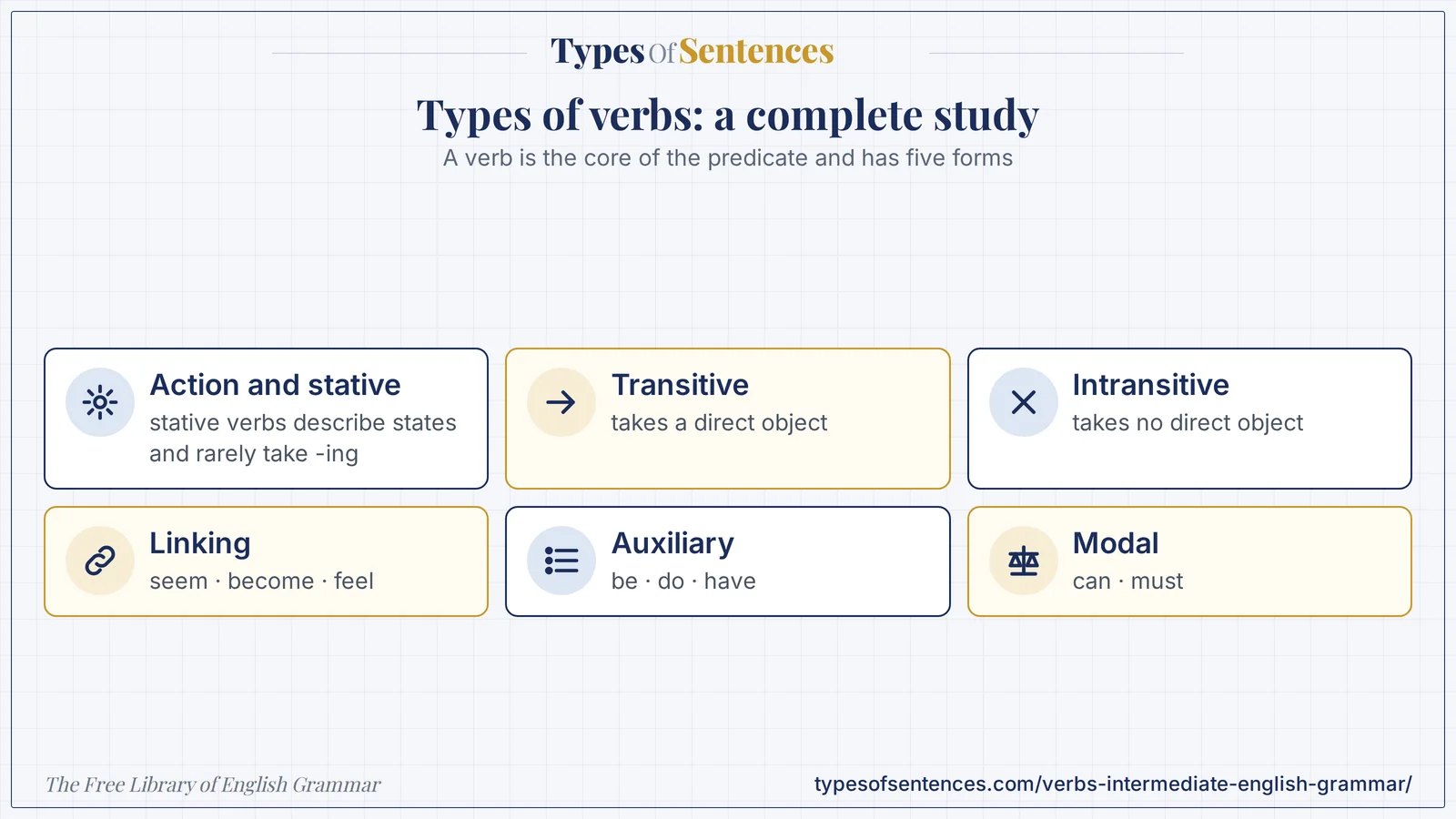
Not all verbs work the same way. Kick needs something to kick; sleep does not. Seem links a subject to a description; run shows an action.
Why it matters: The type of a verb decides what kind of word or phrase can come next, so knowing it helps you build correct sentences and avoid errors such as I am knowing.
Summary: A verb is the core of the predicate. It has five forms, and it can be an action verb or a stative verb, a transitive or an intransitive one, a linking verb, an auxiliary, or a modal. Each type has its own pattern.
- Transitive verbs take a direct object; intransitive verbs do not.
- Stative verbs describe states and rarely take -ing.
- Linking verbs join the subject to a complement (seem, become, feel).
- Auxiliaries (be, do, have) and modals (can, must) help the main verb.
What You’ll Learn
- 1. Types of Verbs: What Is a Verb? A Quick Review
- 2. Action Verbs and Being Verbs: A Review
- 3. The Five Verb Forms
- 4. Transitive and Intransitive Verbs
- 5. Action Verbs vs. Stative Verbs
- 6. Linking Verbs
- 7. Auxiliary Verbs (Helping Verbs)
- 8. Modal Verbs (Introduction)
- 9. Regular vs. Irregular Verbs
- 10. Exercises
- 11. Test Your Knowledge
- 12. Frequently Asked Questions
- 13. Conclusion
1. Types of Verbs: What Is a Verb? A Quick Review
A verb is the word, or group of words, that shows an action, an event, or a state. Every complete sentence has at least one verb, and the verb is the core of the predicate. A verb that is the main one in its clause is the main verb; verbs that come before it to help are auxiliary verbs.
- She writes every day. main verb
- She is writing a letter. auxiliary is + main verb writing
- She will have finished by noon. two auxiliaries + main verb
Verbs also change form to show tense, person, and number; the forms are in the next section. The verb that carries tense and agrees with the subject is called finite. Verb forms that do not (to write, writing, written) are non-finite.
2. Action Verbs and Being Verbs: A Review
Action verbs, also called active verbs or dynamic verbs, show something a person or thing does: run, write, open, decide. Being verbs show what someone or something is: am, is, are, was, were.
| Kind | What it shows | Examples |
|---|---|---|
| Action (dynamic) | an action, event, or process | Birds fly. She decided to leave. |
| Being | existence or identity | Tom is a doctor. They were late. |
| Linking | a state joined to a description | The soup tastes good. He became angry. |
These three groups overlap, as the later sections explain. The Basic chapter on verbs gave the first picture; here you will see the finer types.
3. The Five Verb Forms
Every English verb has up to five forms. Learning the five forms of a verb is the key to forming every tense.
| Form | Regular: walk | Irregular: write | Used for |
|---|---|---|---|
| Base form | walk | write | present (not he/she/it), infinitive, after modals |
| -s form | walks | writes | present with he, she, it |
| Past form | walked | wrote | simple past |
| Past participle | walked | written | perfect tenses, passive |
| Present participle (-ing form) | walking | writing | continuous tenses, gerund |
For regular verbs, the past form and the past participle are the same (walked). For irregular verbs they often differ (wrote, written). The verb be has the most forms: be, am, is, are, was, were, been, being.
4. Transitive and Intransitive Verbs
A transitive verb needs a direct object to complete its meaning: the action passes from the subject to the object. An intransitive verb does not take a direct object. Learning the transitive, intransitive verbs distinction explains many sentence patterns.
| Type | Pattern | Example |
|---|---|---|
| Transitive | Subject + Verb + Object | She kicked the ball. (Kicked what?) |
| Intransitive | Subject + Verb (+ adverbial) | The baby slept. The train arrived late. |
| Ditransitive | Subject + Verb + Indirect object + Direct object | He gave Maria a book. |
To test a verb, ask what? or whom? after it. If there is an answer in the sentence, the verb is transitive. She kicked what? The ball. The baby slept what? There is no answer, so slept is intransitive. The objects are explained in the chapter on direct and indirect objects.
| Always transitive | Always intransitive | Both |
|---|---|---|
| make, put, need, have, enjoy | arrive, sleep, go, happen, fall | read, eat, run, open, win, change |
- She runs every morning. intransitive
- She runs a small company. transitive: runs what? a company
- The door opened. intransitive
- He opened the door. transitive
Only transitive verbs can be made passive: The ball was kicked. You cannot say The baby was slept. See the chapter on active and passive voice. Dictionaries label the two kinds vt. and vi.
Happen is intransitive, so it cannot be used in the passive.
5. Action Verbs vs. Stative Verbs
A dynamic verb (an action verb) describes an action or event that can happen over time and be repeated or interrupted. A stative verb describes a state: a thought, a feeling, a relationship, or a condition. Stative verbs are rarely used in the continuous (-ing) form.
| Kind of state | Stative verbs | Example |
|---|---|---|
| Thought | know, believe, understand, remember, doubt | I know the answer. |
| Feeling | love, like, hate, want, prefer, need | She loves music. |
| Possession and relationship | own, belong, have (possess), contain | The book belongs to Tom. |
| Appearance and senses | seem, appear, look (seem), sound, taste, smell | That sounds great. |
Know is stative, so it does not normally use the continuous form.
Some verbs are stative in one meaning and dynamic in another, and the continuous form is correct only for the dynamic meaning.
| Verb | Stative meaning | Dynamic meaning |
|---|---|---|
| think | opinion: I think it is good. | mental activity: I am thinking about it. |
| have | possess: She has a car. | experience or eat: She is having lunch. |
| see | perceive: I see a bird. | meet or visit: I am seeing the doctor. |
| taste | have a flavor: It tastes sweet. | try food: She is tasting the soup. |
6. Linking Verbs
A linking verb does not show an action. It connects the subject to a word or phrase that describes or renames it, called the subject complement. The most common linking verb is be. Other common linking verbs are become, seem, appear, remain, stay, grow, turn, and the sense verbs look, sound, feel, taste, and smell.
| Linking verb | Complement | Example |
|---|---|---|
| be | adjective or noun | Maria is tall. Maria is a doctor. |
| become | noun or adjective | He became a teacher. He became angry. |
| seem | adjective | They seem happy. |
| feel | adjective | I feel tired. |
| taste | adjective | The soup tastes delicious. |
Many of these verbs can also be action verbs. Compare:
| Linking | Action |
|---|---|
| The soup tastes good. | She tasted the soup. |
| He looked angry. | He looked at me. |
| The room grew cold. | The farmer grew corn. |
| I feel tired. | I felt the wall. |
In the first column the verb is followed by an adjective that describes the subject. In the second, the verb has an adverbial or an object. The patterns are explained in the chapter on subject and object complements.
7. Auxiliary Verbs (Helping Verbs)
An auxiliary verb comes before the main verb and helps it express tense, aspect, voice, a question, or a negative. There are three primary auxiliaries: be, have, and do.
| Auxiliary | Job | Example |
|---|---|---|
| be | continuous tenses and passive voice | She is reading. The book was written by Tom. |
| have | perfect tenses | They have finished. |
| do | questions and negatives in the simple present and past | Do you like tea? She did not call. |
The same verbs can also be main verbs: She has a car (main) and She has finished (auxiliary). The full treatment is in the guide to auxiliary verbs.
8. Modal Verbs (Introduction)
Modal verbs are a special group of auxiliaries that express ability, possibility, permission, obligation, and prediction. The core modals are can, could, may, might, will, would, shall, should, and must.
| Feature | Example |
|---|---|
| No -s in the third person | She can swim (not cans). |
| Followed by the base verb | They must leave (not must to leave). |
| Make questions by inversion | Can you help me? |
| Negative with not, no do | You should not go. |
Modals have no infinitive, past participle, or -ing form, which is why a few meanings use substitute phrases (be able to, have to). The seven chapters on modals begin with modal verbs: introduction.
9. Regular vs. Irregular Verbs
A regular verb forms its past form and past participle by adding -ed. An irregular verb forms them in another way. Irregular verbs are the most common verbs in English, so you must learn them.
| Pattern | Base – Past – Past participle |
|---|---|
| all three the same | cut – cut – cut; put – put – put; hit – hit – hit |
| past and participle the same | buy – bought – bought; sit – sat – sat; leave – left – left |
| all three different | write – wrote – written; go – went – gone; see – saw – seen |
| vowel change | sing – sang – sung; drink – drank – drunk; begin – began – begun |
| -n or -en participle | break – broke – broken; speak – spoke – spoken; take – took – taken |
The perfect tenses need the past participle (written), not the past form (wrote).
Some verbs have two accepted forms, such as learned or learnt and dreamed or dreamt. American English prefers learned and dreamed. The tenses that use these forms are covered from Chapter 35, beginning with verb tenses.
Give the three main forms of drive.
Reveal answer
drive – drove – driven.
Recap in 12 seconds
Watch the lesson build itself: The main types of verb: action and stative, transitive and intransitive, linking, auxiliary, and modal. The video has no sound.
Exercises
Part A: The Five Forms (Exercises 1–6)
Exercise 1: Give the five forms of walk.
Show Answer
Answer: walk, walks, walked, walked, walking.
Exercise 2: Give the five forms of drive.
Show Answer
Answer: drive, drives, drove, driven, driving.
Exercise 3: Which form follows a modal such as can?
Show Answer
Answer: The base form: can drive.
Exercise 4: Which form is used in the perfect tenses?
Show Answer
Answer: The past participle.
Exercise 5: Fix it: She has wrote a letter.
Show Answer
Answer: She has written a letter.
Exercise 6: How many forms does be have?
Show Answer
Answer: Eight: be, am, is, are, was, were, been, being.
Part B: Transitive and Intransitive (Exercises 7–12)
Exercise 7: Transitive or intransitive: She kicked the ball.
Show Answer
Answer: Transitive. Kicked what? The ball.
Exercise 8: Transitive or intransitive: The baby slept.
Show Answer
Answer: Intransitive.
Exercise 9: Transitive or intransitive: She runs a small company.
Show Answer
Answer: Transitive.
Exercise 10: Transitive or intransitive: She runs every morning.
Show Answer
Answer: Intransitive.
Exercise 11: Fix it: The meeting was happened yesterday.
Show Answer
Answer: The meeting happened yesterday.
Exercise 12: Which can be made passive: arrive or make?
Show Answer
Answer: Make. Only transitive verbs have a passive.
Part C: Action and Stative Verbs (Exercises 13–17)
Exercise 13: Action or stative: know
Show Answer
Answer: Stative.
Exercise 14: Action or stative: decide
Show Answer
Answer: Action (dynamic).
Exercise 15: Fix it: I am knowing the answer.
Show Answer
Answer: I know the answer.
Exercise 16: Choose the continuous form if correct: She (has/is having) lunch right now.
Show Answer
Answer: is having. Have is dynamic here.
Exercise 17: Explain the difference: I think it is good. and I am thinking about it.
Show Answer
Answer: The first is an opinion (stative); the second is mental activity (dynamic).
Part D: Linking Verbs (Exercises 18–23)
Exercise 18: Linking or action: The soup tastes good.
Show Answer
Answer: Linking.
Exercise 19: Linking or action: She tasted the soup.
Show Answer
Answer: Action.
Exercise 20: Choose: She looks (beautiful/beautifully).
Show Answer
Answer: beautiful. After a linking verb, use an adjective.
Exercise 21: Choose: He looked (angry/angrily) at me.
Show Answer
Answer: angrily. Here looked at is an action, so an adverb describes it.
Exercise 22: Name the complement: He became a teacher.
Show Answer
Answer: a teacher.
Exercise 23: Apply the test: can seem be replaced by be in They seem happy?
Show Answer
Answer: Yes: They are happy. So seem is linking.
Part E: Auxiliaries and Modals (Exercises 24–27)
Exercise 24: Name the auxiliary: She is reading.
Show Answer
Answer: is.
Exercise 25: Name the main verb and the auxiliary: They have finished.
Show Answer
Answer: Main: finished; auxiliary: have.
Exercise 26: Fix it: She cans swim.
Show Answer
Answer: She can swim.
Exercise 27: Fix it: You must to leave.
Show Answer
Answer: You must leave.
Part F: Regular and Irregular Verbs (Exercises 28–30)
Exercise 28: Give the past and past participle of buy.
Show Answer
Answer: bought, bought.
Exercise 29: Give the past and past participle of sing.
Show Answer
Answer: sang, sung.
Exercise 30: Which is American usage: learned or learnt?
Show Answer
Answer: Learned.
Test Your Knowledge
Ready to check what you learned? Answer all 10 questions, then submit. You need 80% (8 of 10) to pass. Your answers are not stored.
View correct answers and explanations
Question 1: What does a transitive verb need?
✓ Correct Answer: B – A direct object
A transitive verb takes a direct object.
Question 2: Which verb is intransitive?
✓ Correct Answer: C – sleep
Sleep takes no direct object.
Question 3: Which is a stative verb?
✓ Correct Answer: D – know
Know describes a state of mind.
Question 4: Which is correct?
✓ Correct Answer: A – I want a coffee.
Want is stative and does not take the continuous form.
Question 5: Which is a linking verb in The soup tastes good?
✓ Correct Answer: D – tastes
Tastes links the subject soup to the adjective good.
Question 6: Which is correct?
✓ Correct Answer: C – She looks beautiful.
After a linking verb, use an adjective.
Question 7: Which verb is an auxiliary in She is reading?
✓ Correct Answer: A – is
Is is the auxiliary; reading is the main verb.
Question 8: Which is a modal verb?
✓ Correct Answer: B – can
Can is a modal verb.
Question 9: Which is the past participle of write?
✓ Correct Answer: C – written
Written is the past participle.
Question 10: Which is correct?
✓ Correct Answer: D – She has gone home.
The perfect tenses use the past participle gone.
Frequently Asked Questions
What are the types of verbs?
The main types of verbs are action (dynamic) and stative verbs, transitive and intransitive verbs, linking verbs, auxiliary verbs, modal verbs, and regular and irregular verbs. A single verb can belong to several types.
What are transitive, intransitive verbs?
A transitive verb takes a direct object (She kicked the ball). An intransitive verb does not (The baby slept). Many verbs, such as read and run, can be both.
What are linking verbs?
Linking verbs connect a subject to a complement that describes or renames it, as in The soup tastes good and He became a teacher. Be, become, seem, and the sense verbs are the most common.
What are active verbs?
Active verbs, also called action or dynamic verbs, show something that someone does or that happens, such as run, write, and decide. They contrast with stative verbs, which show states.
How do I tell a transitive verb from an intransitive one?
Ask what? or whom? after the verb. If the sentence gives an answer, the verb is transitive. If there is no answer, it is intransitive. A transitive verb can be made passive; an intransitive one cannot.
Why can’t I say I am knowing?
Know is a stative verb, and stative verbs describe states, not actions in progress, so they do not usually take the continuous form. Say I know.
What are the five verb forms?
The base form (write), the -s form (writes), the past form (wrote), the past participle (written), and the present participle (writing).
Conclusion
You now know the types of verbs: transitive and intransitive, action and stative, linking, auxiliary, and modal, and how regular and irregular verbs form their past forms. You can apply the tests (what? or whom?, replace with be, try the continuous form) to any sentence.
Check each verb you meet for its type, and the patterns will become automatic. Next, you will study the types of pronouns.
- Merriam-Webster Dictionary: verb: the dictionary definition and labels (vt., vi.).
- Purdue Online Writing Lab: Grammar: reference section on verbs.
- Quirk, Randolph, et al. A Comprehensive Grammar of the English Language. Longman, 1985.: classification of verbs by complementation, dynamic and stative meaning.
- Huddleston, Rodney, and Geoffrey K. Pullum. The Cambridge Grammar of the English Language. Cambridge University Press, 2002.: verb forms and the auxiliary system.
Last reviewed: October 29, 2026. How it was made: drafted with AI assistance, then checked with automated tests (structure, links, answer keys, spelling) and against the sources above. A person has not yet read this chapter line by line. Found a mistake? Report it.