Adjective types matter because adjectives do more than describe: they classify, compare, and order the details around a noun. English has descriptive and classifying adjectives, gradable and non-gradable ones, participial and compound ones, and adjectives that can stand before a noun, after a verb, or both.
This chapter shows the types of adjectives, the order of adjectives before a noun, and the adjective degrees: positive, comparative, and superlative. It explains how to form comparatives and superlatives, how to tell an adjective from an adverb, and how to use -ing and -ed adjectives correctly. Thirty exercises and a quiz follow.
An adjective gives more information about a noun: what kind it is, how big, how old, what color, how it compares to something else. Different kinds of information follow different rules.
Why it matters: If you can name the type, you can say where the adjective goes, whether it can be compared, and whether it needs a hyphen.
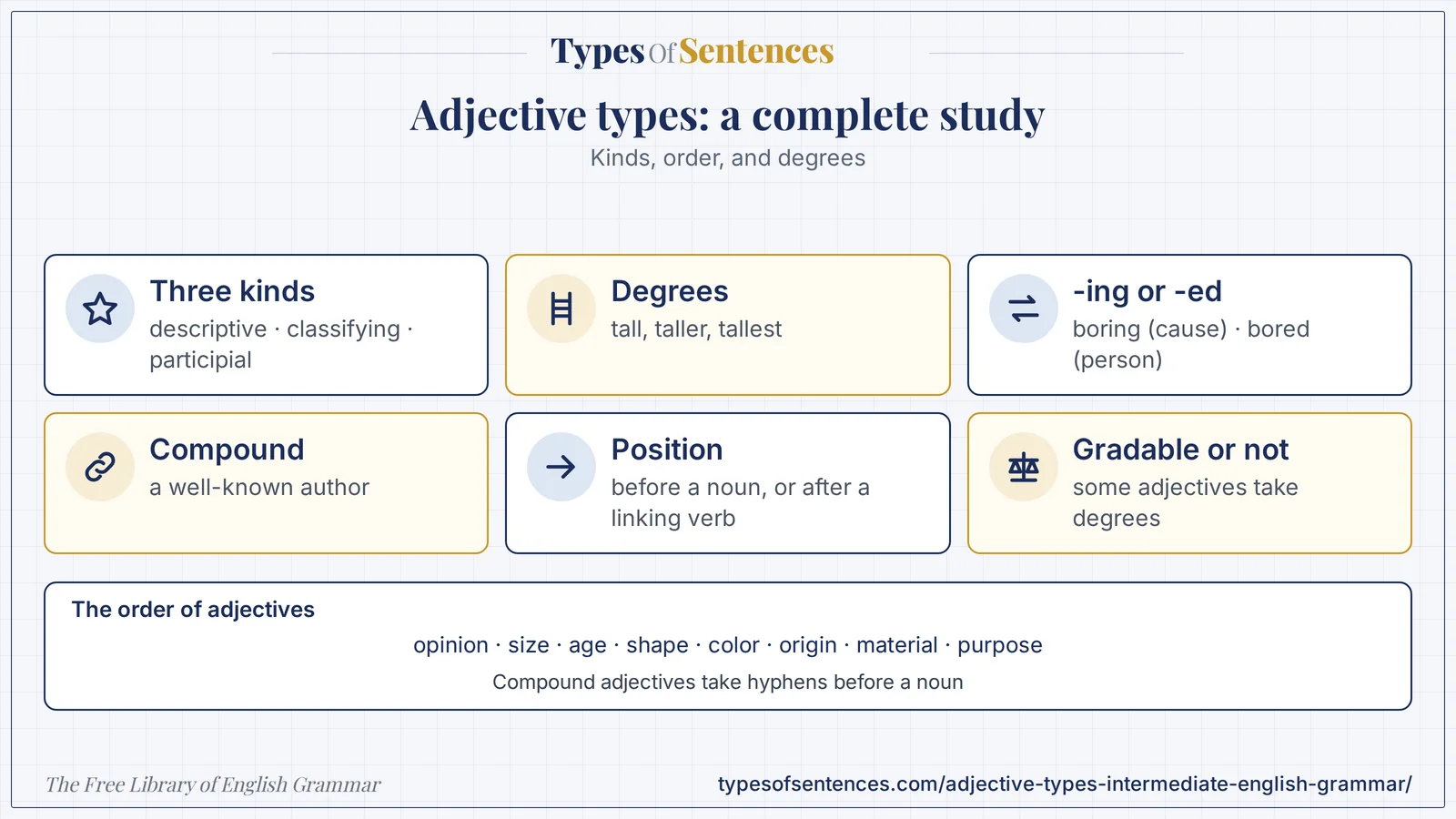
Summary: Adjectives are descriptive, classifying, or participial; they can be gradable or non-gradable; and they appear before a noun (attributive) or after a linking verb (predicative). Several adjectives follow a fixed order, and most gradable adjectives have comparative and superlative forms.
- Order: opinion, size, age, shape, color, origin, material, purpose (OSASCOMP).
- Degrees: tall, taller, tallest; beautiful, more beautiful, most beautiful.
- -ing describes the cause (boring); -ed describes the person who feels it (bored).
- Compound adjectives take hyphens before a noun: a well-known author.
What You’ll Learn
- 1. Adjective Types: What Is an Adjective? A Review
- 2. The Main Types of Adjectives
- 3. Descriptive Adjectives: Opinion, Fact, and Classifying
- 4. Order of Adjectives
- 5. Degrees of Comparison
- 6. Forming Comparatives and Superlatives
- 7. Adjectives vs. Adverbs
- 8. Compound Adjectives
- 9. Participial Adjectives: -ing and -ed
- 10. Attributive vs. Predicative Adjectives
- 11. Exercises
- 12. Test Your Knowledge
- 13. Frequently Asked Questions
- 14. Conclusion
1. Adjective Types: What Is an Adjective? A Review
An adjective modifies a noun or a pronoun. It answers the questions What kind?, Which one?, How many?, and How much?. Adjectives can come before the noun (a tall tree) or after a linking verb (The tree is tall), and in English they do not change for number or gender: a red apple, two red apples.
| Question | Example |
|---|---|
| What kind? | a kind teacher, a wooden table |
| Which one? | this book, the second floor |
| How many or how much? | three apples, some water |
| Whose? | my house, Tom’s car |
The words in the last three rows, such as this, some, and my, are classed as adjectives in traditional grammar and as determiners in modern grammar; see the chapter on determiners. This chapter concentrates on the adjectives that describe and compare.
2. The Main Types of Adjectives
Traditional grammar divides adjectives into types by meaning. This table lists the main adjective types and gives examples.
| Type | What it does | Examples |
|---|---|---|
| Descriptive (qualitative) | says what kind or quality | tall, beautiful, red, friendly, old |
| Quantitative | says how many or how much | few, many, several, enough, three |
| Demonstrative | points to a noun | this, that, these, those |
| Possessive | shows ownership | my, your, his, her, its, our, their |
| Interrogative | asks about a noun | which book? what time? whose bag? |
| Distributive | refers to each member of a group | each, every, either, neither |
| Proper | made from a proper noun | American, Shakespearean, Victorian |
| Compound | two or more words as one adjective | well-known, blue-green, five-year-old |
- She wore a red dress. descriptive
- Several students were late. quantitative
- Each player received a medal. distributive
- He studies American history. proper
3. Descriptive Adjectives: Opinion, Fact, and Classifying
Descriptive adjectives are the largest group. They divide into opinion adjectives, which give a judgment (beautiful, boring, delicious), and fact adjectives, which give a measurable detail (tall, old, round, wooden). A third group, classifying adjectives, says what category something belongs to (nuclear power, medical school, annual report).
| Gradable | Non-gradable (classifying or absolute) |
|---|---|
| tall, happy, cold, interesting | nuclear, annual, wooden, dead, unique |
| can take very, more, most | do not normally take very, more, most |
| very tall, taller | not very nuclear, more annual |
Gradable adjectives can be intensified with words such as very, quite, and extremely. Non-gradable adjectives name something that is or is not the case, so you cannot say very wooden. Strong adjectives such as exhausted and terrible are gradable in a special way: use absolutely or completely with them, not very (absolutely exhausted).
4. Order of Adjectives
When several adjectives come before a noun, English speakers use a fixed order. The order of adjectives is easiest to remember with the first letters: OSASCOMP.
| Position | Category | Example |
|---|---|---|
| 1 | Opinion | lovely, ugly, delicious |
| 2 | Size | small, huge, tall |
| 3 | Age | old, new, young |
| 4 | Shape | round, square, flat |
| 5 | Color | red, blue, golden |
| 6 | Origin | Italian, American, Indian |
| 7 | Material | wooden, silk, plastic |
| 8 | Purpose | sleeping (bag), cooking (pot) |
- a lovely small old round brown Italian wooden table all categories, rarely used
- a beautiful big red kite opinion, size, color
- two small brown dogs number before opinion and size
5. Degrees of Comparison
Gradable adjectives have three degrees. These adjective degrees show how much of a quality something has.
| Degree | Use | Example |
|---|---|---|
| Positive | describes without comparing | Tom is tall. |
| Comparative | compares two things | Tom is taller than Sam. |
| Superlative | compares three or more | Tom is the tallest boy in the class. |
- The comparative is followed by than (taller than Sam).
- The superlative takes the (the tallest).
- To show equality, use as … as (as tall as Sam) and not as … as or less … than for inequality.
6. Forming Comparatives and Superlatives
| Adjective | Rule | Comparative | Superlative |
|---|---|---|---|
| one syllable | add -er, -est | tall | taller, tallest |
| one syllable, ending in e | add -r, -st | nice | nicer, nicest |
| one syllable, short vowel + consonant | double the consonant | big | bigger, biggest |
| two syllables ending in -y | change y to i, add -er, -est | happy | happier, happiest |
| two syllables, other | more, most (or -er, -est for some) | careful, clever | more careful, cleverer or more clever |
| three or more syllables | more, most | beautiful | more beautiful, most beautiful |
| irregular | memorize | good, bad, far, little, many | better, worse, farther, less, more |
The irregular set is short but vital: good – better – best, bad – worse – worst, far – farther (or further) – farthest (or furthest), little – less – least, many/much – more – most. Many two-syllable adjectives take either form, so check a dictionary.
Use either -er or more, never both. The same applies to most and -est.
Words such as unique, perfect, dead, and empty are called absolute adjectives because they name an extreme. Strict usage avoids more unique, but writers do say more perfect (as in the U.S. Constitution’s opening line) and nearly perfect. Use almost or nearly before such an adjective in careful writing.
7. Adjectives vs. Adverbs
An adjective modifies a noun or a pronoun; an adverb modifies a verb, an adjective, or another adverb. Many adverbs are formed by adding -ly to an adjective, but some adjectives end in -ly (friendly, lovely, lonely) and some adverbs have the same form as the adjective (fast, hard, late).
| Adjective (modifies a noun) | Adverb (modifies a verb) |
|---|---|
| She is a careful driver. | She drives carefully. |
| It was a fast train. | The train went fast. |
| He gave a good answer. | He answered well. |
| She has hard work. | She works hard. |
After a linking verb (be, seem, feel, look, taste), use an adjective, not an adverb; see the chapter on types of verbs. She feels bad (an adjective describing her) is correct, and She feels badly usually means her sense of touch is poor. Use well as an adjective only for health: She is well means she is healthy.
Verbs need adverbs. Quick and careful are adjectives.
8. Compound Adjectives
A compound adjective is made of two or more words that work together before a noun. Join them with hyphens when they come before the noun, and leave the hyphens out when they come after the noun and the verb.
| Before the noun (hyphens) | After the verb (usually no hyphens) |
|---|---|
| a well-known author | The author is well known. |
| a five-year-old child | The child is five years old. |
| a high-quality product | The product is of high quality. |
| a part-time job | She works part time. |
9. Participial Adjectives: -ing and -ed
Many adjectives come from participles. The -ing form describes the thing or person that causes a feeling. The -ed form describes the person who experiences it.
| -ing (the cause) | -ed (the person who feels) |
|---|---|
| The movie was boring. | I was bored. |
| The news was surprising. | We were surprised. |
| It is an interesting book. | I am interested in it. |
| The class was tiring. | The students were tired. |
I am boring means that I make other people bored. To say how you feel, use bored.
These adjectives come from the present and past participle; the verb forms are in the chapter on participles.
10. Attributive vs. Predicative Adjectives
An attributive adjective comes before the noun it modifies (a happy child). A predicative adjective comes after a linking verb and describes the subject (The child is happy). Most adjectives can do both, but some work in only one position.
| Only attributive (before a noun) | Only predicative (after a verb) | Both |
|---|---|---|
| the main reason, a mere child, the only option | The child is asleep. She is afraid. He is alone. | a happy child; the child is happy |
A few adjectives come after the noun in fixed phrases or when they modify an indefinite pronoun: attorney general, something interesting, the people involved. The roles of complements are in the chapter on subject and object complements.
Which position does afraid take: an afraid child or The child is afraid?
Reveal answer
The child is afraid. Afraid is normally predicative; before a noun we say a frightened child.
Recap in 12 seconds
Watch the lesson build itself: Adjectives can be descriptive, classifying, or participial, follow a fixed order, and take degrees. The video has no sound.
Exercises
Part A: Types of Adjectives (Exercises 1–5)
Exercise 1: Type: tall
Show Answer
Answer: Descriptive.
Exercise 2: Type: several
Show Answer
Answer: Quantitative.
Exercise 3: Type: each
Show Answer
Answer: Distributive.
Exercise 4: Type: American
Show Answer
Answer: Proper.
Exercise 5: Type: well-known
Show Answer
Answer: Compound.
Part B: Gradable and Non-Gradable (Exercises 6–9)
Exercise 6: Gradable or non-gradable: cold
Show Answer
Answer: Gradable.
Exercise 7: Gradable or non-gradable: nuclear
Show Answer
Answer: Non-gradable.
Exercise 8: Choose: I am (very/absolutely) exhausted.
Show Answer
Answer: absolutely. Use absolutely with strong adjectives.
Exercise 9: Choose: She is (very/absolutely) tired.
Show Answer
Answer: very.
Part C: Order of Adjectives (Exercises 10–14)
Exercise 10: Order: wooden / old / big / a table
Show Answer
Answer: a big old wooden table.
Exercise 11: Order: red / beautiful / a dress
Show Answer
Answer: a beautiful red dress.
Exercise 12: Order: Italian / leather / a / new / bag
Show Answer
Answer: a new Italian leather bag.
Exercise 13: Add a comma if needed: a long thin road
Show Answer
Answer: a long, thin road. Both are fact adjectives of the same kind.
Exercise 14: Add a comma if needed: a small brown dog
Show Answer
Answer: No comma. Size and color are different categories.
Part D: Comparatives and Superlatives (Exercises 15–21)
Exercise 15: Comparative and superlative of nice:
Show Answer
Answer: nicer, nicest.
Exercise 16: Comparative and superlative of big:
Show Answer
Answer: bigger, biggest.
Exercise 17: Comparative and superlative of happy:
Show Answer
Answer: happier, happiest.
Exercise 18: Comparative and superlative of beautiful:
Show Answer
Answer: more beautiful, most beautiful.
Exercise 19: Comparative and superlative of good:
Show Answer
Answer: better, best.
Exercise 20: Comparative and superlative of bad:
Show Answer
Answer: worse, worst.
Exercise 21: Fix it: She is more taller than her sister.
Show Answer
Answer: She is taller than her sister.
Part E: Adjectives vs Adverbs and Compounds (Exercises 22–26)
Exercise 22: Choose: She drives (careful/carefully).
Show Answer
Answer: carefully.
Exercise 23: Choose: The soup tastes (good/well).
Show Answer
Answer: good.
Exercise 24: Choose: He did (good/well) on the test.
Show Answer
Answer: well.
Exercise 25: Hyphens: a ten year old boy
Show Answer
Answer: a ten-year-old boy.
Exercise 26: Hyphens: a highly paid doctor
Show Answer
Answer: No hyphen: a highly paid doctor.
Part F: Participial and Position (Exercises 27–30)
Exercise 27: Choose: The movie was (boring/bored).
Show Answer
Answer: boring.
Exercise 28: Choose: I was (surprising/surprised).
Show Answer
Answer: surprised.
Exercise 29: Fix it: I am very boring today.
Show Answer
Answer: I am very bored today.
Exercise 30: Fix the position: an asleep child
Show Answer
Answer: a sleeping child (or The child is asleep).
Test Your Knowledge
Ready to check what you learned? Answer all 10 questions, then submit. You need 80% (8 of 10) to pass. Your answers are not stored.
View correct answers and explanations
Question 1: Which is the correct order of adjectives?
✓ Correct Answer: B – a big old wooden table
Size, age, material: a big old wooden table.
Question 2: What does OSASCOMP stand for?
✓ Correct Answer: A – Opinion, size, age, shape, color, origin, material, purpose
OSASCOMP lists the categories in order.
Question 3: Which is the comparative of good?
✓ Correct Answer: D – better
Good is irregular: better.
Question 4: Which is correct?
✓ Correct Answer: A – She is taller than him.
Use either -er or more, not both.
Question 5: Which is the superlative of happy?
✓ Correct Answer: C – happiest
Happy changes y to i: happiest.
Question 6: Which is correct?
✓ Correct Answer: D – He runs quickly.
A verb needs an adverb.
Question 7: Which is correct?
✓ Correct Answer: C – The soup tastes good.
After a linking verb, use an adjective.
Question 8: Which describes how a person feels?
✓ Correct Answer: A – bored
The -ed form describes the person who feels.
Question 9: Which is correct?
✓ Correct Answer: C – a ten-year-old boy
In a number compound, the noun stays singular, with hyphens.
Question 10: Which adjective is normally predicative only?
✓ Correct Answer: B – asleep
Asleep is normally used after a verb.
Frequently Asked Questions
What are the main adjective types?
The main adjective types are descriptive, quantitative, demonstrative, possessive, interrogative, distributive, proper, and compound. Modern grammars treat several of these as determiners.
What are the types of adjectives by meaning?
By meaning, adjectives are descriptive (tall), quantitative (several), demonstrative (this), possessive (my), interrogative (which), distributive (each), and proper (American).
What is the order of adjectives?
The usual order of adjectives is opinion, size, age, shape, color, origin, material, and purpose (OSASCOMP): a lovely small old round brown Italian wooden table. In practice, use no more than three.
What are descriptive adjectives?
Descriptive adjectives tell what kind or quality something has: tall, beautiful, red, friendly. They are the largest group, and most of them are gradable.
What are the adjective degrees?
The adjective degrees are the positive (tall), the comparative (taller), and the superlative (tallest). Long adjectives use more and most instead of endings.
When do I use -ing and -ed adjectives?
Use the -ing form for the thing or person that causes the feeling (a boring movie) and the -ed form for the person who has the feeling (a bored student).
Can I say more unique?
Strict usage says no, because unique means one of a kind. Writers do use more nearly perfect or almost unique. For clear writing, use unique alone or choose another word such as unusual.
Conclusion
You now know the adjective types, from descriptive and classifying to compound and participial adjectives. You can order several adjectives with OSASCOMP, use the adjective degrees correctly, tell an adjective from an adverb, and choose between -ing and -ed.
Look at the adjectives in the next thing you read and name the type of each one. Next, you will study the types of adverbs.
- Merriam-Webster Dictionary: adjective: the dictionary definition of an adjective.
- Purdue Online Writing Lab: Grammar: reference section on adjectives.
- Quirk, Randolph, et al. A Comprehensive Grammar of the English Language. Longman, 1985.: classification of adjectives and the order of adjectives.
- Huddleston, Rodney, and Geoffrey K. Pullum. The Cambridge Grammar of the English Language. Cambridge University Press, 2002.: adjectives, gradability, and the determiner class.
Last reviewed: October 29, 2026. How it was made: drafted with AI assistance, then checked with automated tests (structure, links, answer keys, spelling) and against the sources above. A person has not yet read this chapter line by line. Found a mistake? Report it.