This grammar glossary H to M explains the grammar terms starting with H, I, L, and M in plain language. Each entry gives a short definition, an example, and a link to the lesson on this site that teaches the topic in full. It covers the kinds of clauses, objects, and moods, the words that are easily confused, and the verbs that carry meaning, from head noun to modifier.
The glossary is in six parts, and this is the third. It continues from D to G and is followed by N to P. The mood of the verb (indicative, imperative, and subjunctive) is explained in the entries for each mood. The grammar terms starting with I are especially numerous, because they include independent clause, indirect object, infinitive, and irregular verb.
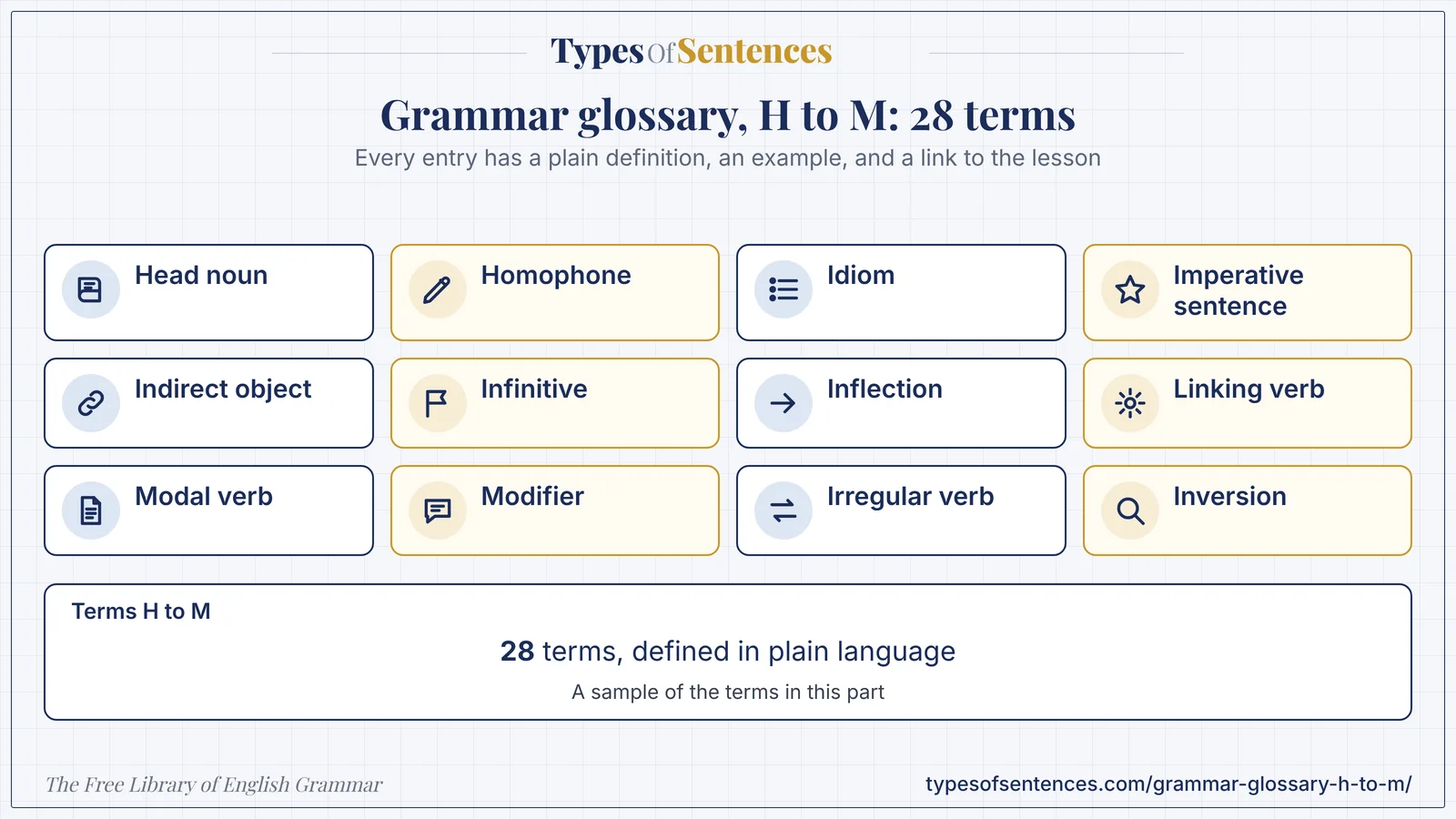
This part of the glossary covers terms from H to M. Many are pairs that are easy to mix up: direct and indirect speech, main and independent clause, homophone and homonym.
Why it matters: The entries tell you what each word means and which lesson to read next.
Summary: This part of the glossary defines 28 grammar terms from head noun to modifier, with an example for each and a link to the full lesson. Terms are in alphabetical order, and the letter list takes you to each section.
- Entries: a definition, an example, and a link to the lesson.
- Includes the moods, the objects, and the kinds of clauses.
- Previous part: D to G. Next part: N to P.
- Words with more than one name are listed under each name.
Jump to a Letter
H
head noun
Definition: The main noun of a noun phrase, the word that the other words in the phrase describe or modify. It is also called the head.
Example: the old house on the hill (house is the head)
Learn more: Noun Phrases
helping verb
Definition: Another name for an auxiliary verb: a verb such as be, do, have, or a modal that helps the main verb.
Example: She has finished.
Learn more: Auxiliary Verbs (Helping Verbs): Be, Do, Have and Modals
homograph
Definition: One of two or more words that are spelled the same but have different meanings, and sometimes different pronunciations.
Example: lead (a metal) and lead (to guide); bass (a fish) and bass (low sound)
Learn more: Ambiguity in English
homonym
Definition: One of two or more words that sound alike or are spelled alike but have different meanings. The term is often used for words with the same spelling and sound.
Example: bat (an animal) and bat (for a game)
Learn more: Ambiguity in English
homophone
Definition: One of two or more words that sound alike but differ in spelling and meaning.
Example: their, there, they’re
Learn more: Common Grammar Errors
hyphen
Definition: A short mark (-) that joins parts of a compound word or divides a word at the end of a line.
Example: well-known author, mother-in-law
Learn more: Punctuation Marks – Complete Study
I
idiom
Definition: A fixed phrase whose meaning is not the sum of the meanings of its words.
Example: kick the bucket, a piece of cake
Learn more: Common Idioms – Idioms and Common Phrases
imperative mood
Definition: The mood of the verb used for commands, requests, and instructions. It uses the base form and usually has no stated subject.
Example: Close the door.
Learn more: Imperative Sentence: Definition, Rules and Examples
imperative sentence
Definition: A sentence that gives a command, a request, or an instruction.
Example: Please sit down.
Learn more: Imperative Sentence: Definition, Rules and Examples
indefinite article
Definition: The words a and an, used before a singular count noun that is not specific.
Example: a dog, an egg
Learn more: Definite and Indefinite Articles – Complete Study
indefinite pronoun
Definition: A pronoun that does not point to a specific person or thing.
Example: someone, everything, nobody, each
Learn more: Types of Pronouns – Complete Study
independent clause
Definition: A clause that has a subject and a predicate and can stand alone as a sentence. It is also called a main clause.
Example: She left.
Learn more: Independent Clause and Dependent Clause Explained
indicative mood
Definition: The mood of the verb used for statements and questions of fact. It is the most common mood.
Example: She lives in Pune.
Learn more: Verb Tenses – Introduction to the 12 Tenses
indirect object
Definition: The noun or pronoun that receives the direct object, or for whom the action is done. It usually comes before the direct object.
Example: She gave him a book.
Learn more: Direct Object and Indirect Object
indirect speech
Definition: A report of what someone said, without the exact words. It is also called reported speech. The verb is usually shifted to the past.
Example: She said that she was tired.
Learn more: Reported Speech – Direct and Indirect Speech
infinitive
Definition: The base form of a verb, usually with to. It can work as a noun, an adjective, or an adverb.
Example: to swim, to be
Learn more: Infinitives – Complete Study
inflection
Definition: A change in the form of a word to show a grammatical meaning such as plural, tense, or comparison.
Example: cat → cats; walk → walked; tall → taller
Learn more: Prefixes and Suffixes – Word Formation Basics
interjection
Definition: A word or short phrase that expresses sudden feeling and is not part of the grammar of the sentence.
Example: Wow! Oh no!
Learn more: Interjections – Emotion Words
interrogative sentence
Definition: A sentence that asks a question and ends with a question mark.
Example: Where do you live?
Learn more: Interrogative Sentence: Definition, Types and Examples
intransitive verb
Definition: A verb that does not take a direct object.
Example: The baby sleeps.
Learn more: Types of Verbs – Complete Study
inversion
Definition: A change of the usual order of the subject and the verb, as in questions and in some formal or emphatic sentences.
Example: Are you ready? Never have I seen such courage.
Learn more: Elements of a Sentence
irregular verb
Definition: A verb whose past tense and past participle are not formed by adding -ed.
Example: go, went, gone; write, wrote, written
Learn more: Irregular Verbs: Complete List with All Three Forms
L
linking verb
Definition: A verb that links the subject to a word that describes or identifies it. It is also called a copular verb.
Example: The soup tastes good.
Learn more: Types of Verbs – Complete Study
M
main clause
Definition: Another name for an independent clause: the clause that can stand alone and that carries the main idea.
Example: We left after the rain stopped.
Learn more: Independent Clause and Dependent Clause Explained
main verb
Definition: The verb that carries the main meaning in a verb phrase. It is also called the lexical verb.
Example: She has finished.
Learn more: Verb Phrases
mass noun
Definition: A noun that names something that is not counted as separate items, so it has no plural. It is also called an uncountable noun.
Example: water, advice, information
Learn more: The Noun – Types of Nouns, A Complete Study
modal verb
Definition: An auxiliary verb that expresses ability, possibility, permission, obligation, or deduction: can, could, may, might, must, shall, should, will, would.
Example: You must go. She can swim.
Learn more: Modal Verbs – Introduction
modifier
Definition: A word, phrase, or clause that adds information about another word in the sentence. Adjectives and adverbs are the most common modifiers.
Example: the red car; She ran quickly.
Learn more: Adjective Types – Adjectives, A Complete Study
Recap in 12 seconds
Watch the lesson build itself: A sample of the 28 grammar terms from H to M: head noun, homophone, idiom, imperative sentence, indirect object, infinitive, inflection, linking verb, modal verb, modifier, irregular verb, inversion. The video has no sound.
Frequently Asked Questions
What is in the grammar glossary H to M?
This part lists the grammar terms starting with H, I, L, and M, from head noun to modifier, including idiom, independent clause, infinitive, irregular verb, and modal verb.
What is the difference between a homophone and a homonym?
A homophone sounds like another word but is spelled differently (their, there). A homonym is a word that has the same sound or spelling as another word but a different meaning (bat).
What is the difference between a direct object and an indirect object?
The direct object receives the action (a book in She gave him a book). The indirect object receives the direct object (him).
What are the three moods of the verb?
The indicative mood states facts and asks questions, the imperative mood gives commands, and the subjunctive mood expresses wishes, requirements, and unreal conditions. Each is explained in its own entry.
- Huddleston, Rodney, and Geoffrey K. Pullum. A Student’s Introduction to English Grammar. Cambridge University Press, 2005.: standard definitions of grammatical terms.
- Crystal, David. A Dictionary of Linguistics and Phonetics. 6th ed. Blackwell, 2008.: a reference for the terms.
- Quirk, Randolph, Sidney Greenbaum, Geoffrey Leech, and Jan Svartvik. A Comprehensive Grammar of the English Language. Longman, 1985.: a reference grammar.
- Merriam-Webster Dictionary: modifier: the dictionary entry.
Last reviewed: October 29, 2026. How it was made: drafted with AI assistance, then checked with automated tests (structure, links, spelling) and against the sources above. A person has not yet read this glossary line by line. Found a mistake? Report it.