Which are the best English grammar books? There is no single best English grammar book, because the right book depends on your level, your purpose, and the variety of English you need. A beginner needs short explanations and many simple exercises; an adult learner preparing for an exam needs a book with an answer key; a writer needs a usage guide; a teacher needs a reference. This page names twenty well-known books, says who each is for, and gives one recommendation for each need.
It covers how to choose an English grammar book, the best grammar books for beginners and for adults, the grammar reference books that serious students use, books for India, books for writers, and books for teachers. It lists authors, publishers, and editions, and it says plainly where I could confirm an edition and where you should check the current one. There are no affiliate links and no prices on this page; prices and editions change, so check them with a library or bookshop.
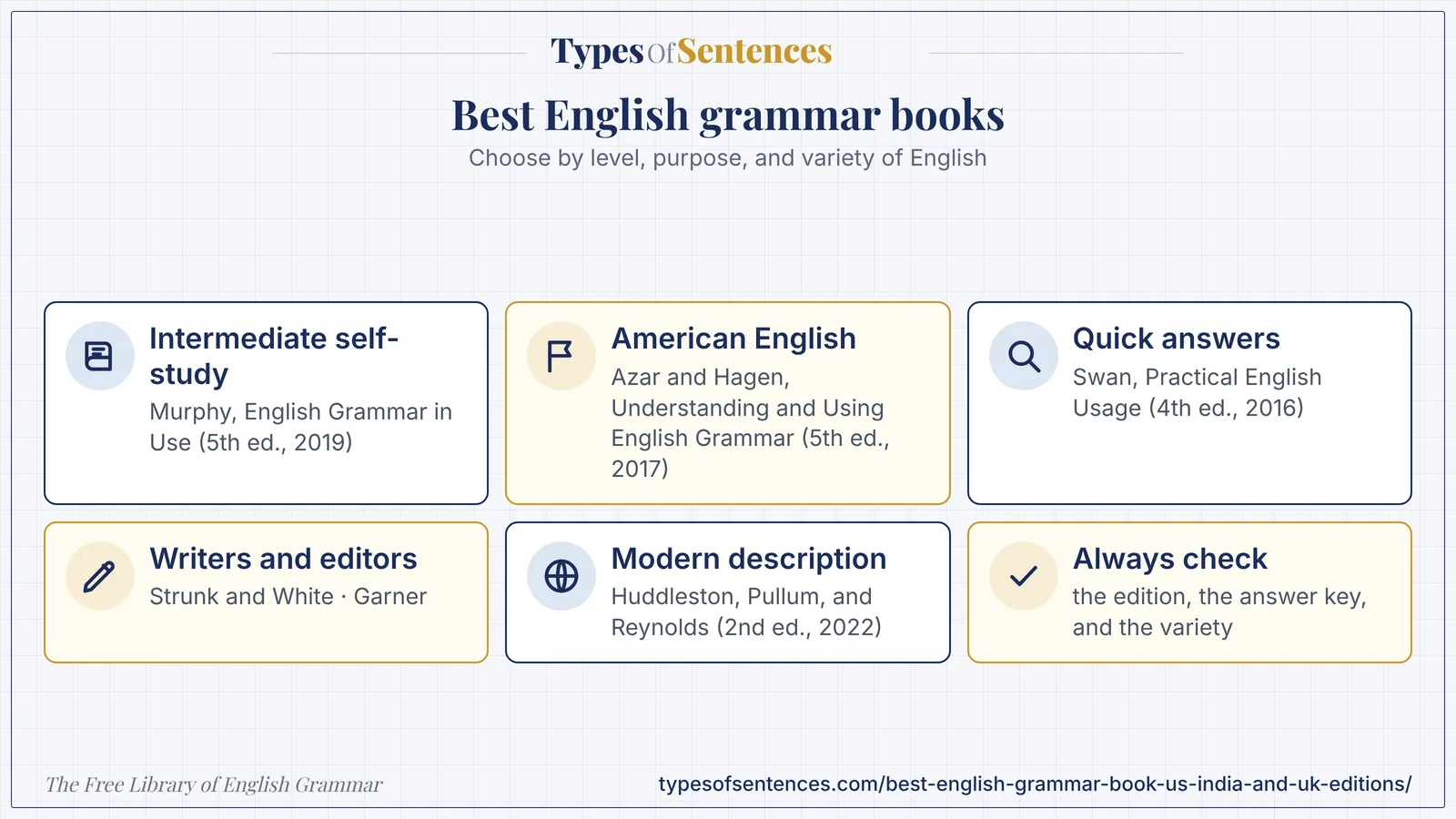
Pick a book by three things: your level (beginner, intermediate, advanced), your purpose (self-study, exams, writing, teaching), and your variety of English (American, British, Indian). Then check that the book has an answer key and a recent edition.
Why it matters: If you are not sure, start with the free Basic level of this course and a library copy of one book from the list.
Summary: For most self-study learners at intermediate level, the first choice is Raymond Murphy’s English Grammar in Use (5th ed., 2019); for American English with charts and many exercises, Azar and Hagen’s Understanding and Using English Grammar (5th ed., 2017); for beginners, Essential Grammar in Use or Azar and Hagen’s Basic English Grammar; for school and exam work in India, Wren and Martin; for quick answers, Michael Swan’s Practical English Usage (4th ed., 2016); for writers, Strunk and White and Garner; for a modern linguistic description, Huddleston, Pullum, and Reynolds (2nd ed., 2022). Always check the edition, the answer key, and the variety of English.
- Choose by level, purpose, and variety of English.
- One recommendation per need is in the table below.
- Check the edition and the answer key; use a library first.
- Avoid pirated PDFs; use free legal sources.
What You’ll Learn
- 1. How to Choose the Best English Grammar Book
- 2. The Best English Grammar Books: Twenty Well-Known Titles Compared
- 3. The Best English Grammar Book for Each Need
- 4. How to Use a Grammar Book Well
- 5. Buying Tips: Editions, Libraries, and Free Legal Alternatives
- 6. Frequently Asked Questions
- 7. Conclusion
1. How to Choose the Best English Grammar Book
| Question | What to look for | Example |
|---|---|---|
| What is my level? | a book labeled with your level (CEFR A1 to C2, or beginner, intermediate, advanced) | a beginner should not start with a reference grammar |
| What is my purpose? | self-study, exams, writing, teaching, or reference | exams: a workbook with an answer key |
| Which variety of English? | American, British, or Indian examples and spelling | match the variety you need to write |
| Explanation or practice? | a course book (explains and tests), a workbook (practice), or a reference (look up) | most learners need a course book |
| Does it have an answer key? | self-study needs answers and explanations | check before buying |
| How current is the edition? | a recent edition for usage; older books can be dated | look at the copyright page |
| Is it clear to me? | read a sample chapter in a library or bookshop | a book you will actually open is the best book |
| What does it cost to own? | a library or used copy can be enough | — |
| If you are … | Choose | Why |
|---|---|---|
| a complete beginner | a beginner grammar book with simple exercises, and the Basic level of this course | short units and many examples |
| an intermediate self-study learner | English Grammar in Use or Understanding and Using English Grammar | explanations with exercises and answers |
| an advanced learner | Advanced Grammar in Use and Practical English Usage | finer points and a reference |
| preparing for exams in India | Wren and Martin, and Objective General English | the format of the exams |
| a writer or editor | Strunk and White, Garner, and a style guide | clarity, usage, and verdicts |
| a teacher | Parrott, Swan, and a reference grammar | explanations and error anticipation |
| curious about how grammar works | Huddleston, Pullum, and Reynolds | a modern, evidence-based account |
2. The Best English Grammar Books: Twenty Well-Known Titles Compared
The table below lists the books, with the edition as far as I could confirm it. Where I have written check the current edition, I could not confirm the latest edition, and you should look at the publisher’s page or a library catalog. A confirmed edition does not mean that it is the newest in print, only that it exists as described. Prices are not given.
| Title | Authors | Publisher | Edition | Level | Best for | Limits |
|---|---|---|---|---|---|---|
| English Grammar in Use (with answers) | Raymond Murphy | Cambridge University Press | 5th ed., 2019 (confirmed) | B1–B2 (intermediate) | self-study learners; short units with practice on facing pages | British English; not for beginners or advanced users |
| Essential Grammar in Use | Raymond Murphy | Cambridge University Press | check the current edition (4th ed., 2015, as I recall) | A1–B1 (elementary) | absolute beginners to lower intermediate | British English; basic topics only |
| Advanced Grammar in Use | Martin Hewings | Cambridge University Press | check the current edition (3rd ed., 2013, as I recall) | C1–C2 (advanced) | advanced learners and exam candidates | assumes a strong base |
| Understanding and Using English Grammar | Betty S. Azar and Stacy A. Hagen | Pearson | 5th ed., 2017 (confirmed) | intermediate to advanced | learners who want charts, explanations, and many exercises in American English | long; chart-heavy |
| Basic English Grammar | Betty S. Azar and Stacy A. Hagen | Pearson | 5th ed. (confirmed to exist; check the printing) | beginner | American English for beginners | less detail on writing |
| English for Everyone: English Grammar Guide | DK (Dorling Kindersley) | DK | check the current edition | beginner to intermediate | visual learners; diagrams and short explanations | less depth; check the printing |
| High School English Grammar and Composition | P. C. Wren and H. Martin (revised by later editors) | S. Chand | check the latest revised edition | school and exam level | students in India preparing for school and competitive exams | style of some exercises is dated |
| Objective General English | S. P. Bakshi | Arihant | check the latest edition | exam practice | objective questions for competitive exams in India | practice more than explanation |
| Oxford Guide to English Grammar | John Eastwood | Oxford University Press | check the current printing (first published 1994) | intermediate to advanced | a clear reference with examples | not a workbook |
| Practical English Usage | Michael Swan | Oxford University Press | 4th ed., 2016 | all levels (reference) | quick answers on hundreds of usage problems | an A to Z reference, not a course |
| Garner’s Modern English Usage | Bryan A. Garner | Oxford University Press | 5th ed., 2022 | advanced (reference) | writers and editors who need a verdict on disputed points | American focus; opinionated |
| A Student’s Introduction to English Grammar | Rodney Huddleston, Geoffrey K. Pullum, and Brett Reynolds | Cambridge University Press | 2nd ed., 2022 (confirmed) | university | students of linguistics and teachers who want the modern analysis | uses terms that differ from school grammar |
| The Cambridge Grammar of the English Language | Rodney Huddleston and Geoffrey K. Pullum | Cambridge University Press | 2002 | research reference | the most complete modern description | large and technical |
| A Comprehensive Grammar of the English Language | Randolph Quirk, Sidney Greenbaum, Geoffrey Leech, and Jan Svartvik | Longman | 1985 | research reference | a classic full description | older than the Cambridge grammar |
| Longman Grammar of Spoken and Written English | Douglas Biber and others | Longman | 1999 | research reference | grammar based on a corpus; speech and writing compared | large and technical |
| The Elements of Style | William Strunk Jr. and E. B. White | Longman | 4th ed., 1999 (the 1918 original is in the public domain) | all levels (writing) | a short guide to clear writing | some rules are disputed |
| The Blue Book of Grammar and Punctuation | Jane Straus and others | Jossey-Bass (Wiley) | check the current edition | intermediate | quick rules and exercises for punctuation and usage | American English; brief |
| Style: Lessons in Clarity and Grace | Joseph M. Williams and Joseph Bizup | Pearson | 12th ed., 2017 | advanced (writing) | writers who want to improve their sentences | style, not a grammar |
| The Chicago Manual of Style | University of Chicago Press | University of Chicago Press | 17th ed., 2017; a newer edition may exist | professional reference | editors and authors; punctuation and style | large and expensive |
| Grammar for English Language Teachers | Martin Parrott | Cambridge University Press | 2nd ed., 2010 (as I recall) | teachers | teachers who want to explain grammar and anticipate errors | written for teachers, not learners |
| Count | Kind |
|---|---|
| 5 | learner books with exercises (Murphy’s two, Hewings, and Azar and Hagen’s two) |
| 1 | a visual guide (DK) |
| 3 | school and exam books for India, and one general reference (Wren and Martin, Bakshi, Eastwood) |
| 6 | reference grammars and usage guides (Swan, Garner, Huddleston and Pullum’s two, Quirk, Biber) |
| 5 | writing, style, and teaching books (Strunk and White, the Blue Book, Williams and Bizup, Chicago, Parrott) |
3. The Best English Grammar Book for Each Need
| Need | My recommendation | Second choice |
|---|---|---|
| best English grammar book for beginners | Essential Grammar in Use (Murphy) or Basic English Grammar (Azar and Hagen), plus the free Basic level of this course | English for Everyone: English Grammar Guide |
| best grammar book for adults (self-study, intermediate) | English Grammar in Use (Murphy, 5th ed., 2019) | Understanding and Using English Grammar (Azar and Hagen, 5th ed., 2017) |
| best for American English | Understanding and Using English Grammar | The Blue Book of Grammar and Punctuation |
| best for British English | English Grammar in Use | Oxford Guide to English Grammar |
| best for India (school and exams) | Wren and Martin, High School English Grammar and Composition | Objective General English (Bakshi) for objective questions |
| best for advanced learners | Advanced Grammar in Use (Hewings) | Practical English Usage (Swan) |
| best for quick answers | Practical English Usage (Swan, 4th ed., 2016) | this site’s glossary and chapters |
| best for writers and editors | Garner’s Modern English Usage (5th ed., 2022) with a style guide | The Elements of Style |
| best for a modern description of English grammar | A Student’s Introduction to English Grammar (2nd ed., 2022) | The Cambridge Grammar of the English Language (2002) |
| best for teachers | Grammar for English Language Teachers (Parrott) | Swan and a reference grammar |
| best for punctuation | The Chicago Manual of Style (or your required guide) | The Blue Book of Grammar and Punctuation |
For the full set of resources for studying grammar, including websites, corpora, and apps, see the chapter on grammar resources and references; for a plan of independent study, see the chapter on the grammar self-study guide.
4. How to Use a Grammar Book Well
| Step | What to do |
|---|---|
| 1 test yourself first | use the book’s diagnostic or the exercises to find your weak areas |
| 2 study one unit at a time | read the explanation, then do the exercises, then check the answers |
| 3 write your own sentences | apply each rule in your own examples |
| 4 review errors | keep an error log and re-do the units you missed |
| 5 read real texts | notice the rules in newspapers, books, and speeches |
| 6 retest after a few weeks | to see what has stuck |
| 7 use a second source for doubts | a usage guide or a corpus when two books disagree |
| Do not | Why |
|---|---|
| read a grammar book like a novel | you will not remember it; practice is needed |
| rely on one book for every question | books differ on disputed points |
| buy many books and finish none | one finished book is better than five begun |
| trust an old edition on usage | usage changes; check the date |
5. Buying Tips: Editions, Libraries, and Free Legal Alternatives
| Tip | Explanation |
|---|---|
| check the edition on the copyright page | a newer edition may have corrections and new content |
| look for the answer key | with answers or without answers are different books |
| look for a digital version if you need one | some books come with an ebook or an app; check what the code covers |
| borrow first | a public or university library lets you test the book at no cost |
| consider a used copy of a previous edition for basic topics | basic grammar changes slowly; usage guides date faster |
| check the ISBN | the same title can have US and international editions |
| avoid sellers that offer a free PDF of a new book | these are usually pirated, and may carry malware |
| support authors where you can | buy a legitimate copy when you rely on a book |
| Free legal alternatives | What it offers |
|---|---|
| this course | free chapters with exercises and quizzes at three levels |
| public and university libraries | books to borrow, and often online access to reference works |
| OpenStax Writing Guide with Handbook (2021) | a free, openly licensed textbook with a handbook on grammar and mechanics; it is aimed at college writing, not beginners |
| public-domain grammars on Project Gutenberg, the Internet Archive, and Wikisource | old grammars that are free to read; they reflect older usage |
| university writing centers (such as Purdue OWL and the UNC Writing Center) | free handouts on grammar and writing |
| learners’ dictionaries online | definitions and patterns in examples |
| corpora such as English-Corpora.org | real examples of usage (some free access) |
The free PDF resources, with a guide to using them safely, are on the next page. For learning plans and strategies, see the chapters on grammar learning strategies, and, for the myths that some older books repeat, the chapter on advanced grammar myths.
Recap in 12 seconds
Watch the lesson build itself: One recommendation per need, from intermediate self-study to modern descriptive grammar, with the advice to check edition and variety. The video has no sound.
Frequently Asked Questions
Which is the best English grammar book?
There is no single best book; it depends on your level, purpose, and variety of English. For intermediate self-study, English Grammar in Use is the most widely used; for American English, Understanding and Using English Grammar.
What is an English grammar book for beginners?
Good choices for beginners are Essential Grammar in Use, Basic English Grammar by Azar and Hagen, and the free Basic level of this course. These grammar books for beginners use short explanations and simple exercises.
What is the best grammar book for adults?
For adult learners at intermediate level, English Grammar in Use by Raymond Murphy is a common first choice, and Understanding and Using English Grammar suits those who want more charts and exercises. These are the best grammar book for adults in many classrooms.
What are grammar reference books?
Grammar reference books are books you look things up in, not study from beginning to end: Practical English Usage, Garner’s Modern English Usage, The Cambridge Grammar of the English Language, and similar works. They are the grammar reference books that teachers and editors use.
Which book is best for India?
For school and exam work in India, Wren and Martin’s High School English Grammar and Composition is widely used, and Bakshi’s Objective General English is common for competitive exams. Murphy’s book is also widely used by learners.
Should I buy the newest edition?
For usage and style guides, yes, because usage changes. For basic grammar, a previous edition can be enough, but check that the exercises and answers match.
Are there free grammar books?
Yes. This course is free, many libraries lend grammar books, and some open textbooks and public-domain grammars are free to download. Avoid pirated copies of new books.
Conclusion
You now know how to choose an English grammar book by level, purpose, and variety of English, twenty well-known books with their authors, publishers, and limits, one recommendation for each need, how to use a book well, and how to buy sensibly or borrow for free.
Start with one book at your level, finish it, and use this course and a reference for everything else. Next, you will see the free PDF resources and how to use them safely.
- Cambridge University Press and Assessment. Catalog records for the Grammar in Use series and for A Student’s Introduction to English Grammar, 2nd ed. cambridge.org. (online; confirmed for the 5th edition of English Grammar in Use, 2019, and the 2nd edition of the Student’s Introduction, 2022): edition details.
- Pearson. Catalog records for Azar and Hagen, Understanding and Using English Grammar, 5th ed. (2017), and Basic English Grammar, 5th ed. pearson.com. (online): edition details.
- Oxford University Press. Catalog records for Swan, Practical English Usage, 4th ed. (2016), and Garner, Garner’s Modern English Usage, 5th ed. (2022). global.oup.com. (online; not opened): edition details.
- Library catalogs (WorldCat and national libraries).: to confirm editions and ISBNs before buying.
- Merriam-Webster Dictionary: grammar: the dictionary entry.
Last reviewed: October 29, 2026. How it was made: drafted with AI assistance, then checked with automated tests (structure, links, answer keys, spelling) and against the sources above. A person has not yet read this chapter line by line. Found a mistake? Report it.