What are possessive nouns? A possessive noun is a noun that shows who or what owns something: the dog’s bowl, the students’ notebooks, the children’s toys. The usual form is an apostrophe plus s for a singular noun (the dog’s bowl) and an apostrophe alone after a plural noun that already ends in s (the dogs’ bowls). A plural noun that does not end in s takes ’s (the children’s toys). This is the possessive s.
This page gives the rules for singular possessive nouns, plural possessive nouns, and plural and possessive nouns together (the most common source of mistakes), with 100 possessive nouns examples in groups. It explains how style guides treat singular nouns that end in s, joint and separate possession, compound nouns, time and measure expressions, and the of alternative. It ends with 30 exercises and a 10-question quiz.
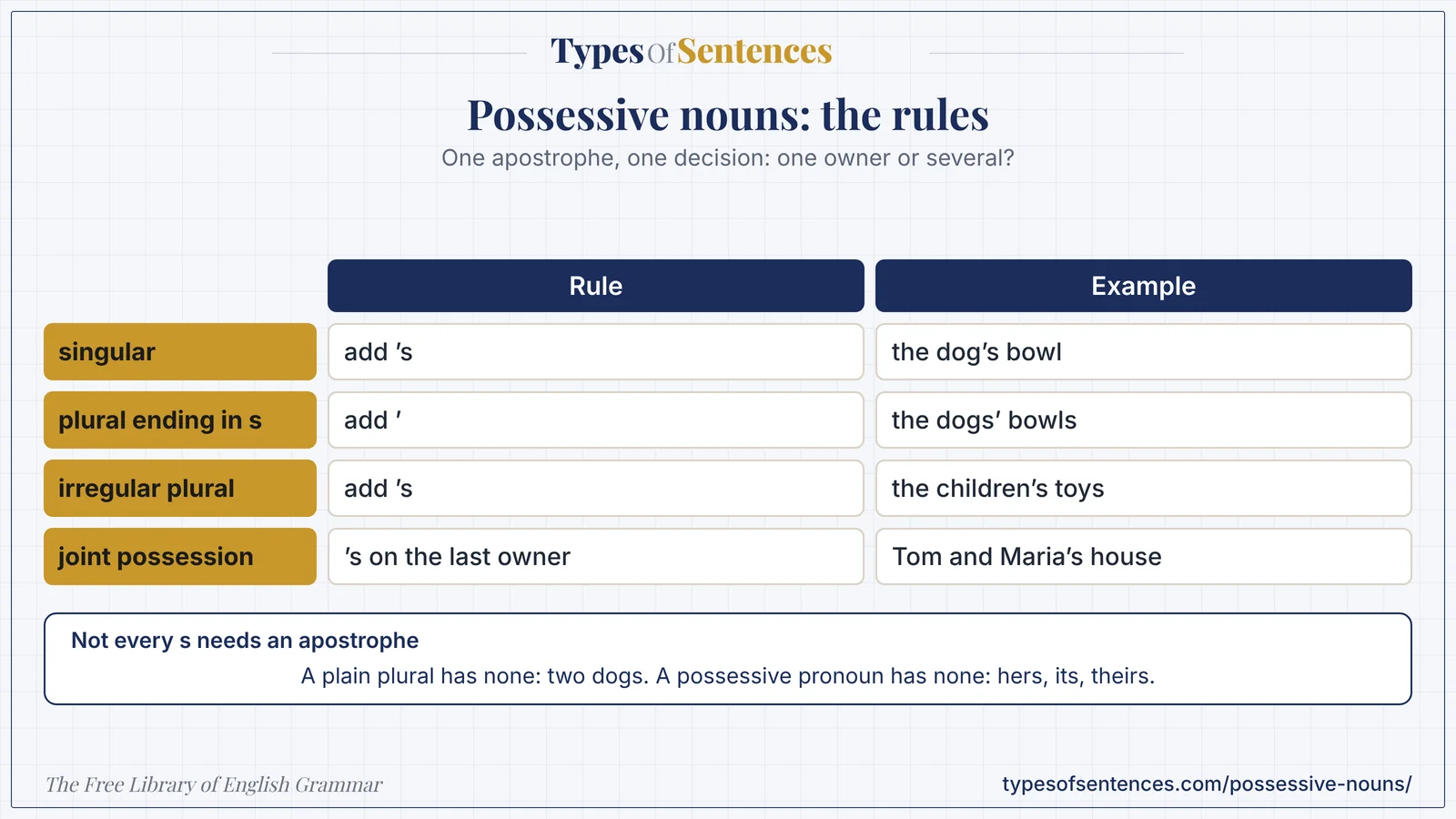
To show ownership, put an apostrophe after the owner. If the owner is one, add s after the apostrophe: the dog’s bowl. If the owners are many and the plural already ends in s, the apostrophe comes after that s: the dogs’ bowls.
Why it matters: First decide whether the noun is singular or plural, and then add the apostrophe. A wrong decision about number is the source of almost every mistake.
Summary: A possessive noun shows ownership or a close relationship. Singular nouns add ’s (the dog’s bowl, the boss’s office in most style guides). Plural nouns that end in s add only an apostrophe (the dogs’ bowls). Plural nouns that do not end in s add ’s (the children’s toys). Joint possession puts ’s on the last owner (Tom and Maria’s house); separate possession puts ’s on each (Tom’s and Maria’s cars). Possessive pronouns (his, hers, its, theirs) never take an apostrophe. A plural without possession takes no apostrophe (the dogs barked).
- Singular: add ’s.
- Plural ending in s: add ’.
- Irregular plural: add ’s.
- Plural is not possessive: no apostrophe.
What You’ll Learn
- 1. Possessive Nouns: The Short Answer
- 2. Singular Possessive Nouns: 25 Examples
- 3. Plural Possessive Nouns and Plural and Possessive Nouns: 20 Examples
- 4. Irregular Plural Possessive Nouns: 15 Examples
- 5. Singular Nouns Ending in S: 15 Examples and the Style Guides
- 6. Joint, Separate, and Compound Possession: 10 Examples
- 7. Time, Measure, Inanimate Nouns, and the Of Alternative: 15 Examples
- 8. Possessive S: When an Apostrophe Is Not Needed
- 9. Common Mistakes With Possessive Nouns
- 10. Exercises
- 11. Test Your Knowledge
- 12. Frequently Asked Questions
- 13. Conclusion
1. Possessive Nouns: The Short Answer
| Kind of noun | Rule | Example | Meaning |
|---|---|---|---|
| singular | add ’s | the dog’s bowl | the bowl of one dog |
| plural ending in s | add only an apostrophe | the dogs’ bowls | the bowls of several dogs |
| irregular plural (no s) | add ’s | the children’s toys | the toys of the children |
| singular ending in s | add ’s in most style guides | the boss’s office | the office of one boss |
| joint possession | ’s on the last owner | Tom and Maria’s house | one house they share |
| separate possession | ’s on each owner | Tom’s and Maria’s cars | a car each |
| a possessive pronoun | no apostrophe | hers, its, theirs | — |
| Plural or possessive? | Form | Meaning | Example |
|---|---|---|---|
| plural | dogs | more than one dog | The dogs barked. |
| singular possessive | dog’s | belonging to one dog | The dog’s bowl is empty. |
| plural possessive | dogs’ | belonging to several dogs | The dogs’ bowls are empty. |
| contraction (not possession) | dog’s | dog is or dog has | The dog’s hungry. |
The same apostrophe appears in a contraction (the dog’s hungry), so the meaning, not the shape, shows whether the apostrophe marks possession. For the plural forms themselves, see the chapter on plural nouns.
2. Singular Possessive Nouns: 25 Examples
To form a singular possessive noun, add an apostrophe and s to the singular noun. The noun that follows names the thing owned.
| Singular possessive nouns examples | Owner | Owned |
|---|---|---|
| the dog’s bowl | dog | bowl |
| the teacher’s desk | teacher | desk |
| my mother’s kitchen | mother | kitchen |
| the child’s toy | child | toy |
| the company’s profits | company | profits |
| the doctor’s advice | doctor | advice |
| Maria’s book | Maria | book |
| the cat’s whiskers | cat | whiskers |
| the king’s crown | king | crown |
| the city’s mayor | city | mayor |
| the student’s notebook | student | notebook |
| a woman’s voice | woman | voice |
| the bird’s nest | bird | nest |
| the author’s style | author | style |
| the driver’s license | driver | license |
| the baby’s smile | baby | smile |
| Tom’s idea | Tom | idea |
| the museum’s collection | museum | collection |
| the river’s source | river | source |
| the player’s injury | player | injury |
| the farmer’s field | farmer | field |
| the manager’s decision | manager | decision |
| the nurse’s shift | nurse | shift |
| the team’s coach | team | coach |
| the writer’s block | writer | block |
A singular noun can be a common noun (the teacher), a proper noun (Maria), or a collective noun (the team). The kinds of noun are explained in the chapter on nouns.
3. Plural Possessive Nouns and Plural and Possessive Nouns: 20 Examples
To form a plural possessive noun, first make the noun plural, and then add only an apostrophe if the plural ends in s. The words plural and possessive nouns describe nouns that are both: more than one owner, and ownership.
| Plural possessive nouns | Owners (plural) | Thing owned |
|---|---|---|
| the dogs’ bowls | dogs | bowls |
| the teachers’ lounge | teachers | lounge |
| my parents’ house | parents | house |
| the students’ notebooks | students | notebooks |
| the girls’ team | girls | team |
| the neighbors’ garden | neighbors | garden |
| the doctors’ meeting | doctors | meeting |
| the cats’ toys | cats | toys |
| the players’ bus | players | bus |
| the workers’ union | workers | union |
| the farmers’ market | farmers | market |
| the soldiers’ camp | soldiers | camp |
| the drivers’ licenses | drivers | licenses |
| the babies’ cribs | babies | cribs |
| the companies’ merger | companies | merger |
| the cities’ budgets | cities | budgets |
| the writers’ conference | writers | conference |
| the visitors’ center | visitors | center |
| the families’ stories | families | stories |
| the boys’ locker room | boys | locker room |
| Step | Singular owner | Plural owner |
|---|---|---|
| 1 name the owner | one student | two students |
| 2 make it plural if needed | — | students |
| 3 add the apostrophe | student’s | students’ |
| 4 add the thing owned | the student’s notebook | the students’ notebooks |
The common mistake is to add the apostrophe before the s when the owners are several: *the students’ notebook is about several students, and the student’s notebook is about one. The pattern does not change when the plural ends in -ies: the baby’s crib but the babies’ cribs.
4. Irregular Plural Possessive Nouns: 15 Examples
Irregular plurals do not end in s, so they take apostrophe and s exactly like singular nouns. The unchanged plurals (sheep, deer, fish) also take ’s.
| Irregular plural possessive nouns | Plural owner (no s) | Thing owned |
|---|---|---|
| the children’s toys | children | toys |
| the women’s rights | women | rights |
| the men’s shoes | men | shoes |
| the people’s voices | people | voices |
| the mice’s nest | mice | nest |
| the geese’s pond | geese | pond |
| the oxen’s yokes | oxen | yokes |
| the sheep’s wool | sheep | wool |
| the deer’s antlers | deer | antlers |
| the fish’s fins | fish | fins |
| the alumni’s donations | alumni | donations |
| the salespeople’s targets | salespeople | targets |
| the policewomen’s uniforms | policewomen | uniforms |
| the chairmen’s speeches | chairmen | speeches |
| the congressmen’s votes | congressmen | votes |
The plural forms of nouns, including the irregular ones, follow the patterns for plural nouns.
5. Singular Nouns Ending in S: 15 Examples and the Style Guides
| Singular nouns that end in s | The possessive |
|---|---|
| boss | the boss’s office |
| class | the class’s schedule |
| princess | the princess’s crown |
| Chris | Chris’s idea |
| Charles | Charles’s book |
| witness | the witness’s testimony |
| actress | the actress’s role |
| waitress | the waitress’s tip |
| Jones | Jones’s store |
| lens | the lens’s focus |
| bus | the bus’s route |
| gas | the gas’s smell |
| business | the business’s plan |
| Thomas | Thomas’s house |
| hostess | the hostess’s smile |
| Style guide | Singular nouns and names ending in s | Example | Note |
|---|---|---|---|
| The Chicago Manual of Style | add ’s to every singular noun, including names; a few classical and biblical names take only an apostrophe | Charles’s book · Moses’ law | check the current edition |
| APA and MLA | add ’s | James’s idea | used in academic writing |
| AP Stylebook | singular common nouns: ’s (but only an apostrophe if the next word begins with s); singular proper names: apostrophe only | the witness’s story · Jones’ idea | newspaper style; check the current AP Stylebook |
| Strunk and White | add ’s to every singular noun, including names ending in s | Charles’s friend | the 4th edition |
The practical rule is to choose one style guide and apply it to every name in a text. Pronunciation helps: if you say an extra syllable (BOSS-iz), the written form ’s is natural. Whatever style guide you follow, the plural of a name ending in s (the Joneses) has its own possessive: the Joneses’ garden.
6. Joint, Separate, and Compound Possession: 10 Examples
| Special cases | Pattern |
|---|---|
| Tom and Maria’s house | joint possession: one shared house |
| Tom’s and Maria’s cars | separate possession: two cars |
| my mother-in-law’s recipe | compound noun: ’s on the last word |
| my sisters-in-law’s cars | plural compound noun: plural main word, then ’s |
| the editor-in-chief’s desk | compound noun |
| the president-elect’s speech | compound noun |
| somebody else’s umbrella | indefinite pronoun with else |
| anyone’s guess | indefinite pronoun |
| a friend of Maria’s | double possessive |
| the Smiths’ house | plural family name, possessive |
| Question | Rule | Example |
|---|---|---|
| one owner or one shared thing? | put ’s on the last owner for joint possession | Tom and Maria’s house |
| separate things? | put ’s on each owner | Tom’s and Maria’s cars |
| compound noun? | put ’s on the last word | my mother-in-law’s recipe |
| plural compound noun? | make the main word plural, then ’s on the end | my sisters-in-law’s cars |
| indefinite pronoun? | add ’s | someone’s · anybody else’s |
| double possessive? | of + possessive noun or pronoun | a friend of Maria’s · a friend of mine |
7. Time, Measure, Inanimate Nouns, and the Of Alternative: 15 Examples
| Time and measure | Singular or plural | Meaning |
|---|---|---|
| a day’s work | singular possessive | the work of one day |
| two weeks’ notice | plural possessive | notice of two weeks |
| a year’s salary | singular possessive | the pay of one year |
| ten dollars’ worth | plural possessive | the worth of ten dollars |
| today’s news | singular possessive | the news of today |
| yesterday’s match | singular possessive | the match of yesterday |
| Possessive or of-phrase? | Examples | Guidance |
|---|---|---|
| people and animals | the dog’s bowl (not the bowl of the dog) | prefer the possessive |
| inanimate things | the roof of the house or the house’s roof | both are correct; the of phrase is common |
| long or complex owners | the leader of the opposition (not the leader of the opposition’s) | use of |
| a mix | the end of the day | use of for abstract nouns |
| Of-phrase examples | Possessive alternative |
|---|---|
| the roof of the house | the house’s roof |
| the end of the day | the day’s end |
| the cause of the problem | the problem’s cause |
| the name of the street | the street’s name |
| the leg of the table | the table’s leg |
Names of organizations and places often drop the apostrophe (Teachers College, Veterans Day), and a plural noun used as an adjective takes none (a sports car, a students union in some names); follow the official spelling of a proper name.
8. Possessive S: When an Apostrophe Is Not Needed
| Case | Right form | Wrong form |
|---|---|---|
| plural noun, not possessive | The dogs barked. | *The dog’s barked. |
| possessive pronoun | The bowl is hers. | *The bowl is her’s. |
| possessive determiner | Its tail wagged. | *It’s tail wagged. |
| decade or numeral plural | the 1990s | *the 1990’s (older style) |
| family name, plural | the Smiths | *the Smith’s |
| a noun used as an adjective | a sports car | *a sport’s car |
The possessive s is for nouns only. The possessive forms of pronouns never take an apostrophe; the pair that is most often confused is explained in the guide to its and it’s.
9. Common Mistakes With Possessive Nouns
| Mistake | Example | Correction |
|---|---|---|
| apostrophe in a plain plural | *We bought two apple’s. | We bought two apples. |
| wrong side of the apostrophe for plurals | *the students’s books | the students’ books |
| singular form for several owners | *the girl’s team (the team of all the girls) | the girls’ team |
| plural form for one owner | *the dogs’ bowl (one dog) | the dog’s bowl |
| apostrophe after an irregular plural with s | *the childrens’ toys | the children’s toys |
| missing apostrophe | *the dogs bowl | the dog’s bowl |
| apostrophe in a possessive pronoun | *The idea is their’s. | The idea is theirs. |
| ’s on both joint owners | *Tom’s and Maria’s house (one shared house) | Tom and Maria’s house |
| plural family name with an apostrophe | *the Jones’ are here | the Joneses are here |
| mixed style for names ending in s | *Chris’s idea and James’ idea in one text | Chris’s idea and James’s idea |
Fix: The three girl’s coats and the childrens toys are on the teachers desk, next to the boss’ keys.
- three girl’s coats: three owners, so three girls’ coats.
- childrens toys: irregular plural, ownership: children’s toys.
- teachers desk: one teacher owns the desk: teacher’s desk.
- boss’ keys: in most style guides a singular noun ending in s takes ’s: boss’s keys (use ’ only if your style guide requires it).
- Result: The three girls’ coats and the children’s toys are on the teacher’s desk, next to the boss’s keys. (the sentence is invented)
Recap in 12 seconds
Watch the lesson build itself: Singular nouns add ’s, plural nouns ending in s add an apostrophe, irregular plurals add ’s, and plain plurals and possessive pronouns take none. The video has no sound.
Exercises
Part A: Form the Singular Possessive (Exercises 1–8)
Exercise 1: the bowl of one dog
Show Answer
Answer: the dog’s bowl
Exercise 2: the desk of the teacher
Show Answer
Answer: the teacher’s desk
Exercise 3: the office of the boss
Show Answer
Answer: the boss’s office (Chicago, APA, MLA; the AP style for common nouns is the same).
Exercise 4: the idea of Maria
Show Answer
Answer: Maria’s idea
Exercise 5: the toy of the child
Show Answer
Answer: the child’s toy
Exercise 6: the crown of the princess
Show Answer
Answer: the princess’s crown
Exercise 7: the book of Chris
Show Answer
Answer: Chris’s book (most style guides).
Exercise 8: the profits of the company
Show Answer
Answer: the company’s profits
Part B: Form the Plural Possessive (Exercises 9–16)
Exercise 9: the bowls of several dogs
Show Answer
Answer: the dogs’ bowls
Exercise 10: the notebooks of the students
Show Answer
Answer: the students’ notebooks
Exercise 11: the toys of the children
Show Answer
Answer: the children’s toys
Exercise 12: the cribs of the babies
Show Answer
Answer: the babies’ cribs
Exercise 13: the voices of the women
Show Answer
Answer: the women’s voices
Exercise 14: the garden of the Joneses
Show Answer
Answer: the Joneses’ garden
Exercise 15: the lounge of the teachers
Show Answer
Answer: the teachers’ lounge
Exercise 16: the wool of the sheep
Show Answer
Answer: the sheep’s wool
Part C: Choose the Right Form (Exercises 17–24)
Exercise 17: Choose: The (dog’s/dogs’) bowls are empty. (three dogs)
Show Answer
Answer: dogs’.
Exercise 18: Choose: The (girl’s/girls’) team won. (all the girls)
Show Answer
Answer: girls’.
Exercise 19: Choose: The (children’s/childrens’) toys are here.
Show Answer
Answer: children’s.
Exercise 20: Choose: She wrote two (letter’s/letters).
Show Answer
Answer: letters (a plural, not a possessive).
Exercise 21: Choose: The bowl is (hers/her’s).
Show Answer
Answer: hers.
Exercise 22: Choose: (Tom and Maria’s/Tom’s and Maria’s) house (one shared house)
Show Answer
Answer: Tom and Maria’s house.
Exercise 23: Choose: my (mother-in-law’s/mother’s-in-law) recipe
Show Answer
Answer: mother-in-law’s.
Exercise 24: Choose: a (days/day’s) work
Show Answer
Answer: day’s.
Part D: Correct the Errors (Exercises 25–30)
Exercise 25: Correct: *We bought two apple’s.
Show Answer
Answer: We bought two apples.
Exercise 26: Correct: *the childrens’ toys
Show Answer
Answer: the children’s toys
Exercise 27: Correct: *the dogs bowl (one dog)
Show Answer
Answer: the dog’s bowl
Exercise 28: Correct: *The idea is their’s.
Show Answer
Answer: The idea is theirs.
Exercise 29: Correct: *the students’s notebooks
Show Answer
Answer: the students’ notebooks
Exercise 30: Correct: *the Smith’s are here (the Smith family)
Show Answer
Answer: the Smiths are here
Test Your Knowledge
Ready to check what you learned? Answer all 10 questions, then submit. You need 80% (8 of 10) to pass. Your answers are not stored.
View correct answers and explanations
Question 1: The possessive of dog is
✓ Correct Answer: C – dog’s
Singular: add ’s.
Question 2: The possessive plural of dogs is
✓ Correct Answer: A – dogs’
Plural in s: apostrophe.
Question 3: The possessive of children is
✓ Correct Answer: B – children’s
Irregular plural: ’s.
Question 4: Which is correct for several girls’ team?
✓ Correct Answer: D – the girls’ team
Plural possessive.
Question 5: Which needs no apostrophe?
✓ Correct Answer: B – The dogs barked.
A plain plural.
Question 6: Which is correct?
✓ Correct Answer: A – The bowl is hers.
No apostrophe.
Question 7: Joint possession of one shared house:
✓ Correct Answer: D – Tom and Maria’s house
’s on the last owner.
Question 8: The possessive of mother-in-law is
✓ Correct Answer: C – mother-in-law’s
’s on the end.
Question 9: Two weeks’ notice uses
✓ Correct Answer: B – a plural possessive
A time expression.
Question 10: Which is a plural, not a possessive?
✓ Correct Answer: A – two dogs
No ownership.
Frequently Asked Questions
What are possessive nouns?
Possessive nouns show ownership or a close relationship, such as the dog’s bowl and the students’ notebooks. They are formed with an apostrophe and usually an s.
What are some possessive nouns examples?
The teacher’s desk, Maria’s book, the dogs’ bowls, the children’s toys, Tom and Maria’s house, and a day’s work are all possessive nouns examples.
How do I form plural possessive nouns?
First make the noun plural. If the plural ends in s, add only an apostrophe (the dogs’ bowls). If it does not end in s, add ’s (the children’s toys).
What is the difference between plural and possessive nouns?
A plural noun shows number (dogs) and has no apostrophe. A possessive noun shows ownership (dog’s, dogs’). A noun can be both plural and possessive: the dogs’ bowls.
What is the possessive s?
It is the ending ’s (apostrophe and s) that marks a singular or irregular plural possessive noun. Plurals that end in s take only the apostrophe.
How do I make a singular noun ending in s possessive?
Most style guides (Chicago, APA, MLA, Strunk and White) add ’s: the boss’s office, James’s idea. AP style adds only an apostrophe to singular proper names that end in s. Follow one style guide.
Do possessive pronouns take an apostrophe?
No. His, hers, its, ours, yours, and theirs never take an apostrophe. Write The idea is theirs, not their’s.
Conclusion
You now know the rules for possessive nouns: add ’s to singular nouns and irregular plurals, add an apostrophe to plurals that end in s, and never use an apostrophe in a plain plural or in a possessive pronoun. You have seen 100 examples in groups, the style-guide differences for names ending in s, and the common mistakes.
Whenever you are unsure, first decide whether there is one owner or several, and then add the apostrophe. Next, study the list of verbs, the other great reference list of the English language.
- The Chicago Manual of Style. University of Chicago Press. (check the current edition): the possessive of singular and plural nouns, and of names ending in s.
- Strunk, William, Jr., and E. B. White. The Elements of Style. 4th ed. Longman, 1999.: the first rule, forming the possessive singular.
- Garner, Bryan A. Garner’s Modern English Usage. 5th ed. Oxford University Press, 2022.: the entries on possessives and on the apostrophe.
- Swan, Michael. Practical English Usage. 4th ed. Oxford University Press, 2016.: possessive forms, the of-phrase, and the double possessive.
- Huddleston, Rodney, and Geoffrey K. Pullum. The Cambridge Grammar of the English Language. Cambridge University Press, 2002.: the genitive case.
- Merriam-Webster Dictionary: possessive: the dictionary entry (not opened when this page was written).
Last reviewed: October 29, 2026. How it was made: drafted with AI assistance, then checked with automated tests (structure, links, answer keys, spelling) and against the sources above. A person has not yet read this chapter line by line. Found a mistake? Report it.