What is a pronouns list? A pronouns list sets out the words that stand in for nouns, grouped by type. The main types are personal (I, you, he, she, it, we, they), possessive (mine, yours, hers), reflexive (myself, themselves), demonstrative (this, that, these, those), interrogative (who, what, which), relative (who, whom, whose, which, that), indefinite (someone, everybody, nothing), and reciprocal (each other, one another).
This page is an all pronouns list that you can use for reference. It gives the personal pronouns examples in every case, the list of pronouns in English by type, the complete indefinite pronouns with their agreement rules, the less common pronouns, singular they, and an A to Z index of 85 forms. It ends with 30 exercises and a 10-question quiz.
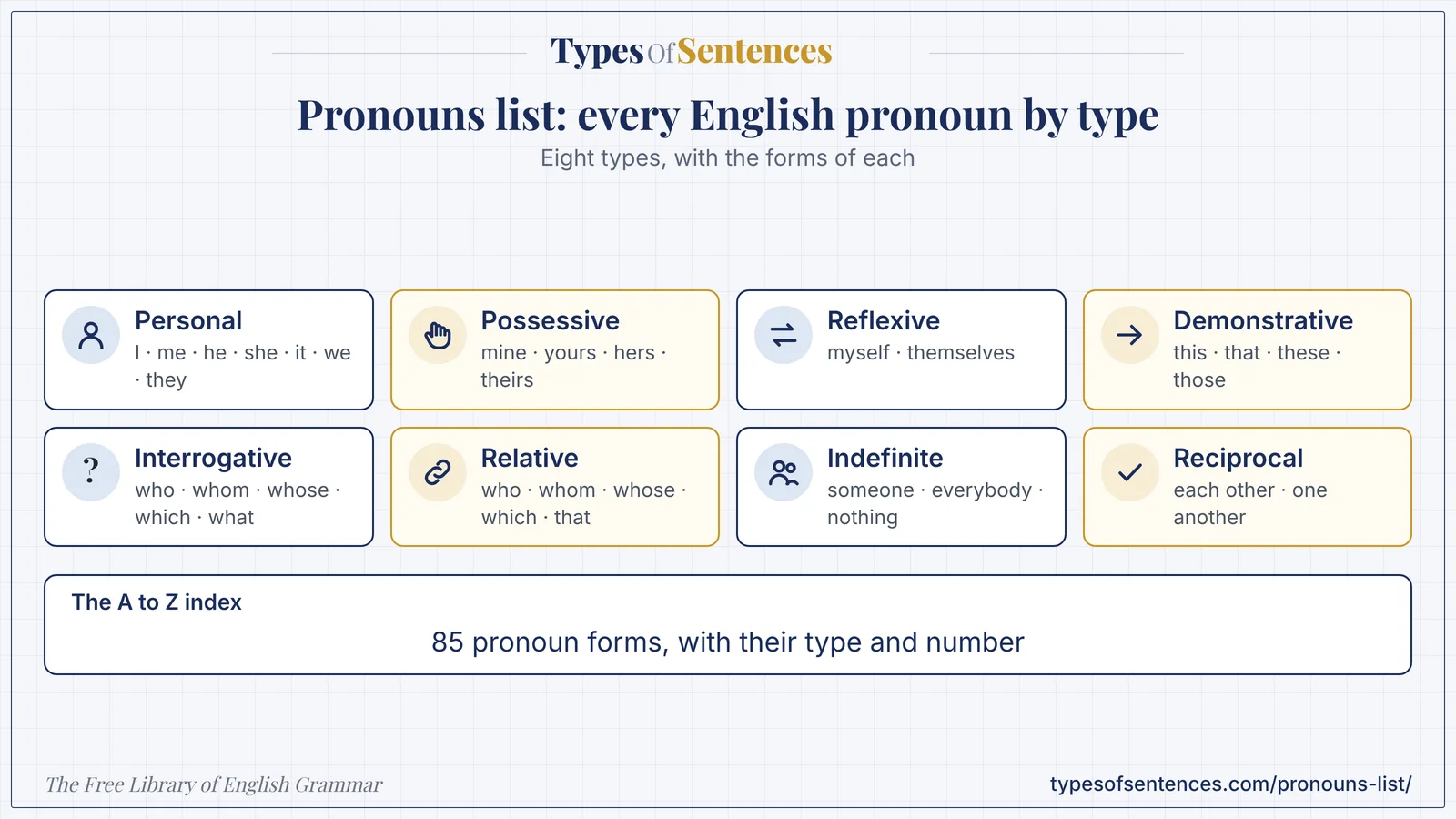
A pronoun is a short word that takes the place of a noun so that you do not have to repeat it: Maria lost her keys, and she found them later. The words her, she, and them are pronouns.
Why it matters: Pronouns come in families. Knowing the families lets you choose the right form (I or me, who or whom) and the right verb (everyone is, not everyone are).
Summary: English pronouns fall into eight main types: personal, possessive, reflexive and intensive, demonstrative, interrogative, relative, indefinite, and reciprocal. The personal pronouns have five forms for each person (subject, object, possessive determiner, possessive pronoun, and reflexive). The indefinite pronouns are singular (everyone, each), plural (both, few), or either (all, some), and the verb agrees with them. The A to Z index lists 85 pronoun forms. Singular they is widely accepted.
- Eight main types of pronoun.
- Personal pronouns: five forms per person.
- Indefinite pronouns: singular, plural, or either.
- Check case and agreement.
What You’ll Learn
- 1. Pronouns List: The Short Answer
- 2. Personal Pronouns Examples: Subject, Object, Possessive, and Reflexive
- 3. List of Pronouns in English: Demonstrative, Interrogative, and Relative
- 4. Indefinite Pronouns: The Complete List With Verb Agreement
- 5. Reciprocal, Intensive, Generic, and Archaic Pronouns
- 6. Singular They and Gender-Neutral Pronouns
- 7. All Pronouns List: The A to Z Index (85 Forms)
- 8. Pronoun Case and Agreement: Quick Rules
- 9. Common Mistakes With Pronouns
- 10. Exercises
- 11. Test Your Knowledge
- 12. Frequently Asked Questions
- 13. Conclusion
1. Pronouns List: The Short Answer
| Type | What it does | Members | Example |
|---|---|---|---|
| personal | names the speaker, the listener, or the topic | I, me, you, he, him, she, her, it, we, us, they, them, one | She called me. |
| possessive | shows ownership | mine, yours, his, hers, ours, theirs (and the determiners my, your, her, its, our, their) | The bag is hers. |
| reflexive and intensive | refers back to the subject, or adds emphasis | myself, yourself, himself, herself, itself, oneself, ourselves, yourselves, themselves | He hurt himself. |
| demonstrative | points to something | this, that, these, those | Those are mine. |
| interrogative | asks a question | who, whom, whose, which, what | Who called? |
| relative | introduces a relative clause | who, whom, whose, which, that | The man who called is here. |
| indefinite | refers to a person or thing that is not specific | someone, everybody, nothing, each, both, some | Everyone is here. |
| reciprocal | shows a two-way action | each other, one another | They help each other. |
The system of pronouns and their cases is explained in the advanced chapter on pronoun concepts.
2. Personal Pronouns Examples: Subject, Object, Possessive, and Reflexive
Each person has several forms. The subject form comes before a verb, the object form follows a verb or a preposition, the possessive determiner comes before a noun, the possessive pronoun stands alone, and the reflexive form refers back to the subject.
| Person | Subject | Object | Possessive determiner | Possessive pronoun | Reflexive |
|---|---|---|---|---|---|
| 1st person singular | I | me | my | mine | myself |
| 2nd person | you | you | your | yours | yourself (singular), yourselves (plural) |
| 3rd person singular, masculine | he | him | his | his | himself |
| 3rd person singular, feminine | she | her | her | hers | herself |
| 3rd person singular, neuter | it | it | its | — | itself |
| 1st person plural | we | us | our | ours | ourselves |
| 3rd person plural | they | them | their | theirs | themselves |
| generic (formal) | one | one | one’s | — | oneself |
| Personal pronouns examples | Sentence |
|---|---|
| I (subject) | I called her yesterday. |
| me (object) | She called me back. |
| my (possessive determiner) | My phone is dead. |
| mine (possessive pronoun) | That seat is mine. |
| myself (reflexive) | I taught myself to swim. |
| you (subject) | You are early. |
| you (object) | I will help you. |
| your (possessive determiner) | Is this your bag? |
| yours (possessive pronoun) | The decision is yours. |
| yourself (reflexive) | Please help yourself. |
| he (subject) | He plays the violin. |
| him (object) | We invited him. |
| his (possessive pronoun) | The idea was his. |
| himself (reflexive) | He cut himself shaving. |
| she (subject) | She teaches history. |
| her (object) | I met her at the station. |
| hers (possessive pronoun) | The red car is hers. |
| herself (reflexive) | She reminded herself to breathe. |
| it (subject) | It is raining. |
| its (possessive determiner) | The dog wagged its tail. |
| itself (reflexive) | The door closed by itself. |
| we (subject) | We won the match. |
| us (object) | They gave us tickets. |
| ours (possessive pronoun) | The garden is ours. |
| ourselves (reflexive) | We enjoyed ourselves. |
| they (subject) | They live nearby. |
| them (object) | I saw them leave. |
| theirs (possessive pronoun) | The choice is theirs. |
| themselves (reflexive) | The children dressed themselves. |
The possessive determiners (my, your, his, her, its, our, their) are classed as pronouns in many school grammars and as determiners in modern reference grammars; they are shown here because every pronouns list includes them. They are described in the chapter on determiners.
3. List of Pronouns in English: Demonstrative, Interrogative, and Relative
| Demonstrative pronoun | Distance and number | Example |
|---|---|---|
| this | near, singular | This is my seat. |
| that | far, singular | That is a good idea. |
| these | near, plural | These are fresh. |
| those | far, plural | Those were the days. |
| Interrogative pronoun | Asks about | Example |
|---|---|---|
| who | the subject (a person) | Who wrote this? |
| whom | the object (a person), formal | Whom did you meet? |
| whose | ownership | Whose is this? |
| which | a choice among known things | Which do you prefer? |
| what | a thing or an idea | What happened? |
| whoever, whomever, whatever, whichever | any person or thing (emphatic) | Whatever do you mean? |
| Relative pronoun | Refers to | Example |
|---|---|---|
| who | people (subject) | the teacher who helped me |
| whom | people (object), formal | the teacher whom I met |
| whose | ownership | the teacher whose class I joined |
| which | things and animals | the book which I read |
| that | people or things (defining clauses) | the book that I read |
4. Indefinite Pronouns: The Complete List With Verb Agreement
The indefinite pronouns do not refer to a particular person or thing. Whether they take a singular or a plural verb depends on the pronoun, as the table shows.
| Group | Indefinite pronouns | Verb | Example |
|---|---|---|---|
| singular | another, anybody, anyone, anything, each, either, everybody, everyone, everything, little, much, neither, nobody, no one, nothing, one, somebody, someone, something | singular | Everyone is here. · Each of the girls has a ticket. |
| plural | both, few, many, others, several | plural | Both are ready. · Few were left. |
| singular or plural | all, any, more, most, none, other, some | depends on the noun | All of the water is gone. · All of the books are gone. |
| Indefinite pronouns | Sentence | Verb form |
|---|---|---|
| everyone | Everyone is welcome. | is (singular) |
| everybody | Everybody has a ticket. | has (singular) |
| someone | Someone is knocking. | is (singular) |
| nobody | Nobody knows the answer. | knows (singular) |
| nothing | Nothing was left. | was (singular) |
| each | Each of the players has a number. | has (singular) |
| neither | Neither of them is late. | is (singular in formal style) |
| both | Both are ready. | are (plural) |
| few | Few are left. | are (plural) |
| many | Many have tried. | have (plural) |
| several | Several were absent. | were (plural) |
| some | Some of the cake is gone. | is (uncountable, singular) |
| some | Some of the cakes are gone. | are (countable, plural) |
| all | All is well. | is (singular) |
| none | None of the students were late. | were (plural; singular is also accepted) |
The possessive form of an indefinite pronoun takes ’s: someone’s keys, everybody else’s opinion.
5. Reciprocal, Intensive, Generic, and Archaic Pronouns
| Type | Pronouns | Example | Note |
|---|---|---|---|
| reciprocal | each other, one another | The twins help each other. | shows a two-way action; one another is often used for more than two |
| intensive | myself, yourself, himself, herself, itself, ourselves, yourselves, themselves | I myself wrote it. | adds emphasis; the sentence is complete without it |
| reflexive | the same forms | I hurt myself. | refers back to the subject and cannot be removed |
| generic personal | one, one’s, oneself | One should always check one’s work. | formal; many speakers use you instead |
| dummy (expletive) it | it | It is raining. | has no real meaning; it fills the subject position |
| archaic | thou, thee, thy, thine, ye | Thou art my friend. | found in older texts and the Bible, not in modern English |
6. Singular They and Gender-Neutral Pronouns
| Form | Use | Example |
|---|---|---|
| they, them, their, theirs, themselves | one person whose gender is unknown, unspecified, or not binary | Someone left their umbrella. · I asked Sam, and they said yes. |
| themself | a reflexive form used with singular they by some speakers | Everyone should ask themselves. · A person should ask themself. |
| he or she, his or her | a formal alternative that names two genders | Each student must bring his or her book. |
| rewording | the plural or no pronoun | Students must bring their books. |
| neopronouns (for example ze, hir) | used by some individuals for themselves; they are not yet part of standard written English | follow the pronouns a person states |
Singular they has been used for centuries, and major style guides now accept it in many contexts; some formal contexts still prefer rewording. The guidance on gender-inclusive language is in the advanced chapter on gender-inclusive language. Whichever form you choose, use the pronouns that a person says they use.
7. All Pronouns List: The A to Z Index (85 Forms)
This all pronouns list gives every pronoun form on this page in alphabetical order, with its type and number. A form that belongs to more than one type (such as that, her, or one) is shown with all of its types. The terms are defined in the grammar glossary.
| Pronoun | Type or types | Number |
|---|---|---|
| all | indefinite | singular or plural |
| another | indefinite | singular |
| any | indefinite | singular or plural |
| anybody | indefinite | singular |
| anyone | indefinite | singular |
| anything | indefinite | singular |
| both | indefinite | plural |
| each | indefinite | singular |
| each other | reciprocal | plural |
| either | indefinite | singular |
| everybody | indefinite | singular |
| everyone | indefinite | singular |
| everything | indefinite | singular |
| few | indefinite | plural |
| he | personal (subject) | singular |
| her | personal (object); possessive determiner | singular owner |
| hers | possessive pronoun | singular owner |
| herself | reflexive or intensive | singular |
| him | personal (object) | singular |
| himself | reflexive or intensive | singular |
| his | possessive determiner and pronoun | singular owner |
| I | personal (subject) | singular |
| it | personal (subject); personal (object) | singular |
| its | possessive determiner | singular owner |
| itself | reflexive or intensive | singular |
| little | indefinite | singular |
| many | indefinite | plural |
| me | personal (object) | singular |
| mine | possessive pronoun | singular owner |
| more | indefinite | singular or plural |
| most | indefinite | singular or plural |
| much | indefinite | singular |
| my | possessive determiner | singular owner |
| myself | reflexive or intensive | singular |
| neither | indefinite | singular |
| no one | indefinite | singular |
| nobody | indefinite | singular |
| none | indefinite | singular or plural |
| nothing | indefinite | singular |
| one | indefinite and generic personal; indefinite | singular |
| one another | reciprocal | plural |
| one’s | possessive determiner | generic |
| oneself | reflexive or intensive | generic |
| other | indefinite | singular or plural |
| others | indefinite | plural |
| our | possessive determiner | plural owner |
| ours | possessive pronoun | plural owner |
| ourselves | reflexive or intensive | plural |
| several | indefinite | plural |
| she | personal (subject) | singular |
| some | indefinite | singular or plural |
| somebody | indefinite | singular |
| someone | indefinite | singular |
| something | indefinite | singular |
| that | demonstrative and relative | singular |
| thee | archaic personal (object) | singular |
| their | possessive determiner | plural owner (also singular) |
| theirs | possessive pronoun | plural owner (also singular) |
| them | personal (object) | plural (also singular) |
| themself | reflexive or intensive | singular (singular they) |
| themselves | reflexive or intensive | plural |
| these | demonstrative | plural |
| they | personal (subject) | plural (also singular) |
| thine | archaic possessive pronoun | singular |
| this | demonstrative | singular |
| those | demonstrative | plural |
| thou | archaic personal (subject) | singular |
| thy | archaic possessive determiner | singular |
| us | personal (object) | plural |
| we | personal (subject) | plural |
| what | interrogative and relative | either |
| whatever | relative (compound) | either |
| which | interrogative and relative | either |
| whichever | relative (compound) | either |
| who | interrogative and relative | either |
| whoever | relative (compound) | either |
| whom | interrogative and relative | either |
| whomever | relative (compound) | either |
| whose | interrogative and relative | either |
| ye | archaic personal | plural |
| you | personal (subject); personal (object) | singular or plural |
| your | possessive determiner | singular or plural owner |
| yours | possessive pronoun | singular or plural owner |
| yourself | reflexive or intensive | singular |
| yourselves | reflexive or intensive | plural |
8. Pronoun Case and Agreement: Quick Rules
| Question | Rule | Example |
|---|---|---|
| I or me? | I before a verb; me after a verb or preposition | She and I left. · He saw her and me. |
| who or whom? | who for the subject; whom for the object (formal) | Who called? · To whom did you write? |
| pronoun with a noun | drop the other noun to test | (We/Us) students vote. → We vote. → We students vote. |
| than or as | add the missing verb | She is taller than I (am). |
| reflexive | only when the subject is the same person | I saw myself. but She and I saw each other. |
| number | the pronoun agrees with its antecedent | The students lost their books. |
| clear reference | each pronoun must have one clear antecedent | When Ana met Maria, she smiled. (unclear) → Ana smiled when she met Maria. |
| possessive | no apostrophe in a possessive pronoun | hers, ours, theirs, its |
9. Common Mistakes With Pronouns
| Mistake | Example | Correction |
|---|---|---|
| wrong case after and | *Me and her went home. | She and I went home. |
| object form as a subject | *Them are my friends. | They are my friends. |
| reflexive for a plain pronoun | *Please give it to myself. | Please give it to me. |
| hisself or theirselves | *He did it hisself. | He did it himself. |
| apostrophe in a possessive pronoun | *The book is her’s. | The book is hers. |
| wrong agreement with everyone | *Everyone are here. | Everyone is here. |
| unclear antecedent | *Tom told Ben he was wrong. | Tom told Ben, “You are wrong.” |
| whom for who | *Whom is calling? | Who is calling? |
| them as a determiner | *Look at them books. | Look at those books. |
| its and it’s mixed | *Its raining. | It’s raining. |
Fix: Me and him gave the books to she, and everyone brought their own lunch, but nobody remembered hisself.
- Me and him: the subject needs subject forms, so He and I.
- to she: a preposition takes the object form, so to her.
- everyone brought their own lunch: singular their is accepted in standard English; it can stay.
- hisself: the form is himself.
- Result: He and I gave the books to her, and everyone brought their own lunch, but nobody remembered himself. (the sentence is invented; nobody remembered themselves is also acceptable.)
Recap in 12 seconds
Watch the lesson build itself: The eight types of English pronoun and their members, with an A to Z index of 85 forms. The video has no sound.
Exercises
Part A: Name the Type (Exercises 1–10)
Exercise 1: She called me. What type is me?
Show Answer
Answer: personal (object).
Exercise 2: The bag is hers. What type is hers?
Show Answer
Answer: possessive pronoun.
Exercise 3: He hurt himself. What type is himself?
Show Answer
Answer: reflexive.
Exercise 4: Those are mine. What type is those?
Show Answer
Answer: demonstrative.
Exercise 5: Who called? What type is who?
Show Answer
Answer: interrogative.
Exercise 6: The man who called is here. What type is who?
Show Answer
Answer: relative.
Exercise 7: Everyone is here. What type is everyone?
Show Answer
Answer: indefinite.
Exercise 8: They help each other. What type is each other?
Show Answer
Answer: reciprocal.
Exercise 9: I myself wrote it. What type is myself?
Show Answer
Answer: intensive.
Exercise 10: It is raining. What type is it?
Show Answer
Answer: dummy (expletive) it.
Part B: Choose the Right Form (Exercises 11–18)
Exercise 11: Choose: (She/Her) and (I/me) left.
Show Answer
Answer: She and I.
Exercise 12: Choose: The gift is for (he/him) and (I/me).
Show Answer
Answer: him and me.
Exercise 13: Choose: The seat is (your/yours).
Show Answer
Answer: yours.
Exercise 14: Choose: The book is (hers/her’s).
Show Answer
Answer: hers.
Exercise 15: Choose: He did it (himself/hisself).
Show Answer
Answer: himself.
Exercise 16: Choose: (Who/Whom) did you meet? (formal)
Show Answer
Answer: Whom.
Exercise 17: Choose: She is taller than (I/me).
Show Answer
Answer: I (than I am).
Exercise 18: Choose: (We/Us) students voted.
Show Answer
Answer: We.
Part C: Agreement With Indefinite Pronouns (Exercises 19–24)
Exercise 19: Choose: Everyone (is/are) here.
Show Answer
Answer: is.
Exercise 20: Choose: Both (is/are) ready.
Show Answer
Answer: are.
Exercise 21: Choose: Each of the girls (has/have) a ticket.
Show Answer
Answer: has.
Exercise 22: Choose: Few (was/were) left.
Show Answer
Answer: were.
Exercise 23: Choose: Some of the cake (is/are) gone.
Show Answer
Answer: is.
Exercise 24: Choose: Nobody (know/knows) the answer.
Show Answer
Answer: knows.
Part D: Correct the Errors (Exercises 25–30)
Exercise 25: Correct: *Me and her went home.
Show Answer
Answer: She and I went home.
Exercise 26: Correct: *Look at them books.
Show Answer
Answer: Look at those books.
Exercise 27: Correct: *Everyone are here.
Show Answer
Answer: Everyone is here.
Exercise 28: Correct: *The book is her’s.
Show Answer
Answer: The book is hers.
Exercise 29: Correct: *Them are my friends.
Show Answer
Answer: They are my friends.
Exercise 30: Correct: *Please give it to myself.
Show Answer
Answer: Please give it to me.
Test Your Knowledge
Ready to check what you learned? Answer all 10 questions, then submit. You need 80% (8 of 10) to pass. Your answers are not stored.
View correct answers and explanations
Question 1: Which is a possessive pronoun?
✓ Correct Answer: C – hers
Hers.
Question 2: Everyone ___ here.
✓ Correct Answer: B – is
Singular.
Question 3: Which is a reflexive pronoun?
✓ Correct Answer: D – himself
Himself.
Question 4: She and ___ left.
✓ Correct Answer: A – I
A subject form.
Question 5: Which pronoun is plural?
✓ Correct Answer: B – both
Both.
Question 6: Which is an interrogative pronoun?
✓ Correct Answer: C – who
Who.
Question 7: Which is a demonstrative pronoun?
✓ Correct Answer: A – those
Those.
Question 8: The idea was ___.
✓ Correct Answer: D – theirs
A possessive pronoun.
Question 9: Which is NOT standard?
✓ Correct Answer: B – hisself
Hisself.
Question 10: One another is a
✓ Correct Answer: C – reciprocal pronoun
Reciprocal.
Frequently Asked Questions
What is a pronouns list?
A pronouns list is a reference list of the words that stand in for nouns, grouped by type: personal, possessive, reflexive, demonstrative, interrogative, relative, indefinite, and reciprocal. This page is a complete list with examples.
How many pronouns are there in English?
It depends on what you count. This page’s A to Z index lists 85 forms, including the possessive determiners, the compound relatives, the reciprocal pronouns, and a few archaic forms. A short school list of personal pronouns has only about twenty.
What are some personal pronouns examples?
I, me, you, he, him, she, her, it, we, us, they, and them. In a sentence: She called me. They invited us.
What are the indefinite pronouns?
The indefinite pronouns refer to people or things that are not specific, such as someone, everybody, nothing, each, both, few, and some. Some are singular, some are plural, and some can be either; the verb agrees with them.
Is it everyone is or everyone are?
Everyone is. Everyone and the other pronouns that end in -one, -body, and -thing are singular and take a singular verb.
What is the difference between a possessive determiner and a possessive pronoun?
A possessive determiner comes before a noun (my book), and a possessive pronoun stands alone (the book is mine). Possessive pronouns and determiners never take an apostrophe.
Is singular they correct?
Yes in most contexts. Singular they is widely used and accepted by major style guides for a person whose gender is unknown or not specified. Some very formal contexts still prefer rewording.
Conclusion
You now have a complete pronouns list: eight main types, the five forms of each personal pronoun, the demonstrative, interrogative, and relative pronouns, the indefinite pronouns with their agreement rules, the less common pronouns, singular they, and an A to Z index of 85 forms.
Keep this page as a reference whenever you are unsure of a form. Next, study the possessive nouns, which take an apostrophe, to see how nouns show ownership.
- Huddleston, Rodney, and Geoffrey K. Pullum. The Cambridge Grammar of the English Language. Cambridge University Press, 2002.: the classification of pronouns and determiners (chapter 5).
- Quirk, Randolph, Sidney Greenbaum, Geoffrey Leech, and Jan Svartvik. A Comprehensive Grammar of the English Language. Longman, 1985.: the system of pronouns (chapter 6).
- Swan, Michael. Practical English Usage. 4th ed. Oxford University Press, 2016.: indefinite pronouns, reflexive pronouns, and they.
- Garner, Bryan A. Garner’s Modern English Usage. 5th ed. Oxford University Press, 2022.: the entries on who and whom, singular they, and pronoun case.
- Merriam-Webster Dictionary: pronoun: the dictionary entry (not opened when this page was written).
Last reviewed: October 29, 2026. How it was made: drafted with AI assistance, then checked with automated tests (structure, links, answer keys, spelling) and against the sources above. A person has not yet read this chapter line by line. Found a mistake? Report it.