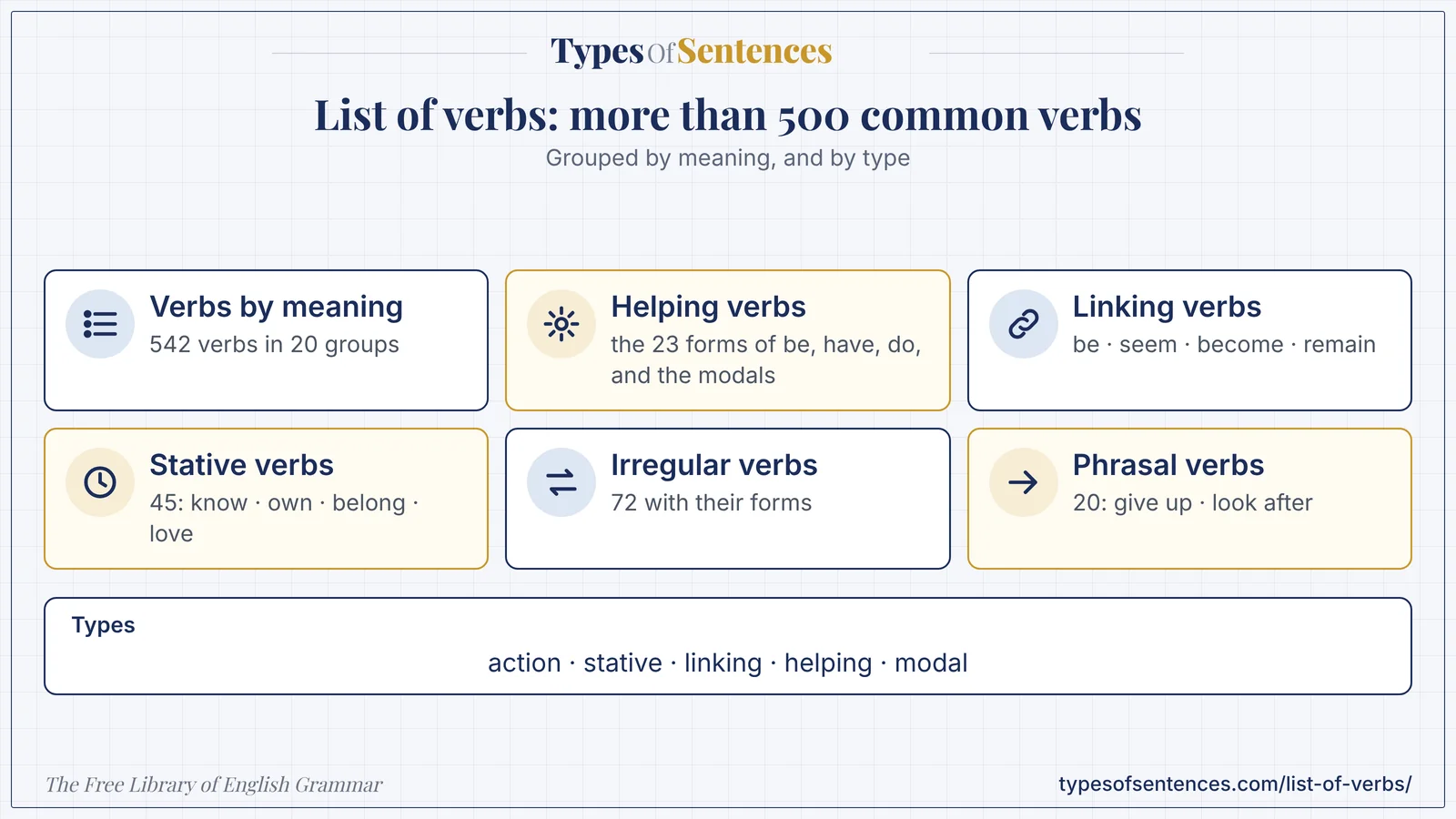
What is a list of verbs? A list of verbs gathers the words that name actions, states, and events: run, think, be, become. This page is a list of verbs in English that you can use for reference. It contains 542 common verbs in twenty groups by meaning (motion, speaking, thinking, feeling, and more), the 23 helping verbs, the linking verbs, the stative verbs, the most useful irregular verbs with their past forms, and 20 phrasal verbs.
It also gives an action verb list with example sentences, the spelling rules for the verb endings, and thirty of the common verbs in English that learners meet first. It ends with 30 exercises and a 10-question quiz.
A verb tells what someone or something does, is, or becomes: Maria runs. The soup is hot. He became a doctor. Every sentence needs at least one verb.
Why it matters: Verbs are easiest to learn in groups. Learn them by meaning (all the motion verbs together) and by type (action, linking, helping), and you will remember them far better than from a single alphabetical list.
Summary: A verb names an action (run), a state (know), or an event (happen). This page lists 542 common verbs in twenty groups, the 23 helping verbs (be, have, do, and the nine modals), the linking verbs (be, seem, become, and others), 45 stative verbs, and the most useful irregular verbs. Regular verbs add -ed for the past; irregular verbs change form. Phrasal verbs combine a verb and a particle (give up). Verbs also take -s in the third person singular and -ing in the participle.
- Action, stative, linking, helping.
- 542 verbs by meaning.
- Irregular verbs: learn the forms.
- Phrasal verbs: verb + particle.
What You’ll Learn
- 1. List of Verbs: The Short Answer
- 2. List of Verbs in English: 542 Common Verbs by Meaning
- 3. Common Verbs in English: 30 Verbs Every Learner Meets First
- 4. Action Verb List: Physical and Mental Actions (20 Examples)
- 5. Helping Verbs, Linking Verbs, and Stative Verbs
- 6. Irregular Verbs: 72 of the Most Useful
- 7. Phrasal Verbs: 20 Common Examples
- 8. Verb Endings: Spelling Rules for -s, -ing, and -ed
- 9. Common Mistakes With Verbs
- 10. Exercises
- 11. Test Your Knowledge
- 12. Frequently Asked Questions
- 13. Conclusion
1. List of Verbs: The Short Answer
| Type of verb | What it does | Examples | Example sentence |
|---|---|---|---|
| action verb | names a physical or mental action | run, build, think, decide | She decided to leave. |
| stative verb | names a state, not an action | know, love, own, belong | He owns a bakery. |
| linking verb | joins the subject to a description | be, seem, become, remain | The soup seems cold. |
| helping (auxiliary) verb | helps another verb to make a tense, a question, or a negative | be, have, do | She has finished. |
| modal verb | shows ability, permission, possibility, or obligation | can, may, must, should, will | You should rest. |
| regular verb | forms the past with -ed | walk → walked | We walked home. |
| irregular verb | changes form in the past | go → went → gone | They went home. |
| phrasal verb | verb + particle with a special meaning | give up, look after | Do not give up. |
The types are described in detail in the Intermediate study of the verb types, and the irregular forms are grouped by pattern further down this page.
2. List of Verbs in English: 542 Common Verbs by Meaning
These 542 verbs are grouped by meaning. A verb can belong to more than one group (run a race, run a company), but each verb appears once, in its most common group. They are the base forms; any verb here can take -s, -ing, and a past form.
| Group | Verbs | How many |
|---|---|---|
| motion and travel | walk, run, jump, climb, swim, fly, drive, ride, travel, move, arrive, leave, enter, exit, follow, lead, pass, cross, turn, return, hurry, rush, crawl, slide, slip, fall, rise, lift, carry, push, pull, throw, catch, drop, kick, step, wander, march, dance, roll | 40 |
| speaking and communication | say, tell, speak, talk, ask, answer, reply, call, shout, whisper, explain, describe, discuss, argue, agree, disagree, announce, mention, suggest, advise, warn, promise, complain, praise, thank, apologize, greet, introduce, invite, offer, request, report, repeat, quote, state, declare, admit, deny, express | 39 |
| thinking and knowing | think, know, believe, understand, remember, forget, imagine, consider, decide, doubt, expect, guess, hope, realize, recognize, suppose, wonder, assume, learn, notice, judge, trust, suspect, predict, plan, intend, wish, prefer, mean, concentrate, analyze, compare, recall, examine, estimate, ponder, reflect, interpret | 38 |
| feeling and emotion | love, like, hate, enjoy, fear, miss, worry, envy, adore, admire, regret, appreciate, dislike, resent, mourn, rejoice, delight, amuse, annoy, anger, please, upset, surprise, shock, excite, bore, frighten, comfort, calm, embarrass | 30 |
| the senses | see, hear, look, watch, listen, smell, taste, feel, touch, observe, glance, stare, gaze, spot, sense, overhear, peek, glimpse, sniff | 19 |
| everyday actions | eat, drink, sleep, wake, wash, clean, cook, bake, boil, fry, cut, chop, open, close, shut, lock, unlock, switch, plug, fill, empty, pour, spill, mix, stir, sweep, dust, iron, fold, pack, unpack, dress, brush, comb, shave, shower, bathe, sit, stand, lie, lay, park | 42 |
| work and business | work, manage, organize, schedule, hire, fire, employ, train, supervise, negotiate, sell, buy, pay, charge, invoice, deliver, order, ship, earn, save, spend, invest, borrow, lend, owe, budget, audit, advertise, promote, market, launch, produce, manufacture, design, develop, test, repair, install, operate, record, file, sign, approve, submit | 44 |
| study and school | study, teach, read, write, spell, practice, revise, memorize, copy, underline, highlight, translate, calculate, measure, solve, draw, paint, sketch, label, summarize, edit, proofread, correct, grade, mark, enroll, graduate, review | 28 |
| making, changing, and breaking | make, build, create, form, shape, grow, change, transform, convert, improve, increase, decrease, reduce, expand, shrink, destroy, break, crush, smash, tear, burn, melt, freeze, dissolve, erase, delete, remove, replace, fix, mend, join, connect, separate, divide, split, combine, attach, detach | 38 |
| having, giving, and taking | have, own, give, take, get, receive, accept, grab, keep, hold, lose, find, hide, seek, share, donate, steal, collect, gather, store, contain, include, belong, deserve, lack, possess, win, gain | 28 |
| people and care | help, support, serve, protect, rescue, guide, visit, meet, marry, divorce, hug, kiss, shake, wave, smile, laugh, cry, welcome, forgive, blame, punish, reward, respect, impress | 24 |
| nature and weather | rain, snow, shine, blow, flow, bloom, wither, fade, flash, erupt, flood, ripen, sprout, glow, sparkle, flicker, drip, splash | 18 |
| sports and play | play, score, hit, pitch, bat, race, compete, exercise, stretch, skate, ski, surf, row | 13 |
| food and cooking | roast, grill, slice, peel, grate, whisk, knead, simmer, steam, toast, season, marinate, sip, chew, swallow, bite, munch, feast | 18 |
| home and building | decorate, furnish, renovate, demolish, plaster, tile, wire, plumb, dig, hammer, nail, drill, saw, sand, polish, scrub, mop, tidy, rent, lease | 20 |
| law, rules, and society | vote, elect, govern, rule, arrest, sentence, sue, testify, convict, accuse, defend, prosecute, obey, forbid, permit, allow, require, demand, command | 19 |
| health and the body | heal, cure, treat, injure, hurt, bleed, breathe, cough, sneeze, sweat, faint, recover, diagnose, vaccinate, rest, relax, yawn | 17 |
| time, sequence, and existence | begin, start, end, finish, stop, continue, pause, wait, last, delay, postpone, cancel, hesitate, linger, hasten, occur, happen, exist, appear, vanish, disappear, remain, stay | 23 |
| general-purpose actions | use, try, need, want, let, enable, cause, prevent, avoid, ignore, choose, select, refuse, resist, attempt, achieve, succeed, fail, handle, control, check, confirm | 22 |
| technology | click, type, scroll, download, upload, update, print, scan, search, browse, stream, post, email, text, message, log, program, code, debug, backup, reboot, sync | 22 |
In total this list of verbs in English has 542 entries. A learner who knows all of them can describe most everyday situations. The terms are defined in the grammar glossary.
3. Common Verbs in English: 30 Verbs Every Learner Meets First
These are common verbs in English that appear in almost every conversation. The list is a teaching selection, not a ranking from a corpus.
| Verb | Example sentence |
|---|---|
| be | She is a teacher. |
| have | We have two cats. |
| do | Do your homework. |
| say | He said hello. |
| go | They go to school by bus. |
| get | I get up at six. |
| make | She makes bread every Sunday. |
| know | I know the answer. |
| think | What do you think? |
| take | Take an umbrella. |
| see | I see a bird. |
| come | Come here, please. |
| want | I want some water. |
| look | Look at the sky. |
| use | Use a pencil. |
| find | I cannot find my keys. |
| give | Give me a minute. |
| tell | Tell me the truth. |
| work | He works in a bank. |
| call | Call me tonight. |
| try | Try again. |
| ask | Ask the teacher. |
| need | We need more time. |
| feel | I feel tired. |
| become | She became a doctor. |
| leave | The train leaves at noon. |
| put | Put the book on the shelf. |
| mean | What does this word mean? |
| keep | Keep the receipt. |
| begin | The class begins at nine. |
4. Action Verb List: Physical and Mental Actions (20 Examples)
An action verb names something that a person or thing does. Physical action verbs describe movement or work you can see, and mental action verbs describe thinking and feeling. Both kinds work in this action verb list; the verbs are in bold.
| Physical action verb list | Example |
|---|---|
| run | She runs every morning. |
| jump | The children jumped into the pool. |
| kick | He kicked the ball over the fence. |
| carry | I carried the box upstairs. |
| build | They built a small house. |
| chop | The chef chopped the onions. |
| paint | She painted the wall blue. |
| climb | We climbed the hill. |
| catch | The cat caught a mouse. |
| throw | He threw the keys to me. |
| Mental action verb list | Example |
|---|---|
| remember | I remember her name. |
| decide | She decided to leave. |
| believe | We believe the story. |
| plan | He is planning a trip. |
| discuss | They discussed the problem. |
| explain | The teacher explained the rule. |
| wonder | I wonder why it is late. |
| realize | She realized her mistake. |
| imagine | He imagined a quiet beach. |
| consider | We considered the offer. |
5. Helping Verbs, Linking Verbs, and Stative Verbs
| Helping verbs (23) | Forms |
|---|---|
| be | am, is, are, was, were, be, been, being |
| have | have, has, had |
| do | do, does, did |
| modal | can, could, may, might, must, shall, should, will, would |
| Linking verbs | List |
|---|---|
| linking verbs | be (am, is, are, was, were), seem, appear, become, remain, stay, look, sound, feel, smell, taste, grow, turn, get, prove |
| Stative verbs (45) | List |
|---|---|
| stative verbs | be, have, own, possess, belong, contain, include, consist, exist, know, believe, understand, mean, remember, forget, doubt, imagine, suppose, recognize, realize, love, like, hate, prefer, want, need, wish, hope, hear, see, smell, taste, seem, appear, depend, matter, cost, weigh, fit, resemble, lack, owe |
| Test | How it works | Example |
|---|---|---|
| action or linking? | replace the verb with is; if the sentence still makes sense, the verb is linking | The soup tastes good. → The soup is good. ✓ (linking). She tasted the soup. → She is the soup. ✗ (action) |
| stative or dynamic? | stative verbs rarely take the -ing form | I know (not I am knowing) |
| helping or main? | a helping verb is followed by another verb | She has finished. (has = helping) · She has a car. (has = main) |
6. Irregular Verbs: 72 of the Most Useful
Irregular verbs do not form the past with -ed. Learn the three forms (base, past, past participle) together.
| Base | Past | Past participle | Note |
|---|---|---|---|
| be | was / were | been | regular pattern for this group |
| begin | began | begun | regular pattern for this group |
| break | broke | broken | regular pattern for this group |
| bring | brought | brought | regular pattern for this group |
| buy | bought | bought | regular pattern for this group |
| catch | caught | caught | regular pattern for this group |
| choose | chose | chosen | regular pattern for this group |
| come | came | come | regular pattern for this group |
| cost | cost | cost | regular pattern for this group |
| cut | cut | cut | regular pattern for this group |
| do | did | done | regular pattern for this group |
| draw | drew | drawn | regular pattern for this group |
| drink | drank | drunk | regular pattern for this group |
| drive | drove | driven | regular pattern for this group |
| eat | ate | eaten | regular pattern for this group |
| fall | fell | fallen | regular pattern for this group |
| feel | felt | felt | regular pattern for this group |
| find | found | found | regular pattern for this group |
| fly | flew | flown | regular pattern for this group |
| forget | forgot | forgotten | regular pattern for this group |
| get | got | gotten | got in British use |
| give | gave | given | regular pattern for this group |
| go | went | gone | regular pattern for this group |
| grow | grew | grown | regular pattern for this group |
| have | had | had | regular pattern for this group |
| hear | heard | heard | regular pattern for this group |
| hide | hid | hidden | regular pattern for this group |
| hold | held | held | regular pattern for this group |
| keep | kept | kept | regular pattern for this group |
| know | knew | known | regular pattern for this group |
| lead | led | led | regular pattern for this group |
| leave | left | left | regular pattern for this group |
| lend | lent | lent | regular pattern for this group |
| let | let | let | regular pattern for this group |
| lose | lost | lost | regular pattern for this group |
| make | made | made | regular pattern for this group |
| mean | meant | meant | regular pattern for this group |
| meet | met | met | regular pattern for this group |
| pay | paid | paid | regular pattern for this group |
| put | put | put | regular pattern for this group |
| read | read | read | pronounced like red |
| ride | rode | ridden | regular pattern for this group |
| ring | rang | rung | regular pattern for this group |
| rise | rose | risen | regular pattern for this group |
| run | ran | run | regular pattern for this group |
| say | said | said | regular pattern for this group |
| see | saw | seen | regular pattern for this group |
| sell | sold | sold | regular pattern for this group |
| send | sent | sent | regular pattern for this group |
| set | set | set | regular pattern for this group |
| shake | shook | shaken | regular pattern for this group |
| show | showed | shown | also showed |
| shut | shut | shut | regular pattern for this group |
| sing | sang | sung | regular pattern for this group |
| sit | sat | sat | regular pattern for this group |
| sleep | slept | slept | regular pattern for this group |
| speak | spoke | spoken | regular pattern for this group |
| spend | spent | spent | regular pattern for this group |
| stand | stood | stood | regular pattern for this group |
| steal | stole | stolen | regular pattern for this group |
| swim | swam | swum | regular pattern for this group |
| take | took | taken | regular pattern for this group |
| teach | taught | taught | regular pattern for this group |
| tear | tore | torn | regular pattern for this group |
| tell | told | told | regular pattern for this group |
| think | thought | thought | regular pattern for this group |
| throw | threw | thrown | regular pattern for this group |
| understand | understood | understood | regular pattern for this group |
| wake | woke | woken | also waked |
| wear | wore | worn | regular pattern for this group |
| win | won | won | regular pattern for this group |
| write | wrote | written | regular pattern for this group |
All 220 irregular verbs are grouped by pattern in the chapter on irregular verbs, and the past participle is explained in the chapter on the past participle.
7. Phrasal Verbs: 20 Common Examples
| Phrasal verb | Meaning | Example |
|---|---|---|
| give up | stop trying | Do not give up. |
| look after | take care of | She looks after her brother. |
| turn on | start a device | Turn on the light. |
| turn off | stop a device | Turn off the TV. |
| pick up | lift; collect | Pick up your toys. |
| put off | delay | Do not put off the test. |
| carry on | continue | Carry on working. |
| find out | discover | I found out the truth. |
| set up | arrange; start | They set up a company. |
| take off | leave the ground; remove | The plane takes off at six. |
| run out of | use all of | We ran out of milk. |
| get along | have a good relationship | They get along well. |
| break down | stop working | The car broke down. |
| call off | cancel | They called off the game. |
| look up | search for | Look up the word. |
| figure out | understand; solve | I cannot figure it out. |
| come across | find by chance | I came across an old photo. |
| bring up | raise a topic; raise a child | Do not bring up politics. |
| check in | register on arrival | We check in at noon. |
| work out | exercise; solve | She works out daily. |
A phrasal verb is a verb plus a particle; the meaning is often not the sum of the parts (give up is not about giving). Some are separable (turn the light on) and some are not (look after the baby).
8. Verb Endings: Spelling Rules for -s, -ing, and -ed
| Ending | Rule | Examples |
|---|---|---|
| -s (third person present) | add -s | work → works, run → runs |
| -s after a sibilant or o | add -es | watch → watches, go → goes, pass → passes |
| -s after consonant + y | change y to i, add -es | study → studies, carry → carries |
| -ing | add -ing | work → working |
| -ing after silent e | drop the e | make → making, write → writing |
| -ing, short vowel + consonant | double the final consonant | run → running, stop → stopping |
| -ed (regular past) | add -ed | walk → walked |
| -ed after e | add -d | live → lived |
| -ed after consonant + y | change y to i, add -ed | study → studied, carry → carried |
| -ed, short vowel + consonant | double the final consonant | stop → stopped, plan → planned |
| -ed after vowel + y | keep the y | play → played, enjoy → enjoyed |
The simple present and past tenses are explained in the Basic chapters on the present and the past tense, and the modal verbs are introduced in the chapter on modal verbs.
9. Common Mistakes With Verbs
| Mistake | Example | Correction |
|---|---|---|
| regular ending on an irregular verb | *He goed home. | He went home. |
| past participle for the past | *She seen the film. | She saw the film. |
| past for the participle | *I have ate. | I have eaten. |
| missing -s | *She walk to school. | She walks to school. |
| -ing with a stative verb | *I am knowing the answer. | I know the answer. |
| double past | *Did he went? | Did he go? |
| wrong helping verb | *She have finished. | She has finished. |
| lie and lay | *She lay the book on the table. (past of lie) | She laid the book on the table. |
| to + -ed | *He wants to played. | He wants to play. |
| modal + to | *You should to go. | You should go. |
Fix: Yesterday she goed to the market, buyed some fruit, and have eat it on the bus.
- goed: the past of go is went.
- buyed: the past of buy is bought.
- have eat: after have use the past participle eaten; but with yesterday the simple past is better: ate.
- Result: Yesterday she went to the market, bought some fruit, and ate it on the bus. (the sentence is invented)
Recap in 12 seconds
Watch the lesson build itself: A reference list of 542 common verbs by meaning, with helping, linking, stative, irregular, and phrasal verbs. The video has no sound.
Exercises
Part A: Name the Type of Verb (Exercises 1–10)
Exercise 1: She runs every morning. What type is runs?
Show Answer
Answer: an action verb.
Exercise 2: The soup tastes good. What type is tastes?
Show Answer
Answer: a linking verb (The soup is good).
Exercise 3: She has finished. What type is has?
Show Answer
Answer: a helping verb.
Exercise 4: I know the answer. What type is know?
Show Answer
Answer: a stative verb.
Exercise 5: You should rest. What type is should?
Show Answer
Answer: a modal verb.
Exercise 6: Do not give up. What type is give up?
Show Answer
Answer: a phrasal verb.
Exercise 7: He became a doctor. What type is became?
Show Answer
Answer: a linking verb.
Exercise 8: They walked home. Regular or irregular?
Show Answer
Answer: regular (walked).
Exercise 9: They went home. Regular or irregular?
Show Answer
Answer: irregular (go, went, gone).
Exercise 10: He owns a bakery. What type is owns?
Show Answer
Answer: a stative verb.
Part B: Give the Forms (Exercises 11–18)
Exercise 11: Past of go
Show Answer
Answer: went.
Exercise 12: Past participle of eat
Show Answer
Answer: eaten.
Exercise 13: Past of buy
Show Answer
Answer: bought.
Exercise 14: Past participle of write
Show Answer
Answer: written.
Exercise 15: -ing form of make
Show Answer
Answer: making.
Exercise 16: -ing form of stop
Show Answer
Answer: stopping.
Exercise 17: Third person of study
Show Answer
Answer: studies.
Exercise 18: Past of study
Show Answer
Answer: studied.
Part C: Choose the Right Verb (Exercises 19–24)
Exercise 19: Choose a motion verb: swim, doubt, regret
Show Answer
Answer: swim.
Exercise 20: Choose a communication verb: whisper, bake, climb
Show Answer
Answer: whisper.
Exercise 21: Choose a mental verb: realize, kick, chop
Show Answer
Answer: realize.
Exercise 22: Choose a linking verb: seem, jump, throw
Show Answer
Answer: seem.
Exercise 23: Choose a helping verb: do, walk, paint
Show Answer
Answer: do.
Exercise 24: Choose a technology verb: download, rain, sweep
Show Answer
Answer: download.
Part D: Correct the Errors (Exercises 25–30)
Exercise 25: Correct: *He goed home.
Show Answer
Answer: He went home.
Exercise 26: Correct: *She seen the film.
Show Answer
Answer: She saw the film.
Exercise 27: Correct: *I have ate.
Show Answer
Answer: I have eaten.
Exercise 28: Correct: *She walk to school.
Show Answer
Answer: She walks to school.
Exercise 29: Correct: *I am knowing the answer.
Show Answer
Answer: I know the answer.
Exercise 30: Correct: *Did he went?
Show Answer
Answer: Did he go?
Test Your Knowledge
Ready to check what you learned? Answer all 10 questions, then submit. You need 80% (8 of 10) to pass. Your answers are not stored.
View correct answers and explanations
Question 1: Which is a linking verb?
✓ Correct Answer: D – seem
Seem.
Question 2: The past participle of write is
✓ Correct Answer: A – written
Written.
Question 3: Which is a helping verb?
✓ Correct Answer: B – have
Have.
Question 4: Which verb is stative?
✓ Correct Answer: C – know
Know.
Question 5: Give up is a
✓ Correct Answer: B – phrasal verb
Verb + particle.
Question 6: The -ing form of make is
✓ Correct Answer: A – making
Drop the e.
Question 7: Which is irregular?
✓ Correct Answer: C – go
Go.
Question 8: The third person of watch is
✓ Correct Answer: D – watches
Add -es.
Question 9: Which is a modal verb?
✓ Correct Answer: B – should
Should.
Question 10: How many helping verbs are on this page’s list?
✓ Correct Answer: A – 23
Twenty-three.
Frequently Asked Questions
What is a list of verbs?
A list of verbs is a reference list of the words that name actions, states, and events. This page is a list of verbs in English with 542 common verbs grouped by meaning, plus the helping, linking, stative, irregular, and phrasal verbs.
How many verbs are there in English?
Thousands. English has a very large vocabulary of verbs, and new ones are formed all the time (text, google). A learner who knows a few hundred common verbs can handle most everyday situations.
What are the most common verbs in English?
The verbs that learners meet first are be, have, do, say, go, get, make, know, think, and take. This page gives 30 of them with examples; the list is a teaching selection, not a corpus ranking.
What is an action verb list?
It is a list of verbs that name actions, such as run, jump, build, decide, and remember. Some action verbs are physical and some are mental.
What are the helping verbs?
The 23 common helping verbs are the forms of be (am, is, are, was, were, be, been, being), have (have, has, had), do (do, does, did), and the modals (can, could, may, might, must, shall, should, will, would).
What is the difference between regular and irregular verbs?
Regular verbs form the past and the past participle by adding -ed (walk, walked, walked). Irregular verbs change in other ways (go, went, gone) and must be learned.
What are linking verbs?
Linking verbs join the subject to a word that describes or renames it: The soup is hot. She became a doctor. The main linking verb is be; others include seem, appear, become, and remain.
Conclusion
You now have a list of verbs for reference: 542 common verbs by meaning, the helping, linking, and stative verbs, an action verb list, the most useful irregular verbs, twenty phrasal verbs, and the spelling rules for the endings.
Use the groups to learn verbs in families, and return to the tables whenever you are unsure of a form. Next, practice with the other pages in this series of lists and references.
- Quirk, Randolph, Sidney Greenbaum, Geoffrey Leech, and Jan Svartvik. A Comprehensive Grammar of the English Language. Longman, 1985.: the classification of verbs (chapter 3).
- Huddleston, Rodney, and Geoffrey K. Pullum. The Cambridge Grammar of the English Language. Cambridge University Press, 2002.: verb forms and inflection (chapter 3).
- Swan, Michael. Practical English Usage. 4th ed. Oxford University Press, 2016.: irregular verbs and stative verbs.
- Murphy, Raymond. English Grammar in Use. 5th ed. Cambridge University Press, 2019.: the appendix of irregular verbs.
- Merriam-Webster Dictionary: verb: the dictionary entry (not opened when this page was written).
Last reviewed: October 29, 2026. How it was made: drafted with AI assistance, then checked with automated tests (structure, links, answer keys, spelling) and against the sources above. A person has not yet read this chapter line by line. Found a mistake? Report it.