The types of pronouns in English are more than the he, she, and they of the Basic level. A pronoun can be personal, possessive, reflexive, demonstrative, interrogative, indefinite, or relative, and each type has its own job and its own traps. Choosing the wrong one produces errors such as Tom and myself went or The book is her’s.
This chapter reviews the personal pronouns and then works through the pronoun types one by one: subject pronouns and object pronouns, possessive pronouns, reflexive pronouns, demonstrative, interrogative, indefinite, and relative pronouns. It ends with the rules for making a pronoun agree with its antecedent. Thirty exercises and a quiz follow.
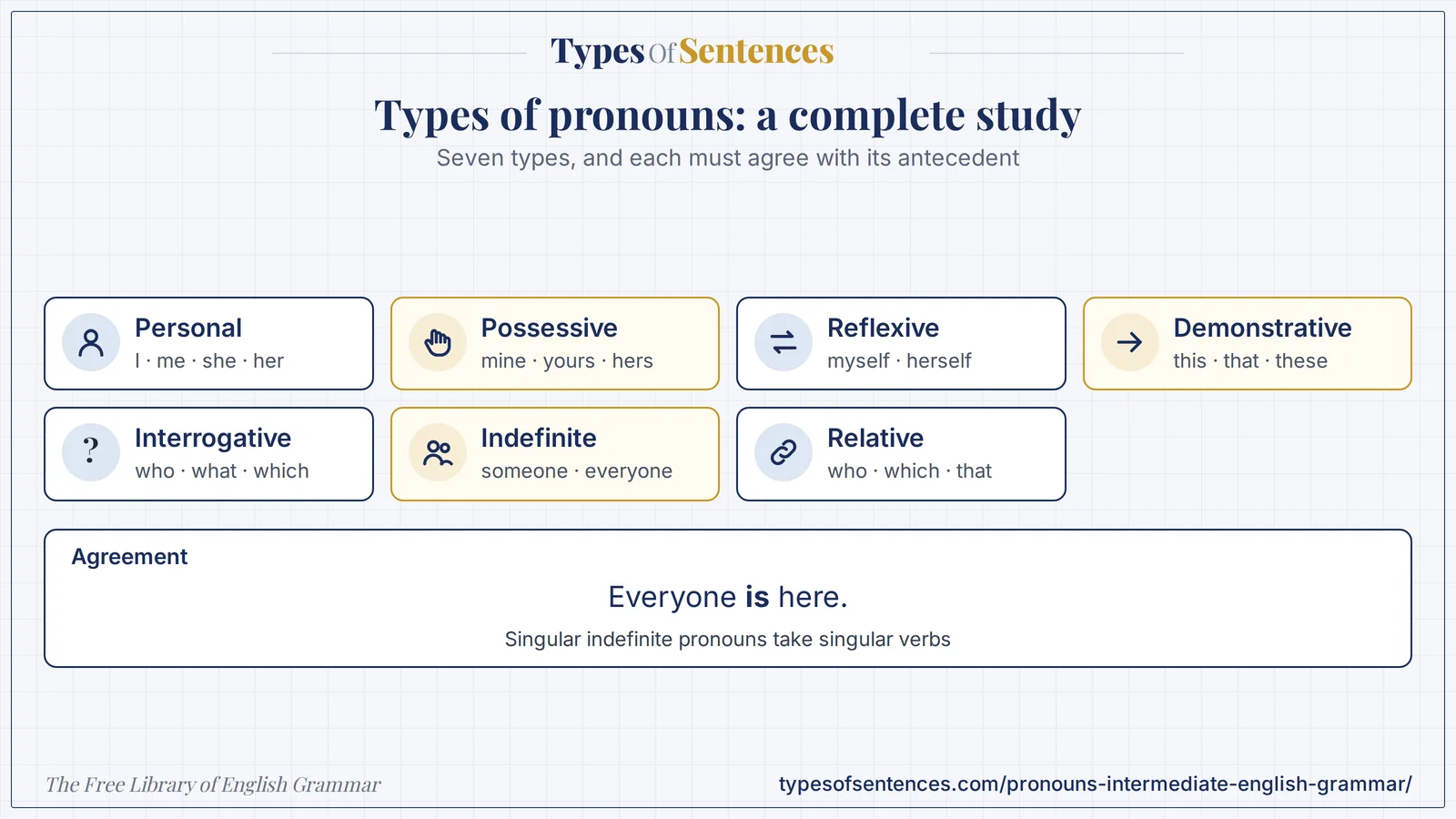
A pronoun stands in for a noun so that you do not have to repeat it. The different types are different ways of standing in: pointing (this), asking (who), owning (mine), joining clauses (who, that), or referring back to the subject (herself).
Why it matters: The most common pronoun errors come from mixing types. This chapter gives each type a clear test so that you can choose correctly.
Summary: Pronouns take the place of nouns. The main types are personal (I, me), possessive (mine), reflexive (myself), demonstrative (this), interrogative (who), indefinite (someone), and relative (who, which, that). A pronoun must agree with its antecedent in number, person, and gender.
- Subject pronouns: I, you, he, she, it, we, they. Object pronouns: me, you, him, her, it, us, them.
- Possessive pronouns stand alone: The book is mine. Possessive adjectives come before a noun: my book.
- Reflexive pronouns reflect the subject: She hurt herself.
- Singular indefinite pronouns take singular verbs: Everyone is here.
What You’ll Learn
- 1. Types of Pronouns: What Is a Pronoun? A Review
- 2. Personal Pronouns: Subject and Object Forms
- 3. Possessive Pronouns
- 4. Reflexive Pronouns
- 5. Demonstrative Pronouns
- 6. Interrogative Pronouns
- 7. Indefinite Pronouns
- 8. Relative Pronouns
- 9. Pronoun-Antecedent Agreement
- 10. Exercises
- 11. Test Your Knowledge
- 12. Frequently Asked Questions
- 13. Conclusion
1. Types of Pronouns: What Is a Pronoun? A Review
A pronoun replaces a noun or a noun phrase. The noun it replaces is its antecedent. In Maria said she was late, she is the pronoun and Maria is the antecedent.
| Pronoun type | Job | Examples |
|---|---|---|
| Personal | refers to the speaker, the listener, or someone else | I, you, he, she, it, we, they; me, him, her, us, them |
| Possessive | shows ownership, standing alone | mine, yours, his, hers, ours, theirs |
| Reflexive (and intensive) | refers back to the subject | myself, yourself, himself, herself, itself, ourselves, themselves |
| Demonstrative | points to something near or far | this, that, these, those |
| Interrogative | asks a question | who, whom, whose, which, what |
| Indefinite | refers to no particular person or thing | someone, anything, everybody, nobody, each, both, few |
| Relative | joins a clause to a noun | who, whom, whose, which, that |
The sections below take each of these pronoun types in turn, beginning with the personal pronouns, which carry the most forms.
2. Personal Pronouns: Subject and Object Forms
Personal pronouns change form for person, number, gender, and case. This table shows the whole system, including the possessive and reflexive forms you will meet in the next sections.
| Person | Subject | Object | Possessive adjective | Possessive pronoun | Reflexive |
|---|---|---|---|---|---|
| 1st singular | I | me | my | mine | myself |
| 2nd singular | you | you | your | yours | yourself |
| 3rd singular (m.) | he | him | his | his | himself |
| 3rd singular (f.) | she | her | her | hers | herself |
| 3rd singular (thing) | it | it | its | — | itself |
| 1st plural | we | us | our | ours | ourselves |
| 2nd plural | you | you | your | yours | yourselves |
| 3rd plural | they | them | their | theirs | themselves |
I. Subject pronouns
Subject pronouns (I, you, he, she, it, we, they) are used as the subject of a verb and after the verb be in formal English: It is I (formal) or It’s me (everyday). After than and as, the pronoun follows the clause you would complete in your mind: She is taller than I (am) is formal, and taller than me is common in speech.
II. Object pronouns
Object pronouns (me, him, her, us, them) are used as the object of a verb or a preposition: She called me; between you and me.
After a preposition, use the object form, even in a pair: between you and me.
3. Possessive Pronouns
Possessive pronouns show ownership and stand alone, with no noun after them: mine, yours, his, hers, ours, theirs. The forms that come before a noun (my, your, her, its, our, their) are possessive adjectives, which modern grammars call possessive determiners; see the chapter on determiners.
| Possessive adjective + noun | Possessive pronoun alone |
|---|---|
| This is my book. | This book is mine. |
| Is that your coat? | Is that coat yours? |
| Her house is big. | The big house is hers. |
| Their team won. | The victory was theirs. |
Possessive pronouns never take an apostrophe: hers, ours, yours, theirs. Only the contraction it’s has one; see apostrophe rules.
- A friend of mine called. double possessive
- That idea is not yours or mine.
4. Reflexive Pronouns
Reflexive pronouns end in -self or -selves and refer back to the subject of the clause: She hurt herself. They are used when the subject and the object are the same person or thing.
| Use | Example |
|---|---|
| Object is the same as the subject | Tom taught himself to play the guitar. |
| Object of a preposition, same person | She spoke to herself. They looked at themselves in the mirror. |
| Intensive (for emphasis) | I myself saw it. The manager herself called. |
| After by for “alone” or “without help” | He did it by himself. |
Use himself and themselves. The forms hisself and theirselves are not standard.
5. Demonstrative Pronouns
Demonstrative pronouns point to something and show whether it is near or far, one or many.
| Near | Far | |
|---|---|---|
| Singular | this | that |
| Plural | these | those |
- This is my phone. near, singular
- Those are my keys over there. far, plural
- I prefer that to this.
The same four words are determiners when a noun follows them: this book, those keys. In that case the word modifies the noun, and it is not a pronoun. A demonstrative pronoun stands alone: This is mine. Be careful that it has a clear referent; This is a problem should leave no doubt about what this means.
6. Interrogative Pronouns
Interrogative pronouns ask a question about a person or a thing: who, whom, whose, which, and what.
| Pronoun | Asks about | Example |
|---|---|---|
| who | a person (subject) | Who called? |
| whom | a person (object, formal) | Whom did you call? |
| whose | ownership | Whose is this coat? |
| which | a choice from a known group | Which do you want? |
| what | a thing or information | What happened? |
The question words are introduced in the Basic chapter on question words.
7. Indefinite Pronouns
Indefinite pronouns refer to people or things in general rather than to a particular one: someone, anybody, nothing, each, both, several.
| Number | Pronouns | Example |
|---|---|---|
| Always singular | each, either, neither, one, everyone, everybody, everything, someone, somebody, something, anyone, anybody, anything, no one, nobody, nothing | Everyone is ready. Nothing was lost. |
| Always plural | both, few, many, several, others | Both are correct. Few know the answer. |
| Singular or plural, by meaning | all, any, more, most, none, some | Most of the cake is gone. Most of the cookies are gone. |
The words that tell how much or how many are also covered as determiners in a later chapter. In writing, singular indefinite pronouns take singular verbs, and the pronouns that refer back to them have a choice.
- Everyone should bring their book. The singular their is common in speech and accepted in many style guides, though advice differs by guide and edition.
- Everyone should bring his or her book. This is formal and can sound heavy.
- All students should bring their books. Rewriting with a plural subject avoids the problem.
Everyone and everybody look plural in meaning, but they are grammatically singular.
8. Relative Pronouns
Relative pronouns connect a dependent clause to a noun in the main clause and stand for that noun inside the clause. They are who, whom, whose, which, and that.
| Pronoun | Refers to | Example |
|---|---|---|
| who | people (subject) | The man who called is my uncle. |
| whom | people (object) | The woman whom I met is a doctor. |
| whose | ownership | The girl whose bag was lost cried. |
| which | things | The book which I read was long. |
| that | people or things (essential clauses) | The book that I read was long. |
American style usually uses that for essential information and which (with commas) for extra information: The car that I bought is red; The car, which I bought in May, is red. For the full guide, see relative pronouns, and for the clauses they introduce see relative clauses.
9. Pronoun-Antecedent Agreement
A pronoun must agree with its antecedent in number (singular or plural), person (first, second, third), and gender. Verb agreement is in the chapter on subject-verb agreement.
| Rule | Correct | Incorrect |
|---|---|---|
| Number | The students lost their books. | The students lost his book. |
| Person (do not shift) | If you study, you will pass. | If one studies, you will pass. |
| Collective noun as a unit (American) | The team lost its game. | The team lost their game. (inconsistent with is) |
| Clear reference | Anna told Beth, “You are late.” | Anna told Beth that she was late. (who?) |
Fix: Everyone must show their ticket, and if you lose it, one will pay.
- Everyone is singular; their is accepted in speech, but you can avoid it.
- The sentence shifts from everyone to you to one.
- Rewrite in one person: All passengers must show their tickets, and anyone who loses one will pay.
Whether to use their for a singular antecedent is a matter of style; style guides differ. Choose one approach in a document and apply it consistently.
Recap in 12 seconds
Watch the lesson build itself: Seven types of pronoun: personal, possessive, reflexive, demonstrative, interrogative, indefinite, and relative. The video has no sound.
Exercises
Part A: Personal Pronouns (Exercises 1–6)
Exercise 1: Choose: Tom and (I/me) went home.
Show Answer
Answer: I. Test: I went home.
Exercise 2: Choose: She gave it to Tom and (I/me).
Show Answer
Answer: me. Test: gave it to me.
Exercise 3: Choose: Between you and (I/me), this is a secret.
Show Answer
Answer: me. Use the object form after a preposition.
Exercise 4: Choose (formal): She is taller than (I/me).
Show Answer
Answer: I (formal: than I am).
Exercise 5: Name the object pronoun: Maria called him yesterday.
Show Answer
Answer: him.
Exercise 6: Name the subject pronoun: They gave us a gift.
Show Answer
Answer: They.
Part B: Possessive Pronouns (Exercises 7–11)
Exercise 7: Choose: This book is (my/mine).
Show Answer
Answer: mine.
Exercise 8: Choose: Is that (your/yours) coat?
Show Answer
Answer: your.
Exercise 9: Fix it: The red car is her’s.
Show Answer
Answer: The red car is hers.
Exercise 10: Choose: The dog wagged (its/it’s) tail.
Show Answer
Answer: its.
Exercise 11: Rewrite with a possessive pronoun: This is our house.
Show Answer
Answer: This house is ours.
Part C: Reflexive Pronouns (Exercises 12–16)
Exercise 12: Choose: She hurt (her/herself).
Show Answer
Answer: herself.
Exercise 13: Choose: Tom and (I/myself) went home.
Show Answer
Answer: I. There is no matching subject for myself.
Exercise 14: Fix it: He cut hisself.
Show Answer
Answer: He cut himself.
Exercise 15: Is I myself saw it reflexive or intensive?
Show Answer
Answer: Intensive. It adds emphasis.
Exercise 16: Complete: The children did it by ___.
Show Answer
Answer: themselves.
Part D: Demonstrative and Interrogative (Exercises 17–21)
Exercise 17: Pronoun or determiner: This is mine.
Show Answer
Answer: Pronoun.
Exercise 18: Pronoun or determiner: This book is mine.
Show Answer
Answer: Determiner.
Exercise 19: Choose (formal): (Who/Whom) did you call?
Show Answer
Answer: Whom. (Informal speech accepts who.)
Exercise 20: Choose: (Who/Whom) called you?
Show Answer
Answer: Who.
Exercise 21: Choose: (Which/What) do you prefer, the red one or the blue one?
Show Answer
Answer: Which. It is a choice from a known group.
Part E: Indefinite Pronouns (Exercises 22–26)
Exercise 22: Choose: Everyone (is/are) ready.
Show Answer
Answer: is.
Exercise 23: Choose: Both (is/are) correct.
Show Answer
Answer: are.
Exercise 24: Choose: Most of the cake (is/are) gone.
Show Answer
Answer: is.
Exercise 25: Choose: Most of the cookies (is/are) gone.
Show Answer
Answer: are.
Exercise 26: Rewrite to avoid a pronoun choice: Everyone should bring his or her book.
Show Answer
Answer: All students should bring their books.
Part F: Relative Pronouns and Agreement (Exercises 27–30)
Exercise 27: Choose: The man (who/which) called is my uncle.
Show Answer
Answer: who.
Exercise 28: Choose: The book (who/that) I read was long.
Show Answer
Answer: that (or which).
Exercise 29: Fix the reference: Anna told Beth that she was late.
Show Answer
Answer: Anna told Beth, “You are late.”
Exercise 30: Fix it: The team lost their first game. (American, team as a unit)
Show Answer
Answer: The team lost its first game.
Test Your Knowledge
Ready to check what you learned? Answer all 10 questions, then submit. You need 80% (8 of 10) to pass. Your answers are not stored.
View correct answers and explanations
Question 1: Which is correct?
✓ Correct Answer: B – Tom and I went home.
Test by removing Tom: I went home.
Question 2: Which is a possessive pronoun?
✓ Correct Answer: A – mine
Mine stands alone and shows ownership.
Question 3: Which is correct?
✓ Correct Answer: C – The car is hers.
Possessive pronouns take no apostrophe.
Question 4: Which is a reflexive pronoun?
✓ Correct Answer: D – himself
Himself ends in -self and refers back to the subject.
Question 5: Which is correct?
✓ Correct Answer: C – He cut himself.
The standard reflexive is himself.
Question 6: Which are demonstrative pronouns?
✓ Correct Answer: A – this, that, these, those
These four words point to something near or far.
Question 7: Which verb fits: Everyone ___ ready.
✓ Correct Answer: D – is
Everyone is singular.
Question 8: Which pronoun is always plural?
✓ Correct Answer: C – both
Both is plural.
Question 9: Which relative pronoun refers to people?
✓ Correct Answer: A – who
Who refers to people.
Question 10: Which sentence has an unclear reference?
✓ Correct Answer: B – Anna told Beth that she was late.
In the second sentence, she could mean Anna or Beth.
Frequently Asked Questions
What are the types of pronouns?
The main types of pronouns are personal, possessive, reflexive, demonstrative, interrogative, indefinite, and relative. A seventh group, the intensive pronouns, uses the same forms as the reflexive ones.
What are subject pronouns and object pronouns?
Subject pronouns (I, he, she, we, they) are used as the subject of a verb. Object pronouns (me, him, her, us, them) are used after verbs and prepositions.
What are possessive pronouns?
Possessive pronouns show ownership and stand alone: mine, yours, his, hers, ours, theirs. They never take an apostrophe.
What are reflexive pronouns?
Reflexive pronouns end in -self or -selves and refer back to the subject, as in She hurt herself. They are not substitutes for I or me.
What is the difference between pronoun types such as who and which?
Who and whom refer to people, which refers to things, and that can refer to either in essential clauses. Pronoun types also differ by job: interrogative pronouns ask questions, and relative pronouns join clauses.
Is it correct to say everyone … their?
It is widely used in speech and accepted by many style guides, though advice differs by guide and edition, and some writers prefer his or her or a plural rewrite. Pick one approach and be consistent.
How do I avoid an unclear pronoun?
Make sure each pronoun has one obvious antecedent. If two nouns could be the antecedent, repeat the noun or rewrite the sentence, for example by using a quotation.
Conclusion
You now know the types of pronouns: personal, possessive, reflexive, demonstrative, interrogative, indefinite, and relative. You can choose between subject and object forms, tell possessive pronouns from possessive adjectives, use reflexive pronouns only when the subject is repeated, and make a pronoun agree with its antecedent.
Check the antecedent of every pronoun you write. Next, you will study the types of adjectives, including their order and degrees.
- Merriam-Webster Dictionary: pronoun: the dictionary definition of a pronoun.
- The Chicago Manual of Style, 17th edition, chapter 5 (Grammar and Usage): guidance on pronoun case and agreement (its treatment of the singular their differs between editions, so check the edition you follow).
- Quirk, Randolph, et al. A Comprehensive Grammar of the English Language. Longman, 1985.: the standard classification of pronouns.
- Huddleston, Rodney, and Geoffrey K. Pullum. The Cambridge Grammar of the English Language. Cambridge University Press, 2002.: pronouns, case, and reflexive forms.
Last reviewed: October 29, 2026. How it was made: drafted with AI assistance, then checked with automated tests (structure, links, answer keys, spelling) and against the sources above. A person has not yet read this chapter line by line. Found a mistake? Report it.