Determiners in English are the words that come before a noun and say which one, whose, or how many: the book, that book, my book, some books, three books. They are a class of their own in modern grammar, although traditional grammar called many of them adjectives. Every singular countable noun needs one, and knowing the types tells you which can go together and in what order.
This chapter shows what determiners are, the determiners types (articles, demonstrative determiners, possessive determiners, quantifiers, numbers, and others), how they are ordered, and how to tell determiners from adjectives. It also explains the difference between articles vs determiners and ends with common errors. Thirty exercises and a quiz follow.
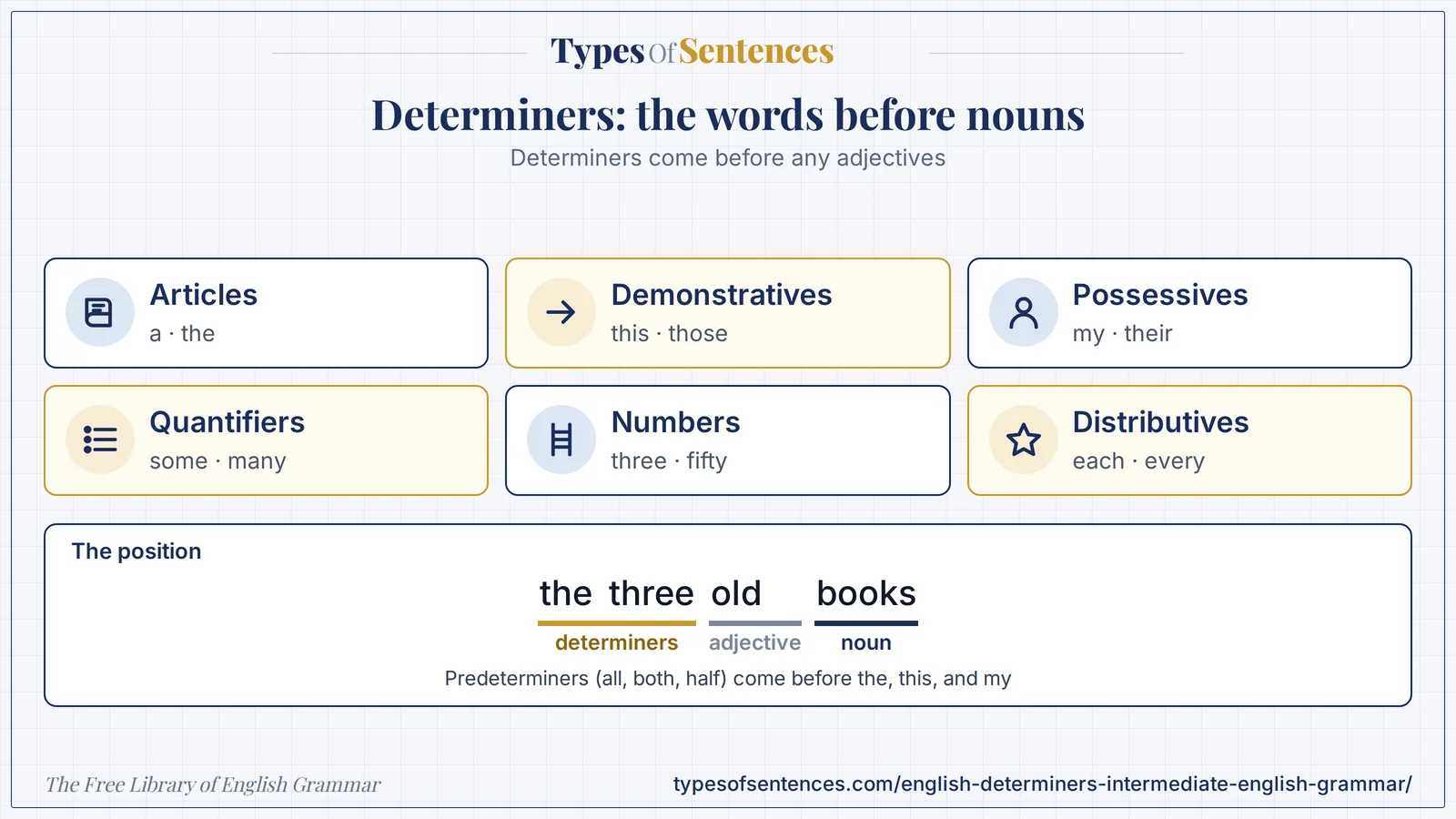
A determiner opens a noun phrase and tells the reader how to identify the noun: by naming it (the), pointing (this), showing the owner (my), or counting (three).
Why it matters: If you choose the wrong determiner, the noun may not match: this books and the my book are wrong because of the type and number of the determiner.
Summary: A determiner comes before a noun and before any adjectives. The main types are articles (a, the), demonstratives (this, those), possessives (my, their), quantifiers (some, many), numbers, and distributives (each, every). You cannot normally use two central determiners together.
- Position: determiner + adjectives + noun: the three old books.
- Demonstratives agree in number: this book, these books.
- Possessives agree with the owner: Tom and his sister.
- Predeterminers (all, both, half) come before the, this, and my.
What You’ll Learn
- 1. Determiners in English: What Are Determiners?
- 2. Determiners Types
- 3. Articles vs. Determiners
- 4. Demonstrative Determiners
- 5. Possessive Determiners
- 6. Quantifying and Distributive Determiners
- 7. Order and Combination of Determiners
- 8. Determiners vs. Adjectives
- 9. Predeterminers, Central Determiners, and Postdeterminers
- 10. Common Determiner Errors
- 11. Exercises
- 12. Test Your Knowledge
- 13. Frequently Asked Questions
- 14. Conclusion
1. Determiners in English: What Are Determiners?
A determiner is a word that stands at the start of a noun phrase and limits or specifies the noun. It answers questions such as Which?, Whose?, How many?, and How much?.
| Question | Determiner | Example |
|---|---|---|
| Which one? | the, this, that | that book |
| Whose? | my, your, Tom’s | my book |
| How many? | three, many, several | three books |
| How much? | some, much, little | some water |
| Each or all? | each, every, all | every student |
A noun phrase has a fixed structure: determiner + modifiers + head noun. In those three old wooden chairs, those is the determiner, three a number, old and wooden are adjectives, and chairs is the head noun. Noun phrases are studied in the chapter on noun phrases.
2. Determiners Types
These are the main determiners types.
| Type | Determiners | Example |
|---|---|---|
| Articles | a, an, the | the dog |
| Demonstratives | this, that, these, those | these shoes |
| Possessives | my, your, his, her, its, our, their; Tom’s | their house |
| Quantifiers | some, any, no, much, many, few, little, enough, several, all, both, half | several reasons |
| Numbers | one, two, three; first, second, third | two cats; the second day |
| Distributives | each, every, either, neither | each student |
| Interrogative | which, what, whose | Which book? |
| Relative | whose (also which, what) | the girl whose bag was lost |
| Other | another, other, such, what (exclamative), certain | another chance; such a day |
Several of these appear in the Basic and Intermediate chapters under other names. In traditional grammar the demonstratives, possessives, and quantifiers were called demonstrative, possessive, and quantitative adjectives; see adjective types.
3. Articles vs. Determiners
The words a, an, and the are the most frequent determiners, and many learners meet them first as articles. The question articles vs determiners has a simple answer: every article is a determiner, but not every determiner is an article.
| Articles | Other determiners | |
|---|---|---|
| Members | a, an, the | this, my, some, each, three, … |
| Slot in noun phrase | the same position | the same position |
| Can combine with an article? | — | no for most: the my ✗; yes for predeterminers: all the ✓ |
The full rules for the three articles are in the previous chapter on definite and indefinite articles. This chapter treats the wider class.
4. Demonstrative Determiners
Demonstrative determiners point to a noun and show distance. They agree in number with the noun that follows.
| Near | Far | |
|---|---|---|
| Singular | this book | that book |
| Plural | these books | those books |
- I like this song. near
- Those shoes are expensive. far
- That day was the worst of my life. distant in time
- These days, people text more than they call. present period
The demonstrative must agree in number: this/that with singular nouns, these/those with plural nouns.
When no noun follows, the same words are demonstrative pronouns: This is mine. See the chapter on types of pronouns. The word that can also be a conjunction or a relative pronoun.
5. Possessive Determiners
Possessive determiners show who owns or is related to the noun. They agree with the owner, not with the noun.
| Owner | Possessive determiner | Example |
|---|---|---|
| I | my | my book |
| you | your | your coat |
| he | his | his car |
| she | her | her house |
| it | its | its tail |
| we | our | our team |
| they | their | their idea |
| who | whose | whose bag? |
| a noun phrase | ’s or s’ | the teacher’s desk; the girls’ books |
The possessive agrees with the owner (Tom: male), not with the noun (sister).
- The form its has no apostrophe. It’s means it is or it has.
- Add own for emphasis: my own room, their own idea.
- The pronoun forms (mine, yours) are not determiners, because they stand alone: This book is mine.
6. Quantifying and Distributive Determiners
The determiners that tell how many or how much are covered fully in the next chapter on quantifiers. Here are the distributive determiners, which refer to the members of a group one by one.
| Determiner | Meaning | Verb | Example |
|---|---|---|---|
| each | every one, taken separately | singular | Each student has a book. |
| every | all, thought of as a whole | singular | Every student is here. |
| either | one or the other of two | singular | Either answer is correct. |
| neither | not one of two | singular | Neither answer is correct. |
- Each is used for two or more; every is used for three or more.
- Each and every take a singular noun and verb: every student is, not every students are.
- No is the determiner (no time); none is the pronoun (None of them came).
7. Order and Combination of Determiners
Determiners fall into three groups according to their position.
| Group | Determiners | Position |
|---|---|---|
| Predeterminers | all, both, half, double, twice, such, what | before the other determiners |
| Central determiners | articles, demonstratives, possessives, whose, which, what | the main slot; only one |
| Postdeterminers | numbers, many, few, several, other, last, next, first | after the central determiner and before adjectives |
| Predeterminer | Central | Postdeterminer | Noun |
|---|---|---|---|
| all | the | three | boys |
| both | my | — | brothers |
| half | a | — | hour |
| — | these | other | options |
| — | my | last | two exams |
All three boys or the three boys works, but all the three is clumsy. The and my are both central determiners, so only one can be used.
8. Determiners vs. Adjectives
Determiners and adjectives both come before a noun, so they can look alike. Four tests separate them.
| Test | Adjective | Determiner |
|---|---|---|
| After a linking verb | The book is old. ✓ | The book is my. ✗ (use mine) |
| Intensified with very | a very old book ✓ | a very my book ✗ |
| Order | free to stack: old red book | fixed slot: only one central determiner |
| Closed or open class | open: thousands of adjectives | closed: a small set |
Borderline words such as many, few, several, and other behave like determiners (they come in a fixed slot) but can also be intensified (too many, very few). Modern grammars class them as determiners (postdeterminers or quantifiers).
9. Predeterminers, Central Determiners, and Postdeterminers
Determiners come before a noun in a fixed order, and grammarians sort them into three positions. Only one word from the central group can be used with a noun, which explains why *the my book and *a this idea are impossible.
| Position | Words | Examples |
|---|---|---|
| predeterminers (first) | all, both, half, double, twice, such, what | all the students; both my brothers; half the cake; twice the price |
| central determiners (one only) | a, an, the, this, that, these, those, my, your, his, her, its, our, their, whose, some, any, no, each, every, either, neither | all the students; both my brothers |
| postdeterminers (last) | cardinal numbers (one, two), ordinal numbers (first, last, next), quantifiers (many, few, several, other) | the first two chapters; my many friends; the other three |
- all the students predeterminer + central
- both my brothers predeterminer + central
- the first two chapters central + postdeterminer + postdeterminer
- half the cake predeterminer + central
To use two possessive or demonstrative words with one noun, restructure the phrase with of and a possessive pronoun: a friend of mine (not *a my friend) and that book of hers (not *that her book).
| Same word | As determiner (before a noun) | As pronoun (stands alone) |
|---|---|---|
| this | this book | This is mine. |
| some | some water | Some are late. |
| my / mine | my car | The car is mine. |
| each | each student | Each is different. |
| which | which road | Which is yours? |
Several determiners compete for the same position, so they cannot be used together. When you want both meanings, choose a different structure.
| Not possible | Possible | Why |
|---|---|---|
| *the my book | my book | two central determiners |
| *a some idea | some idea, or an idea | two central determiners |
| *this the house | this house | two central determiners |
| *every the student | every student | two central determiners |
| *my the friends | my friends | two central determiners |
| *a few of friends | a few friends, or a few of my friends | of needs a determiner or pronoun after it |
10. Common Determiner Errors
| Error | Correction | Rule |
|---|---|---|
| this books | these books | demonstratives agree in number |
| the my book | my book | one central determiner |
| a my friend | a friend of mine | double determiner |
| every students | every student | every takes a singular noun |
| each of the students have | each of the students has | each takes a singular verb |
| all of people | all people / all of the people | of requires a determiner or pronoun |
| another books | other books / another book | another = an + other (singular) |
| both of my sister | both of my sisters / both my sisters | both needs a plural noun |
Fix: All the my friends came to the party, and each of them have a gift.
- All the my combines two central determiners: all my friends.
- Each of them takes a singular verb: has.
- Result: All my friends came to the party, and each of them has a gift.
Different dialects and informal speech allow some forms that formal writing avoids, such as them books and this here book. These are not standard in writing. Everyday speech also uses they or their to refer to each and every.
Recap in 12 seconds
Watch the lesson build itself: The main types of determiner: articles, demonstratives, possessives, quantifiers, numbers, and distributives. The video has no sound.
Exercises
Part A: Recognizing Determiners (Exercises 1–6)
Exercise 1: Find the determiner: My brother bought three tickets.
Show Answer
Answer: My, three.
Exercise 2: Type: these
Show Answer
Answer: Demonstrative.
Exercise 3: Type: their
Show Answer
Answer: Possessive.
Exercise 4: Type: each
Show Answer
Answer: Distributive.
Exercise 5: Type: second (in the second day)
Show Answer
Answer: Number (ordinal).
Exercise 6: Is a a determiner, an article, or both?
Show Answer
Answer: Both. Every article is a determiner.
Part B: Demonstratives and Possessives (Exercises 7–12)
Exercise 7: Choose: (This/These) shoes are new.
Show Answer
Answer: These.
Exercise 8: Choose: I like (that/those) song.
Show Answer
Answer: that.
Exercise 9: Choose: Tom and (her/his) sister went.
Show Answer
Answer: his.
Exercise 10: Fix it: She hurt the arm. (her own arm)
Show Answer
Answer: She hurt her arm.
Exercise 11: Pronoun or determiner: This is mine.
Show Answer
Answer: Pronoun (mine stands alone).
Exercise 12: Choose: The dog wagged (its/it’s) tail.
Show Answer
Answer: its.
Part C: Distributives and Quantifiers (Exercises 13–18)
Exercise 13: Choose: Every student (is/are) here.
Show Answer
Answer: is.
Exercise 14: Fix it: Every students are here.
Show Answer
Answer: Every student is here.
Exercise 15: Fix it: Each of the students have a book.
Show Answer
Answer: Each of the students has a book.
Exercise 16: Choose: (No/None) time was left.
Show Answer
Answer: No. It is followed by a noun.
Exercise 17: Choose: (No/None) of them came.
Show Answer
Answer: None.
Exercise 18: Each or every: for exactly two people?
Show Answer
Answer: Each (or both).
Part D: Order (Exercises 19–24)
Exercise 19: Order: boys / three / the / all
Show Answer
Answer: all the three boys (or all three boys).
Exercise 20: Order: hour / a / half
Show Answer
Answer: half an hour.
Exercise 21: Order: brothers / both / my
Show Answer
Answer: both my brothers.
Exercise 22: Fix it: a my friend
Show Answer
Answer: a friend of mine.
Exercise 23: Fix it: the my book
Show Answer
Answer: my book.
Exercise 24: Name the predeterminer: all the students
Show Answer
Answer: all.
Part E: Determiners vs Adjectives (Exercises 25–28)
Exercise 25: Adjective or determiner: old
Show Answer
Answer: Adjective.
Exercise 26: Adjective or determiner: every
Show Answer
Answer: Determiner.
Exercise 27: Does The book is my work?
Show Answer
Answer: No. A possessive determiner cannot stand alone after be; use mine.
Exercise 28: Which can be stacked: adjectives or central determiners?
Show Answer
Answer: Adjectives. Only one central determiner is allowed.
Part F: Errors (Exercises 29–30)
Exercise 29: Fix it: another books
Show Answer
Answer: other books (or another book).
Exercise 30: Fix it: All of people left.
Show Answer
Answer: All the people left. (or All people left.)
Test Your Knowledge
Ready to check what you learned? Answer all 10 questions, then submit. You need 80% (8 of 10) to pass. Your answers are not stored.
View correct answers and explanations
Question 1: What does a determiner do?
✓ Correct Answer: C – Specifies a noun
A determiner introduces a noun and says which one, whose, or how many.
Question 2: Which is a demonstrative determiner?
✓ Correct Answer: B – these
These points to a noun.
Question 3: Which is correct?
✓ Correct Answer: D – these books
Demonstratives agree in number.
Question 4: Which is correct?
✓ Correct Answer: A – Tom and his sister
The possessive agrees with the owner.
Question 5: Which uses two central determiners incorrectly?
✓ Correct Answer: C – the my book
Only one central determiner is allowed.
Question 6: Which is correct?
✓ Correct Answer: D – every student is
Every takes a singular noun and verb.
Question 7: Which can follow a linking verb?
✓ Correct Answer: C – mine
The pronoun mine stands alone; the others are determiners.
Question 8: Which is a predeterminer?
✓ Correct Answer: D – all
All comes before the central determiner.
Question 9: Which is correct?
✓ Correct Answer: A – another book
Another takes a singular noun.
Question 10: Which is correct?
✓ Correct Answer: B – a friend of mine
Use of + possessive pronoun.
Frequently Asked Questions
What are determiners in English?
Determiners in English are words that come before a noun and specify it: the, this, my, some, three, each. They tell which one, whose, or how many.
What are the determiners types?
The determiners types are articles (a, the), demonstratives (this, those), possessives (my, their), quantifiers (some, many), numbers, distributives (each, every), and interrogative and relative determiners (which, whose).
What are demonstrative determiners?
Demonstrative determiners are this, that, these, and those used before a noun. They show whether the noun is near or far and agree with it in number.
What are possessive determiners?
Possessive determiners are my, your, his, her, its, our, their, and whose. They show ownership and agree with the owner, not with the noun.
What is the difference between articles vs determiners?
Articles (a, an, the) are a small group of determiners. Every article is a determiner, but determiners also include demonstratives, possessives, quantifiers, and numbers.
How are determiners different from adjectives?
Determiners fill a fixed slot at the start of a noun phrase, and you can use only one central determiner. Adjectives describe the noun, can come after be, can be intensified with very, and can be stacked.
Can I use two determiners together?
Yes, in the right order: a predeterminer, then one central determiner, then a postdeterminer (all the three boys, both my brothers). You cannot use two central determiners, as in the my book.
Conclusion
You now know what determiners in English are, the determiners types, and how articles vs determiners compare. You can use demonstrative and possessive determiners, order several determiners correctly, tell determiners from adjectives, and avoid the common errors.
Check each noun you write for its determiner. Next, you will study quantifiers, the determiners that tell how much and how many.
- Merriam-Webster Dictionary: determiner: the dictionary definition of a determiner.
- Purdue Online Writing Lab: Grammar: reference section on articles and adjectives.
- Quirk, Randolph, et al. A Comprehensive Grammar of the English Language. Longman, 1985.: predeterminers, central determiners, and postdeterminers.
- Huddleston, Rodney, and Geoffrey K. Pullum. The Cambridge Grammar of the English Language. Cambridge University Press, 2002.: the determiner as a distinct word class.
Last reviewed: October 29, 2026. How it was made: drafted with AI assistance, then checked with automated tests (structure, links, answer keys, spelling) and against the sources above. A person has not yet read this chapter line by line. Found a mistake? Report it.