What is the pound sign? The pound sign (#) is the symbol made of two horizontal and two slanting lines that you press on a phone keypad and type with Shift + 3 on a US keyboard. It has more names than almost any other symbol. In the United States, it is the pound sign or the number sign (#5 means number 5, and 5# can mean 5 pounds); in the United Kingdom and in computing, it is the hash symbol; on social media, it begins a hashtag; and in a name invented at Bell Labs, it is the octothorpe.
This page explains the pound sign from the start: its names and why it has so many, where it came from, how the number sign is used in writing, on phone keypads, in the hashtag symbol of social media, and in programming, how it differs from the British pound sign (£) and the musical sharp (♯), where to find it on keyboards of different countries, and the rules of style for using it. It ends with 30 exercises and a 10-question quiz.
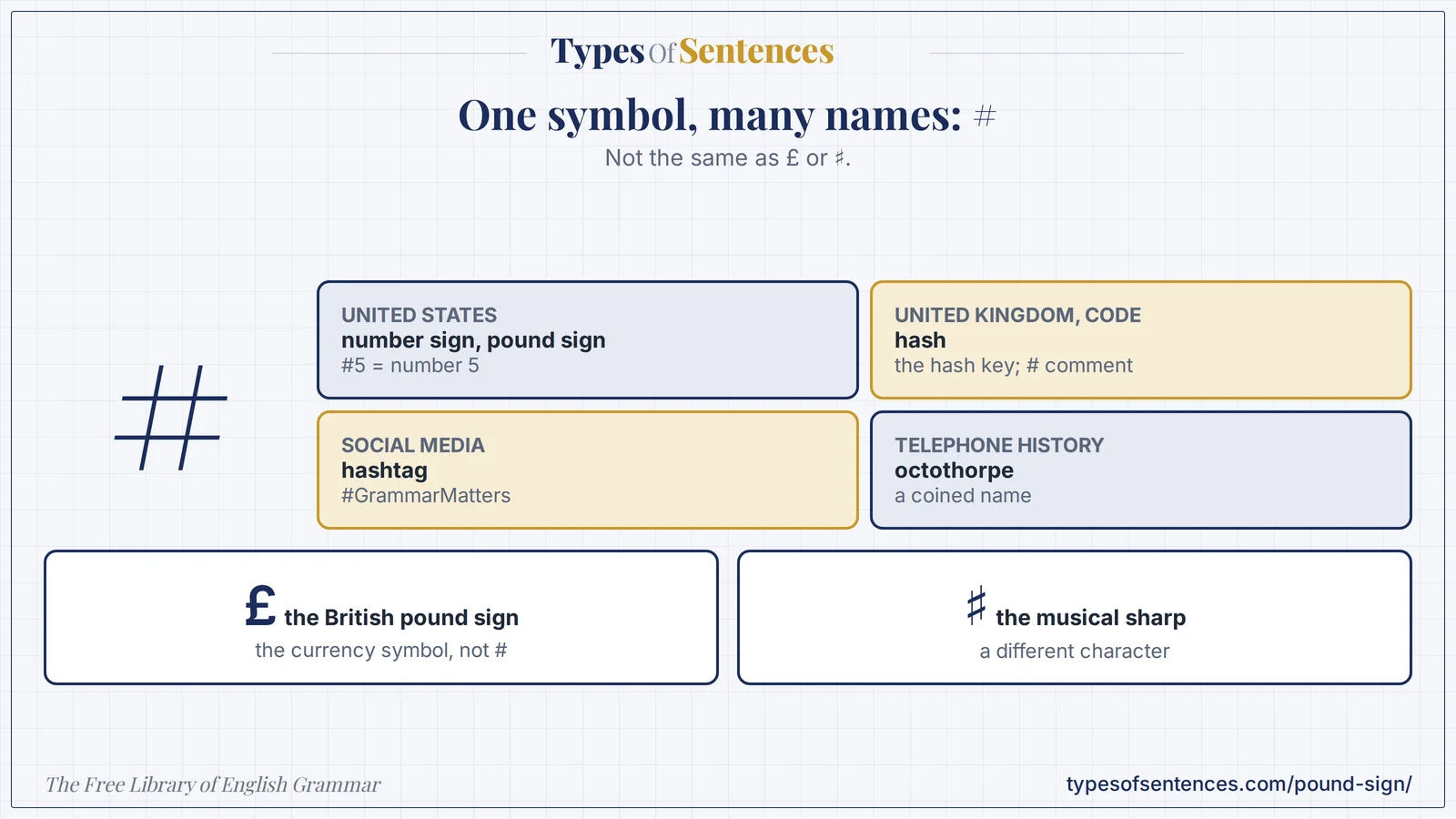
The # symbol has four common names: pound sign and number sign (US), hash (UK and computing), and hashtag (social media). They all mean the same character. Which one you use depends on where you are and what you are doing.
Why it matters: In the UK, pound sign means £, not #. When you write for readers in several countries, choose the name that cannot be misread, or show the symbol.
Summary: The # symbol is ASCII character 35 (Unicode U+0023 NUMBER SIGN). It is called the number sign or pound sign in the United States, the hash in British English and in computing, and the octothorpe in a name that dates from Bell Labs in the 1960s. It probably developed from a scribal abbreviation of lb (pounds in weight). It means number (#5), a hashtag marker (proposed by Chris Messina in 2007), a comment marker in many programming languages, a color prefix in CSS, and a heading marker in Markdown. It is not the British pound sign (£) or the musical sharp (♯). Type it with Shift + 3 on a US keyboard.
- Names: number sign, pound sign (US); hash (UK, code); hashtag; octothorpe.
- Not the same as £ (British pound sign) or ♯ (musical sharp).
- Uses: number, weight, hashtag, comments, colors, headings, channels.
- US keyboard: Shift + 3; Windows Alt code: Alt + 35.
What You’ll Learn
- 1. What Is the Pound Sign? Names and Appearance
- 2. History: From a Scribe’s Pound to the Hashtag
- 3. Uses of the Number Sign and the Hashtag Symbol in Writing
- 4. Uses of the Hash Symbol in Computing and Programming
- 5. How to Type the Pound Sign on a Keyboard
- 6. Style Rules: Number Sign, Pound Sign, and Hashtag
- 7. Common Mistakes with the Pound Sign
- 8. Exercises
- 9. Test Your Knowledge
- 10. Frequently Asked Questions
- 11. Conclusion
1. What Is the Pound Sign? Names and Appearance
| Name | Where it is used | Meaning |
|---|---|---|
| number sign | the United States and Canada; Unicode’s official name | #5 means number 5 |
| pound sign | the United States, especially for weight and on phones | 5# means 5 pounds; the pound key on a phone |
| hash, hash sign, hash key | the United Kingdom, Ireland, Australia, and in computing | the hash key on a phone; the hash in code |
| hashtag | social media | the mark that begins a tag: #grammar |
| octothorpe | a coined name, used by enthusiasts and in telephone history | the symbol itself |
| sharp (♯) | music | a different character (U+266F), used for a raised note |
| pound sign (£) | the United Kingdom | the currency symbol, U+00A3 |
| Property | Pound sign (#) |
|---|---|
| symbol | # |
| Unicode name and code | NUMBER SIGN, U+0023 |
| ASCII code | 35 (hexadecimal 23) |
| HTML entity | # or # |
| key on a US keyboard | Shift + 3 |
| key on a UK keyboard | the # key beside the Enter key, without Shift |
| read aloud as | pound, number, hash, or hashtag, by context |
| direction | two vertical lines (slightly slanted in many fonts) crossed by two horizontal lines |
| Easily confused with | What it is | How to tell them apart |
|---|---|---|
| British pound sign (£) | the currency of the United Kingdom | it is a curled letter L with a bar |
| musical sharp (♯) | a symbol for a raised note | its vertical lines are straight and its horizontal lines slope upward |
| the programming language name C# | written with # on the keyboard but named C sharp | read sharp |
| tic-tac-toe grid | a game board | a picture, not a character |
| the at sign (@) and the asterisk (*) | other keypad and keyboard symbols | different shapes |
The name octothorpe is a playful coinage. Accounts of its invention at Bell Labs in the 1960s differ on who made it up and what the second half refers to: the first part comes from octo, for the eight points of the symbol, and the second is often linked to the name of the Olympic athlete Jim Thorpe, though some accounts dispute this. It is a good example of a name that is best repeated with the words as the story goes.
2. History: From a Scribe’s Pound to the Hashtag
The pound sign is thought to come from the medieval abbreviation lb for the Latin libra pondo, a pound in weight. Scribes wrote the abbreviation with a bar across it, and in hasty handwriting the letters and the bar became a figure of crossing lines, which is the source of the American use of # for pounds. The use for number grew from the same kind of handwriting, in which the abbreviation of numero and No. were shortened. When the touch-tone telephone was introduced in the 1960s, the # key and the * key were added to the keypad, and the symbol gained its telephone names. Programmers used it for comments and directives, and in 2007, Chris Messina proposed using it as a mark for grouping messages on Twitter; the hashtag spread worldwide.
| Period | Development |
|---|---|
| Middle Ages | the abbreviation lb with a bar for pounds in weight |
| nineteenth century | used in the United States for number and pound |
| 1960s | added to touch-tone telephone keypads; named octothorpe at Bell Labs |
| ASCII | code 35 for the number sign |
| 1970s to 1990s | a comment and directive mark in programming (Unix shell, C preprocessor); a channel prefix in IRC |
| 2007 | Chris Messina proposes the use of # for grouping on Twitter |
| 2009 | Twitter links hashtags; the use spreads to other services |
| today | a hashtag, a Markdown heading, a CSS color and ID prefix, a URL fragment marker, and a comment symbol |
The general outline of the history is widely told; some details, such as the exact origin of the use of # for number and the origin of octothorpe, are disputed, and sources differ.
3. Uses of the Number Sign and the Hashtag Symbol in Writing
| Use | Example | Notes |
|---|---|---|
| number | #5, apartment #12 | informal in the US; formal writing uses No. 5 |
| weight in pounds | 5# of flour | a US trade and recipe usage; lb is clearer |
| hashtag | #GrammarMatters | a tag on social media: no spaces, no punctuation; capitalize each word |
| telephone key | Press # to continue. | US: pound key; UK: hash key |
| proofreading mark | a # in the margin means insert a space | a standard proofreading mark |
| comic swearing | #@$%! | a string of symbols as a mild oath |
| rank or position | #1 bestseller | informal and in advertising |
| section or channel | #general | chat channel names |
| end of a press release | # # # or -30- | a traditional end mark in journalism (# # #) |
| musical sharp | not #: ♯ | use the sharp sign for music |
| theme or topic | #TeachersOfInstagram | a hashtag that groups posts |
| Hashtag convention | Guidance | Example |
|---|---|---|
| no spaces | a hashtag ends at a space or punctuation | #GrammarTips |
| capitalize each word | improves readability and helps screen readers say each word | #EnglishGrammar rather than #englishgrammar |
| no punctuation | apostrophes and hyphens break the tag | #DontPanic |
| numbers are allowed | but a tag of only digits may not be recognized | #Grammar101 |
| do not use as a sentence | long tags are hard to read | *#IHopeTheGrammarLessonIsHelpful |
Hashtags are a feature of the grammar of social media: they are tags, not words of a sentence, and they follow their own conventions, which are treated in the chapter on grammar in social media. For the writing of numbers and the abbreviation No., see the chapter on numbers in writing.
4. Uses of the Hash Symbol in Computing and Programming
| Context | Use | Example |
|---|---|---|
| Python, Ruby, and shell scripts | a comment: the rest of the line is ignored | # this is a comment |
| the Unix “shebang” | the first line of a script names its interpreter | #!/bin/bash |
| C and C++ preprocessor | directives | #include <stdio.h> |
| CSS | a color value, and an ID selector | color: #1B2D5B; and #header |
| URLs | the fragment: a position in a page | example.com/page#section |
| Markdown | heading levels | # Title, ## Subtitle |
| chat and IRC | a channel name | #general |
| spreadsheets | a cell too narrow to show a number shows #####; errors begin with # (#DIV/0!) | #DIV/0! |
| C# | the name of a programming language | read aloud as C sharp |
| templating and string formatting | a marker in some languages | #{name} in Ruby |
Because the # is a comment mark in so many languages, a line that begins with it is usually ignored by the computer, which makes it useful for notes to the reader. The grammar of technology terms is treated in the chapter on grammar and technology.
5. How to Type the Pound Sign on a Keyboard
| Device or system | How to type # (the pound sign) |
|---|---|
| Windows or Mac, US keyboard | hold Shift and press 3 |
| UK keyboard (Windows) | press the # key beside the Enter key (no Shift) |
| UK keyboard (Mac) | hold Option and press 3 |
| Windows Alt code | hold Alt and type 35 on the numeric keypad (with Num Lock on) |
| German keyboard | press the # key beside the Enter key (no Shift) |
| French AZERTY keyboard | hold AltGr and press 3 |
| Spanish keyboard | hold AltGr and press 3 |
| iPhone and iPad | tap 123, then #+=, then # |
| Android | tap ?123, then # |
| Indian English keyboards | follow the US or UK layout |
| web pages (HTML) | write # or # |
| phone keypad | the # key, below the 9 and to the right of 0 |
| If you cannot find the key | What to try |
|---|---|
| Shift + 3 types £ instead | you are using a UK layout: use the # key beside Enter, or switch the layout |
| Option + 3 types £ | you are using a US layout on a Mac: Shift + 3 gives #; Option + 3 gives £ |
| the key is missing on a small keyboard | use the Alt code, an on-screen keyboard, or copy and paste |
| you want the sharp sign (♯) instead | insert ♯ from the symbol menu |
| you want to copy it | select this character: # |
6. Style Rules: Number Sign, Pound Sign, and Hashtag
| Question | Guidance |
|---|---|
| Which name should I use? | for an international audience, show the symbol (#) and say number sign or hash as the context requires; avoid pound sign alone, because it means £ in the United Kingdom |
| Is # acceptable for number in formal writing? | no; write No. or number; the Chicago Manual of Style and AP style prefer No. |
| Space between # and the number? | no space: #5 |
| Pounds as weight? | write lb or pounds; # is ambiguous |
| Hashtag capitalization? | capitalize each word |
| Where in a sentence? | at the end of a post is usual; inside a sentence when the tag is also a word |
| Hashtags in formal writing? | avoid in formal prose; quote them when you are discussing them |
| Accessibility? | camel-case hashtags are read correctly by many screen readers; a tag in lower case may be read as one long word |
A good test: ask what a reader in another country would think. In the UK, press the pound key would mean the £ key, and in the US, press the hash key may be understood but sounds unusual. The symbol itself is the safest instruction.
7. Common Mistakes with the Pound Sign
| Mistake | Example | Better |
|---|---|---|
| confusing # with £ | *The pound sign (#) costs £5. (in a UK text) | The hash sign (#) … or show the symbol |
| using # for number in formal writing | *See paragraph #3. | See paragraph 3. or No. 3 |
| using # for pounds in a recipe | *2# of sugar | 2 lb of sugar |
| spaces inside a hashtag | *#grammar tips | #GrammarTips |
| punctuation inside a hashtag | *#don’t-panic | #DontPanic |
| all lower case for a long hashtag | *#englishgrammarmatters | #EnglishGrammarMatters |
| confusing # with the sharp sign in music | *F# minor in a score | F♯ minor |
| writing C# as C pound | *C pound | C sharp (written C#) |
| a hashtag that is a sentence | *#ThisLessonWasVeryHelpfulToMeToday | a shorter tag |
Fix: Press the pound key, then enter #3 and 2# of flour; our hashtag is #english grammar tips and we play F# minor. (a mixed message for UK and US readers).
- pound key: ambiguous across countries; write the # key.
- #3: informal; write No. 3 or 3.
- 2# of flour: write 2 lb of flour.
- #english grammar tips: a hashtag cannot contain spaces and should be capitalized: #EnglishGrammarTips.
- F# minor: music uses the sharp sign: F♯ minor (on the keyboard, F# is often accepted in plain text).
- Result: Press the # key, then enter 3 and 2 lb of flour; our hashtag is #EnglishGrammarTips and we play F♯ minor. (the message is invented)
Recap in 12 seconds
Watch the lesson build itself: The names of the # symbol in different places, and two symbols that look similar but are different. The video has no sound.
Exercises
Part A: Names and History (Exercises 1–6)
Exercise 1: Name three English names for #.
Show Answer
Answer: Number sign, pound sign, hash (also hashtag, octothorpe).
Exercise 2: What is the Unicode name of #?
Show Answer
Answer: NUMBER SIGN (U+0023).
Exercise 3: What is the ASCII code of #?
Show Answer
Answer: 35.
Exercise 4: Which symbol is the British pound sign?
Show Answer
Answer: £.
Exercise 5: Which symbol is the musical sharp?
Show Answer
Answer: ♯.
Exercise 6: Who proposed the hashtag on Twitter in 2007?
Show Answer
Answer: Chris Messina.
Part B: Writing (Exercises 7–14)
Exercise 7: What does #5 mean in the US?
Show Answer
Answer: Number 5.
Exercise 8: What does 5# mean in a US recipe?
Show Answer
Answer: 5 pounds.
Exercise 9: What does a # in the margin mean in proofreading?
Show Answer
Answer: Insert a space.
Exercise 10: Should you use # for number in formal writing?
Show Answer
Answer: No; write No. or number.
Exercise 11: How should a long hashtag be written?
Show Answer
Answer: With each word capitalized, with no spaces.
Exercise 12: Why capitalize each word of a hashtag?
Show Answer
Answer: It is more readable and helps screen readers.
Exercise 13: What is the UK name for the # key on a phone?
Show Answer
Answer: The hash key.
Exercise 14: What does pound sign mean in the UK?
Show Answer
Answer: The £ symbol.
Part C: Computing (Exercises 15–20)
Exercise 15: What does # note do in Python?
Show Answer
Answer: Starts a comment.
Exercise 16: What is #!/bin/bash called?
Show Answer
Answer: A shebang line.
Exercise 17: What does #1B2D5B represent in CSS?
Show Answer
Answer: A color value.
Exercise 18: What does page#section do in a URL?
Show Answer
Answer: Points to a position (fragment) in the page.
Exercise 19: What does ## Heading make in Markdown?
Show Answer
Answer: A second-level heading.
Exercise 20: How is C# read aloud?
Show Answer
Answer: C sharp.
Part D: Typing (Exercises 21–26)
Exercise 21: How do you type # on a US keyboard?
Show Answer
Answer: Shift + 3.
Exercise 22: What is the Windows Alt code?
Show Answer
Answer: Alt + 35.
Exercise 23: How do you type # on a UK Windows keyboard?
Show Answer
Answer: Press the # key beside Enter.
Exercise 24: How do you type # on a UK-layout Mac?
Show Answer
Answer: Option + 3.
Exercise 25: How do you type # on a French AZERTY keyboard?
Show Answer
Answer: AltGr + 3.
Exercise 26: Why might Shift + 3 type £?
Show Answer
Answer: The keyboard layout is set to UK.
Part E: Style and Correction (Exercises 27–30)
Exercise 27: Correct: *See paragraph #3. (formal)
Show Answer
Answer: See paragraph 3.
Exercise 28: Correct: *2# of sugar
Show Answer
Answer: 2 lb of sugar.
Exercise 29: Correct: *#grammar tips
Show Answer
Answer: #GrammarTips.
Exercise 30: Correct: *F# minor (in a score).
Show Answer
Answer: F♯ minor.
Test Your Knowledge
Ready to check what you learned? Answer all 10 questions, then submit. You need 80% (8 of 10) to pass. Your answers are not stored.
View correct answers and explanations
Question 1: What is # called in the United Kingdom and in programming?
✓ Correct Answer: B – hash
Hash.
Question 2: What is the ASCII code of #?
✓ Correct Answer: D – 35
35.
Question 3: How do you type # on a US keyboard?
✓ Correct Answer: A – Shift + 3
Shift + 3.
Question 4: What does pound sign mean in the UK?
✓ Correct Answer: B – £
£.
Question 5: Who proposed the hashtag in 2007?
✓ Correct Answer: C – Chris Messina
Chris Messina.
Question 6: How should a long hashtag be written?
✓ Correct Answer: D – with each word capitalized
Camel case.
Question 7: What does # note do in Python?
✓ Correct Answer: A – starts a comment
A comment.
Question 8: Which is the musical sharp?
✓ Correct Answer: B – ♯
♯.
Question 9: What does a # in a proofreading margin mean?
✓ Correct Answer: C – insert a space
Insert a space.
Question 10: What does page#section do in a URL?
✓ Correct Answer: D – points to a position in the page
A fragment.
Frequently Asked Questions
What is the pound sign?
The pound sign (#) is the symbol of crossed lines that is called the number sign or pound sign in the United States and the hash in the United Kingdom. It marks numbers, hashtags, comments in code, and phone keys.
What is the hash symbol?
The hash symbol is the British and computing name for #. The hash symbol begins a hashtag, a comment in many programming languages, a color value in CSS, and a heading in Markdown.
What is the number sign used for?
The number sign (#) means number in informal US writing (#5), and in formal writing No. is preferred. The number sign can also mean pounds in a recipe, so avoid it where the meaning could be unclear.
What is the hashtag symbol?
The hashtag symbol is # used to begin a tag on social media. A hashtag has no spaces or punctuation, and each word should be capitalized for readability.
What is an octothorpe?
An octothorpe is a name for # that is said to have been coined at Bell Labs in the 1960s; accounts of the origin of the second half of the word differ.
How do I type the pound sign on a UK keyboard?
Press the # key beside the Enter key. On a UK-layout Mac, hold Option and press 3.
Is # the same as £?
No. # is the number sign or hash; £ is the British pound sign, the symbol for the currency.
Conclusion
You now know why # has so many names, where it came from, how it is used in writing, on phones, in hashtags, and in code, how it differs from £ and ♯, how to type the pound sign on different keyboards, and how to avoid the common mistakes with it.
Choose the name that your reader cannot misread, or show the symbol. Next, and last in the series, is the at sign.
- The Unicode Consortium. The Unicode Standard. Basic Latin block (U+0000 to U+007F).: the character name and code point.
- Messina, Chris. “Groups for Twitter; or A Proposal for Twitter Tag Channels.” 2007. (online post): the proposal of the hashtag (check the archived copy).
- Houston, Keith. Shady Characters: The Secret Life of Punctuation, Symbols, and Other Typographical Marks. W. W. Norton, 2013.: the history of the number sign and other marks.
- The Chicago Manual of Style. University of Chicago Press. (check the current edition): the use of No. and of symbols in text.
- Merriam-Webster Dictionary: octothorpe: the dictionary entry.
Last reviewed: October 29, 2026. How it was made: drafted with AI assistance, then checked with automated tests (structure, links, answer keys, spelling) and against the sources above. A person has not yet read this chapter line by line. Found a mistake? Report it.