What is the caret symbol? The caret symbol (^) is a small, upward-pointing wedge on the number row of the keyboard. Editors use a caret to show where something should be inserted. In mathematics and programming, it often means to the power of (2^3 is 8), and in regular expressions it means the start of a line. People also call it the hat symbol, and the same shape, when it sits on a letter, is the circumflex accent, as in the French être.
This page explains the caret symbol from the start: its names and the story of the word, its uses in proofreading, mathematics, and computing, how it relates to the circumflex, how not to confuse the caret with carat, karat, and carrot, where to find the caret key and how to type the caret on keyboard layouts of different countries, and the rules for using it. It ends with 30 exercises and a 10-question quiz.
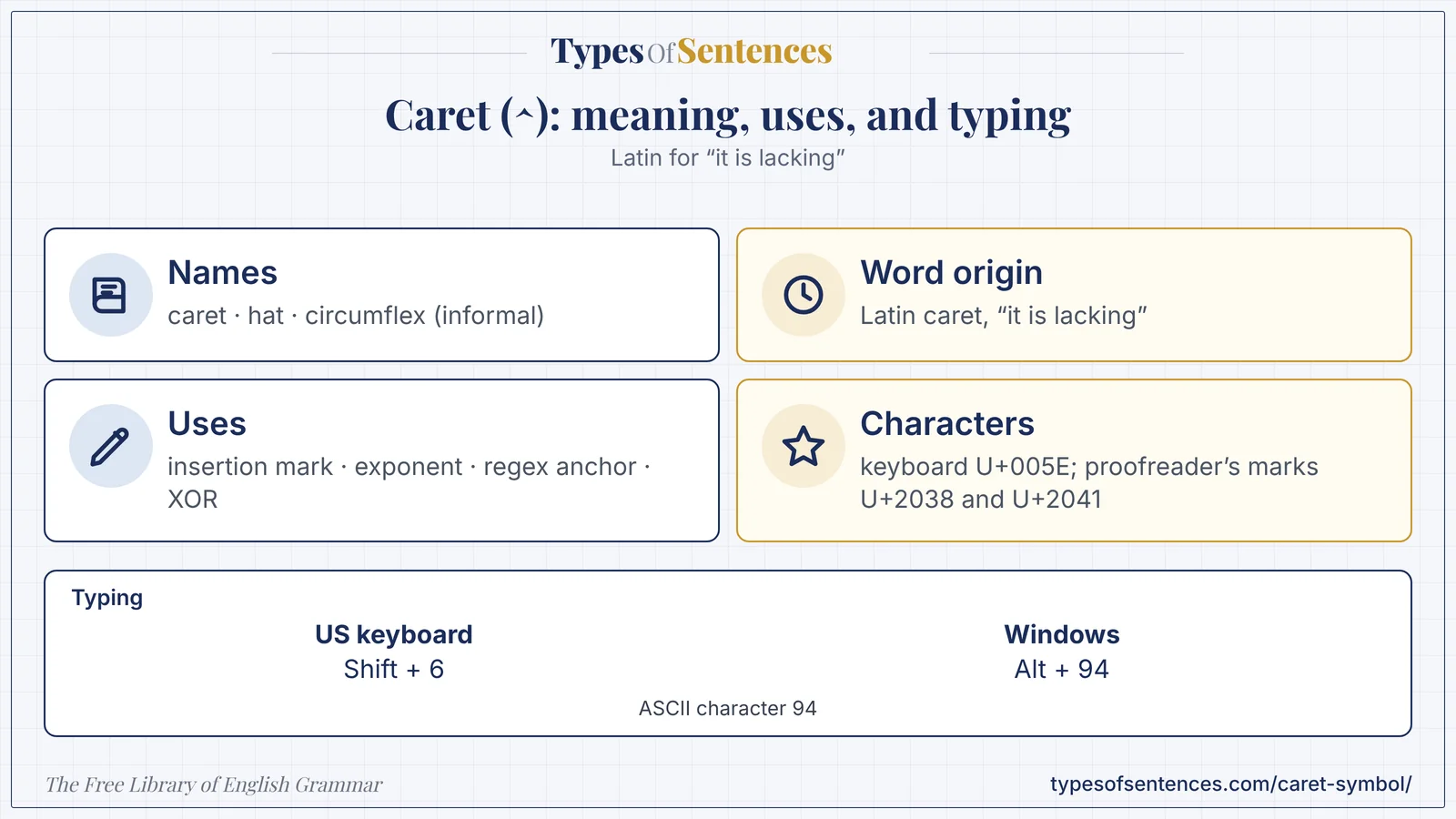
The caret is the little roof ^. An editor draws it under a line to say insert here. A computer user types it to mean a power (2^3), and a programmer uses it in patterns and in version numbers.
Why it matters: You type it by holding Shift and pressing 6 on a US keyboard. On some European keyboards, it is a dead key: press it, then press the space bar.
Summary: The caret (^) is ASCII character 94; Unicode calls the keyboard character U+005E CIRCUMFLEX ACCENT, and the proofreader’s mark has its own characters (U+2038 and U+2041). The word caret is Latin for it is lacking, and editors write a caret to mark an insertion. On the keyboard, it means a power in calculators and spreadsheets, XOR in C-style languages, the start of a line and a negation in regular expressions, Control in terminal notation (^C), and a compatible-version range in some package managers. It is not the same as carat (gem weight), karat (gold purity), or carrot.
- Names: caret, hat, circumflex (informal).
- Word origin: Latin caret, “it is lacking.”
- Uses: insertion mark, exponent, regex anchor, XOR, Control key, version range.
- US keyboard: Shift + 6; Windows Alt code: Alt + 94.
What You’ll Learn
- 1. What Is the Caret Symbol? Names and Appearance
- 2. History: The Editor’s Mark and the Keyboard Character
- 3. Uses of the Caret in Proofreading, Writing, and Mathematics
- 4. Uses of the Caret in Computing and Programming
- 5. How to Type the Caret and Find the Caret on a Keyboard
- 6. Style Rules: Using the Caret and the Circumflex
- 7. Common Mistakes with the Caret
- 8. Exercises
- 9. Test Your Knowledge
- 10. Frequently Asked Questions
- 11. Conclusion
1. What Is the Caret Symbol? Names and Appearance
| Property | Caret symbol |
|---|---|
| symbol | ^ |
| common names | caret, hat, circumflex (informal), up arrow (informal) |
| origin of the word | Latin caret, “it is lacking” (from carere, to lack) |
| Unicode name and code of the keyboard character | CIRCUMFLEX ACCENT, U+005E |
| Unicode proofreading marks | CARET U+2038 (‸) and CARET INSERTION POINT U+2041 (⁁) |
| ASCII code | 94 (hexadecimal 5E) |
| HTML entity | ^ or ^ |
| key on a US keyboard | Shift + 6 |
| read aloud as | caret; hat |
| Easily confused with | What it is | How to tell them apart |
|---|---|---|
| circumflex accent (ˆ, ◌̂) | a mark over a vowel, as in ê | it sits on a letter |
| carat | a unit of mass for gems (200 milligrams) | a word for a weight |
| karat | a measure of the purity of gold (24 karat is pure) | a word for a purity |
| carrot | a vegetable | a word for a food |
| logical and (∧) | a wedge in logic | a separate character |
| less than (<) and greater than (>) | comparison signs | they open sideways |
| up arrow (↑) | an arrow | it has a shaft |
Four words sound alike in many accents: caret (the mark), carat (gems), karat (gold), and carrot (the vegetable). A simple memory device: the caret is the mark you draw, the carat is a diamond’s weight, the karat is gold’s purity (the K in 18K), and the carrot is the one you eat.
2. History: The Editor’s Mark and the Keyboard Character
The word caret was a Latin verb long before it was a symbol. A scribe or an editor who found that a word had been left out wrote the missing word above the line and marked its place with a small wedge below the line, which meant it is lacking. In English the mark and its name have been used in this way for centuries, and editors still draw it in the margin of a manuscript or a proof. When typewriters and early computer terminals needed a character for the circumflex accent, the same shape was given to code 94, and programmers took it over for other jobs because the key was there.
| Period | Development |
|---|---|
| Latin and medieval manuscripts | a mark showing where text was omitted |
| early modern printing | the caret in proofs for insertions |
| typewriter era | a key for the circumflex accent (often as a dead key) |
| ASCII | code 94 for the circumflex accent or the caret |
| 1970s and later | used as an exponent sign in calculators and in the BASIC language; as an anchor in regular expressions; for control characters in terminals |
| today | exponent in spreadsheets, XOR in C-style languages, anchors in regular expressions, and version ranges in package managers |
The outline is clear; the dates at which particular programming languages adopted the caret for exponents or XOR vary, and sources differ on details.
3. Uses of the Caret in Proofreading, Writing, and Mathematics
| Use | Example | Notes |
|---|---|---|
| insertion mark in proofreading | a caret under the line with the new text above it | the standard mark for insert here |
| plain-text exponent | 2^10 = 1,024; x^2 | in emails and plain text where superscripts are not available |
| “hat” in mathematics and statistics | x̂ (read x-hat) | a circumflex over a letter, not the keyboard caret |
| pointing to a post above, in forums and chats | ^ this | informal: “I agree with the post above” |
| emoticons | ^_^ | a smiling face |
| the circumflex accent | être, forêt, você | a mark over a vowel |
| symbol for “control” in plain text | ^C means Control + C | used in manuals |
| logic | ∧ (and) is a wedge; the caret is sometimes typed in its place in plain text | not standard |
| chemistry and physics notes | 10^-3 in plain text | a plain-text form of a power |
| Language | Letters with a circumflex | Example | What it does |
|---|---|---|---|
| French | â ê î ô û | forêt (forest), fête | often marks a lost s from an older spelling; also distinguishes words (sur, sûr) |
| Portuguese | â ê ô | você, avô | a closed vowel |
| Romanian | â î | România | separate letters for a vowel |
| Welsh | â ê î ô û ŵ ŷ | tŷ (house) | marks a long vowel |
| Vietnamese | â ê ô and tone-marked forms | Việt | a vowel quality |
| Esperanto | ĉ ĝ ĥ ĵ ŝ | ĉu | consonant letters |
In English, words borrowed from French sometimes keep the circumflex (rôle, château, fête), though many dictionaries now list the forms without it (role, chateau). The grammar of editing marks and the treatment of borrowed letters are discussed in the chapters on editing and proofreading and on typography and grammar, and exponents and numbers in the chapter on numbers in writing.
4. Uses of the Caret in Computing and Programming
| Context | Use | Example |
|---|---|---|
| calculators and spreadsheets | exponent (a power) | =2^3 gives 8 |
| C, C++, Java, JavaScript, and Python | XOR (exclusive OR) of bits | a ^ b |
| regular expressions | the start of a line or string | ^Hello |
| regular expressions inside brackets | negation: any character except those listed | [^0-9] |
| terminals | ^C stands for Control + C (interrupt) |
^D ends input |
| LaTeX | superscript | x^2 |
| Windows batch files | escape character | echo a ^& b |
| package managers such as npm | compatible-version range | ^1.2.3 |
| R and many languages | exponent | 2^3 |
| pointers in Pascal | dereference | p^ |
| Markdown extensions | footnote reference in some systems | [^1] |
| math in plain text | a power in an email | E = mc^2 |
The meaning of the caret in code varies by language and context: in one language it is an exponent, and in the next it is XOR. Always check the documentation. The grammar of technology terms is treated in the chapter on grammar and technology.
5. How to Type the Caret and Find the Caret on a Keyboard
| Device or system | How to type ^ (the caret) |
|---|---|
| Windows or Mac, US keyboard | hold Shift and press 6 |
| UK keyboard | hold Shift and press 6 |
| Windows Alt code | hold Alt and type 94 on the numeric keypad (with Num Lock on) |
| German keyboard | press the key to the left of 1 (a dead key; press it, then the space bar) |
| French AZERTY keyboard | press the ^ key to the right of P, then the space bar; or hold AltGr and press 9 |
| Spanish keyboard | hold Shift and press the key to the right of P (a dead key; then the space bar) |
| iPhone and iPad | tap 123, then #+=, then ^ |
| Android | tap ?123, then the second symbols page, then ^ |
| Indian English keyboards | follow the US or UK layout |
| web pages (HTML) | write ^ or ^ |
| Letter | Windows (Alt code) | Mac | Other methods |
|---|---|---|---|
| â | Alt + 0226 | Option + I, then a | HTML â |
| ê | Alt + 0234 | Option + I, then e | HTML ê |
| î | Alt + 0238 | Option + I, then i | HTML î |
| ô | Alt + 0244 | Option + I, then o | HTML ô |
| û | Alt + 0251 | Option + I, then u | HTML û |
| If you cannot find the key | What to try |
|---|---|
| the caret does not appear when you press the key | it may be a dead key: press the space bar after it |
| the caret appears with a letter (ê) instead | press the space bar between the caret and the letter if you need a bare caret |
| Shift + 6 gives another character | check the input language and layout |
| the key is missing on a small keyboard | use the Alt code, an on-screen keyboard, or copy and paste |
| you want to copy it | select this character: ^ |
6. Style Rules: Using the Caret and the Circumflex
| Question | Guidance |
|---|---|
| Caret for exponents in formal writing? | use a superscript (x²) or the words to the power of; use the caret in plain text and code |
| Spaces around a caret exponent? | none: 2^10 |
| How to show an insertion in a manuscript? | draw a caret under the line and write the addition above it |
| Keep the circumflex in French words used in English? | follow your dictionary and style guide; for names and titles, keep it |
| Caret or hat? | hat is informal speech; caret is the standard name of the keyboard character |
| Caret in a password or a username? | follow the rules of the system |
| Caret in a regular expression? | escape it with a backslash to match it literally: \^ |
| Plain text emphasis with a caret? | not standard |
A good test for exponents: if a reader may have only plain text, use 2^10; if the page can show superscripts, use 210.
7. Common Mistakes with the Caret
| Mistake | Example | Better |
|---|---|---|
| confusing caret with carat, karat, or carrot | *a two-caret diamond | a two-carat diamond |
| using caret for exponent in formal text | *the area is r^2 times pi | the area is πr² |
assuming ^ means a power in every language |
*in Python, 2^3 gives 8 | in Python, 2 ** 3 gives 8; 2 ^ 3 is XOR and gives 1 |
| dropping the circumflex in a title | *La Fete | La Fête (if the source has it) |
Fix: The six-caret stone weighs 2^3 grams, and the ring is eighteen carrot gold; add a caret between “the” and “stone” in the proof.
- six-caret stone: the unit of weight for a gem is the carat.
- 2^3 grams: acceptable in plain text; in formal text, write 8 grams or use a superscript.
- eighteen carrot gold: the purity of gold is measured in karats (carats in British usage).
- add a caret: the proofreading mark is correct: a caret shows the place of an insertion.
- Result: The six-carat stone weighs 23 grams, and the ring is eighteen-karat gold; add a caret between “the” and “stone” in the proof. (the numbers are invented to illustrate the spelling)
Recap in 12 seconds
Watch the lesson build itself: The caret is an insertion mark, an exponent sign, and a regular-expression anchor, typed with Shift and 6. The video has no sound.
Exercises
Part A: Names and Appearance (Exercises 1–6)
Exercise 1: What is the Latin meaning of caret?
Show Answer
Answer: “It is lacking.”
Exercise 2: What is the Unicode name of the keyboard character ^?
Show Answer
Answer: CIRCUMFLEX ACCENT (U+005E).
Exercise 3: What is the ASCII code of ^?
Show Answer
Answer: 94.
Exercise 4: Name two informal names for ^.
Show Answer
Answer: Hat and circumflex.
Exercise 5: Which HTML entity shows ^?
Show Answer
Answer: ^ (or ^).
Exercise 6: Which word names the unit of weight of a diamond?
Show Answer
Answer: Carat.
Part B: Writing and Mathematics (Exercises 7–14)
Exercise 7: What does a proofreader’s caret show?
Show Answer
Answer: Where to insert text.
Exercise 8: What does 2^3 equal?
Show Answer
Answer: 8.
Exercise 9: What does ^ this mean in a forum?
Show Answer
Answer: “I agree with the post above.”
Exercise 10: Which letter in forêt carries the circumflex?
Show Answer
Answer: ê.
Exercise 11: What does the circumflex often show in French?
Show Answer
Answer: A lost s from an older spelling.
Exercise 12: Which word names the purity of gold?
Show Answer
Answer: Karat.
Exercise 13: Read aloud: x̂.
Show Answer
Answer: x-hat.
Exercise 14: What does ^C mean in a manual?
Show Answer
Answer: Control + C.
Part C: Computing (Exercises 15–20)
Exercise 15: What does ^Hello match in a regular expression?
Show Answer
Answer: Hello at the start of a line.
Exercise 16: What does [^0-9] match?
Show Answer
Answer: Any character that is not a digit.
Exercise 17: What does a ^ b do in JavaScript?
Show Answer
Answer: XOR of a and b.
Exercise 18: What does ^1.2.3 mean in npm?
Show Answer
Answer: A range of compatible versions.
Exercise 19: What does =2^3 give in a spreadsheet?
Show Answer
Answer: 8.
Exercise 20: How do you match a literal caret in a regular expression?
Show Answer
Answer: Escape it: \^.
Part D: Typing (Exercises 21–26)
Exercise 21: How do you type ^ on a US keyboard?
Show Answer
Answer: Shift + 6.
Exercise 22: What is the Windows Alt code?
Show Answer
Answer: Alt + 94.
Exercise 23: Why does the caret not appear at once on some keyboards?
Show Answer
Answer: It is a dead key and waits for the next character.
Exercise 24: How do you type ê on a Mac?
Show Answer
Answer: Option + I, then e.
Exercise 25: How do you type the caret on an iPhone?
Show Answer
Answer: Tap 123, then #+=, then ^.
Exercise 26: What is the Alt code for ê?
Show Answer
Answer: Alt + 0234.
Part E: Style and Correction (Exercises 27–30)
Exercise 27: Correct: *a two-caret diamond
Show Answer
Answer: a two-carat diamond.
Exercise 28: Correct: *eighteen carrot gold
Show Answer
Answer: eighteen-karat gold.
Exercise 29: Write 2^10 for formal text.
Show Answer
Answer: 210 (or 2 to the power of 10).
Exercise 30: Correct: *La Fete (a French title).
Show Answer
Answer: La Fête.
Test Your Knowledge
Ready to check what you learned? Answer all 10 questions, then submit. You need 80% (8 of 10) to pass. Your answers are not stored.
View correct answers and explanations
Question 1: What does an editor’s caret show?
✓ Correct Answer: B – where to insert
An insertion point.
Question 2: What is the ASCII code of ^?
✓ Correct Answer: D – 94
94.
Question 3: How do you type ^ on a US keyboard?
✓ Correct Answer: A – Shift + 6
Shift + 6.
Question 4: What does 2^3 usually mean in a spreadsheet?
✓ Correct Answer: C – 2 to the power of 3
A power.
Question 5: Which word names the weight of a diamond?
✓ Correct Answer: D – carat
Carat.
Question 6: What does ^Hello match in a regular expression?
✓ Correct Answer: B – Hello at the start of a line
The start of a line.
Question 7: What is a dead key?
✓ Correct Answer: B – a key that waits for the next character
It waits for the next character.
Question 8: What does the circumflex often show in French forêt?
✓ Correct Answer: A – a lost s
A lost s.
Question 9: Which word names the purity of gold?
✓ Correct Answer: C – karat
Karat.
Question 10: In many C-style languages, a ^ b is
✓ Correct Answer: D – XOR
Exclusive OR.
Frequently Asked Questions
What is the caret symbol?
The caret symbol (^) is an upward-pointing wedge. Editors use it to mark where text is to be inserted; in mathematics and code it means a power, XOR, the start of a line, or a version range; and it shares its shape with the circumflex accent.
What is the caret key and where is it?
The caret key on a US or UK keyboard is the 6 key, typed with Shift. On German, French, and Spanish keyboards, the caret key is a dead key near the top left or to the right of P.
What is the hat symbol?
The hat symbol is an informal name for the caret (^) and for the circumflex accent over a letter, as in the statistical notation x̂, read x-hat.
What is a circumflex?
A circumflex is a mark over a vowel (â, ê, î, ô, û) used in French, Portuguese, Romanian, Welsh, and other languages. The circumflex has the same shape as the caret symbol.
How do I find the caret on keyboard layouts that lack it?
To find the caret on keyboard layouts that differ, look for the ^ printed on a key near the top left or beside P, or use Alt + 94 on Windows, the symbols page on a phone, or copy and paste.
What is the difference between caret, carat, karat, and carrot?
A caret is the mark (^). A carat is the weight of a gem. A karat is the purity of gold. A carrot is a vegetable.
How do I type ê?
On Windows, hold Alt and type 0234; on a Mac, press Option + I and then e.
Conclusion
You now know what the caret symbol is, how it differs from the circumflex and from carat, karat, and carrot, how it is used in proofreading, mathematics, and code, how to find the caret key and type the caret on different keyboards, and how to avoid the common mistakes with it.
When you meet a caret in code, check what it means in that language. Next in the series is the pound sign.
- The Unicode Consortium. The Unicode Standard. Basic Latin and General Punctuation blocks.: the character names and code points.
- The Chicago Manual of Style. University of Chicago Press. (check the current edition): proofreading marks and diacritics.
- Houston, Keith. Shady Characters: The Secret Life of Punctuation, Symbols, and Other Typographical Marks. W. W. Norton, 2013.: the history of editorial marks.
- Bringhurst, Robert. The Elements of Typographic Style. 4th ed. Hartley and Marks, 2012.: diacritics and typography.
- Merriam-Webster Dictionary: caret: the dictionary entry.
Last reviewed: October 29, 2026. How it was made: drafted with AI assistance, then checked with automated tests (structure, links, answer keys, spelling) and against the sources above. A person has not yet read this chapter line by line. Found a mistake? Report it.