Numbers in writing present a choice that every writer meets daily: seven or 7, twenty-five percent or 25%, the third of May or May 3, 5 million or 5,000,000. There is no single rule in English; there are conventions, and the major style guides agree on the principle (small, simple numbers in words; larger or precise numbers in figures) but differ on where the line falls. A writer who knows the conventions and follows one consistently makes the text look professional and easy to scan; a writer who mixes them produces a text in which three and 3 and III appear at random.
This chapter sets out the conventions. You will study the basic number rules (spelling out numbers up to a limit and using figures beyond), the rule for numbers that begin a sentence, large numbers (including the Indian system of lakh and crore), dates and times, percentages and decimals, ordinal numbers (first and 1st), and the differences among Chicago, AP, APA, and MLA styles. The chapter also treats writing numbers consistently and the cases in which both words and figures are used. The guiding principle is that consistency matters with numbers, and that the form should serve the reader. Thirty exercises and a quiz follow.
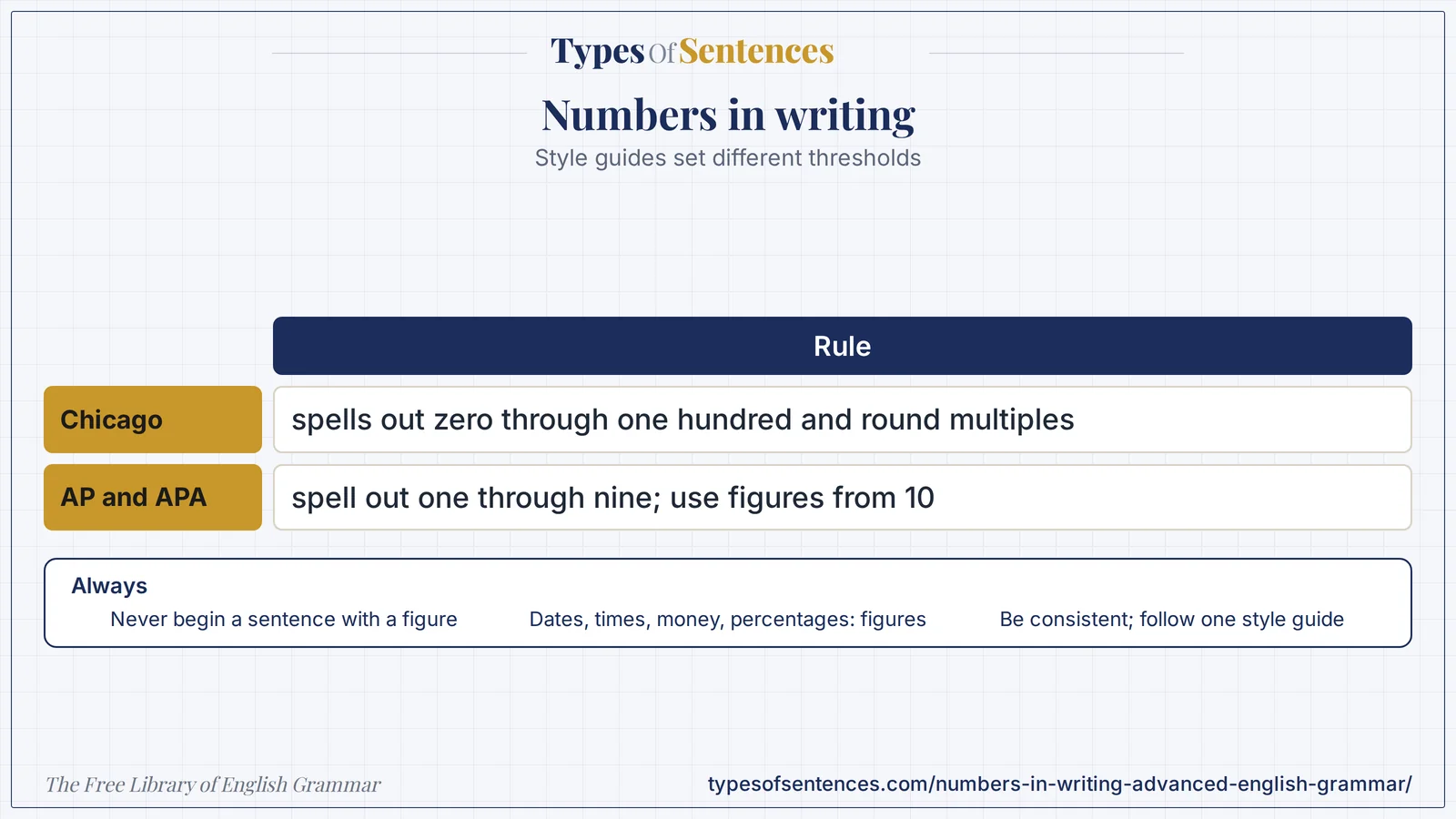
In ordinary text, write small numbers as words and bigger numbers as figures. The dividing line depends on the style guide: AP and APA spell out one through nine and use figures from 10; Chicago spells out up to one hundred. Always use figures for measurements, money, percentages, dates, and times when precision matters.
Why it matters: Never begin a sentence with a figure (rewrite it, or spell the number out), and be consistent: choose one style guide and follow it throughout.
Summary: Style guides set different thresholds. Chicago spells out zero through one hundred and round multiples of hundreds, thousands, and so on; AP and APA spell out one through nine and use figures from 10; MLA spells out numbers that can be written in one or two words. All use figures for measurements, percentages, money, dates, times, and statistics. A sentence should not begin with a figure (except for a year in AP style): spell out or recast. Large numbers combine figures with million or billion (5 million); Indian usage groups digits in lakhs and crores. Dates follow national order (day–month–year in India and the UK; month–day–year in the US; ISO year–month–day for data). Percentages use percent or the symbol according to the guide; ordinals are spelled out up to a limit and written with suffixes (1st, 2nd, 3rd, 4th) in figures. Within a group, numbers are written alike.
- Spell out small numbers; use figures for larger and precise ones.
- Never begin a sentence with a figure.
- Dates, times, money, percentages: figures.
- Be consistent; follow one style guide.
What You’ll Learn
- 1. Numbers in Writing: Basic Rules for Spelling Out Numbers
- 2. Beginning Sentences with Numbers: Spell Out or Rewrite
- 3. Large Numbers: Combinations and Readability
- 4. Dates and Times: Conventions
- 5. Percentages and Decimals: 25% or 25 Percent; 3.5
- 6. Ordinal Numbers: First, 1st
- 7. Style Guide Differences: Chicago, AP, APA, and MLA
- 8. Common Errors and a Worked Example
- 9. Exercises
- 10. Test Your Knowledge
- 11. Frequently Asked Questions
- 12. Conclusion
1. Numbers in Writing: Basic Rules for Spelling Out Numbers
| Style guide | Spell out | Use figures | Example |
|---|---|---|---|
| Chicago (humanities, general publishing) | zero through one hundred, and round multiples (two hundred, three thousand) | 101 and above, except round multiples | She has twelve cousins and 130 students. |
| AP (journalism) | one through nine | 10 and above | She has nine cousins and 12 students. |
| APA (psychology and social sciences) | zero through nine (with exceptions) | 10 and above | Nine participants; 12 participants. |
| MLA (literature and languages) | any number that can be written in one or two words | all others | twenty-five; one hundred; three thousand; 2,350 |
| most British newspapers (for example the Guardian, the Economist) | one through nine (Guardian) or one through ten (Economist) | 10 or 11 and above | — |
| most scientific journals | one through nine | 10 and above, and any number with a unit | 5 mg; 12 samples |
| legal and financial documents | often both in words and figures | — | thirty (30) days; INR five lakh (₹5,00,000) |
| Situation | Rule (common to most guides) | Example |
|---|---|---|
| numbers in a series or a comparison | use the same form for all numbers in the group (figures for all if any is a figure) | The class had 8 boys and 15 girls. (APA, AP: figures for both) |
| numbers that are adjacent in a sentence | spell out one and use figures for the other, or reword | twelve 6-foot poles; 12 six-foot poles |
| approximate numbers | spell out | about thirty people; roughly two hundred |
| exact measurements | figures with a unit | 5 kg; 12 cm; 3 hours |
| ages | Chicago spells out; AP uses figures | a five-year-old (Chicago); a 5-year-old (AP); she is 12 years old |
| money | figures, with the currency symbol | ₹500; $20; £5.50; 5 million dollars |
| scores and statistics | figures | a 3–1 victory; a mean of 4.2 |
| addresses and telephone numbers | figures | 221 Baker Street |
| page and chapter numbers | figures | page 12; Chapter 4 |
| time with a.m./p.m. | figures | 9 a.m.; 3:30 p.m. |
| time with o’clock | words | five o’clock |
| dates | figures for the day and year | 4 March 2024 |
| decades and centuries | Chicago: spell out centuries; figures for decades | the nineteenth century; the 1990s |
| fractions | spell out and hyphenate in prose | two-thirds; one-half |
| mixed numbers | figures | 3½; 2 1/2 |
| percentages | figures with percent or % | 25 percent; 25% |
| decimals | figures | 3.14; 0.5 |
| ratios | figures with a colon or words | a ratio of 3:1; three to one |
| numbers in a name or a title | as in the name | Fahrenheit 451; 7-Eleven |
| numbers with abbreviations | figures | 10 kg; 5 mph |
| numbers with symbols | figures | 25%; ₹500 |
| units of measurement in text | figures with a space and the unit symbol | 25 kg |
| room, floor, and house numbers | figures (floors: spelled out in prose) | room 204; the third floor |
| one as a pronoun or idiom | words | one of them; the one and only |
| numbers in dialogue | spelled out in fiction | “I’ve told you twenty times.” |
| number words in idioms | words | one in a million; a thousand thanks |
| hyphenation of compound numbers | hyphenate twenty-one through ninety-nine | forty-two |
| numbers used as nouns | words or figures | the number 7; the number seven |
| a number as a word | may be italic or quoted | the numeral 8 |
| numbers in tables | figures | — |
| numbers in headings | style-dependent | — |
| numbers in lists | figures for steps | 1. Open … |
| numbers in titles (headline case) | figures | 10 Ways to Write Better |
| units combined with figures | figures with the unit (symbols or words) | 5 kilometers; 5 km |
The thresholds differ because the guides were written for different readers: journalism favors the compact figure, and the humanities favor the word. A writer should adopt the guide required by the publication, and follow it throughout. The same principle applies to the typographic details of figures (separators, spacing, and alignment), which are treated in the chapter on typography and grammar.
2. Beginning Sentences with Numbers: Spell Out or Rewrite
| Problem | Poor | Better |
|---|---|---|
| a figure at the start | *25 students passed the test. | Twenty-five students passed the test. / The test was passed by 25 students. / Of the students, 25 passed. |
| a large figure at the start | *1,500 people attended. | Fifteen hundred people attended. / Attendance was 1,500. |
| a long spelled-out number | Two thousand three hundred and forty-five students enrolled. | Enrollment reached 2,345 students. |
| a year at the start | *2024 was a good year. | Twenty twenty-four was a good year. (Chicago); 2024 was a good year. (AP allows a year at the start) |
| a percentage at the start | *50% of the staff left. | Half of the staff left. / Fifty percent of the staff left. |
| a decimal at the start | *3.5 million people voted. | Three and a half million people voted. / Voters numbered 3.5 million. |
| a date at the start | *4 March was the deadline. | The deadline was 4 March. / March 4 was the deadline. |
| a number with a unit | *5 kg of rice is needed. | Five kilograms of rice are needed. / Rice weighing 5 kg is needed. |
| an abbreviation with a number | *3D printing … | Three-dimensional printing … / Printing in 3D … |
| a numbered list | — | figures are standard in lists |
| a number after a period inside a sentence | — | no problem |
| a compound number | *21 students … | Twenty-one students … |
| a number in dialogue | — | spell out |
| a title starting with a number | 1984 (the title is as published) | titles are as published |
- Spell out a number that begins a sentence, if it is short.
- Rewrite the sentence if the number is long or awkward.
- The exception is a year in AP style, and titles that begin with a figure.
- Do not put a figure and a number word together unless the style requires (thirty (30) days in legal drafting).
- Make the sentence start with a word that matters, not an incidental number.
3. Large Numbers: Combinations and Readability
| Convention | Example | Note |
|---|---|---|
| figures with million, billion, trillion | 5 million; 2.3 billion; $1.2 trillion | a figure plus a word is easier to read than a long figure |
| spell out million in running text | 3 million people | — |
| do not repeat the unit | *$5 million dollars | $5 million |
| round numbers | about three thousand; roughly 3,000 | spell out for approximate figures in humanities style |
| exact large numbers | 1,234,567 | use figures with separators |
| numbers in ranges | 5 to 10 million; 5–10 million | repeat the unit only if the ranges differ (₹5 lakh to 2 crore) |
| compound numbers (twenty-one to ninety-nine) | forty-two | hyphenate |
| hundreds and thousands in words | two hundred thirty-four; two hundred and thirty-four (British) | American style omits and in numbers |
| a thousand or one thousand | a thousand years; one thousand and one nights | — |
| abbreviations (informal) | 5k; 5M; 5B | use in tables or informal text |
| large numbers in tables | figures with separators; units in the heading | — |
| the Indian system (lakh and crore) | 1,00,000 (one lakh); 1,00,00,000 (one crore) | digits are grouped in threes from the right, and then in twos |
| the international system | 100,000; 10,000,000 | digits are grouped in threes |
| converting | 1 lakh = 100,000; 1 crore = 10 million | give both for international readers |
| billion | one thousand million (10⁹) in current American and British usage | the older British “long scale” billion (10¹²) is obsolete |
| lakh crore | 1,00,000 crore = 1 trillion | common in Indian finance reporting |
| a number and a noun as a modifier | a 5-million-dollar budget; a ₹5-crore project | hyphenate the compound modifier |
| space or no space in thousands | 1,000 (comma) or 1 000 (thin space, SI) | follow the style |
| years | 2024 (no comma) | — |
| decimals and thousands | 1,234.56 | — |
| scientific notation | 3.2 × 10⁸ | for very large and very small numbers |
| order of magnitude words | dozens, hundreds, thousands (not exact) | spell out |
| figures for populations and counts | 1.4 billion people | — |
| rounding | state the precision (about 1.4 billion) | — |
| units and prefixes | kilo-, mega-, giga- | 5 GB |
| currency | ₹5,00,000; Rs 5 lakh; INR 500,000 | follow the document’s convention |
| percentages of large numbers | a 12 percent rise to 3.4 million | — |
| too many digits | more than about seven digits in running text | use words and figures |
| mixing units | *5 lakh and 2.5 million | use one system |
| commas in numbers with four digits | 1,000 or 1000 | be consistent; many styles omit the comma in four-digit numbers in tables |
Numbers in business reports are discussed in the chapter on business writing, and numbers and decimals in scientific text in the chapter on scientific writing.
The Indian numbering system is standard in India and widely understood in South Asia, but readers elsewhere may not know that a lakh is 100,000 and a crore is 10 million. For an international readership, give both (₹5 crore, or about 50 million rupees) or use million and billion. Readability is the test: write large numbers in the form that the reader can take in at a glance.
4. Dates and Times: Conventions
| Format | Example | Used in |
|---|---|---|
| day month year | 4 March 2024 | India, the UK, much of the world |
| month day, year | March 4, 2024 | the United States |
| month day year (no comma, AP and some) | March 4, 2024 | — |
| ISO 8601 (year-month-day) | 2024-03-04 | data, computing, international standards |
| numeric, day first | 04/03/2024 | India, the UK; ambiguous to Americans (April 3) |
| numeric, month first | 03/04/2024 | the US; ambiguous elsewhere |
| month and year | March 2024 | — |
| full date with the day of the week | Monday, 4 March 2024 | — |
| dates in running text | on 4 March; on March 4 | — |
| ordinal numbers in dates | 4th March (British, older); March 4 (modern); AP does not use ordinals in dates | ordinals are said, not written, in modern style |
| years | 2024; the year 2024; in 2024 | — |
| year ranges | 2020–2024; 2020–24 (some styles) | use an en dash |
| fiscal years | FY2024–25; fiscal 2025 | follow the organization’s form |
| decades | the 1990s; the ’90s; the nineties | — |
| centuries | the twenty-first century (Chicago); the 21st century (AP) | — |
| eras | AD 2024; 500 BC; 500 BCE | AD before the year |
| months | spell out in formal text; abbreviate in tables (Jan.) | — |
| days of the week | spell out | — |
| times (12-hour) | 3 p.m.; 3:30 p.m. | a.m. and p.m. in lowercase with periods (American) |
| times (24-hour) | 15:30; 1530 (military) | transport, military, computing |
| noon and midnight | noon; midnight | avoid 12 a.m. and 12 p.m., which are ambiguous |
| o’clock | five o’clock | words; not with a.m. or p.m. |
| time zones | 3 p.m. IST; 3 p.m. Eastern | state the zone for international readers |
| durations | 2 hours 30 minutes; 2.5 hours; two and a half hours | — |
| time ranges | 9 a.m.–5 p.m.; 9 a.m. to 5 p.m. | — |
| dates and times together | 4 March 2024, 3:30 p.m. | — |
| all-day or recurring events | every Monday; daily | — |
| deadlines | by 5 p.m. on 4 March | state the zone |
| historical dates | c. 1500; 1500s | — |
| dates in headings | style-dependent | — |
| dates in legal documents | often with words: the fourth day of March, 2024 | — |
| dates on forms | dd/mm/yyyy (India) | — |
| dates in email | spell out the month to avoid confusion | — |
| Ambiguity of numeric dates | Reading in the US | Reading in India and the UK |
|---|---|---|
| 03/04/2024 | March 4, 2024 | 3 April 2024 |
| 04/03/2024 | April 3, 2024 | 4 March 2024 |
| 12/12/2024 | December 12, 2024 | 12 December 2024 (the same) |
| recommended solution | write the month in words, or use ISO format (2024-03-04) | the same |
The date and time formats of a document should fit its readers and be consistent. For international readers, spell out the month. The time words used in everyday speech are treated at the Basic level, and the style rules for dates in journalism are in the chapter on journalistic writing.
5. Percentages and Decimals: 25% or 25 Percent; 3.5
| Situation | Rule | Example |
|---|---|---|
| percent with a number | use figures with percent or %, according to the guide | 25 percent; 25% |
| Chicago | spell out percent in nonscientific prose; use % in scientific and tabular contexts | 25 percent; 25% (in a table) |
| AP | use figures with the % sign (since 2019 revisions) | 25% |
| APA | use the % symbol with numerals | 25% |
| percent with a spelled-out number | at the start of a sentence | Twenty-five percent of the staff left. |
| percentage (as a noun) | no number | A large percentage of students agreed. |
| percentage points versus percent | a rise from 10% to 15% is 5 percentage points, or 50 percent | state which you mean |
| range of percentages | 5 to 10 percent; 5–10% | — |
| no space before the % sign (most guides) | 25% | SI style uses a space |
| percentages in a series | use the same form | 5%, 10%, and 15% |
| decimals | a point, with a leading zero | 0.5; 3.14 |
| leading zero omitted (APA) | for values that cannot exceed 1 (correlations, probabilities) | p = .05; r = .32 |
| decimal places | be consistent in a table | 2.50, 3.00, 4.75 |
| decimals in text | figures | a mean of 3.5 |
| fractions in prose | spell out and hyphenate | two-thirds; three-quarters |
| fractions with a figure | a mixed number | 2½; 2 1/2 |
| half | words | half of the class |
| ratios | figures with a colon | 3:1 |
| ratios in words | three to one | — |
| odds | — | 5 to 1 |
| multiples | words or figures | twice as many; 3 times as many |
| interest rates and statistics | figures | an interest rate of 7.5% |
| rounding | state the precision | about 33 percent |
| a percentage change | figures | a 12% increase |
| in headlines | figures | Prices up 5% |
| percent versus per cent | American percent; British per cent | — |
| percentage or percent as a modifier | a 5-percent increase; a 5 percent increase | hyphenation varies |
| units with decimals | a space and the unit | 3.5 kg |
| money with decimals | figures | $3.50; ₹250.75 |
| thousands and decimals together | 1,234.56 (international); 1.234,56 (some European languages) | — |
| an approximate percent | about 25 percent; roughly a quarter | — |
The central points are the choice between percent and %, which depends on the guide, and the consistent use of decimals. A common error is to confuse a change in percentage points with a change in percent; the writer should be explicit about which is meant.
6. Ordinal Numbers: First, 1st
| Rule | Example | Note |
|---|---|---|
| spell out ordinals in running text up to a limit | first, second, third, … ninth (AP); … one hundredth (Chicago) | the same threshold as for cardinal numbers |
| use figures with suffixes for larger ordinals (AP: 10th and above) | 10th; 21st; 112th | — |
| suffixes: -st for numbers ending in 1 (except 11) | 1st, 21st, 31st, 101st | — |
| suffixes: -nd for numbers ending in 2 (except 12) | 2nd, 22nd, 102nd | — |
| suffixes: -rd for numbers ending in 3 (except 13) | 3rd, 23rd, 103rd | — |
| suffixes: -th for the rest and for 11, 12, 13 | 4th, 11th, 12th, 13th, 20th | — |
| superscript suffixes | 1st, 2nd | typographic option; not needed |
| ordinals in dates | March 4 (modern); the fourth of March (said) | avoid 4th in formal writing |
| centuries | the twenty-first century (Chicago); the 21st century (AP) | — |
| floors and streets | the third floor; Fifth Avenue; 42nd Street | — |
| anniversaries and birthdays | her fortieth birthday; the 50th anniversary | — |
| rank in sports | first place; 1st place (AP, in some contexts) | — |
| firstly, secondly | first, second, third (preferred) | the -ly forms are acceptable in British use |
| ordinals in lists | first, second, third, finally | — |
| the “nth” degree | a mathematical ordinal | — |
| ordinals as nouns | the first of the month | — |
| ordinals in names | Elizabeth II; Pope John Paul II; Louis XIV | Roman numerals |
| ordinals in a hyphenated compound | a second-floor flat; a third-year student | — |
| first to tenth in series | the first three examples | not the three first |
| one-hundredth, two-thousandth | hyphenate compound ordinals | — |
| fractions and ordinals | third is also a fraction | one-third |
| ordinal numbers in other languages | — | — |
| one versus first | Chapter One and the first chapter | — |
| ordinals in legal text | the first day of March | — |
| ordinals in rankings | top 10; the top ten | — |
| ordinals in dates in India | 5th March (common in Indian English) | — |
Ordinals follow the same logic as cardinals: spell out the small ones in text and use figures with suffixes for the larger ones. The suffix is the main trap: 11th, 12th, and 13th take -th, not -st, -nd, or -rd.
7. Style Guide Differences: Chicago, AP, APA, and MLA
| Point | Chicago | AP | APA | MLA |
|---|---|---|---|---|
| general threshold | zero to one hundred spelled out | one to nine spelled out | zero to nine spelled out | numbers expressible in one or two words spelled out |
| numbers at the start | spell out or rewrite | spell out (except years) | spell out | spell out |
| percentages | percent in prose; % in science | % | % | percent in prose; % in tables (typical) |
| ages | spell out (a five-year-old) | figures always (a 5-year-old) | figures (5-year-olds) | spell out |
| money | $5; five dollars; $5 million | $5; $5 million | $5; $5 million | $5; five dollars |
| dates | March 4, 2024 (US) | March 4, 2024 (no ordinals) | March 4, 2024 | 4 March 2024 or March 4, 2024 |
| time | 3 p.m.; three o’clock | 3 p.m. | 3:00 p.m.; 15:00 (24-hour) | 3 p.m. |
| centuries | twenty-first century | 21st century | 21st century or twenty-first century | twenty-first century |
| decades | 1990s | 1990s; ’90s | 1990s | 1990s |
| fractions | two-thirds | two-thirds | two-thirds | two-thirds |
| large numbers | 5 million; 5,000,000 | 5 million; 5,000,000 | 5 million; 5,000,000 | five million; 5,000,000 |
| ordinals | spell out to one hundredth | spell out to ninth; 10th and above | as for cardinals | spell out when one or two words |
| page ranges | en dash (10–20) | hyphen or to | en dash | en dash |
| numbers in a series | consistency within the category | figures for all if any is 10 or above | figures for all in a comparison group | consistency |
| numbers with units | figures (5 kg) | figures | figures | figures |
| hyphens in compounds | forty-two | forty-two | forty-two | forty-two |
| ranges | 5 to 10 or 5–10 | 5 to 10 | 5 to 10 or 5–10 | 5 to 10 |
| symbols | use words in prose | words in prose except % | symbols in text with numerals | words in prose |
| ratios | 3:1 | 3-1 or 3 to 1 | 3:1 | 3:1 |
| scientific notation | 3 × 10⁸ | — | 3 × 10⁸ | — |
| British and Indian conventions | Note |
|---|---|
| spelling out numbers | many British newspapers spell out one to nine (or ten); British book publishers often use Chicago-like rules |
| and in numbers | two hundred and forty is common in British and Indian speech; American style omits and |
| dates | day month year; ordinals such as 4th March are common in British and Indian English |
| currency | ₹500, Rs. 500, Rs 500, INR 500; pick one |
| lakh and crore | standard in India; explain for others |
| numeric separators | Indian grouping (1,00,000); international grouping (100,000) |
| telephone numbers | +91 80 1234 5678 |
| percent | per cent in British usage; percent in American |
| billion | one thousand million |
- Know which guide governs. Publications, institutions, and instructors specify one.
- Apply it consistently and keep a style sheet for numbers.
- Where no guide applies, choose the Chicago-style threshold for general prose, the AP threshold for news and web writing, and the APA threshold for scientific papers.
- Convert for the reader. International readers need clear units and dates.
- When guides disagree on an edge case, choose the clearest form.
8. Common Errors and a Worked Example
| Error | Example | Correction |
|---|---|---|
| figure at the start of a sentence | *100 people came. | One hundred people came. |
| inconsistent forms in a group | *She bought 3 apples and twelve pears. | She bought 3 apples and 12 pears. / three apples and twelve pears (Chicago) |
| repeating the unit | *$5 million dollars | $5 million |
| wrong ordinal suffix | *22th; *3th; *12nd | 22nd; 3rd; 12th |
| hyphen omitted in a compound number | *twenty one | twenty-one |
| ambiguous numeric date | *03/04/2024 | 4 March 2024 / 2024-03-04 |
| 12 a.m. for midnight | *the shop opens at 12 a.m. | the shop opens at midnight |
| o’clock with a.m. | *5 o’clock p.m. | 5 p.m. / five o’clock |
| percent without a number | *a 5 percentage | a 5 percent increase |
| percent confused with percentage points | *rose by 5% (from 10% to 15%) | rose by 5 percentage points (50 percent) |
| inconsistent percent form | *5 percent and 10% | 5 percent and 10 percent |
| spelling out figures with units | *five kg | 5 kg |
| figures for approximate numbers | *about 30 people (in Chicago style) | about thirty people |
| comma in a year | *2,024 | 2024 |
| mixing numbering systems | *5 lakh and 2.5 million | ₹5 lakh and ₹25 lakh |
| a series with different forms | *one, 2, three | one, two, three |
| a decimal without a leading zero | *.5 kg | 0.5 kg |
| a missing zero in a decimal table | 2.5, 3, 4.75 | 2.50, 3.00, 4.75 |
| and in an American number | *two hundred and forty | two hundred forty |
| ages without a hyphen | *a five year old child | a five-year-old child |
| wrong centuries | *the 1900s as a century | the twentieth century (1901–2000) or the 1900s as a decade |
Edit (style: Chicago, for a general readership): 25 students from the 3rd year attended on 03/04/2024 at 12 a.m. Of them, 5 percentage failed, and 10% passed with 3.5 GPA, up from 5 percent to 10 percent, a rise of 5%. The budget was $5 million dollars, i.e. five lakh and 2.5 million, and 22th place went to a five year old.
- 25 students: a figure starts the sentence: Twenty-five students.
- the 3rd year: the third year.
- 03/04/2024: ambiguous: 4 March 2024.
- 12 a.m.: midnight (or noon if that was meant).
- 5 percentage failed, and 10% passed: 5 percent failed, and 10 percent passed (consistent; Chicago uses percent in prose).
- 3.5 GPA: a 3.5 GPA (and the precision should be stated).
- up from 5 percent to 10 percent, a rise of 5%: a rise of 5 percentage points (or 100 percent).
- $5 million dollars: $5 million.
- five lakh and 2.5 million: mixed systems: ₹5 lakh and ₹25 lakh or about 500,000 and 2.5 million rupees.
- 22th: twenty-second.
- five year old: five-year-old.
- i.e.: unrelated: remove.
- Result: Twenty-five students from the third year attended on 4 March 2024 at midnight. Of them, 5 percent failed, and 10 percent passed with a 3.5 GPA, a rise of 5 percentage points. The budget was $5 million, and twenty-second place went to a five-year-old. (the passage is invented and the sentences are deliberately incoherent; the point is the corrections)
Recap in 12 seconds
Watch the lesson build itself: Number style depends on the style guide; never begin a sentence with a figure and be consistent. The video has no sound.
Exercises
Part A: Basic Rules (Exercises 1–7)
Exercise 1: Under AP style, spell out which numbers?
Show Answer
Answer: One through nine.
Exercise 2: Under Chicago style, spell out up to what?
Show Answer
Answer: One hundred (and round multiples).
Exercise 3: Spell out: 21.
Show Answer
Answer: twenty-one.
Exercise 4: Write in figures: forty-two kilograms.
Show Answer
Answer: 42 kg.
Exercise 5: Always figures for which kind of numbers?
Show Answer
Answer: Measurements, percentages, money, dates, times, statistics.
Exercise 6: Correct: *She bought 3 apples and twelve pears.
Show Answer
Answer: She bought 3 apples and 12 pears. (AP/APA)
Exercise 7: What is a good principle for numbers in a group?
Show Answer
Answer: Write them in the same form.
Part B: Sentence Starts and Large Numbers (Exercises 8–14)
Exercise 8: Rewrite: *50% of the staff left.
Show Answer
Answer: Half of the staff left. / Fifty percent of the staff left.
Exercise 9: Rewrite: *1,500 people attended.
Show Answer
Answer: Fifteen hundred people attended. / Attendance was 1,500.
Exercise 10: Correct: *$5 million dollars
Show Answer
Answer: $5 million.
Exercise 11: How many is a lakh?
Show Answer
Answer: 100,000.
Exercise 12: How many is a crore?
Show Answer
Answer: 10 million.
Exercise 13: Write 1,000,000 in the Indian system.
Show Answer
Answer: 10,00,000.
Exercise 14: Hyphenate: twenty one.
Show Answer
Answer: twenty-one.
Part C: Dates, Times, and Percentages (Exercises 15–21)
Exercise 15: Write 03/04/2024 unambiguously.
Show Answer
Answer: 4 March 2024 (or 2024-03-04).
Exercise 16: What is the ISO date format?
Show Answer
Answer: YYYY-MM-DD.
Exercise 17: Replace 12 a.m. for clarity.
Show Answer
Answer: midnight.
Exercise 18: Which style uses % in prose: Chicago or AP?
Show Answer
Answer: AP (Chicago spells out percent in nonscientific prose).
Exercise 19: A rise from 10% to 15% is how many percentage points?
Show Answer
Answer: 5 percentage points.
Exercise 20: Correct: *.5 kg
Show Answer
Answer: 0.5 kg.
Exercise 21: Spell out: 2/3 in prose.
Show Answer
Answer: two-thirds.
Part D: Ordinals and Styles (Exercises 22–27)
Exercise 22: Correct: *22th
Show Answer
Answer: 22nd.
Exercise 23: Correct: *12nd
Show Answer
Answer: 12th.
Exercise 24: Suffix for 13.
Show Answer
Answer: 13th.
Exercise 25: Century in Chicago style.
Show Answer
Answer: the twenty-first century.
Exercise 26: Century in AP style.
Show Answer
Answer: the 21st century.
Exercise 27: Which style spells out numbers expressible in one or two words?
Show Answer
Answer: MLA.
Part E: Editing (Exercises 28–30)
Exercise 28: Correct: *five year old child
Show Answer
Answer: five-year-old child.
Exercise 29: Correct: *5 o’clock p.m.
Show Answer
Answer: 5 p.m. (or five o’clock).
Exercise 30: Name two things a style sheet for numbers should record.
Show Answer
Answer: The threshold; the forms for dates, percentages, and money.
Test Your Knowledge
Ready to check what you learned? Answer all 10 questions, then submit. You need 80% (8 of 10) to pass. Your answers are not stored.
View correct answers and explanations
Question 1: In AP style, numbers below 10 are
✓ Correct Answer: A – spelled out
AP spells out one through nine.
Question 2: How should a sentence that begins with a number be written?
✓ Correct Answer: B – with the number spelled out, or rewritten
Spell out or rewrite.
Question 3: Which is correct?
✓ Correct Answer: C – twenty-one
Hyphenate compound numbers.
Question 4: What does the ISO 8601 date format look like?
✓ Correct Answer: D – 2024-03-04
Year-month-day.
Question 5: Which ordinal is correct?
✓ Correct Answer: C – 22nd
22nd.
Question 6: In Chicago style, percent in nonscientific prose is
✓ Correct Answer: A – spelled out
Spelled out.
Question 7: Which is the Indian way to write 1,000,000?
✓ Correct Answer: D – 10,00,000
Ten lakh.
Question 8: Which is best for 12 a.m. to avoid confusion?
✓ Correct Answer: C – midnight
Midnight.
Question 9: Which is a common rule for consistency in a group of numbers?
✓ Correct Answer: B – use the same form for the whole group
Same form.
Question 10: Which style spells out zero through one hundred in general text?
✓ Correct Answer: B – Chicago
Chicago.
Frequently Asked Questions
What are the rules for numbers in writing?
Spell out small numbers and use figures for larger and precise ones; the threshold depends on the style guide (Chicago: up to one hundred; AP and APA: up to nine). Numbers in writing should be consistent within a text.
What is spelling out numbers?
Spelling out numbers means writing them as words (seven) instead of figures (7). Spelling out numbers is the rule for small numbers in most styles and for numbers that begin a sentence.
What are the number rules for beginning a sentence?
Do not begin a sentence with a figure: spell the number out or rewrite the sentence. These number rules have an exception for years in AP style.
How are writing numbers different in India?
Indian usage groups digits in lakhs and crores (10,00,000) and uses the day–month–year order for dates; give both systems for international readers. Writing numbers for a global audience calls for clarity.
When do I use figures vs words?
Use words for small, approximate, and sentence-initial numbers; use figures for measurements, money, percentages, dates, times, statistics, and larger numbers. The choice of figures vs words depends on the style guide.
Percent or %?
Chicago uses percent in prose and % in scientific contexts; AP and APA use %. Follow your guide.
How do I write dates for an international readership?
Spell out the month (4 March 2024) or use the ISO format (2024-03-04), to avoid the ambiguity of 03/04/2024.
Conclusion
You now have a guide to numbers in writing: the basic rules, sentence-initial numbers, large numbers, dates and times, percentages and decimals, ordinals, and the differences among style guides. You can write numbers consistently and clearly.
When you write a number, ask which style governs and what the reader needs. Next, you will study title capitalization and headline grammar.
- The Chicago Manual of Style. University of Chicago Press. (check the current edition): the chapter on numbers.
- The Associated Press Stylebook. Associated Press. (updated regularly): numerals, percent, dates, and times.
- Publication Manual of the American Psychological Association. 7th ed. American Psychological Association, 2020.: numbers and statistics.
- MLA Handbook. 9th ed. Modern Language Association, 2021.: numbers in prose.
- Merriam-Webster Dictionary: numeral: the dictionary entry.
Last reviewed: October 29, 2026. How it was made: drafted with AI assistance, then checked with automated tests (structure, links, answer keys, spelling) and against the sources above. A person has not yet read this chapter line by line. Found a mistake? Report it.