Grammar in social media is the grammar of writing that behaves like speech: fast, public, informal, and shared among people who know the conventions. A post may be a fragment, a joke, a reaction, or a one-word reply; it may be written in lowercase on purpose, may contain an emoji where a period would be, and may use a spelling that is wrong by design. Yet it follows rules, and those rules differ by platform, by community, and by purpose. The writer who knows them can sound natural, be understood, and, if the account is a business, keep a consistent voice that readers trust.
This chapter explains social media grammar: the trends of informal, abbreviated, emoji-enhanced style; the effect of character limits (the grammar of the short post, often called Twitter grammar); hashtags, mentions, and tags; internet slang such as FOMO, TBT, and OOTD; memes and the grammar of intentional error; and the contrast between professional and personal voice and between the conventions of platforms (Facebook grammar, Instagram grammar, LinkedIn, and others). The principle is that social media is informal but strategic: every choice of wording is a choice about audience and effect. Platform features and limits change often, so the details below should be checked against the current platform. Thirty exercises and a quiz follow.
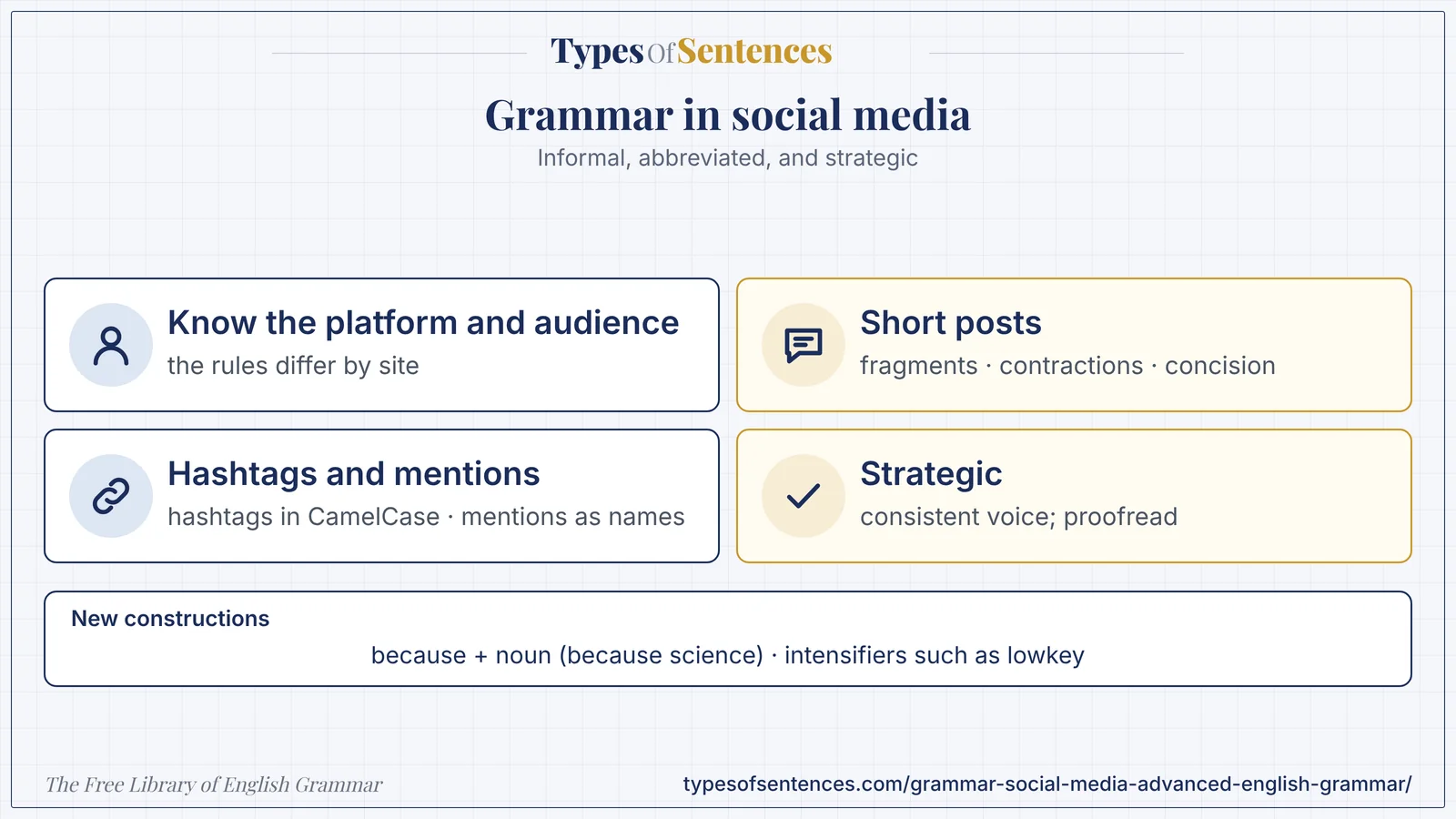
Posting is writing in public, so even informal posts are judged by their style. A personal post can be loose, with lowercase, emoji, and slang, if your readers share the code. A business or professional post needs consistent, clear, and correct language, because readers treat it as the voice of the organization.
Why it matters: The best habit is to know the platform, know your audience, keep the message short, and read the post once before you send it.
Summary: Social media style is informal, abbreviated, and emoji-enhanced; it has produced constructions such as because + noun (because science), intensifiers such as lowkey, and tone markers such as /s. Character limits encourage fragments, contractions, symbols, and the omission of articles. Hashtags use CamelCase for readability and accessibility; mentions use @username and follow the grammar of names. Internet slang (FOMO, TBT, OOTD, IRL, ICYMI) is informal and ages quickly. Memes use intentional errors and fixed templates (I can has cheezburger?; much wow). Platforms differ: short and timely on Twitter or X, conversational on Facebook, caption-plus-hashtags on Instagram, professional first person on LinkedIn. Brand accounts need a consistent voice and careful proofreading, since errors are public and spread. Informal does not mean careless: the writer chooses the style.
- Know the platform and audience.
- Short posts: fragments, contractions, concision.
- Hashtags in CamelCase; mentions as names.
- Informal but strategic: consistent voice; proofread.
What You’ll Learn
- 1. Grammar in Social Media: Trends in Informal, Abbreviated, Emoji-Enhanced Style
- 2. Character Limits: Twitter Grammar and Conciseness
- 3. Hashtag Grammar: Creating Effective Hashtags
- 4. Mentions and Tags: @username Grammar
- 5. Internet Slang: FOMO, TBT, OOTD, and Their Status
- 6. Memes and Viral Grammar: Intentional Errors and Templates
- 7. Professional vs Personal: Brand Voice and Consistency
- 8. Common Errors and a Worked Example
- 9. Exercises
- 10. Test Your Knowledge
- 11. Frequently Asked Questions
- 12. Conclusion
1. Grammar in Social Media: Trends in Informal, Abbreviated, Emoji-Enhanced Style
| Trend | Example (invented) | Note |
|---|---|---|
| lowercase as a style | just landed. tired but happy. | a deliberate casual aesthetic; capitals may return in serious posts |
| minimal or no end punctuation | best day ever | the line break replaces the period |
| periods for tone | ok. fine. | a period can signal seriousness or irritation |
| exclamation marks for warmth | So excited!! | several marks intensify |
| ellipsis for trailing off | well … we will see | hesitation or suspense |
| stretched words | soooo good; noooo | emphasis |
| all capitals for emphasis | I LOVE this | can read as shouting; also used playfully |
| alternating or random capitals (mocking tone) | sUrE tHaT’s hOw iT wOrKs | a mocking voice; avoid in professional writing |
| abbreviations | tbh, idk, imo, rn | — |
| emoji replacing words or punctuation | see you soon 🙂 | see the chapter on email and digital communication |
| hashtags inside sentences | Loving this #sunset | — |
| sentence fragments | On my way. Late again. | — |
| dropped subjects | Going now. Loved it. | — |
| dropped auxiliaries | You coming? | — |
| because + noun or adjective | because science; because reasons; because tired | because used like a preposition; the American Dialect Society chose because as its 2013 Word of the Year for this use |
| slash as a conjunction | tired slash hungry | — |
| intensifiers lowkey and highkey | lowkey obsessed with this song | adverbs of degree |
| af and asf after an adjective | tired af | an intensifier from an abbreviation of an expletive phrase; informal |
| so as an intensifier with a noun | so over it; so done | — |
| literally as an intensifier | literally dying | see the chapter on grammar myths |
| I can’t even | I can’t even | a truncated structure used for overwhelm |
| this alone as a reaction | This. | — |
| same and mood as replies | Same. Mood. | — |
| that moment when | that moment when your tea is perfect | a template |
| me when and me: | me when it rains | a meme template; see below |
| no cap; cap | no cap, best pizza | slang for “no lie”; ages quickly |
| -core and -vibes | cottagecore | productive suffixes for aesthetics |
| stan as a verb or noun | I stan this band | slang |
| tone indicators (/s, /j) | great idea /s | mark sarcasm or a joke in text |
| ratio | — | a platform-specific term |
| quotation of one’s own thought in a tweet | “why am I like this” | — |
| speech-like fillers | like, honestly, ok so | — |
| regionally marked slang | — | varies by community |
| multi-language mixing | a post mixing English and a local language | code-mixing is common among bilingual users |
| repetition for emphasis | very very very good | — |
| emoji strings | 🙂🙂🙂 | — |
| screen-reader effects | many emoji or all-caps words can be tiresome to listen to | accessibility |
| threads and numbering | 1/5, 2/5 | — |
| reply chains | @name and the reply | — |
| informal address | hey, y’all, folks | — |
| typo tolerance | tolerated in casual posts | less so for brands |
The informality of social media has been described as a new written register that borrows the features of speech, as the chapters on email and digital communication and technology and grammar discuss. It is a register, not a failure of grammar, and writers move into and out of it by choice. The wider study of how new forms spread is in the chapter on language change in modern English.
2. Character Limits: Twitter Grammar and Conciseness
Some platforms limit the length of a post. Twitter (now X) long limited posts to 140 characters and raised the limit to 280 characters in 2017; paid accounts on some platforms may be allowed longer posts. Other platforms allow much longer text but show only the first lines before a “see more” link. Limits change, so check the current rules. The effect on grammar is constant: short posts reward concision.
| Technique | Before | After |
|---|---|---|
| drop articles and auxiliaries | The meeting is at the library at noon. | Meeting at the library, noon. |
| use contractions | We are going to launch it and we will not delay. | We’re launching it. No delays. |
| use fragments | This is a very important announcement for all. | Big announcement for everyone. |
| use symbols | Tea and coffee with milk. | Tea & coffee w/ milk. |
| use figures | Five people attended. | 5 people attended. |
| use abbreviations that readers know | as soon as possible | ASAP |
| cut filler | In order to apply, you should send us an email. | To apply, email us. |
| cut hedges | We think that it might perhaps be useful. | This may help. |
| use the active voice | The report was published by us. | We published the report. |
| use strong verbs | We made a decision to move. | We decided to move. |
| replace phrases with single words | at this point in time | now |
| use numerals and symbols for time | half past six in the evening | 6:30 p.m. |
| shorten links | a long URL | a short link or a descriptive anchor |
| use hashtags for topics | — | #Pune |
| put the key word first | Tonight we will hold a concert. | Concert tonight. |
| use a thread for longer ideas | one long post | 1/3 … 2/3 … 3/3 |
| use a list of short lines | — | Fresh. Local. Fast. |
| cut repeated words | very very big | huge |
| cut adverbs | really quickly | fast |
| use a colon for attribution | He said that the plan would proceed. | Minister: plan will proceed. |
| cut “that” | He said that he would come. | He said he’d come. |
| merge sentences | We opened. We were busy. | We opened and got busy. |
| use ampersands and plus signs | — | Q&A; 4+ years |
| use a question | — | Free Saturday? |
| use direct address | — | You can join us. |
| use present tense for news | — | Council approves plan. |
| avoid abbreviations that confuse | — | write the full word if readers may not know it |
| replace long words | utilize | use |
| cut “there is” and “it is” | There is a new post on our site. | New post on our site. |
| cut “in order to” | — | to |
| cut “the fact that” | Despite the fact that it rained … | Though it rained … |
| count characters | — | check the limit before posting |
| keep the hook at the start | — | the first line is shown before “see more” |
| keep meaning intact | do not sacrifice clarity for brevity | — |
| Platform (limits change; check the current rules) | Typical length and style |
|---|---|
| X (formerly Twitter) | short posts (280 characters for standard accounts at the time of writing); quick, timely, conversational; threads for longer points |
| long posts are allowed; a conversational tone; the first lines matter because of the “see more” cut | |
| a caption beside an image or video, with a character limit and hashtags; the first line is shown before truncation | |
| professional posts with a limit of a few thousand characters; first person; line breaks for readability | |
| YouTube | titles and descriptions with limits; titles are headlines |
| TikTok and short-video platforms | on-screen text and captions are short; spoken grammar in the video |
| WhatsApp and messaging apps | informal chat; broadcast messages are short |
| forums and community sites | longer text; titles matter |
| blogs and newsletters | longer text; headlines and subheadings |
The grammar of the short post is the grammar of the headline: present tense, omitted articles, strong verbs, and a clear subject, as described in the chapter on title capitalization and headline grammar. A short post must still be clear: if cutting words makes the meaning ambiguous, restore them.
3. Hashtag Grammar: Creating Effective Hashtags
| Guideline | Example | Note |
|---|---|---|
| one string, no spaces | #GrammarMatters | spaces end the tag |
| CamelCase | #SundayReading | readable for people and screen readers |
| no punctuation inside | #DontPanic | apostrophes and hyphens end the tag |
| digits allowed | #Grammar101 | not only digits |
| keep it short | #TeaTime | easy to type and remember |
| check the lowercase reading | #NowThatchersDead (2013) was widely read as “Now That’s Cher’s Dead” | ambiguous splits cause embarrassment |
| one meaning | one idea per tag | — |
| search before using | check existing use | — |
| use a few, relevant tags | three to five is common on many platforms; follow current norms | — |
| place at the end, or one or two in the sentence | Loving this #sunset | — |
| branded tags | #YourBrandName | follow the brand’s capitalization |
| campaign tags | a short, unique phrase | — |
| event tags | #PuneBookFair | include place or year if needed |
| avoid hijacking trending tags for unrelated promotion | — | often seen as spam |
| accessibility | CamelCase; tags at the end | — |
| hashtags as nouns and verbs | a trending hashtag; to hashtag a post | — |
| plural and possessive | #Books; #Priya’s is not a single tag | a hashtag is one word-string |
| numbers and years | #Election2025 | — |
| acronyms in tags | #NASA or #Nasa | consistent form |
| non-Latin scripts | supported on many platforms | — |
| punctuation after a tag | Love this #grammar! | the mark follows the tag |
| avoid over-long tags | #ThisIsAVeryLongHashtagNobodyWillRead | hard to read |
| grammar of tags in speech | say the words; the “hash” sound is optional | — |
| tag order | most specific first | — |
The rules of hashtag creation were introduced in the chapter on grammar and technology; the point here is strategy: a hashtag is a label that lets strangers find a post, so it should be short, readable, and unambiguous.
4. Mentions and Tags: @username Grammar
| Convention | Example | Note |
|---|---|---|
| mention a person or an organization | Thanks @priya_nair for the idea! | the handle works like a proper noun |
| mention at the start of a reply | @priya_nair Great point. | the reply is directed to the person |
| mention inside a sentence | I met @priya_nair at the fair. | the handle is a noun phrase |
| possessive | @priya_nair’s post | add ’s after the handle |
| plural reference | @priya_nair and @raj_k | two mentions |
| tag in an image | a tagged person | the platform notifies the person |
| do not tag without a reason | — | tagging people who are not involved can be seen as spam |
| respect privacy | ask before tagging a person in a private context | — |
| cc and via | via @name | credit or copy |
| h/t (hat tip) | h/t @name | credit for a find |
| RT and QT | RT @name: … | share and quote post conventions vary by platform |
| OP | original poster | — |
| DM me | Send me a DM. | direct message as a noun or a verb |
| @here, @everyone in chat tools | — | alerts a group |
| handle formatting | as displayed; case rarely matters | — |
| display name versus handle | Priya Nair (@priya_nair) | — |
| mentions of organizations | @OrgName announced … | — |
| use of the name without the @ for general reference | Priya said … | — |
| punctuation after a handle | Thanks, @priya_nair! | — |
| mentions of someone who is not on the platform | use the name | — |
| mention etiquette in disputes | avoid piling on; moderate tone | — |
| mentions of customers by brands | respond publicly with care | — |
| mentions for credit | Photo by @name | — |
| mentions for collaboration | with @name | — |
| mention limits per post | platform-specific | — |
| mention as a verb | to @ someone | informal |
5. Internet Slang: FOMO, TBT, OOTD, and Their Status
| Term | Meaning | Notes on grammar and use |
|---|---|---|
| FOMO | fear of missing out | a noun; also JOMO (joy of missing out) |
| TBT | throwback Thursday | a hashtag for posting an old photo |
| FBF | flashback Friday | a similar tag |
| OOTD | outfit of the day | a caption label |
| MCM; WCW | man crush Monday; woman crush Wednesday | tags (the phrases are informal and often ironic) |
| POV | point of view | used as a template: POV: you’re late |
| IYKYK | if you know, you know | an insider phrase |
| GOAT | greatest of all time | a noun |
| NGL | not gonna lie | a sentence adverbial |
| ICYMI | in case you missed it | a label |
| TMI | too much information | a reaction |
| FTW | for the win | an approving tag |
| SMH | shaking my head | a reaction |
| IRL | in real life | an adverbial |
| AMA | ask me anything | a label for a Q&A |
| ELI5 | explain like I’m five | an imperative label |
| TL;DR | too long; didn’t read | a summary label |
| FYI | for your information | neutral |
| DM; PM | direct message; private message | noun and verb |
| IG; FB | abbreviations of platform names | informal |
| bio | the profile description | clipping of biography |
| story | a short-lived post | a platform feature |
| reel; short | a short video | platform terms |
| feed | the stream of posts | — |
| handle | a username | — |
| follower; follow; unfollow | relations on a platform | verbs and nouns |
| like; share; repost | reactions | verbs and nouns |
| trending | widely discussed at the moment | adjective or participle |
| viral | spreading widely | adjective |
| influencer | a person with a social following | noun |
| collab | collaboration | clipping |
| sus | suspicious | clipping |
| slay | to do something very well | verb used as praise |
| vibe check | — | a phrase |
| ratio’d | replies outnumber likes (on some platforms) | a verb from a noun |
| doomscrolling | continuous reading of bad news | compound |
| ghosting | ending contact without explanation | verb |
| cancel; canceled | public withdrawal of support | verb and participle |
| clapback | a sharp reply | compound |
| stan | an obsessive fan | — |
| thirst trap | — | a phrase |
| flex | to show off | verb |
| lit | exciting | adjective |
| salty | bitter or upset | adjective |
| shade | subtle insult | noun |
| tea; spill the tea | gossip | noun and idiom |
| receipts | evidence | noun |
| hot take | a provocative opinion | compound |
| mute; block | controls | verbs |
| lurk | read without posting | verb |
| bestie; BFF | best friend | — |
| bae | — | a term of endearment |
| rizz | charm | clipping of charisma |
- Slang ages quickly. A term that is current this year may sound dated next year, and one that is used in one community may mean something else in another.
- Check before you use it. Using slang you do not know can embarrass an individual or a brand.
- Do not force slang on a professional account; readers notice.
- Some terms are in dictionaries (selfie, hashtag, FOMO in some), but dictionary entry does not make a term formal.
- Spell out an abbreviation when the audience may not know it.
6. Memes and Viral Grammar: Intentional Errors and Templates
| Meme grammar feature | Example | Explanation |
|---|---|---|
| lolspeak (the “lolcat” style) | I can has cheezburger? | intentional nonstandard grammar and spelling in captions on cat pictures, popular from about 2007 |
| “doge” style | such wow; much grammar; very language | a pattern of such/much/very + noun and short fragments in a mock inner voice, popular from about 2013 |
| intentional misspelling | teh; pwned; definately (mock) | — |
| wrong agreement for effect | this is bad news bears | — |
| template with a fixed frame | nobody: … / me: … | the frame supplies the grammar; the writer fills the slots |
| me when | me when the tea is ready | — |
| the way I | the way I just stared at the wall | — |
| no thoughts, head empty | — | a stock phrase for a blank mind |
| it’s giving | it’s giving hot tea energy | a recent slang frame; may be dated by the time you read this |
| repetition for comedy | tea tea tea tea | — |
| mixing registers for contrast | a formal sentence with slang | — |
| overly formal diction as a joke | one must simply endeavor to snack | — |
| ironic capitalization | The Most Important Meeting Of My Life | — |
| all caps and punctuation as voice | WHY. IS. IT. LIKE. THIS. | — |
| captioned images and text over pictures | — | the text is short and often in a bold font |
| “expectation vs reality” | expectation: neat tea; reality: spilled tea | a parallel structure |
| nobody: as a setup | nobody: … me: | an absence marker |
| quotative be like | and I’m like, no way | spoken grammar in text |
| alternate spellings for dialect imitation | — | can caricature; see the note below |
| mock errors as an in-group sign | — | the error signals that the writer knows the standard |
| multilingual memes | English with local phrases | — |
| the “Karen” and similar type labels | — | labels for types of people; consider whether they are fair |
| grammar jokes | Let’s eat, Grandma! | — |
| correction culture | people correct the grammar in comments | tone varies |
- Intentional errors are a skill. A writer who deliberately uses teh knows the standard spelling; the humor depends on the shared knowledge.
- Do not mock real dialects. Some memes imitate features of real varieties of English; imitation without understanding can become caricature (see the chapter on global Englishes).
- Templates change fast. A template that is fresh this month may feel stale next month.
- Know the origin. Some meme phrases carry meanings that you may not intend.
- Respect copyright and people’s images. Do not post others’ photographs without permission.
- For brands, using a meme without understanding it is a common mistake; check the meaning and the audience.
7. Professional vs Personal: Brand Voice and Consistency
| Dimension | Personal account | Professional or brand account |
|---|---|---|
| formality | informal; lowercase, slang, emoji acceptable | plain, correct, and consistent; informal touches that suit the brand |
| grammar and spelling | errors tolerated | errors damage trust; proofread |
| tone | the writer’s own | the brand’s voice, defined in a style guide |
| person | first person (I) | first person plural (we) or second person (you) |
| humor | personal | chosen with care; consistent with the brand |
| slang | as the writer likes | used only if natural to the brand and the audience |
| emoji | as the writer likes | a few that suit the brand |
| hashtags | personal tags | branded and campaign tags; relevant tags |
| responses | as one wishes | timely, polite, and in the brand voice |
| corrections | delete or edit | a visible correction where the error matters |
| disclosures | not usually required | required for sponsored content (#ad, “sponsored”); see the chapter on advertising |
| legal exposure | low | higher (claims, endorsements, privacy) |
| consistency | not required | required across posts and platforms |
| accessibility | a courtesy | a standard (alt text, captions, CamelCase) |
| crisis communication | — | measured, clear, and responsible |
| approval process | none | a review or approval step for important posts |
| audience | friends and followers | customers, clients, the public |
| goals | self-expression | awareness, trust, response, and sales |
| content planning | spontaneous | planned calendar with room for timely posts |
| language choices | any | consistent with an agreed style guide |
| multilingual use | as the writer likes | plan the languages and keep the translations accurate |
| humor about sensitive topics | — | avoid |
| responding to criticism | — | calm, factual, and prompt |
| responding to errors in comments | — | do not argue about grammar; ignore or reply kindly |
| monitoring slang | — | check meanings before use |
| voice drift | — | periodic review of posts |
| a style sheet for social posts | — | record decisions on capitals, emoji, hashtags, and abbreviations |
| Platform (check current features) | Grammar and tone tendencies |
|---|---|
| X (Twitter) | concise; timely; conversational; fragments and mentions; threads for longer points |
| conversational; community-oriented; longer posts and comments; informal but complete sentences are common | |
| visual-first; short captions; hashtags and emoji; alt text; first line matters | |
| professional; first-person stories and insights; line breaks; a measured tone; business vocabulary | |
| YouTube | titles as headlines; descriptions with keywords; spoken grammar in video |
| short-video platforms | on-screen text and captions; trends and templates |
| messaging apps and channels | informal; short; personal |
| forums and community sites | topic-focused; clear titles; norms set by the community |
| Brand voice checklist | Question |
|---|---|
| Who are we? | a few adjectives for the voice (for example warm, plain, curious) |
| Who are we talking to? | the audience |
| What do we always do? | habits (use you; plain words) |
| What do we never do? | avoid slang that does not fit; avoid shouting |
| How formal are we? | a position on the scale |
| How do we handle errors and complaints? | a policy |
| How do we write numbers, dates, and hashtags? | conventions |
| Who reviews the posts? | a person or a process |
The skill is to use the informality that the platform invites without losing the clarity and credibility that a professional voice needs. The principles of tone and voice are discussed in the chapter on tone and voice in writing, and the techniques of writing for the web in the chapter on writing for digital media.
8. Common Errors and a Worked Example
| Error | Example | Correction |
|---|---|---|
| typo in a brand post | *Our new tea is hear! | Our new tea is here! |
| wrong homophone | *your the best | you’re the best |
| greengrocer’s apostrophe | *Fresh sandwich’s today | Fresh sandwiches today |
| lowercase hashtag with an ambiguous reading | *#susanalbumparty | #SusanAlbumParty |
| hashtag with spaces or punctuation | *#grammar matters; #don’t | #GrammarMatters; #DontPanic |
| too many hashtags | a post with fifteen tags | three to five relevant tags |
| all-caps post for a serious message | *IMPORTANT NOTICE: OFFICE CLOSED | Important notice: office closed. |
| slang misused | a brand using a term incorrectly | check the meaning |
| unclear abbreviation | *Pls DM ASAP re SLA | Please send us a direct message about your issue. |
| tagging the wrong person | *@priya (the wrong account) | check the handle |
| a handle at the start of a post that hides it (platform-specific) | — | check the platform’s rules |
| mismatched voice | a casual joke in a crisis post | a calm, clear tone |
| unlabeled sponsored post | *Love this product! (paid) | Love this product! #ad (clear disclosure) |
| a claim that is untrue | *the best in India | a substantiated statement |
| not checking the first line | a post whose first line is cut off | put the hook first |
| arguing about grammar in replies | — | ignore or reply kindly |
| copying a meme without understanding | — | check the meaning |
| unreadable text in images (no alt text) | — | add alt text |
| using emoji as the only message | — | add words |
| broken link or tag | — | test before posting |
| inconsistent hashtag form | #Pune #pune | one form |
| an error corrected silently where it matters | — | add a correction note |
| dated slang | — | refresh |
| over-punctuation | *Wow!!!!!! | Wow! |
| wrong number or date | *Tuesday 4 March (it is a Monday) | check the calendar |
| no proofreading | — | read aloud and check before posting |
Edit this post for a small tea brand (invented): OMG!!! our new tea’s are HERE n u will luv them!!! Best tea in all of India, no cap. Order NOW pls DM ASAP #newteasarrive #teatime #bestteaindia #chai #tea #teatea #drink #yum #grammar matters
- OMG!!! … HERE: shouting and too many exclamation marks: Our new teas are here!
- tea’s: apostrophe in a plural: teas.
- n u will luv them: texting forms (fine for a personal account, but they do not fit the brand voice): and you will love them.
- Best tea in all of India, no cap: an unprovable claim and a dated slang tag: Hand-picked leaves from the hills of Coorg. (a checkable fact; the brand and place are invented).
- Order NOW pls DM ASAP: capitals and abbreviations; a clear action is needed: Order today, or send us a message.
- #newteasarrive: an unreadable string: #NewTeaArrival.
- #teatime #bestteaindia #chai #tea #teatea #drink #yum: too many, repetitive, and one unsubstantiated: keep #TeaTime #Chai.
- #grammar matters: a broken hashtag: omit, or use #GrammarMatters if relevant.
- Result: Our new teas are here! Hand-picked leaves from the hills of Coorg. Order today, or send us a message. #NewTeaArrival #TeaTime #Chai (the post is invented)
- Notes: the revision keeps the warmth (the exclamation mark, the direct address) and drops the claim, the slang, and the clutter.
Recap in 12 seconds
Watch the lesson build itself: Social media style is informal and abbreviated, yet strategic: know the platform, keep one voice, and proofread. The video has no sound.
Exercises
Part A: Trends (Exercises 1–6)
Exercise 1: Name a feature of social media style.
Show Answer
Answer: Informal, abbreviated, emoji-enhanced; fragments; lowercase.
Exercise 2: What is the new use of because in because science?
Show Answer
Answer: Because used with a noun, like a preposition.
Exercise 3: What do lowkey and highkey do?
Show Answer
Answer: They act as intensifiers or hedges.
Exercise 4: What does /s mark?
Show Answer
Answer: Sarcasm.
Exercise 5: Why can a final period be a tone signal?
Show Answer
Answer: It can read as serious or curt.
Exercise 6: Is social media style a failure of grammar?
Show Answer
Answer: No; it is a register.
Part B: Character Limits and Hashtags (Exercises 7–14)
Exercise 7: Shorten: The meeting is at the library at noon.
Show Answer
Answer: Meeting at the library, noon.
Exercise 8: Shorten: In order to apply, you should send us an email.
Show Answer
Answer: To apply, email us.
Exercise 9: What is the current standard post limit on X for standard accounts (at the time of writing)?
Show Answer
Answer: 280 characters.
Exercise 10: Rewrite: #grammar matters
Show Answer
Answer: #GrammarMatters.
Exercise 11: Why avoid ambiguous hashtags?
Show Answer
Answer: They can be read in unintended ways.
Exercise 12: How many hashtags are common on many platforms?
Show Answer
Answer: A few (about three to five).
Exercise 13: Why put the hook first?
Show Answer
Answer: Platforms show only the first lines before “see more.”
Exercise 14: Define a thread.
Show Answer
Answer: A series of numbered, connected posts.
Part C: Mentions and Slang (Exercises 15–21)
Exercise 15: Possessive of @priya_nair.
Show Answer
Answer: @priya_nair’s post.
Exercise 16: What does h/t mean?
Show Answer
Answer: Hat tip: credit for a find.
Exercise 17: What does TBT stand for?
Show Answer
Answer: Throwback Thursday.
Exercise 18: What does OOTD mean?
Show Answer
Answer: Outfit of the day.
Exercise 19: What does FOMO mean?
Show Answer
Answer: Fear of missing out.
Exercise 20: What does ICYMI mean?
Show Answer
Answer: In case you missed it.
Exercise 21: Why check slang before using it?
Show Answer
Answer: It ages quickly and may mean different things in different communities.
Part D: Memes and Voice (Exercises 22–27)
Exercise 22: What is lolspeak?
Show Answer
Answer: Intentional nonstandard grammar and spelling in lolcat captions (I can has cheezburger?).
Exercise 23: What is doge-style grammar?
Show Answer
Answer: Such/much/very + noun and short fragments (such wow).
Exercise 24: Name a meme template frame.
Show Answer
Answer: nobody: … me: …; me when ….
Exercise 25: Why is a brand’s voice kept consistent?
Show Answer
Answer: Readers recognize and trust it.
Exercise 26: What must be disclosed in sponsored posts?
Show Answer
Answer: The paid relationship (#ad or similar).
Exercise 27: Name a difference between personal and brand accounts.
Show Answer
Answer: Brand accounts need proofreading, consistency, and disclosures.
Part E: Editing (Exercises 28–30)
Exercise 28: Correct: *Fresh sandwich’s today
Show Answer
Answer: Fresh sandwiches today.
Exercise 29: Correct: *your the best
Show Answer
Answer: you’re the best.
Exercise 30: Replace for a brand: OMG!!! our new tea’s are HERE!!!
Show Answer
Answer: Our new teas are here!
Test Your Knowledge
Ready to check what you learned? Answer all 10 questions, then submit. You need 80% (8 of 10) to pass. Your answers are not stored.
View correct answers and explanations
Question 1: Which platform feature commonly shapes tweet grammar?
✓ Correct Answer: A – a character limit
The character limit.
Question 2: What does TBT stand for?
✓ Correct Answer: B – throwback Thursday
Throwback Thursday.
Question 3: What does OOTD mean?
✓ Correct Answer: C – outfit of the day
Outfit of the day.
Question 4: Why is CamelCase recommended in hashtags?
✓ Correct Answer: D – it aids readability and screen readers
Readability and accessibility.
Question 5: What is the grammatical novelty in because science?
✓ Correct Answer: C – because used with a noun like a preposition
A new use of because.
Question 6: What does /s often mark?
✓ Correct Answer: A – sarcasm
Sarcasm.
Question 7: The I can has cheezburger style is associated with
✓ Correct Answer: D – lolcat memes with intentional errors
Lolspeak.
Question 8: Which is a good practice for a brand account?
✓ Correct Answer: C – keep a consistent voice and proofread
Consistency and proofreading.
Question 9: What does h/t mean?
✓ Correct Answer: B – hat tip (credit)
Hat tip.
Question 10: Why proofread social media posts?
✓ Correct Answer: B – errors are public and can spread
Errors are public.
Frequently Asked Questions
What is grammar in social media?
Grammar in social media is the set of conventions and habits of writing on social platforms: informal, abbreviated, emoji-enhanced style, hashtags, mentions, and slang. Grammar in social media varies by platform and audience.
What is social media grammar?
Social media grammar is the style of grammar used online, which borrows from speech and creates new forms such as because science. Social media grammar is a register, not an absence of rules.
What is Twitter grammar?
Twitter grammar is the compressed grammar of short posts: fragments, contractions, omitted articles, and symbols. Twitter grammar rewards concision under a character limit, and the limit has changed over time.
What is Facebook grammar?
Facebook grammar is the conversational, relatively longer style of Facebook posts and comments, usually informal but in complete sentences. Facebook grammar suits community and personal sharing.
What is Instagram grammar?
Instagram grammar is the caption-and-hashtag style of Instagram posts: short first lines, hashtags, emoji, and alt text. Instagram grammar supports visual content.
Should businesses use slang on social media?
Only if it fits the brand voice and the audience and its meaning is certain. Brand accounts should prioritize clarity, consistency, and proofreading.
Why do memes use intentional errors?
Intentional errors signal humor and in-group knowledge; the effect depends on the shared knowledge of the standard form.
Conclusion
You now have a study of grammar in social media: the trends of informal style, the grammar of short posts, hashtags, mentions, slang, memes, platform differences, and brand voice. You can write posts that suit the platform, the audience, and the purpose.
Before you post, ask who will read it, what voice it should have, and whether it is clear and correct. Next, you will study plain language and accessibility.
- McCulloch, Gretchen. Because Internet: Understanding the New Rules of Language. Riverhead Books, 2019.: the grammar and conventions of informal online writing.
- Crystal, David. Language and the Internet. 2nd ed. Cambridge University Press, 2006.: the language of the web and of digital communication.
- Zappavigna, Michele. Discourse of Twitter and Social Media. Continuum, 2012.: a study of hashtags and social media discourse.
- American Dialect Society. Word of the Year announcements (2013 and later).: records of new uses such as because and singular they.
- Merriam-Webster Dictionary: hashtag: the dictionary entry.
Last reviewed: October 29, 2026. How it was made: drafted with AI assistance, then checked with automated tests (structure, links, answer keys, spelling) and against the sources above. A person has not yet read this chapter line by line. Found a mistake? Report it.