Grammar in email and in the other forms of digital communication is a question of fit. The same writer may send a formal application, a quick note to a colleague, a message to a friend, and a social media post in a single morning, and each calls for a different level of formality: full sentences and a courteous closing in the first, a short direct message in the second, lowercase and an emoji in the third, a hashtag in the fourth. The grammar has not changed; the choices have. A writer who matches the grammar to the channel, the reader, and the purpose is read as competent and considerate; a writer who uses text-message grammar in a job application or business-letter grammar in a chat with a friend sends the wrong signal.
This chapter sets out the conventions of email grammar and digital communication grammar. You will study the standards of professional email, subject lines, greetings and closings, abbreviations, the informal grammar of texting and messaging, social media conventions (including hashtags), and emojis and how they work as punctuation and tone markers. It also deals with online grammar and internet grammar in general: the rule that formality should match context. The conventions are conventions, not laws, and they differ among workplaces, communities, and countries; the chapter says where this is so. Thirty exercises and a quiz follow.
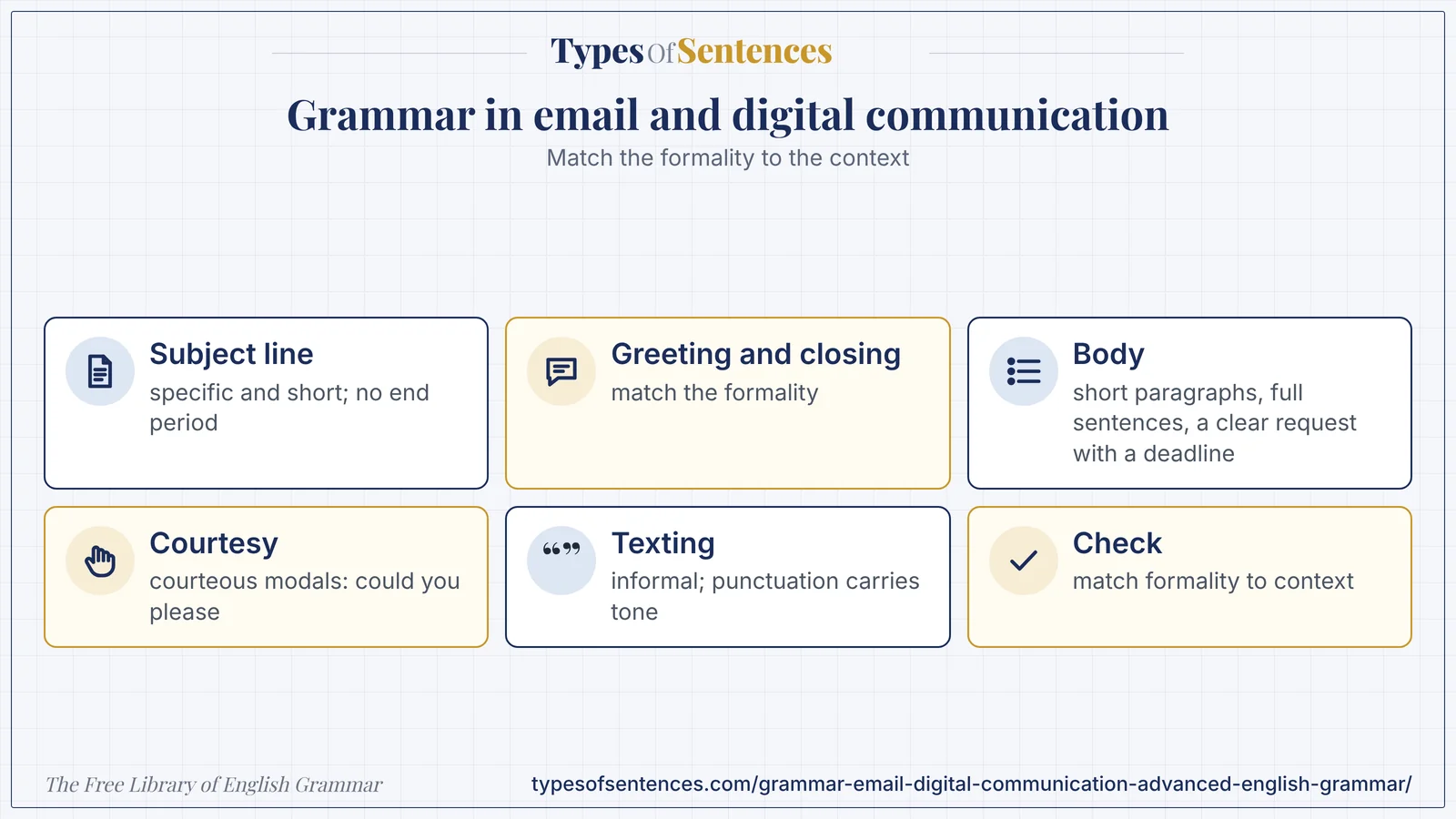
Email is writing, and readers judge it as writing: clear subject, polite greeting, short paragraphs, a clear request, a courteous closing. Messaging and social media are closer to speech, and their grammar is looser, but they have conventions too.
Why it matters: The rule is to match formality to context: who is reading, what is at stake, and what the usual style of the channel is. When in doubt, be a little more formal than the reader, and check your message before you send it.
Summary: Professional email uses a specific subject line, an appropriate greeting and closing, short paragraphs, full sentences, a clear request with a deadline, courteous modals (could you please), and proofreading. Subject lines are concise, specific, and unpunctuated at the end. Greetings and closings follow conventions (Dear Dr. Rao, / Yours sincerely, in British formal letters; Best regards,). Abbreviations such as FYI, ETA, and EOD are acceptable among colleagues but should be avoided or defined for others. Texting uses informal grammar (lowercase, fragments, abbreviations, minimal punctuation) and its punctuation carries tone: a final period can read as curt. Social media follows platform conventions, with CamelCase hashtags for accessibility. Emojis work like gestures and tone markers, replace or soften punctuation, and are read differently across cultures and platforms. Match formality to context.
- Subject: specific and short; no end period.
- Greeting and closing match the formality.
- Texting is informal; punctuation carries tone.
- Match formality to context.
What You’ll Learn
- 1. Grammar in Email: Standards for Professional Messages
- 2. Subject Lines: Grammar and Punctuation
- 3. Greetings and Closings: Conventions and Punctuation
- 4. Abbreviations in Email: Professional vs Casual
- 5. Texting and Messaging: Informal Grammar and Abbreviations
- 6. Social Media Grammar: Platform Conventions and Hashtags
- 7. Emojis and Grammar: Replacing Punctuation and Adding Tone
- 8. Writing for Different Channels: Matching Formality to Context
- 9. Common Errors and a Worked Example
- 10. Exercises
- 11. Test Your Knowledge
- 12. Frequently Asked Questions
- 13. Conclusion
1. Grammar in Email: Standards for Professional Messages
| Part of an email | Purpose | Grammar and style |
|---|---|---|
| subject line | tells the reader what the message is about | a short noun phrase or imperative; no end period |
| greeting | addresses the reader | Dear Dr. Rao,; Hello Priya,; Hi team, |
| opening line | sets the purpose | I am writing to ask about …; Thank you for your message. |
| body | gives the information | short paragraphs; one idea each; full sentences in formal email |
| request or action | says what the reader should do and by when | imperative with please, or a polite modal question: Could you please send the report by Friday? |
| closing line | a courteous end | Thank you for your help.; Please let me know if you have any questions. |
| sign-off | a courteous closing | Best regards,; Yours sincerely, |
| signature | name and contact | name, role, organization, phone |
| attachments and links | mentioned in the text | I have attached the report. (check that the file is attached) |
| Level of formality | When to use | Features | Example |
|---|---|---|---|
| formal | first contact with a senior person, an applicant, a customer, an official body | full sentences; no contractions; formal vocabulary; a full greeting and closing | Dear Dr. Rao, I am writing to request an appointment. I would be grateful if you could confirm a suitable time. Yours sincerely, Priya Nair |
| neutral (standard professional) | colleagues, clients you know, most workplace email | full sentences; some contractions; plain vocabulary; a short greeting and closing | Hi Raj, Could you send the report by Friday? Thanks, Priya |
| informal | close colleagues and teammates | short sentences; fragments allowed; abbreviations; a very short greeting and closing | Raj, report by Fri? Thanks! |
| very informal (chat or text) | friends and chat channels | — | sending now, will ping u |
| Standard | Guidance | Example |
|---|---|---|
| one purpose per email | do not mix unrelated requests | — |
| front-load the main point | say what you want in the first lines | I am writing to confirm Friday’s meeting. |
| use short paragraphs and white space | readable on a phone | one to four sentences per paragraph |
| use lists for steps and items | bullets or numbers; parallel items | see the chapter on typography |
| state the action and the deadline | who, what, by when | Please send the signed form by 5 p.m. on Friday. |
| use polite requests | modal verbs and please | Could you please …? I would appreciate it if you could … |
| avoid bluntness | — | Send it now. → Could you please send it today? |
| avoid excessive politeness | one courteous phrase is enough | — |
| use the active voice | — | I have reviewed the proposal. (rather than The proposal has been reviewed.) |
| avoid clichés | I hope this email finds you well may sound formulaic | Thank you for your message. |
| avoid vague words | soon, ASAP | by Friday |
| name the attachment | — | I have attached the revised budget (Budget_v2.xlsx). |
| check names and titles | spelling and titles | Dr. Rao, not Mr. Rao, if the person is a doctor |
| use consistent date and time formats | spell out the month; state the time zone | 4 March, 3 p.m. IST |
| reply to the point asked | answer each question | — |
| quote the earlier message sparingly | keep the thread readable | — |
| use CC for information; BCC to protect addresses | — | — |
| use Reply All only when everyone needs the reply | — | — |
| proofread | subject, names, numbers, attachments | — |
| check the tone | read it as the reader would | — |
| avoid ALL CAPS and excess exclamation marks | — | — |
| avoid humor and irony with strangers | tone is hard to read | — |
| do not write in anger | wait before sending | — |
| plain text or simple formatting | heavy formatting may not display | — |
| mobile reading | short subject and short paragraphs | — |
| accessibility | descriptive link text; alt text for images | read the full report |
| legal and confidentiality notes | as the organization requires | — |
| follow-ups | a polite reminder after a reasonable time | I am following up on my message of 4 March. |
| out-of-office replies | dates and an alternative contact | — |
| thanks and acknowledgments | reply to confirm receipt | Thank you; I have received the files. |
| sensitive topics | say it in person or by call if possible | — |
| cross-cultural email | avoid idioms, slang, and jokes | — |
| Wording that readers may misread | Alternative |
|---|---|
| Please revert (for please reply) | Please reply. (In some varieties of English, including Indian English, revert means reply; for an international reader, reply is clearer.) |
| Kindly do the needful | Please [state the action]. |
| Please find attached (PFA) | I have attached … |
| Same to you (for thanks) | You are welcome. |
| As per my last email | As I mentioned in my email of 4 March, … |
| Just following up (repeated) | I am following up on … |
| Per my last email (can sound sharp) | As I noted on 4 March, … |
| I am not sure if you saw | Could you confirm that you received …? |
| Any update? alone | Could you give me an update on …? |
| Sorry for the inconvenience (without detail) | I apologize for the delay in replying. |
| Thanks in advance | Thank you for your help. |
| Looking forward to hear from you | I look forward to hearing from you. |
| Do the needful in a formal letter | State the exact action. |
| Revert back | revert (or reply) |
| Pls | Please |
| Regards, alone as a cold closing | Best regards, / Kind regards, |
The wording of the table is a matter of usage, not of grammar: phrases such as kindly do the needful and please revert are established in the English of India and some other countries, and some readers elsewhere find them unclear or stiff. The safest course for a mixed readership is plain wording that states the action. For general business writing, see the chapter on business writing.
2. Subject Lines: Grammar and Punctuation
| Guideline | Example | Note |
|---|---|---|
| be specific | Request: approval for Friday’s budget review | not Question or Hello |
| be concise | about 40 to 60 characters, so that it is not cut off on a phone | — |
| front-load the key words | Budget review: approval needed by Friday | — |
| use a noun phrase or an imperative | Agenda for 4 March meeting; Please review the draft | — |
| no final period | Meeting rescheduled | — |
| capitalization | sentence case or title case, consistently | Meeting rescheduled / Meeting Rescheduled |
| use labels for action | Action required: …; For information: …; Reply by Friday: … | agree labels with the team |
| include dates and deadlines | Report due 4 March | — |
| avoid ALL CAPS | *URGENT!!! | Urgent: report due today |
| avoid exclamation marks | *Please read! | Please read before Monday’s meeting |
| avoid spam triggers | free, win, act now, $$$ | — |
| avoid vague words | *Hi; *Quick question; *Update | Update on Project Alpha timeline |
| keep one topic per subject | change the subject line when the topic changes | — |
| use Re: for replies; Fwd: for forwards | automatic | — |
| avoid long chains of Re: Re: | start a new thread for a new topic | — |
| indicate the project or reference number | [Project Alpha] Timeline update | — |
| use a colon to separate a label from the topic | Invoice: payment overdue | — |
| abbreviations in subject lines | use only well-known ones | FYI; EOD; OOO |
| numbers as figures | 5 items need approval | — |
| questions in subject lines | allowed if specific | Are you free for a call on Thursday? |
| avoid first-person statements as subjects | *I need help | Help needed with the login |
| write the subject last | so that it fits the message | — |
| do not leave blank | — | — |
| language of the subject line | match the language of the email | — |
| subject line in the case of a cold email | state the benefit or the reason | Invitation to speak at the Pune grammar conference |
| subject line for a job application | role and name | Application: Content Editor — Priya Nair |
| subject line for a complaint | state the issue and the reference | Complaint: order 12345 not delivered |
| subject line for a thank-you | Thank you for Tuesday’s meeting | — |
| subject line for a meeting request | Meeting request: budget review, week of 4 March | — |
| Weak subject line | Better |
|---|---|
| Hello | Request for Friday’s meeting agenda |
| Quick question | Question about the invoice dated 4 March |
| URGENT!!! | Urgent: client call moved to 3 p.m. today |
| Meeting | Meeting on 4 March: agenda and venue |
| Update | Update: server migration completed |
| Please read | Policy change effective 1 April |
| Re: Re: Re: plan | New thread: revised plan for Q2 |
| Help | Help needed: cannot access the shared drive |
| FYI | FYI: new exam schedule |
| Document | Draft report for your review by Friday |
3. Greetings and Closings: Conventions and Punctuation
| Greeting | Use | Punctuation |
|---|---|---|
| Dear Dr. Rao, | formal; a person with a title | a comma (American usage also accepts a colon in formal business letters); British usage often omits punctuation after the name in “open” punctuation |
| Dear Mr. Rao, | formal; a person without a doctorate | — |
| Dear Ms. Nair, | formal; the title Ms. is the default for women when marital status is unknown | — |
| Dear Priya, | semi-formal; first name known | — |
| Hello Priya, | neutral | — |
| Hi Priya, | informal and neutral | — |
| Hi all, / Hi team, | a group | — |
| Dear colleagues, | formal group | — |
| Dear Sir or Madam, | formal, when the recipient is unknown | a comma; considered dated; prefer a title or role (Dear Hiring Manager,) |
| To whom it may concern: | formal and impersonal | a colon; dated; avoid if possible |
| Dear [role or team], | when the name is unknown | Dear Admissions Team, |
| Dear Prof. Rao and Dr. Shah, | two recipients | — |
| Priya, | very informal | — |
| no greeting | in a chat or a rapid reply thread | — |
| Good morning, Priya, | neutral; a time-of-day greeting | mind time zones |
| Namaste, / Vanakkam, | greetings in local languages among colleagues | use if appropriate to the culture of the recipients |
| Greetings, | neutral, impersonal | — |
| Hey Priya, | informal | — |
| Dear Friend, | personal letter | — |
| Dear Mr. and Mrs. Rao, | formal couple | — |
| Closing | Use | Note |
|---|---|---|
| Yours sincerely, | British formal, when you know the name (Dear Mr Rao) | also common in other Commonwealth varieties |
| Yours faithfully, | British formal, when you do not know the name (Dear Sir or Madam) | — |
| Sincerely, | American formal and standard | — |
| Sincerely yours, | American formal | — |
| Respectfully, | formal to senior officials | — |
| Best regards, | standard professional | — |
| Kind regards, | standard professional, warm | — |
| Warm regards, | friendly professional | — |
| Regards, | neutral; can sound brief | — |
| Best wishes, | friendly | — |
| Best, | short and friendly | — |
| Thanks, / Thank you, | when asking for something | — |
| Many thanks, | warm thanks | — |
| Cheers, | informal British, Australian, and New Zealand | avoid in formal email |
| Take care, | personal | — |
| With thanks and regards, | Indian business style (variants include Thanks & Regards) | acceptable among colleagues; for an international reader, Best regards is plain |
| Yours, | informal or personal | — |
| Talk soon, | informal | — |
| See you, | informal | — |
| Punctuation and form | Rule | Example |
|---|---|---|
| comma after the closing | Sincerely, | — |
| capitalize only the first word of the closing | Best regards, / Yours sincerely, | not Best Regards in modern usage |
| signature on the next line | name below the closing | Best regards, then Priya Nair on the next line |
| no punctuation after the signature | — | Priya Nair |
| contact details | below the name | role, organization, phone |
| “Thanks in advance” | debated; some readers find it presumptuous | Thank you for your help. |
| “Thanks!” with an exclamation mark | informal | — |
| “Regards” without a comma | — | — |
| avoid ALL CAPS in names | — | — |
| title in a signature | not Dr. before your own name in informal use | — |
| mobile signatures (Sent from my phone) | remove in formal email | — |
| legal disclaimers | as required | — |
| a closing line before the sign-off | Thank you for your time and consideration. | — |
| postscript | P.S. | — |
| multiple signatures in a thread | — | — |
The conventions of the letter (the greeting, the body, the closing) have carried over to email, with some relaxation. The main traps are the choice between faithfully and sincerely (British formal letters), the use of dated formulas (To whom it may concern), and the mismatch of formality between greeting and closing (Dear Sir or Madam … Cheers).
4. Abbreviations in Email: Professional vs Casual
| Abbreviation | Meaning | Level of formality | Note |
|---|---|---|---|
| FYI | for your information | neutral to informal | widely understood |
| ASAP | as soon as possible | informal to neutral | vague; give a date |
| EOD | end of day | neutral (workplace) | state the time zone |
| COB | close of business | neutral (workplace) | state the time zone |
| ETA | estimated time of arrival | neutral | — |
| TBD / TBC | to be determined / to be confirmed | neutral | — |
| NRN | no reply necessary | informal (workplace) | may be unfamiliar |
| OOO | out of office | neutral | — |
| PFA | please find attached | Indian business usage | prefer I have attached for international readers |
| PTO | paid time off | US workplace | — |
| WFH | working from home | informal workplace | — |
| AFAIK | as far as I know | informal | — |
| IMO / IMHO | in my opinion / in my humble opinion | informal | — |
| BTW | by the way | informal | — |
| TL;DR | too long; didn’t read | informal | a summary label |
| FWIW | for what it’s worth | informal | — |
| IIRC | if I recall correctly | informal | — |
| RSVP | répondez s’il vous plaît (please reply) | formal and neutral | — |
| cc / bcc | carbon copy / blind carbon copy | neutral | — |
| Re: | regarding (reply marker) | neutral | — |
| Fwd: | forwarded | neutral | — |
| NB | nota bene (note well) | formal | — |
| pls / thx | please / thanks | texting; avoid in email | — |
| KPI, SLA, RCA | key performance indicator; service level agreement; root cause analysis | professional; define for outsiders | see the chapter on abbreviations |
| HR, CEO, CFO | — | neutral | — |
| Mr / Ms / Dr | titles | formal | — |
| a.m. / p.m. | — | neutral | — |
| IST, EST, GMT | time zones | neutral | state the zone |
| w/ , w/o | with, without | informal notes | avoid in email |
| & | and | informal; in company names | — |
| approx., dept. | approximately; department | neutral in tables | spell out in prose |
| LOL, OMG, BRB | — | texting; avoid in work email | — |
| NNTR | need no thanks reply | rare | avoid |
- Define unfamiliar abbreviations at first use, especially for readers outside your team.
- Avoid texting abbreviations in formal email.
- Do not use an abbreviation to avoid a decision: ASAP without a date is unclear.
- State time zones with EOD and COB when the readers are in different places.
- Check ambiguity: PM can mean afternoon or a manager.
- For the full rules of abbreviations, see the chapter on abbreviations and acronyms.
5. Texting and Messaging: Informal Grammar and Abbreviations
| Feature | Typical forms | Note |
|---|---|---|
| lowercase and missing capitals | i will call u later | informal; acceptable among friends |
| minimal punctuation | ok see u there | — |
| periods as a tone signal | a final period can read as serious or curt in a brief message | research on text-message tone (for example a 2016 study at Binghamton University) found that messages ending in a period were rated as less sincere; the effect depends on the group and the context |
| exclamation marks for warmth | Thanks! | multiple marks (!!!) intensify |
| ellipsis | well…; i guess… | may signal hesitation or trailing off |
| question without a question mark | you coming | — |
| sentence fragments | on my way; almost there | — |
| omitted subject and auxiliary | going now; got it | — |
| abbreviations | LOL, BRB, TBH, IDK, OMG, NP, TTYL, GTG | — |
| letter and number homophones | u (you), r (are), 2 (to, too), 4 (for), b4 (before) | informal |
| clipped words | cuz, tho, gonna, wanna | — |
| stretched words for emphasis | soooo good; noooo | — |
| capitals for emphasis | I said NO | may be read as shouting |
| repeated letters and punctuation | haha; hahaha; ?? | — |
| emoji and emoticons | see you soon 🙂 | — |
| voice notes | spoken grammar in audio | — |
| code-switching and mixed languages | Hinglish and similar mixtures (kal milte hain, ok?) | common among bilingual speakers |
| regional slang | varies by community | — |
| autocorrect errors | ducking for the expected word | proofread important texts |
| greetings and sign-offs | often omitted | — |
| group chat conventions | use of names, replies, reactions | — |
| formality shift | a text to a boss is more formal than to a friend | — |
| messages with stakes (bank, legal, medical) | use full sentences and correct information | — |
| long messages | break into paragraphs or send an email instead | — |
| spelling and typos | tolerated in casual texts, less so in work chat | — |
| abbreviation conflicts | k may read as curt for okay | — |
| politeness markers | please, thanks | still useful |
| voice and tone | read the message aloud in your head | — |
| workplace chat (Slack, Teams) | between email and text: short, with a clear ask | — |
| use of @mentions | address a person | @Priya could you check this? |
| links and threads | keep threads on topic | — |
| reactions and emoji replies | a short acknowledgment | — |
| Informal text | Standard version |
|---|---|
| gonna be late, traffic | I am going to be late; there is traffic. |
| cant talk now, call u l8r | I cannot talk now. I will call you later. |
| u free tmrw? | Are you free tomorrow? |
| omw | I am on my way. |
| idk, ask raj | I do not know. Ask Raj. |
| np | No problem. |
| thx! | Thank you! |
| cu soon | See you soon. |
| ttyl | Talk to you later. |
| brb | I will be right back. |
Texting grammar is a register with its own rules, not a degraded form of standard grammar: its abbreviations, its omissions, and its punctuation carry social meaning, and the writers who use it skillfully switch to a fuller style when the occasion calls for it. The point for the learner is to know both, and to know when to use which. The study of language change in digital media is part of the chapter on language change in modern English.
6. Social Media Grammar: Platform Conventions and Hashtags
| Convention | Description | Example |
|---|---|---|
| character limits | some platforms limit length, which encourages brevity and fragments | — |
| hashtags | a word or phrase with # that marks a topic | #GrammarMatters |
| CamelCase hashtags | capitalize each word so that people and screen readers can read them | #SundayReading (not #sundayreading) |
| placement of hashtags | at the end of a post, or in the middle for one or two key words | — |
| number of hashtags | a few, relevant ones | — |
| mentions | @ plus a username to address someone | @priya |
| links | shortened or descriptive | — |
| threads | numbered posts (1/5) | — |
| calls to action | imperatives: Read more, Share | — |
| questions to engage | What do you think? | — |
| fragments and one-liners | New post. Link below. | — |
| emojis as bullets or separators | — | — |
| platform tone: professional networks | full sentences; business vocabulary; first-person statements | — |
| platform tone: image-based platforms | short captions; hashtags; informal | — |
| platform tone: short-post platforms | concise; quick; conversational | — |
| platform tone: video platforms | spoken grammar in scripts and captions | — |
| alt text for images | a short description for blind users | — |
| captions for videos | accurate, with punctuation | — |
| capitalization of names and brands | follow the brand | — |
| quoting and attribution | credit the source | — |
| tags for people and places | — | — |
| correcting errors | edit if allowed; add a correction if not | — |
| tone and audience | post as you would speak to that audience | — |
| irony and sarcasm | hard to read; add a marker if needed | — |
| trending slang | changes quickly; avoid forced use | — |
| abbreviations | LOL, SMH, TBH, FOMO | — |
| punctuation as style | no punctuation, or deliberate lowercase | a style, not an error |
| replies and quote posts | keep the context clear | — |
| pronunciation of hashtags in video and audio | read CamelCase words as words | — |
| numbers in posts | figures | — |
| dates in posts | spell out the month | — |
| accessibility | CamelCase, alt text, captions, avoiding all-caps blocks | — |
| legal and professional norms | respect copyright, disclosure rules, and privacy | — |
- Know the platform. Its conventions are part of the grammar of the post.
- Use CamelCase in hashtags for readability and accessibility.
- Keep hashtags few and relevant.
- Write complete, correct sentences on professional platforms; informality is fine on casual platforms.
- Proofread before posting. Errors in a public post are visible and sometimes permanent.
- Use alt text and captions so that everyone can read your post.
The grammar of hashtags and usernames is treated further in the next chapter, on grammar and technology. Writing for web and social platforms is also the subject of the chapter on writing for digital media.
7. Emojis and Grammar: Replacing Punctuation and Adding Tone
| Function of an emoji | Example | Note |
|---|---|---|
| marks tone (smiling, joking) | See you tomorrow 🙂 | softens a message; works like a smile or a tone of voice |
| replaces punctuation at the end of a sentence | Thanks 😊 (instead of a period) | a period plus an emoji can look heavy |
| marks irony | Great, another meeting 🙃 | may be misread across cultures |
| expresses emotion | Congratulations 🎉 | — |
| acts as a gesture | 👍 for agreement; 🙏 for thanks or request | meanings vary by culture |
| replaces a word | I ❤ grammar | a rebus; informal |
| marks a list or a section | ✔ item | — |
| repeats for emphasis | 😂😂😂 | — |
| is placed after the sentence | I’ll be there 🙂 | — |
| is placed before the full stop (rare) | — | style varies |
| is combined with text and punctuation | See you soon! 🙂 | — |
| emoticons | 🙂 🙁 😉 | older text-based forms |
| skin-tone and gender modifiers | — | allow choice and representation |
| accessibility | screen readers read emoji names (“smiling face”), so many in a row can be tiresome | limit the number |
| platform differences | the same emoji looks different on different platforms, and may carry a different tone | — |
| cultural differences | a gesture emoji can be rude or neutral in different regions | be cautious in cross-cultural messages |
| professional use | a smile or a thumbs-up in a friendly workplace message is common; use few in formal email | — |
| age and group differences | usage varies; some forms (😂, 👍) may read as dated or as sarcastic in some groups | — |
| do not replace important content | a decision or an instruction should be in words | — |
| emoji in subject lines | may increase visibility but may look unprofessional | use with care |
| emoji as a grammatical device (discussed by linguists) | they function as paralinguistic cues, like gesture and intonation, and have limited syntax of their own | — |
| reaction emojis | a quick acknowledgment without words | — |
| respect for context | avoid cheerful emoji in serious or sad messages | — |
| using the right punctuation with emoticons | a closing parenthesis can be confused with an emoticon | (like this :)) is confusing |
| using emoji in formal documents | avoid | — |
| emoji in resumes and applications | avoid | — |
| emoji in customer service | a friendly tone if the brand allows | — |
| Message without tone marker | Possible reading | With a marker |
|---|---|---|
| Fine. | curt, or annoyed | Fine, thanks! 🙂 |
| Sure | neutral, or reluctant | Sure, happy to help |
| K | dismissive | OK, will do |
| We need to talk. | alarming | Could we talk later today? Nothing urgent. |
| Thanks. | plain, or cold | Thanks so much! |
| Interesting. | genuine, or sarcastic | Interesting — tell me more. |
| No problem | polite | No problem at all 🙂 |
| I see. | neutral, or disapproving | I see. Thanks for explaining. |
Emojis do not replace grammar, but they do some of the work that intonation, facial expression, and gesture do in speech. Because the tone of a written message is easily misread, a writer who is careful about tone uses words (thanks so much), punctuation (an exclamation mark), and sometimes an emoji. The tone of writing in general is the subject of the chapter on tone and voice in writing.
8. Writing for Different Channels: Matching Formality to Context
| Channel | Typical formality | Grammar and style | Response expectations |
|---|---|---|---|
| formal letter or email to an authority | formal | full sentences; formal vocabulary; no contractions or abbreviations | days |
| job application email | formal | tailored; error-free; a courteous tone | — |
| business email to a client | neutral to formal | clear; polite; structured | within a business day |
| email to a colleague | neutral | short; direct; polite | a few hours |
| internal team chat | informal to neutral | short messages; names and mentions; links | minutes |
| text message to a friend | informal | fragments; abbreviations; emoji | minutes |
| text message to a customer or a patient | neutral | full sentences; clear; courteous | — |
| social media post (professional) | neutral | complete sentences; relevant hashtags | — |
| social media post (personal) | informal | free style; hashtags; emoji | — |
| voice message | informal to neutral | spoken grammar; brief | — |
| video meeting chat | informal | short; helpful | — |
| online forum post | neutral | clear title; context; courteous | hours to days |
| comments | — | civil; on topic | — |
| online review | neutral | specific details; honest | — |
| website content | neutral | plain language; scannable | — |
| press release | formal | third person; news style | — |
| newsletter | neutral | a friendly, clear voice | — |
| reports and documents attached to email | formal | as the document type requires | — |
| apology | formal to neutral | sincere; specific | promptly |
| complaint | formal | facts; reference numbers; polite | — |
| thank-you | neutral | warm; specific | — |
| request for a favor | neutral | polite; a clear ask; an easy way to decline | — |
| message to a senior person | formal | concise; respectful | — |
| message to a student or a junior | neutral | clear and kind | — |
- Identify the reader (a senior person, a colleague, a friend, the public).
- Identify the purpose (inform, request, thank, apologize, persuade).
- Choose the channel that suits the purpose and the reader.
- Choose the level of formality: formal, neutral, or informal.
- Write the message in that register: sentences, vocabulary, greeting, closing.
- Check the tone by reading it as the reader would.
- Proofread for names, numbers, dates, and attachments.
- Send and follow up as needed.
9. Common Errors and a Worked Example
| Error | Example | Correction |
|---|---|---|
| vague or empty subject line | *Hi | Request for Friday’s meeting agenda |
| subject line in capitals with exclamation marks | *URGENT!!! | Urgent: report due today |
| text-message style in a formal email | *hi sir, pls send ur cv asap thx | Dear Sir, Could you please send your CV by Friday? Thank you. |
| mismatched greeting and closing | Dear Sir or Madam … Cheers | Dear Sir or Madam … Yours faithfully |
| wrong British closing | *Dear Mr Rao … Yours faithfully | Dear Mr Rao … Yours sincerely |
| blunt request | *Send the report. | Could you please send the report by Friday? |
| no deadline | *Please send it soon. | Please send it by 5 p.m. on Friday. |
| long block of text | a 300-word paragraph | break into short paragraphs and a list |
| forgot the attachment | *I have attached the file. (no file) | check before sending |
| reply-all misuse | — | reply only to the sender when others do not need it |
| cliché opening | I hope this email finds you well | Thank you for your message. |
| unexplained abbreviations | *PFA the SLA RCA | I have attached the root cause analysis for the service level agreement breach. |
| humor or irony that may be misread | — | plain wording |
| typos in names and titles | *Dear Mr. Raa | check the name |
| wrong date format | *03/04/2024 | 4 March 2024 |
| all capitals or color-heavy formatting | — | plain formatting |
| an emoji overload in a formal message | 🙂🙂🙂 | one at most, or none |
| unclear pronouns | *Send it to him after he reviews it | Send the draft to Raj after Raj reviews it. |
| passive evasion | *Mistakes were made in the invoice. | We made mistakes in the invoice, and I apologize. |
| no closing | — | add a courteous closing line and a sign-off |
| excess punctuation | *Please reply!!!! | Please reply by Friday. |
| an ambiguous hashtag | #susanalbumparty | #SusanAlbumParty |
| informal abbreviations in a formal text | *Pls revert asap | Please reply as soon as possible. |
| punctuation after the closing | *Best regards. | Best regards, |
| unprofessional signature | *Sent from my phone | a proper signature |
| no context in a forwarded message | *FYI | FYI: the new exam schedule, for your planning. |
Edit this email for a formal context (a request to a university registrar): Subject: Hi!!! hi sir/madam, pls revert asap regarding my admission. i have attached the docs (PFA). Thx in advance, Regards
- Subject line: Hi!!! is vague and has exclamation marks: Request: confirmation of admission status (Application No. 12345). (the application number is a placeholder)
- Greeting: hi sir/madam is informal and lowercase: Dear Registrar, (or Dear Sir or Madam, if no title is known).
- Request: pls revert asap regarding my admission: abbreviation, informal, unclear deadline, and revert may be unclear to some readers: I am writing to ask about the status of my application for admission to the MA in English. I would be grateful if you could reply by Friday, 8 March.
- Attachment: i have attached the docs (PFA): I have attached my transcripts and identity proof.
- Thanks: Thx in advance: Thank you for your help.
- Closing: Regards without a name: Yours faithfully, (British formal, if the greeting is Dear Sir or Madam) or Yours sincerely, (if the registrar is named) or Sincerely, (American), followed by the full name and contact details.
- Result: Subject: Request: confirmation of admission status (Application No. 12345). Dear Registrar, I am writing to ask about the status of my application for admission to the MA in English. I have attached my transcripts and identity proof. I would be grateful if you could reply by Friday, 8 March. Thank you for your help. Yours sincerely, Priya Nair (Phone: …). (the email is invented)
Recap in 12 seconds
Watch the lesson build itself: Professional email uses a specific subject line, an appropriate greeting and closing, short paragraphs, and a clear request with a deadline. The video has no sound.
Exercises
Part A: Email Standards (Exercises 1–7)
Exercise 1: Name the parts of a professional email.
Show Answer
Answer: Subject, greeting, opening, body, request, closing, sign-off, signature.
Exercise 2: Make polite: Send the report.
Show Answer
Answer: Could you please send the report by Friday?
Exercise 3: Replace the cliché: I hope this email finds you well.
Show Answer
Answer: Thank you for your message.
Exercise 4: Replace: Pls revert asap.
Show Answer
Answer: Please reply by [date].
Exercise 5: Why give a deadline?
Show Answer
Answer: So that the reader knows when to act.
Exercise 6: Name a level of formality.
Show Answer
Answer: Formal, neutral, informal.
Exercise 7: What should you check before sending?
Show Answer
Answer: Names, numbers, dates, attachments, tone.
Part B: Subject Lines, Greetings, and Closings (Exercises 8–14)
Exercise 8: Improve: Hello (subject line).
Show Answer
Answer: Request for Friday’s meeting agenda.
Exercise 9: Improve: URGENT!!!
Show Answer
Answer: Urgent: report due today.
Exercise 10: Does a subject line end with a period?
Show Answer
Answer: No.
Exercise 11: Closing after Dear Sir or Madam (British).
Show Answer
Answer: Yours faithfully,
Exercise 12: Closing after Dear Mr Rao (British).
Show Answer
Answer: Yours sincerely,
Exercise 13: Punctuation after a greeting in US email.
Show Answer
Answer: A comma (or a colon in formal letters).
Exercise 14: Capitalization of the closing.
Show Answer
Answer: Only the first word: Best regards,
Part C: Abbreviations and Texting (Exercises 15–21)
Exercise 15: What does EOD mean?
Show Answer
Answer: End of day.
Exercise 16: What does FYI mean?
Show Answer
Answer: For your information.
Exercise 17: Expand: omw
Show Answer
Answer: on my way.
Exercise 18: Expand: ttyl
Show Answer
Answer: talk to you later.
Exercise 19: Why can a final period in a text sound curt?
Show Answer
Answer: It can signal seriousness; the effect depends on context.
Exercise 20: Name a feature of texting grammar.
Show Answer
Answer: Lowercase, minimal punctuation, fragments, abbreviations.
Exercise 21: Define code-switching.
Show Answer
Answer: Alternating between languages in one message or conversation.
Part D: Social Media and Emojis (Exercises 22–27)
Exercise 22: Rewrite for accessibility: #sundayreading
Show Answer
Answer: #SundayReading.
Exercise 23: Why use alt text?
Show Answer
Answer: So that blind readers can access images.
Exercise 24: What does an emoji do for tone?
Show Answer
Answer: It works like a smile or a gesture, softening or marking a message.
Exercise 25: Name a risk of emojis.
Show Answer
Answer: Ambiguity across cultures and platforms.
Exercise 26: Should important instructions be given only in emoji?
Show Answer
Answer: No; use words.
Exercise 27: Name a rule for professional use of emojis.
Show Answer
Answer: Use few or none in formal messages.
Part E: Matching Formality (Exercises 28–30)
Exercise 28: Name three questions to ask before writing.
Show Answer
Answer: Who is the reader? What is the purpose? What channel and formality?
Exercise 29: Repair: *hi sir, pls send ur cv asap thx
Show Answer
Answer: Dear Sir, Could you please send your CV by Friday? Thank you.
Exercise 30: Repair the mismatch: Dear Sir or Madam … Cheers
Show Answer
Answer: Dear Sir or Madam … Yours faithfully.
Test Your Knowledge
Ready to check what you learned? Answer all 10 questions, then submit. You need 80% (8 of 10) to pass. Your answers are not stored.
View correct answers and explanations
Question 1: Which subject line is best?
✓ Correct Answer: A – Request: approval for Friday’s budget review
Specific and concise.
Question 2: What punctuation usually follows Dear Dr. Rao in an American email?
✓ Correct Answer: B – a comma (or a colon in formal letters)
A comma.
Question 3: In British formal letters, Dear Sir or Madam closes with
✓ Correct Answer: C – Yours faithfully
Yours faithfully.
Question 4: What does FYI stand for?
✓ Correct Answer: D – for your information
For your information.
Question 5: What does EOD mean in business email?
✓ Correct Answer: C – end of day
End of day.
Question 6: Which is a good practice for emojis in a formal business email?
✓ Correct Answer: A – use few or none
Few or none.
Question 7: Why use CamelCase in hashtags?
✓ Correct Answer: D – it helps readability and screen readers
Accessibility.
Question 8: Which is better for a request?
✓ Correct Answer: C – Could you please send the report by Friday?
Polite, specific, with a deadline.
Question 9: A period at the end of a text message can
✓ Correct Answer: B – be read as curt or serious by some recipients
It can change the tone.
Question 10: Which closing is formal?
✓ Correct Answer: B – Yours sincerely
Yours sincerely.
Frequently Asked Questions
What is grammar in email?
Grammar in email is the application of standard grammar and conventions to email: a clear subject line, an appropriate greeting and closing, polite requests, and consistent formality. Grammar in email should match the reader and purpose.
What is email grammar?
Email grammar covers the sentence structure, punctuation, greetings, closings, and tone of email. Email grammar is closer to writing than to speech, so readers judge it by writing standards.
What is digital communication grammar?
Digital communication grammar is the set of conventions across email, messaging, and social media, from full formal sentences to lowercase fragments and emojis. Digital communication grammar varies with the channel.
What is online grammar?
Online grammar means the grammar used on the internet, which ranges from standard to highly informal, and includes platform conventions such as hashtags. Online grammar follows context.
What is internet grammar?
Internet grammar is a loose term for the conventions that have developed online: abbreviations, emoticons, hashtags, and informal punctuation. Internet grammar is a register, not a lack of grammar.
How should I close a formal email?
Use Yours faithfully (British, unknown recipient), Yours sincerely (British, named recipient), or Sincerely or Best regards (American or neutral), followed by a comma and your name.
Are emojis appropriate in work email?
In friendly workplace messages, a few can soften tone; in formal email, applications, and messages to strangers, avoid them, and never use an emoji as the only way to convey important content.
Conclusion
You now have a guide to grammar in email and digital communication: standards for email, subject lines, greetings and closings, abbreviations, texting, social media, emojis, and the matching of formality to context. You can choose the right grammar for each channel.
When you write a message, ask who will read it, what you want them to do, and what style they expect. Next, you will study grammar and technology.
- Crystal, David. Language and the Internet. 2nd ed. Cambridge University Press, 2006.: the language of email, chat, and the web.
- McCulloch, Gretchen. Because Internet: Understanding the New Rules of Language. Riverhead Books, 2019.: informal digital writing and its conventions.
- Gunraj, Danielle N., et al. “Texting Insincerely: The Role of the Period in Text Messaging.” Computers in Human Behavior 55 (2016): 1067–1075.: a study of the period in text messages.
- Federal Plain Language Guidelines. plainlanguage.gov. (online): guidance on clear writing for readers.
- Merriam-Webster Dictionary: email: the dictionary entry.
Last reviewed: October 29, 2026. How it was made: drafted with AI assistance, then checked with automated tests (structure, links, answer keys, spelling) and against the sources above. A person has not yet read this chapter line by line. Found a mistake? Report it.