This grammar glossary N to P explains the grammar terms starting with N, O, and P in plain language. Each entry gives a short definition, an example, and a link to the lesson on this site that teaches the topic in full. If you need the noun definition in grammar, the difference between a phrase and a clause, or the meaning of participle, predicate, or passive voice, you will find it here.
The glossary is in six parts, and this is the fourth. It continues from H to M and is followed by Q to S. This part is the longest, because the letter P begins many of the most important terms of grammar: participle, phrase, predicate, preposition, pronoun, and punctuation mark. The glossary is sorted word by word, so past participle comes before past tense.
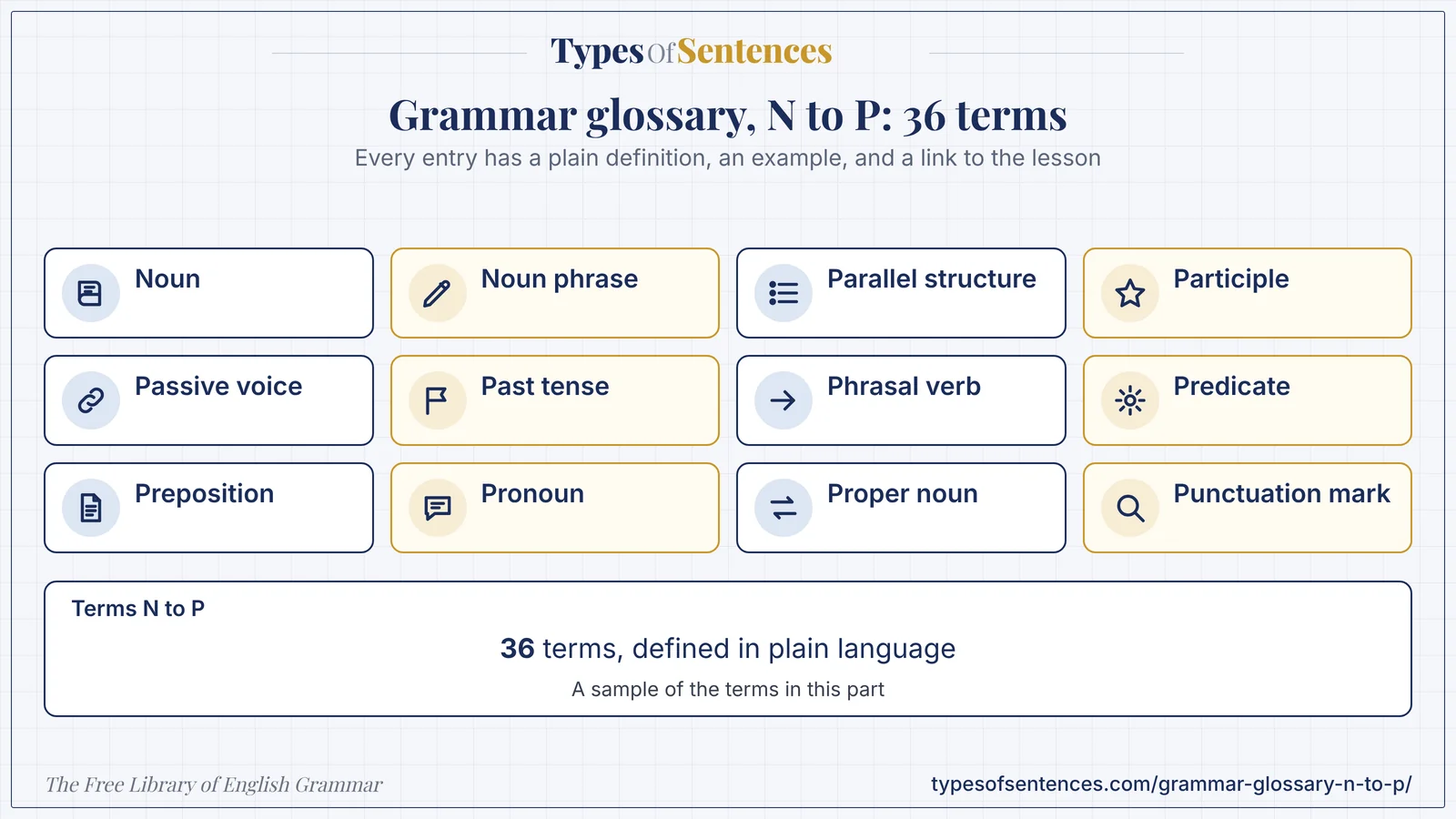
This part of the glossary covers terms from N to P, from the noun, the main word class, to the punctuation mark, the sign that organizes writing.
Why it matters: Many terms come in groups: present, past, and perfect; person, number, and case. Learn the group and you will know the whole set.
Summary: This part of the glossary defines 36 grammar terms from noun to punctuation mark, with an example for each and a link to the full lesson. Terms are in alphabetical order, and the letter list takes you to each section.
- Entries: a definition, an example, and a link to the lesson.
- Includes the parts of speech, the tenses, and the aspects.
- Previous part: H to M. Next part: Q to S.
- The glossary is sorted word by word.
Jump to a Letter
N
noun
Definition: A word that names a person, place, thing, idea, or quality. Nouns can be common or proper, singular or plural, countable or uncountable.
Example: teacher, Pune, table, freedom
Learn more: What is a Noun – Naming Words
noun clause
Definition: A dependent clause that does the job of a noun, for example as a subject or an object.
Example: I know that she is right. What he said was true.
Learn more: Noun Clauses
noun phrase
Definition: A noun with the words that modify it, working as a unit in a sentence.
Example: the old house on the hill
Learn more: Noun Phrases
number
Definition: The grammatical category that shows whether a noun, pronoun, or verb refers to one (singular) or more than one (plural).
Example: one cat, two cats; she walks, they walk
Learn more: Plural Nouns – Singular and Plural Rules
O
object
Definition: The noun or pronoun that receives the action of a verb (direct object) or comes after a preposition (object of the preposition).
Example: She read the book. with him
Learn more: Direct Object and Indirect Object
object complement
Definition: A word or phrase that follows a direct object and describes or renames it.
Example: They elected her president. It made me happy.
Learn more: Subject and Object Complements
objective case
Definition: The form of a pronoun used as the object of a verb or a preposition.
Example: me, him, her, us, them, whom
Learn more: Types of Pronouns – Complete Study
ordinal number
Definition: A number that shows position in a series.
Example: first, second, twenty-third
Learn more: What is a Word
P
parallel structure
Definition: The use of the same grammatical form for items that are joined in a list or by a conjunction.
Example: She likes swimming, hiking, and cycling.
Learn more: Parallel Structure
parenthesis
Definition: A mark of punctuation ( ) that sets off extra information, or the extra information itself. The plural is parentheses.
Example: The report (see page 4) is late.
Learn more: Punctuation Marks – Complete Study
participle
Definition: A verb form used as an adjective or to form compound tenses. English has present participles (-ing) and past participles (-ed, -en, and irregular forms).
Example: a running tap; a broken window
Learn more: Participles – Complete Study
particle
Definition: A small word that is part of a phrasal verb, such as up, out, or off, or that has a grammatical job but does not fit the main word classes.
Example: give up, turn off
Learn more: Types of Verbs – Complete Study
parts of speech
Definition: The classes into which words are sorted by their job in a sentence: noun, pronoun, verb, adjective, adverb, preposition, conjunction, and interjection (and, in many grammars, determiner or article).
Example: The cat sat. (determiner, noun, verb)
Learn more: Parts of Speech – The 8 Kinds of Words
passive voice
Definition: A way of building a sentence in which the subject receives the action. It is formed with a form of be and the past participle.
Example: The plan was approved by the board.
Learn more: Passive Voice and Active Voice
past participle
Definition: The verb form used with have to make perfect tenses, with be to make the passive, and as an adjective.
Example: has written, was seen, a broken cup
Learn more: Past Participle: Forms, Uses and Irregular Past Participles
past perfect
Definition: The tense formed with had and the past participle. It refers to an event before another past event.
Example: When I arrived, the film had started.
Learn more: Past Tenses (All Four)
past tense
Definition: The form of the verb that refers to a time before now.
Example: She walked. He went.
Learn more: Simple Past Tense
perfect aspect
Definition: The verb aspect that shows an action as complete or as having a link to another time. It is formed with have and the past participle.
Example: I have lived here since 2015.
Learn more: Verb Tenses – Introduction to the 12 Tenses
period
Definition: The punctuation mark (.) that ends a statement. In British English, it is called a full stop.
Example: The train leaves at noon.
Learn more: End Punctuation
person
Definition: The grammatical category that shows who is speaking (first person), who is spoken to (second person), or who is spoken about (third person).
Example: I, you, she
Learn more: Types of Pronouns – Complete Study
personal pronoun
Definition: A pronoun that stands for a person or thing and changes its form by person, number, case, and (in the third person singular) gender.
Example: I, you, he, she, it, we, they
Learn more: Types of Pronouns – Complete Study
phrasal verb
Definition: A verb combined with a particle (an adverb or a preposition) that has a meaning of its own.
Example: give up, look after, run out of
Learn more: Types of Verbs – Complete Study
phrase
Definition: A group of words that works together as one part of speech and does not have a subject and a predicate together.
Example: in the morning, the tall man
Learn more: Introduction to Phrases
plural
Definition: The form of a word that refers to more than one.
Example: cats, children, they
Learn more: Plural Nouns – Singular and Plural Rules
possessive
Definition: A form of a noun or pronoun that shows ownership or a close relation.
Example: the dog’s bone, my book, hers
Learn more: Apostrophe Rules
predicate
Definition: The part of a sentence that says something about the subject. It contains the verb.
Example: The dog barked loudly.
Learn more: Subject and Predicate
predicative adjective
Definition: An adjective that comes after a linking verb and describes the subject. The opposite is an attributive adjective.
Example: The tree is tall.
Learn more: Adjective Types – Adjectives, A Complete Study
prefix
Definition: An affix added to the beginning of a word to change its meaning.
Example: unhappy, rewrite, disagree
Learn more: Prefixes and Suffixes – Word Formation Basics
preposition
Definition: A word that shows the relation of a noun or pronoun to another word, usually of place, time, or direction.
Example: in, on, at, by, with
Learn more: What is a Preposition – Position Words
prepositional phrase
Definition: A phrase that begins with a preposition and ends with a noun or pronoun.
Example: on the table, after lunch
Learn more: Prepositional Phrases
present participle
Definition: The -ing form of a verb used with be in progressive tenses and as an adjective.
Example: She is reading. a running tap
Learn more: Participles – Complete Study
present tense
Definition: The form of the verb used for current states, habits, and general truths.
Example: She lives in Pune. Water boils at 100 degrees Celsius.
Learn more: Simple Present Tense
progressive aspect
Definition: The verb aspect that shows an action in progress. It is formed with be and the present participle. It is also called the continuous aspect.
Example: She is reading.
Learn more: Verb Tenses – Introduction to the 12 Tenses
pronoun
Definition: A word that takes the place of a noun or noun phrase.
Example: she, they, this, who
Learn more: What is a Pronoun – Replacement Words
proper noun
Definition: The name of a particular person, place, or thing, written with a capital letter.
Example: Maria, Mumbai, Monday
Learn more: What is a Noun – Naming Words
punctuation mark
Definition: A symbol used in writing to separate and clarify elements of a text, such as the period, comma, colon, or question mark.
Example: . , ; : ? !
Learn more: Introduction to Punctuation
Recap in 12 seconds
Watch the lesson build itself: A sample of the 36 grammar terms from N to P: noun, noun phrase, parallel structure, participle, passive voice, past tense, phrasal verb, predicate, preposition, pronoun, proper noun, punctuation mark. The video has no sound.
Frequently Asked Questions
What is in the grammar glossary N to P?
This part lists the grammar terms starting with N, O, and P, from noun to punctuation mark, including object, participle, passive voice, phrase, predicate, preposition, and pronoun.
What is a noun in grammar?
A noun is a word that names a person, place, thing, idea, or quality. Nouns are the main word class, and they can be common or proper, singular or plural, countable or uncountable.
What is the difference between a phrase and a clause?
A phrase is a group of words without a subject and a predicate together (in the morning); a clause has both (when it rained).
What is the difference between a present participle and a gerund?
Both end in -ing. A present participle works as part of a verb or as an adjective (a running tap); a gerund works as a noun (Running is fun).
- Huddleston, Rodney, and Geoffrey K. Pullum. A Student’s Introduction to English Grammar. Cambridge University Press, 2005.: standard definitions of grammatical terms.
- Crystal, David. A Dictionary of Linguistics and Phonetics. 6th ed. Blackwell, 2008.: a reference for the terms.
- Quirk, Randolph, Sidney Greenbaum, Geoffrey Leech, and Jan Svartvik. A Comprehensive Grammar of the English Language. Longman, 1985.: a reference grammar.
- Merriam-Webster Dictionary: noun: the dictionary entry.
Last reviewed: October 29, 2026. How it was made: drafted with AI assistance, then checked with automated tests (structure, links, spelling) and against the sources above. A person has not yet read this glossary line by line. Found a mistake? Report it.