Advanced pronoun concepts start with a surprise: pronouns are the only words in modern English that still show case clearly (I/me, she/her, who/whom), and so they are the source of most arguments about correctness. At the same time, they do some of the hardest work in a text, pointing back to earlier nouns, forward to later ones, and out to the situation of speaking. These complex pronouns need the care that this chapter gives them.
You will study the pronoun complexities that decide correct usage: case in coordination and comparison, the generic pronouns you, one, they, and we, the debate over the singular they, dummy and anticipatory it, possessive determiners and possessive pronouns, reflexive and emphatic forms, demonstrative and interrogative pronouns, indefinite pronouns and their agreement, and the rules for pronoun-antecedent agreement. The result is expert pronouns and clearer reference. Thirty editing exercises and a quiz follow.
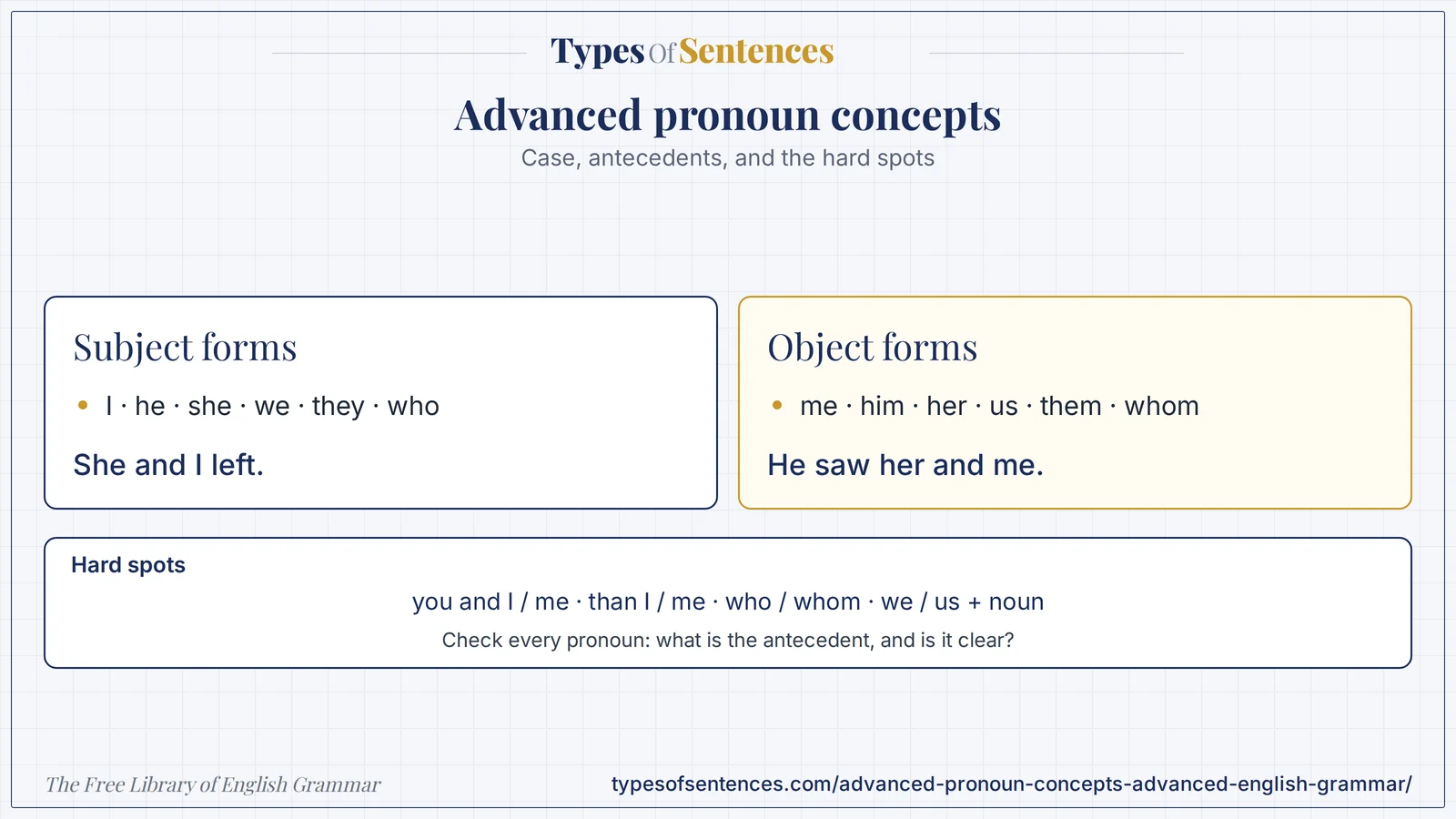
A pronoun stands for a noun phrase, and the reader must always be able to tell which one. Two things can go wrong: the form of the pronoun (me or I) and its reference (who is he?).
Why it matters: Advanced control means knowing the rule, knowing where the rule is bent in real usage, and knowing when a choice that is grammatical is still unclear.
Summary: Pronouns have case forms (subject, object, possessive) and refer to antecedents. Hard spots include you and I/me, than I/me, who/whom, and we/us + noun. Generic reference uses you, one, they, we, and increasingly singular they. Reflexive pronouns refer back to the subject; emphatic ones add stress. Indefinite pronouns are mostly singular for agreement (everyone is). A pronoun must agree with its antecedent in number, person, and, where applicable, gender, and its reference must be unambiguous.
- Subject: I, he, she, we, they, who; object: me, him, her, us, them, whom.
- Possessive determiners need a noun (my book); possessive pronouns stand alone (mine).
- Reflexives refer back to the subject: She hurt herself.
- Check every pronoun: what is the antecedent, and is it clear?
What You’ll Learn
- 1. Advanced Pronoun Concepts: Personal Pronouns and Case
- 2. Who and Whom
- 3. Generic Pronouns: You, One, They, We, and Singular They
- 4. Dummy and Anticipatory It
- 5. Possessive Determiners and Possessive Pronouns
- 6. Reflexive and Emphatic Pronouns
- 7. Demonstrative and Interrogative Pronouns
- 8. Indefinite Pronouns and Agreement
- 9. Pronoun–Antecedent Agreement and Clarity
- 10. Common Errors with Pronouns
- 11. Exercises
- 12. Test Your Knowledge
- 13. Frequently Asked Questions
- 14. Conclusion
1. Advanced Pronoun Concepts: Personal Pronouns and Case
| Person | Subject | Object | Possessive determiner | Possessive pronoun | Reflexive |
|---|---|---|---|---|---|
| 1st singular | I | me | my | mine | myself |
| 2nd | you | you | your | yours | yourself / yourselves |
| 3rd singular (masculine) | he | him | his | his | himself |
| 3rd singular (feminine) | she | her | her | hers | herself |
| 3rd singular (neuter) | it | it | its | (its) | itself |
| 1st plural | we | us | our | ours | ourselves |
| 3rd plural | they | them | their | theirs | themselves |
Case is the form that shows a pronoun’s role: the subject form for the subject, the object form for objects and after prepositions. The advanced difficulties are the places where the role is not obvious.
| Hard spot | Formal standard | Informal usage | Rule |
|---|---|---|---|
| coordinated subject | Tom and I went. | Me and Tom went. (non-standard) | the subject form for a subject |
| coordinated object | She called Tom and me. | She called Tom and I. (hypercorrection) | the object form for an object |
| after a preposition | between you and me | between you and I (hypercorrection) | a preposition takes the object form |
| after than and as | She is taller than I (am). | She is taller than me. | formal: subject form with the understood verb; informal: object form |
| after be | It is I. / This is she. | It’s me. / This is her. | informal usage prefers the object form |
| we/us + noun | We teachers need support. | Us teachers need support. (informal) | the case follows the role of the whole phrase |
| before a gerund | my going; I appreciate your helping. | I appreciate you helping. | the possessive is formal |
Hypercorrection is using a “correct-sounding” form where it is wrong. Because me and Tom was corrected in school, many adults overuse I (between you and I, She gave it to Tom and I). The solution is the principle (case follows role), not a rule of thumb.
2. Who and Whom
Who is the subject form and whom the object form. In formal writing the distinction is kept; in speech and informal writing who is usual in most positions.
| Position | Formal | Informal |
|---|---|---|
| subject | Who called? | Who called? |
| object of a verb | Whom did you meet? | Who did you meet? |
| after a preposition (preposition first) | To whom did you speak? | — |
| after a preposition (preposition last) | Whom did you speak to? | Who did you speak to? |
| in a relative clause | the man whom I met | the man who I met / the man I met |
Many writers treat whom as optional or formal and avoid it by recasting: the man I met. The debate over how much to keep it is in the chapter on grammar myths and controversies.
3. Generic Pronouns: You, One, They, We, and Singular They
| Pronoun | Use | Example | Register |
|---|---|---|---|
| you (generic) | people in general, including the speaker | You never know what will happen. | informal to neutral |
| one | people in general, formal and impersonal | One should always check one’s sources. | formal, especially British |
| they (unspecified) | others in general, an authority | They say it will rain. They raised taxes. | informal |
| we (inclusive) | the speaker and the audience | We all want to be happy. | neutral |
| we (editorial) | a writer, with the reader included | We now turn to the second question. | academic |
| royal we | a single sovereign | We are not amused. | historical |
| Option for “a person” | Example | Note |
|---|---|---|
| he or she / his or her | Each student must bring his or her book. | explicit; wordy |
| singular they | Each student must bring their book. | increasingly standard |
| plural rewrite | Students must bring their books. | avoids the issue |
| one … one’s | One must bring one’s book. | formal; stiff in American English |
| generic he | Each student must bring his book. | now widely avoided |
The singular they has been used in English for centuries (for example, for an unknown or generic person: Everyone has their own opinion) and, more recently, for a known individual who uses they. Many major style guides now accept it, but advice differs by guide and edition: some accept it for a generic person, some for a named individual, and some prefer rewording in formal writing. Follow the guide for your field and keep your choice consistent. The chapter on gender-inclusive language treats the issue in detail.
4. Dummy and Anticipatory It
It does more than refer to a thing. It also fills the subject position when there is nothing to refer to, and it points ahead to a later clause.
| Use | Example | Notes |
|---|---|---|
| referential (a thing already mentioned) | I bought a book. It is long. | an ordinary pronoun |
| dummy (weather, time, distance) | It is raining. It is late. It is ten miles to town. | no antecedent |
| anticipatory subject (extraposition) | It is clear that she is right. It is hard to learn Greek. | the real subject is the clause |
| anticipatory object | I find it strange that he left. | a clause after the object position |
| cleft sentence | It was Maria who called. | used for focus; see the chapter on cleft sentences |
| impersonal passive | It is said that prices will rise. | formal |
Extraposition puts a long subject at the end, which is easier to process: It is obvious that the plan failed rather than That the plan failed is obvious. The dummy it is not used for a person in this way; compare existential there: There is a man at the door.
5. Possessive Determiners and Possessive Pronouns
| Possessive determiner (before a noun) | Possessive pronoun (stands alone) | Example |
|---|---|---|
| my | mine | This is my book. This book is mine. |
| your | yours | Is that your pen? Is it yours? |
| his | his | his car; The car is his. |
| her | hers | her coat; The coat is hers. |
| its | (rare) | The dog wagged its tail. |
| our | ours | our house; The house is ours. |
| their | theirs | their idea; The idea is theirs. |
| whose | whose | Whose book is it? I know whose it is. |
- The possessive pronouns take no apostrophe: hers, ours, yours, theirs, never her’s.
- The double possessive combines of with a possessive pronoun: a friend of mine, that temper of his.
- Its (possessive) and it’s (it is or it has) are different. Whose (possessive) and who’s (who is) are also different.
- Whose can refer to things: a house whose roof leaks.
6. Reflexive and Emphatic Pronouns
| Use | Example | Note |
|---|---|---|
| reflexive (required): the object is the same as the subject | She hurt herself. He taught himself French. | a reflexive is needed because the subject and object are the same person |
| reflexive after a preposition | She looked at herself. He talked to himself. | the same subject |
| emphatic: adds stress | I myself did it. The president himself called. | may be omitted without changing the grammar |
| idiomatic | Enjoy yourself. Behave yourself. Help yourself. | fixed expressions |
| by + reflexive | She did it by herself. (alone, unaided) | by oneself |
| reciprocal (each other, one another) | They love each other. | two or more people |
| Misuse | Correction | Why |
|---|---|---|
| Contact John or myself. | Contact John or me. | myself is not a polite substitute for me |
| He and myself will attend. | He and I will attend. | the reflexive needs a subject antecedent |
| She gave the book to himself. | She gave the book to him. | no antecedent in the clause |
| They washed theirselves. | They washed themselves. | the standard form is themselves |
| Each of them hurt themself. | Each of them hurt himself or herself. | agreement (or singular themself in some usage) |
Many verbs that describe routine actions on the self do not need a reflexive in English: She washed and dressed, He shaved, I relaxed, not She washed herself and dressed herself (unless emphasis is needed). Other languages require the reflexive more often.
7. Demonstrative and Interrogative Pronouns
| Pronoun | Use | Example |
|---|---|---|
| this / these (near) | close in space, time, or the text | This is my house. These are better. |
| that / those (far) | distant, or earlier in the text | That was a mistake. Those were the days. |
| who, whom, whose | questions about people | Who called? Whose is this? |
| which | questions about a choice from a known set | Which do you prefer? |
| what | questions about things or ideas | What happened? |
| whoever, whatever, whichever | any person or thing that (nominal relatives) | Whoever calls, take a message. |
A bare this or that that refers to a whole idea is common in writing and often unclear: The company cut jobs. This caused anger. It is better to add a noun: This decision caused anger. The chapter on reference and deixis studies how demonstratives point in a text. The demonstrative that is also the most common relative word and a conjunction, but those are different uses.
8. Indefinite Pronouns and Agreement
| Group | Pronouns | Agreement | Example |
|---|---|---|---|
| compounds with -one, -body, -thing | everyone, everybody, everything, someone, anyone, nobody, nothing | singular | Everyone is here. Nothing was lost. |
| singular quantifiers | each, either, neither, one, another, much, little | singular | Each of the students has a book. Neither of them is ready. |
| plural | both, few, many, several, others | plural | Both are here. Many were late. |
| either, by sense | all, any, more, most, none, some, half, the rest | singular with mass nouns, plural with plurals | All of the money is gone. All of the guests are here. |
| none | none | singular or plural; plural is common | None of the guests was late. / None of the guests were late. |
| Possessive form | Example |
|---|---|
| indefinite + else + ’s | someone else’s book, anybody else’s idea |
| one + ’s | one’s duty |
| each other’s / one another’s | They respect each other’s opinions. |
9. Pronoun–Antecedent Agreement and Clarity
| Problem | Example | Fix |
|---|---|---|
| number disagreement | A student must bring their book. (formal objection) | A student must bring a book. / Students must bring their books. |
| ambiguous reference | Maria told Anna that she was late. | Maria told Anna, “You are late.” / Maria told Anna that Anna was late. |
| remote antecedent | The report, which the committee reviewed after the meeting that took place on Monday, was late. It was ignored. | repeat the noun: The report was ignored. |
| implied antecedent | In the article it says that prices rose. | The article says that prices rose. |
| collective noun antecedent | The team lost its coach. / The team lost their coach. | be consistent; American usual: singular |
| compound antecedent with or/nor | Either Tom or Maria left her coat. | the pronoun agrees with the nearer noun |
| which with a whole clause | He failed, which surprised us. | acceptable; avoid when unclear |
| this without a noun | This caused anger. | This decision caused anger. |
The cohesion devices that depend on pronouns are described in the chapter on ellipsis and substitution. A final test of clarity is to replace each pronoun with its antecedent: if you cannot decide which noun to use, the reader cannot either.
10. Common Errors with Pronouns
| Error | Correction | Rule |
|---|---|---|
| Between you and I | between you and me | object of a preposition |
| Me and Tom went. | Tom and I went. | subject form |
| She is taller than me. (formal) | She is taller than I (am). | formal comparison |
| Who did she give it to? (very formal) | To whom did she give it? | formal register |
| The dog wagged it’s tail. | The dog wagged its tail. | possessive |
| her’s | hers | no apostrophe |
| Contact myself for details. | Contact me for details. | reflexive misuse |
| Everyone brought their own lunch. (in a formal exam) | Everyone brought his or her own lunch. | follow the style guide |
| Each of the players have a ball. | Each of the players has a ball. | each is singular |
| Tom told Bill he was wrong. | Tom told Bill, “You are wrong.” | ambiguous reference |
| This is the book who I like. | This is the book that I like. | that for things |
| us teachers need rest | we teachers need rest | the subject form for the subject |
Edit: Between you and I, me and Maria think that the team should change their coach, and everyone must bring their own ideas, because this is her’s to decide.
- between you and I: between you and me.
- me and Maria think: Maria and I think.
- the team … their coach: the team should change its coach (American).
- everyone … their: acceptable in most usage; formal: his or her or rewrite: all of us must bring our own ideas.
- this is her’s: this is hers; and this needs a noun: this decision is hers.
- Result: Between you and me, Maria and I think that the team should change its coach, and all of us must bring our own ideas, because the decision is hers to make.
Recap in 12 seconds
Watch the lesson build itself: Pronouns have case forms and antecedents; the hard spots are you and I or me, than I or me, who or whom, and we or us plus a noun. The video has no sound.
Exercises
Part A: Case (Exercises 1–8)
Exercise 1: Edit: Me and Tom went home.
Show Answer
Answer: Tom and I went home.
Exercise 2: Edit: She gave it to Tom and I.
Show Answer
Answer: She gave it to Tom and me.
Exercise 3: Edit: Between you and I
Show Answer
Answer: between you and me.
Exercise 4: Choose (formal): She is taller than (I/me).
Show Answer
Answer: I (understood: than I am).
Exercise 5: Choose: (We/Us) teachers need support.
Show Answer
Answer: We.
Exercise 6: Choose: (Who/Whom) did you meet? (formal)
Show Answer
Answer: Whom.
Exercise 7: Choose: To (who/whom) did you speak?
Show Answer
Answer: whom.
Exercise 8: Choose: The man (who/whom) I think called is here.
Show Answer
Answer: who.
Part B: Generic Pronouns and It (Exercises 9–13)
Exercise 9: Name the register of generic one.
Show Answer
Answer: Formal.
Exercise 10: Rewrite to avoid the pronoun problem: Each student must bring their book.
Show Answer
Answer: Students must bring their books.
Exercise 11: Name the use of It is raining.
Show Answer
Answer: Dummy (weather) it.
Exercise 12: Name the use of It is clear that she is right.
Show Answer
Answer: Anticipatory it (extraposition).
Exercise 13: Name the use of we in We now turn to the second question.
Show Answer
Answer: Editorial we.
Part C: Possessives and Reflexives (Exercises 14–20)
Exercise 14: Edit: The dog wagged it’s tail.
Show Answer
Answer: The dog wagged its tail.
Exercise 15: Edit: The coat is her’s.
Show Answer
Answer: The coat is hers.
Exercise 16: Choose: This book is (my/mine).
Show Answer
Answer: mine.
Exercise 17: Edit: Contact John or myself.
Show Answer
Answer: Contact John or me.
Exercise 18: Edit: They washed theirselves.
Show Answer
Answer: They washed themselves.
Exercise 19: Name the use: I myself did it.
Show Answer
Answer: Emphatic.
Exercise 20: Explain: a friend of mine.
Show Answer
Answer: A double possessive.
Part D: Demonstrative, Interrogative, Indefinite (Exercises 21–26)
Exercise 21: Add a noun to the vague this: The firm cut jobs. This caused anger.
Show Answer
Answer: This decision caused anger. (sample)
Exercise 22: Choose: Everyone (has/have) arrived.
Show Answer
Answer: has.
Exercise 23: Choose: Each of the players (has/have) a ball.
Show Answer
Answer: has.
Exercise 24: Choose: Both (is/are) here.
Show Answer
Answer: are.
Exercise 25: Choose: All of the money (is/are) gone.
Show Answer
Answer: is.
Exercise 26: Name the use of whoever in Whoever calls, take a message.
Show Answer
Answer: Nominal relative pronoun.
Part E: Agreement and Clarity (Exercises 27–30)
Exercise 27: Fix the ambiguity: Maria told Anna that she was late.
Show Answer
Answer: Maria told Anna, “You are late.”
Exercise 28: Fix the implied antecedent: In the article it says that prices rose.
Show Answer
Answer: The article says that prices rose.
Exercise 29: Edit (American): The team lost their coach.
Show Answer
Answer: The team lost its coach.
Exercise 30: Name the test for clarity.
Show Answer
Answer: Replace each pronoun with its antecedent.
Test Your Knowledge
Ready to check what you learned? Answer all 10 questions, then submit. You need 80% (8 of 10) to pass. Your answers are not stored.
View correct answers and explanations
Question 1: Which is correct?
✓ Correct Answer: C – between you and me
A preposition takes the object form.
Question 2: Which is the formal comparison?
✓ Correct Answer: D – She is taller than I am.
The subject form with the understood verb.
Question 3: Which is correct?
✓ Correct Answer: C – Contact John or me.
Myself is not a substitute for me.
Question 4: Which is a possessive pronoun?
✓ Correct Answer: B – mine
Mine stands alone.
Question 5: Which is correct?
✓ Correct Answer: D – The dog wagged its tail.
Its is the possessive.
Question 6: Which agrees correctly?
✓ Correct Answer: C – Everyone has a seat.
Everyone is singular.
Question 7: Which is a dummy it?
✓ Correct Answer: A – It is raining.
It has no antecedent.
Question 8: Which is a reflexive use?
✓ Correct Answer: A – She hurt herself.
The object is the same as the subject.
Question 9: Which is more formal?
✓ Correct Answer: B – Whom did you meet?
Whom is the formal object form.
Question 10: Which avoids an ambiguous pronoun?
✓ Correct Answer: B – Maria told Anna, “You are late.”
Direct speech removes the ambiguity.
Frequently Asked Questions
What are advanced pronoun concepts?
Advanced pronoun concepts are the finer points of the pronoun: case in hard spots, generic pronouns, the singular they, dummy and anticipatory it, possessives, reflexives, indefinite pronouns and their agreement, and clear reference.
What are complex pronouns?
Complex pronouns are pronouns whose use is not simple: who/whom, we/us + noun, reflexive and emphatic forms, indefinite pronouns such as none and everyone, and generic you, one, and they.
What are pronoun complexities that cause errors?
The pronoun complexities that cause most errors are between you and I, me and Tom went, myself for me, its/it’s, who/whom, and unclear reference.
What is advanced pronoun usage?
Advanced pronoun usage means choosing the right case, the right generic pronoun, and a clear antecedent for each pronoun, and knowing which uses are formal, neutral, or informal.
What are expert pronouns?
Expert pronouns are pronouns used with full control: correct case, clear reference, consistent agreement, and the right register. They make a text clear and precise.
Is the singular they correct?
The singular they is established in speech and increasingly accepted in writing. Style guides differ in how and when they accept it, so follow the guide for your field.
When should I use whom?
Use whom as the object form in formal writing (To whom did you speak?). In speech and informal writing, who is usual. You can often avoid the choice by recasting: the man I met.
Conclusion
You now have a deep study of the pronoun: case and its hard spots, who and whom, the generic pronouns, the singular they, dummy and anticipatory it, possessives, reflexive and emphatic pronouns, demonstratives and interrogatives, indefinite pronouns, and pronoun-antecedent agreement. You can use pronouns with expert control and keep every reference clear.
When you edit, check each pronoun for its form and its antecedent. Next, you will study advanced adjective concepts.
- Huddleston, Rodney, and Geoffrey K. Pullum. The Cambridge Grammar of the English Language. Cambridge University Press, 2002.: the reference analysis of pronouns, case, and reference.
- Quirk, Randolph, et al. A Comprehensive Grammar of the English Language. Longman, 1985.: the classic treatment of pronouns.
- Garner, Bryan A. Garner’s Modern English Usage, 5th ed. Oxford University Press, 2022.: usage guidance on case, whom, reflexives, and the singular they.
- APA Style: Singular “They”: the APA guidance on the singular they.
- The Chicago Manual of Style, 17th edition, chapter 5 (Grammar and Usage): American publishing conventions for pronouns.
Last reviewed: October 29, 2026. How it was made: drafted with AI assistance, then checked with automated tests (structure, links, answer keys, spelling) and against the sources above. A person has not yet read this chapter line by line. Found a mistake? Report it.