To, too, two: what is the difference? To is a preposition (to the market) or the marker of an infinitive (to swim). Too is an adverb that means “also” (I like it, too) or “more than is wanted” (too hot). Two is the number 2 (two sisters). The three words sound exactly alike, so the choice is made in writing. If you can say “also” or “very much” in the sentence, write too. If you mean the number, write two. Otherwise, write to.
This page gives the rule for each word and shows too in a sentence and the other two words with 55 examples in all. It explains three tests, the two uses of to, the punctuation of too, fixed phrases, and the mistakes writers make when choosing between to vs too and to or too. It ends with 30 exercises and a 10-question quiz.
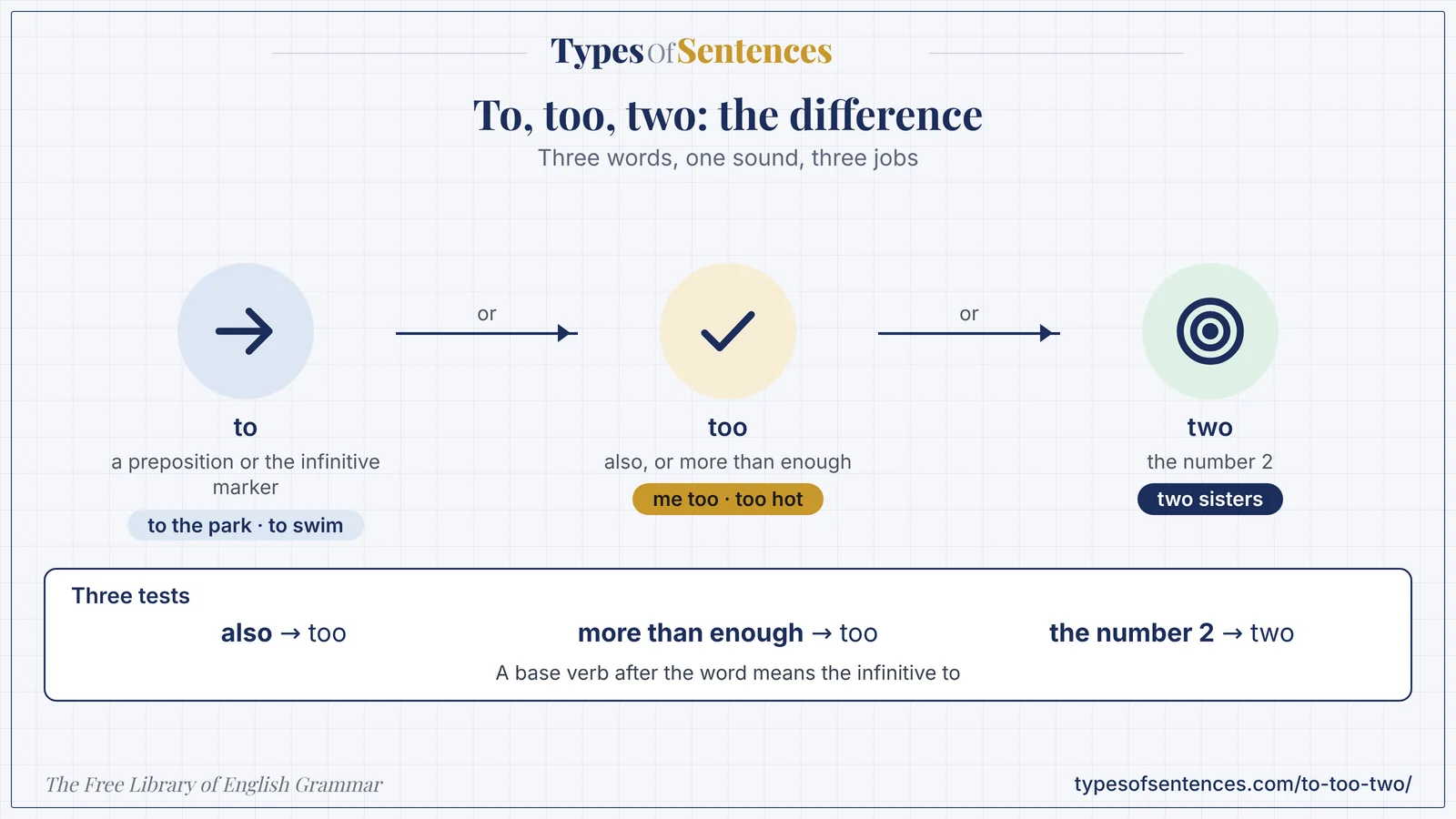
To points toward something or marks a verb: to the park, to run. Too adds something extra, either “also” or “too much”. Two is a number.
Why it matters: The usual mistake is to write the short word to where too is needed. One question fixes it: can I say “also” or “too much” here?
Summary: To has two jobs: a preposition (to the store) and the infinitive marker (to run). Too is an adverb meaning also (me too) or excessively (too hot); it can come at the end of a clause or before an adjective or adverb. Two is the number 2. The tests are: (1) replace with also; if it fits, write too; (2) replace with very much or more than enough; if it fits, write too; (3) if you mean the number 2, write two. The usual spelling slips are to much (should be too much) and I want too go (should be to go).
- To = preposition or infinitive marker.
- Too = also, or excessively.
- Two = the number 2.
- Tests: also / very much / the number.
What You’ll Learn
- 1. To, Too, Two: The Short Answer
- 2. To: 20 Examples of the Preposition and the Infinitive Marker
- 3. Too in a Sentence: 20 Examples of Also and Excessively
- 4. Two: 15 Examples of the Number
- 5. To vs Too: Three Tests to Choose the Right Word
- 6. Fixed Phrases and the Other Confusable Words
- 7. Common Mistakes With To, Too, and Two
- 8. Exercises
- 9. Test Your Knowledge
- 10. Frequently Asked Questions
- 11. Conclusion
1. To, Too, Two: The Short Answer
| Word | Part of speech | Meaning | Replace with | Example |
|---|---|---|---|---|
| to | preposition; infinitive marker | toward; or the sign of a verb’s base form | — | Go to the park. · I want to swim. |
| too | adverb | also; or more than is wanted | also or very much | I like it, too. · It is too hot. |
| two | number (determiner or pronoun) | 2 | 2 | I have two sisters. |
| Spelling clue | Idea |
|---|---|
| too has an extra o | too has “too much” of the letter, or “also” another o |
| two has a w | the same w is in twin, twice, twelve, twenty, and between, all words about two |
| to is the short one | it is the shortest of the three and the most common |
2. To: 20 Examples of the Preposition and the Infinitive Marker
To has two jobs. As a preposition it is followed by a noun or pronoun (to the market, to him). As the infinitive marker it is followed by the base form of a verb (to swim). Each sentence below shows which job.
| To in a sentence | Job of to |
|---|---|
| We went to the market. | preposition (direction) |
| She gave the book to Tom. | preposition (receiver) |
| I want to learn Spanish. | infinitive marker |
| He likes to swim. | infinitive marker |
| The road leads to the lake. | preposition (direction) |
| It is time to go. | infinitive marker |
| From nine to five, I work. | preposition (range) |
| She is married to a doctor. | preposition |
| I talked to my teacher. | preposition |
| They began to sing. | infinitive marker |
| Listen to the music. | preposition |
| He wants to be a pilot. | infinitive marker |
| We walked from the house to the gate. | preposition (direction) |
| She decided to stay. | infinitive marker |
| Add two to three. | preposition (arithmetic) |
| I look forward to meeting you. | preposition (followed by -ing) |
| He drove to work. | preposition (direction) |
| They are used to the cold. | preposition |
| Remember to lock the door. | infinitive marker |
| It belongs to me. | preposition |
The infinitive marker is explained in the chapter on infinitive phrases. Because both jobs use the same word, to is the most common of the three words, and many writers type it by habit where too is needed.
3. Too in a Sentence: 20 Examples of Also and Excessively
Too is an adverb with two meanings. It can mean also (usually at the end of a clause) or more than is wanted or allowed (before an adjective or an adverb).
| Too in a sentence | Meaning of too |
|---|---|
| I like pizza, too. | also |
| She is too tired to walk. | excessively |
| This soup is too hot. | excessively |
| You can come too. | also |
| It is too late to call. | excessively |
| There are too many cars. | excessively |
| He was too proud to ask for help. | excessively |
| Me too! | also |
| The box is too heavy to lift. | excessively |
| That is too bad. | an expression of sympathy |
| We were too early. | excessively |
| She plays the guitar too. | also |
| Don’t talk too loudly. | excessively |
| The test was too easy. | excessively |
| It sounds too good to be true. | excessively |
| My brother wants to go too. | also |
| I have too much work. | excessively |
| The music is too loud. | excessively |
| He, too, was surprised. | also |
| You are never too old to learn. | excessively |
| Punctuation of too | Pattern | Example |
|---|---|---|
| at the end, meaning also | a comma before is common but optional | I like it, too. · I like it too. |
| in the middle, meaning also | commas around it | He, too, was surprised. |
| meaning excessively | no comma | It is too hot. |
| with an infinitive | too + adjective + to + verb | too tired to walk |
4. Two: 15 Examples of the Number
| Two in a sentence | Kind of two |
|---|---|
| I have two sisters. | a number |
| Two plus two is four. | a number |
| The two of us walked home. | a number |
| She ordered two coffees. | a number |
| Two heads are better than one. | a number |
| It costs two dollars. | a number |
| There are two ways to solve it. | a number |
| He arrived at two o’clock. | a number |
| The twins are two years old. | a number |
| Take two tablets a day. | a number |
| We waited for two hours. | a number |
| Two of the students were absent. | a number |
| A bicycle has two wheels. | a number |
| Chapter two begins here. | a number |
| They live two blocks away. | a number |
The words about the number two share the w: twin, twice, twelve, twenty, twilight, between. A useful check is to write the numeral 2 in the same place: if the sentence still makes sense (I have 2 sisters), the word is two.
5. To vs Too: Three Tests to Choose the Right Word
| Test | How it works | Example |
|---|---|---|
| 1 the “also” test | replace the word with also; if it fits, write too | I want to come ___. → I want to come also. ✓ → too |
| 2 the “very much” test | replace the word with very much or more than enough; if it fits, write too | It is ___ hot. → It is very much hot (close; the sense is “more than enough”) ✓ → too |
| 3 the number test | replace the word with the numeral 2; if it fits, write two | I have ___ sisters. → I have 2 sisters. ✓ → two |
| 4 the verb test | if a base verb follows, it is the infinitive to | I want ___ go. → I want to go. (to) |
When you are deciding to or too, run the tests in this order: number, also, very much, verb. If none fits, the word is to as a preposition. The choice between to or too is the most common of the three.
Fill in: I want (to/too/two) go (to/too/two) the park, (to/too/two), but it is (to/too/two) late, and there are only (to/too/two) tickets left.
- want ___ go: a base verb follows, so the infinitive marker to.
- go ___ the park: a noun follows; it is the preposition to.
- , ___,: it means also, so too.
- it is ___ late: it means more than enough, so too.
- only ___ tickets: the number 2 fits, so two.
- Result: I want to go to the park, too, but it is too late, and there are only two tickets left. (the sentence is invented)
6. Fixed Phrases and the Other Confusable Words
| Phrase | Word | Meaning |
|---|---|---|
| too much, too many | too | more than is wanted |
| too bad | too | a pity |
| me too | too | I also |
| too good to be true | too | suspiciously good |
| to and fro | to | back and forth |
| two cents | two | a small opinion |
| two-way street | two | a relationship that goes both ways |
| one or two | two | a few |
| the two of us | two | both of us |
| to be honest | to | an infinitive phrase |
Three other pairs are confused for the same reason. For the pair that depends on an apostrophe, see the guide to its vs it’s; for the trio of look-alikes, the guide to their, there, they’re. The term for a word that sounds like another, a homophone, is defined in the grammar glossary.
7. Common Mistakes With To, Too, and Two
| Mistake | Example | Correction |
|---|---|---|
| to for too (excessively) | *It is to hot. | It is too hot. |
| to for too (also) | *I want to come to. | I want to come, too. |
| too for to (infinitive) | *I want too go. | I want to go. |
| too for to (preposition) | *We went too the market. | We went to the market. |
| two for too | *It is two late. | It is too late. |
| two much | *You eat two much. | You eat too much. |
| to much | *That is to much. | That is too much. |
| too for two | *I have too sisters. | I have two sisters. |
| me to | *Me to! | Me too! |
| all three wrong | *I have to many books to carry two the car. | I have too many books to carry to the car. |
Fix: The test was to hard, and I was to tired too finish, but my two friends passed to.
- to hard: it means excessively, so too hard.
- to tired: the same, so too tired.
- too finish: an infinitive follows, so to finish.
- two friends: the number, correct as written.
- passed to: it means also, so passed, too.
- Result: The test was too hard, and I was too tired to finish, but my two friends passed, too. (the sentence is invented)
Recap in 12 seconds
Watch the lesson build itself: To is a preposition or the infinitive marker, too means also or excessively, and two is the number. The video has no sound.
Exercises
Part A: Choose To, Too, or Two (Exercises 1–10)
Exercise 1: We went ___ the market.
Show Answer
Answer: to.
Exercise 2: I like pizza, ___.
Show Answer
Answer: too (also).
Exercise 3: I have ___ sisters.
Show Answer
Answer: two.
Exercise 4: It is ___ hot.
Show Answer
Answer: too.
Exercise 5: I want ___ learn Spanish.
Show Answer
Answer: to.
Exercise 6: There are ___ many cars.
Show Answer
Answer: too.
Exercise 7: ___ plus ___ is four.
Show Answer
Answer: Two plus two.
Exercise 8: She gave the book ___ Tom.
Show Answer
Answer: to.
Exercise 9: You can come ___.
Show Answer
Answer: too.
Exercise 10: He arrived at ___ o’clock.
Show Answer
Answer: two.
Part B: Apply the Test (Exercises 11–18)
Exercise 11: Which test fits I like it, ___?
Show Answer
Answer: also → too.
Exercise 12: Which test fits It is ___ late?
Show Answer
Answer: very much / more than enough → too.
Exercise 13: Which test fits I have ___ cats?
Show Answer
Answer: the numeral 2 → two.
Exercise 14: Which word comes before a base verb: to or too?
Show Answer
Answer: to (the infinitive marker).
Exercise 15: Which word can mean also?
Show Answer
Answer: too.
Exercise 16: Write the numeral: two
Show Answer
Answer: 2.
Exercise 17: Choose: (To/Too) much sugar is bad.
Show Answer
Answer: Too.
Exercise 18: Choose: Listen (to/too) the music.
Show Answer
Answer: to (preposition).
Part C: Fixed Phrases (Exercises 19–24)
Exercise 19: Complete: ___ bad! (a pity)
Show Answer
Answer: Too.
Exercise 20: Complete: Me ___! (I also)
Show Answer
Answer: too.
Exercise 21: Complete: a ___-way street
Show Answer
Answer: two.
Exercise 22: Complete: ___ and fro
Show Answer
Answer: to.
Exercise 23: Complete: one or ___
Show Answer
Answer: two.
Exercise 24: Complete: too good ___ be true
Show Answer
Answer: to.
Part D: Correct the Errors (Exercises 25–30)
Exercise 25: Correct: *It is to hot.
Show Answer
Answer: It is too hot.
Exercise 26: Correct: *I want too go.
Show Answer
Answer: I want to go.
Exercise 27: Correct: *I have too sisters.
Show Answer
Answer: I have two sisters.
Exercise 28: Correct: *That is to much.
Show Answer
Answer: That is too much.
Exercise 29: Correct: *It is two late.
Show Answer
Answer: It is too late.
Exercise 30: Correct: *We went too the market.
Show Answer
Answer: We went to the market.
Test Your Knowledge
Ready to check what you learned? Answer all 10 questions, then submit. You need 80% (8 of 10) to pass. Your answers are not stored.
View correct answers and explanations
Question 1: Which word is the number?
✓ Correct Answer: D – two
Two.
Question 2: It is ___ hot.
✓ Correct Answer: A – too
Excessively.
Question 3: I want ___ go.
✓ Correct Answer: B – to
The infinitive marker.
Question 4: I like it, ___.
✓ Correct Answer: C – too
Also.
Question 5: Which test works for too?
✓ Correct Answer: B – replace with also
The also test.
Question 6: Which is correct?
✓ Correct Answer: A – That is too much.
Too much.
Question 7: There are ___ cars. (the number)
✓ Correct Answer: C – two
2.
Question 8: The word to can be
✓ Correct Answer: D – a preposition or an infinitive marker
Two jobs.
Question 9: Me ___!
✓ Correct Answer: B – too
Also.
Question 10: Which word shares the w of twin?
✓ Correct Answer: A – two
Two.
Frequently Asked Questions
What is the difference between to, too, and two?
To is a preposition or the infinitive marker, too is an adverb meaning also or excessively, and two is the number 2. They sound alike, so you choose among them in writing.
How do I use too in a sentence?
Use too to mean also (I like it, too) or more than is wanted (It is too hot). If also or very much fits, too is correct. This is too in a sentence.
What is the difference between to vs too?
To points toward a place or marks a verb (to the park, to swim). Too adds an idea: also, or excessively (too hot). If you can say also or more than enough, use too.
How do I choose between to or too?
Run three tests: if also fits, write too; if more than enough fits, write too; if a base verb or a noun follows as a direction, write to. The most common error is to much for too much.
Is it to much or too much?
It is too much. Too means more than is wanted, and the word before much is an adverb of degree.
Do you put a comma before too?
At the end of a clause, a comma before too is common and optional (I like it, too). In the middle of a clause, commas go on both sides (He, too, was surprised). Before an adjective, no comma is used (too hot).
Where can I find to too two sentence examples?
This page has 55 of them: 20 for to, 20 for too, and 15 for two. The to too two sentence examples are in the tables above, each with a note on the job of the word.
Conclusion
You now know the rule for to, too, and two: to is a preposition or the infinitive marker, too means also or excessively, and two is the number. You have seen too in a sentence, the to vs too and to or too tests, the fixed phrases, and the common mistakes.
Run the tests in order: the number first, then also and more than enough, then a verb. Next, study the lists and references in this series, such as the list of phrasal verbs, where to and up work as particles.
- Garner, Bryan A. Garner’s Modern English Usage. 5th ed. Oxford University Press, 2022.: the entries on to, too, and two and on the punctuation of too.
- Swan, Michael. Practical English Usage. 4th ed. Oxford University Press, 2016.: too and enough, the infinitive, and the prepositions.
- Huddleston, Rodney, and Geoffrey K. Pullum. The Cambridge Grammar of the English Language. Cambridge University Press, 2002.: prepositions, the infinitival to, and degree adverbs.
- Merriam-Webster Dictionary: too: the dictionary entry (not opened when this page was written).
Last reviewed: October 29, 2026. How it was made: drafted with AI assistance, then checked with automated tests (structure, links, answer keys, spelling) and against the sources above. A person has not yet read this chapter line by line. Found a mistake? Report it.