What is the difference between your vs you’re? Your shows possession: Is this your bag? You’re is a contraction of you are: You’re late. If you can say “you are” in the sentence, write you’re. If you mean “belonging to you”, write your, with no apostrophe. The two words sound exactly alike, and the apostrophe is the only difference in spelling.
This page gives the rule for each word and shows your in a sentence and you’re in a sentence with 20 examples of each. It explains three tests, why your possessive form has no apostrophe, how your differs from yours and yourself, the common mistakes, and the related pairs. It ends with 30 exercises and a 10-question quiz.
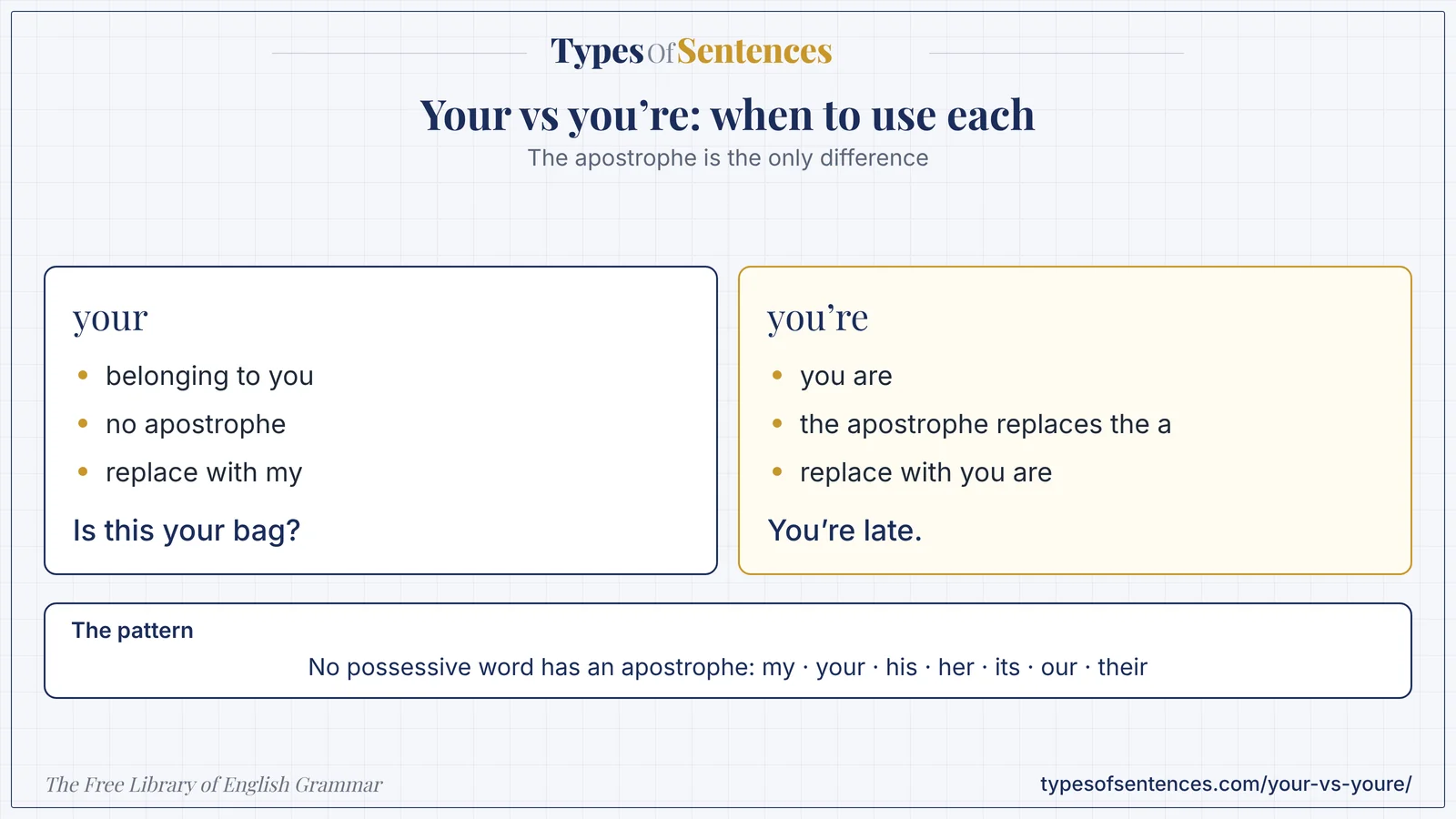
Your goes before a noun and shows that the noun belongs to you: your book. You’re is two words squeezed into one: you are. The apostrophe replaces the missing letter a.
Why it matters: Say the sentence with “you are”. If it still sounds right, use the apostrophe. If it sounds wrong, you want your.
Summary: Your is a possessive word that comes before a noun (your bag); school grammars call it a possessive adjective or possessive pronoun, and modern reference grammars call it a possessive determiner. You’re is the contraction of you are (You’re right). Possessive words never take an apostrophe (my, your, his, her, its, our, their, and yours, hers, ours, theirs). The tests are: (1) replace with you are; (2) replace with my (if it fits, write your); (3) check for a noun after the word. The pronoun that stands alone is yours, and the reflexive form is yourself.
- Your = belonging to you.
- You’re = you are.
- Tests: you are / my / a noun follows.
- Yours and yourself are different forms.
What You’ll Learn
- 1. Your vs You’re: The Short Answer
- 2. Your in a Sentence: 20 Examples of the Possessive Your
- 3. You’re in a Sentence: 20 Examples of You Are
- 4. Three Tests to Choose Between Your and You’re
- 5. Related Forms: Yours, Yourself, Ur, and the Other Look-Alike Pairs
- 6. Common Mistakes With Your and You’re
- 7. Exercises
- 8. Test Your Knowledge
- 9. Frequently Asked Questions
- 10. Conclusion
1. Your vs You’re: The Short Answer
| Your | You’re | |
|---|---|---|
| part of speech | possessive determiner | contraction (pronoun + verb) |
| meaning | belonging to you | you are |
| replace with | my | you are |
| apostrophe? | no | yes: it replaces the letter a of are |
| example | Is this your bag? | You’re late. |
| what follows | a noun (your bag) | a noun, an adjective, or an -ing form (You’re a teacher. You’re tired. You’re going.) |
| Possessive form | Stands alone? | Example |
|---|---|---|
| your | no: it comes before a noun | your book |
| yours | yes | The book is yours. |
| yourself | reflexive | Help yourself. |
| yourselves | reflexive plural | Help yourselves. |
Anyone who searches for the your possessive pronoun will find the same pattern for every possessive word: none has an apostrophe. The whole family is set out in the guide to the pronouns list.
2. Your in a Sentence: 20 Examples of the Possessive Your
In each of these examples, your comes before a noun and shows that the noun belongs to the person addressed. Learners often search for the your possessive pronoun because school lists show your beside my, his, and her. Each sentence can be rewritten with my in place of your.
| Your in a sentence | What belongs to you |
|---|---|
| Is this your bag? | bag |
| Your idea is brilliant. | idea |
| Please wash your hands. | hands |
| I like your new haircut. | new haircut |
| What is your name? | name |
| Your flight leaves at noon. | flight |
| Did you finish your homework? | homework |
| Your teacher called me. | teacher |
| Take your time. | time |
| We admire your courage. | courage |
| Your answer is correct. | answer |
| Is that your car? | car |
| Bring your own lunch. | own lunch |
| Your parents are proud of you. | parents |
| Your room is on the second floor. | room |
| I read your report last night. | report last night |
| Your dog is very friendly. | dog |
| Your turn is next. | turn |
| Keep your receipt. | receipt |
| We will miss your help. | help |
As a possessive determiner, your never changes for number: your book and your books are both correct. The determiners are described in the chapter on determiners.
3. You’re in a Sentence: 20 Examples of You Are
In each of these examples, you’re can be replaced by you are. A quick check is to read the sentence aloud with you are.
| You’re in a sentence | Full form |
|---|---|
| You’re late. | You are late. |
| You’re welcome. | You are welcome. |
| I think you’re right. | I think you are right. |
| You’re going to love it. | You are going to love it. |
| If you’re hungry, eat. | If you are hungry, eat. |
| You’re the best teacher I know. | You are the best teacher I know. |
| Tell me when you’re ready. | Tell me when you are ready. |
| You’re not alone. | You are not alone. |
| You’re invited to the party. | You are invited to the party. |
| I know you’re tired. | I know you are tired. |
| You’re always welcome here. | You are always welcome here. |
| Do you know why you’re upset? | Do you know why you are upset? |
| You’re learning fast. | You are learning fast. |
| You’re a natural. | You are a natural. |
| Since you’re here, stay. | Since you are here, stay. |
| You’re doing great. | You are doing great. |
| I hope you’re well. | I hope you are well. |
| You’re kind to say so. | You are kind to say so. |
| Whatever you’re planning, call me. | Whatever you are planning, call me. |
| You’re one of a kind. | You are one of a kind. |
Contractions are usually avoided in very formal writing, where you are is written in full. The apostrophe replaces the letter a of are.
4. Three Tests to Choose Between Your and You’re
| Test | How it works | Example |
|---|---|---|
| 1 the “you are” test | say the sentence with you are; if it fits, write you’re | I think ___ right. → you are right ✓ → you’re |
| 2 the “my” test | replace the word with my; if it fits, write your | Is this ___ bag? → Is this my bag? ✓ → your |
| 3 the noun test | if a noun comes right after the word, it is probably your | ___ teacher called. → Your teacher called. |
Fill in: (Your/You’re) going to love (your/you’re) new room, and (your/you’re) welcome to paint it.
- First blank: say “you are going to love”. It fits, so You’re.
- Second blank: “my new room” fits, because the room belongs to you. So your.
- Third blank: say “you are welcome to paint”. It fits, so you’re.
- Result: You’re going to love your new room, and you’re welcome to paint it. (the sentence is invented)
5. Related Forms: Yours, Yourself, Ur, and the Other Look-Alike Pairs
| Pair | Possessive (no apostrophe) | Contraction (apostrophe) | Example |
|---|---|---|---|
| you | your | you’re (you are) | You’re using your phone. |
| it | its | it’s (it is, it has) | It’s lost its way. |
| they | their | they’re (they are) | They’re packing their bags. |
| who | whose | who’s (who is, who has) | Who’s the girl whose bag it is? |
| we | our | we’re (we are) | We’re cleaning our room. |
| Form | Status | Note |
|---|---|---|
| yours | correct | stands alone; never your’s |
| yourself | correct | reflexive; one person |
| yourselves | correct | reflexive; more than one person |
| yourselves vs yourself | number matters | Help yourself (one) · Help yourselves (many) |
| ur | texting shorthand | can mean your or you’re; avoid it in writing |
| youre | misspelling | the apostrophe is required |
| yore | a different word | meaning long ago, as in days of yore |
The same tests work for each pair. Say the contraction in full; if it fits, write the contraction. The pairs are also covered in the guide to its and it’s and in the guide to their, there, and they’re.
6. Common Mistakes With Your and You’re
| Mistake | Example | Correction |
|---|---|---|
| your for you’re | *Your late again. | You’re late again. |
| you’re for your | *Is this you’re bag? | Is this your bag? |
| your’s | *The choice is your’s. | The choice is yours. |
| youre | *Youre welcome. | You’re welcome. |
| your before an adjective as a contraction | *Your so kind. | You’re so kind. |
| you’re before a noun as a possessive | *You’re help is needed. | Your help is needed. |
| ur in formal writing | *Ur invited. | You’re invited. |
| yourselves for one person | *Please help yourselves. (to one guest) | Please help yourself. |
| your for you are in questions | *Your going home? | Are you going home? or You’re going home? |
| both wrong | *Your sure you’re ready to share you’re work? | You’re sure you’re ready to share your work? |
Fix: Your going to need you’re coat, because its cold and your feet will get wet.
- Your going: say “you are going”, so You’re going.
- you’re coat: the coat belongs to you, so your coat.
- its cold: say “it is cold”, so it’s cold.
- your feet: belongs to you, so it stays your feet.
- Result: You’re going to need your coat, because it’s cold and your feet will get wet. (the sentence is invented)
Recap in 12 seconds
Watch the lesson build itself: Your shows possession and has no apostrophe; you’re means you are. The video has no sound.
Exercises
Part A: Choose Your or You’re (Exercises 1–10)
Exercise 1: Is this ___ bag?
Show Answer
Answer: your.
Exercise 2: ___ late again.
Show Answer
Answer: You’re.
Exercise 3: I think ___ right.
Show Answer
Answer: you’re.
Exercise 4: Please wash ___ hands.
Show Answer
Answer: your.
Exercise 5: ___ going to love it.
Show Answer
Answer: You’re.
Exercise 6: What is ___ name?
Show Answer
Answer: your.
Exercise 7: If ___ hungry, eat.
Show Answer
Answer: you’re.
Exercise 8: We admire ___ courage.
Show Answer
Answer: your.
Exercise 9: Tell me when ___ ready.
Show Answer
Answer: you’re.
Exercise 10: Did you finish ___ homework?
Show Answer
Answer: your.
Part B: Apply the Test (Exercises 11–18)
Exercise 11: Which test fits ___ welcome?
Show Answer
Answer: you are → You’re.
Exercise 12: Which test fits ___ teacher called?
Show Answer
Answer: my → Your.
Exercise 13: Write in full: You’re kind.
Show Answer
Answer: You are kind.
Exercise 14: Write the possessive: the book of you
Show Answer
Answer: your book.
Exercise 15: Which word can come before a noun: your or you’re?
Show Answer
Answer: your.
Exercise 16: Which word can come before an adjective like happy: your or you’re?
Show Answer
Answer: you’re (you are happy).
Exercise 17: Which stands alone: your or yours?
Show Answer
Answer: yours.
Exercise 18: Is there a word your’s?
Show Answer
Answer: No. The form is yours.
Part C: Related Forms (Exercises 19–24)
Exercise 19: Choose: The choice is (your/yours).
Show Answer
Answer: yours.
Exercise 20: Choose: Please help (yourself/yourselves). (to one guest)
Show Answer
Answer: yourself.
Exercise 21: Choose: (Its/It’s) raining.
Show Answer
Answer: It’s.
Exercise 22: Choose: The dog wagged (its/it’s) tail.
Show Answer
Answer: its.
Exercise 23: Choose: (Whose/Who’s) coat is this?
Show Answer
Answer: Whose.
Exercise 24: Choose: (Their/They’re) late.
Show Answer
Answer: They’re.
Part D: Correct the Errors (Exercises 25–30)
Exercise 25: Correct: *Your late again.
Show Answer
Answer: You’re late again.
Exercise 26: Correct: *Is this you’re bag?
Show Answer
Answer: Is this your bag?
Exercise 27: Correct: *The choice is your’s.
Show Answer
Answer: The choice is yours.
Exercise 28: Correct: *Youre welcome.
Show Answer
Answer: You’re welcome.
Exercise 29: Correct: *You’re help is needed.
Show Answer
Answer: Your help is needed.
Exercise 30: Correct: *Your so kind.
Show Answer
Answer: You’re so kind.
Test Your Knowledge
Ready to check what you learned? Answer all 10 questions, then submit. You need 80% (8 of 10) to pass. Your answers are not stored.
View correct answers and explanations
Question 1: Which word shows ownership?
✓ Correct Answer: D – your
Your.
Question 2: ___ going to be late.
✓ Correct Answer: B – You’re
You are.
Question 3: Is this ___ bag?
✓ Correct Answer: A – your
Belonging to you.
Question 4: The apostrophe in you’re replaces the letter
✓ Correct Answer: C – a
Of are.
Question 5: Which test works for your?
✓ Correct Answer: B – replace with my
The possessive test.
Question 6: Which is correct?
✓ Correct Answer: A – The choice is yours.
No apostrophe.
Question 7: ___ welcome.
✓ Correct Answer: D – You’re
You are.
Question 8: Which form is reflexive?
✓ Correct Answer: C – yourself
Yourself.
Question 9: Which is NOT standard in formal writing?
✓ Correct Answer: A – ur
Texting shorthand.
Question 10: ___ help is needed.
✓ Correct Answer: B – Your
Before a noun.
Frequently Asked Questions
What is the difference between your vs you’re?
Your shows possession (your bag), and you’re means you are (you’re late). They sound alike, so you must choose in writing.
How do I use your in a sentence?
Use your before a noun to show that something belongs to you: Is this your bag? If my fits in the same place, your is correct. That is your in a sentence.
How do I use you’re in a sentence?
Use you’re when you mean you are: You’re late. If the sentence still makes sense with you are, the apostrophe is correct. That is you’re in a sentence.
Is your a possessive pronoun?
In many school grammars your is called a possessive adjective or a possessive pronoun, and in modern reference grammars it is a possessive determiner. The form that stands alone is yours. None of these takes an apostrophe.
Is it yours or your’s?
It is yours. Possessive pronouns never take an apostrophe.
Is ur correct?
No, not in formal writing. Ur is texting shorthand for your or you’re; write the full word.
What is the difference between yourself and yourselves?
Yourself refers to one person (Help yourself), and yourselves to more than one (Help yourselves).
Conclusion
You now know the rule for your vs you’re: your shows possession and has no apostrophe, and you’re means you are. You have seen your in a sentence and you’re in a sentence, three tests, the related forms, and the common mistakes.
Say the sentence with you are. If it fits, write you’re; if not, write your. Next, study another trio that is confused in writing: to, too, and two.
- Garner, Bryan A. Garner’s Modern English Usage. 5th ed. Oxford University Press, 2022.: the entries on your and you’re, and on the apostrophe.
- Strunk, William, Jr., and E. B. White. The Elements of Style. 4th ed. Longman, 1999.: the rule on possessives and the entry on it’s and its (the same principle).
- Swan, Michael. Practical English Usage. 4th ed. Oxford University Press, 2016.: possessive determiners and contractions.
- Huddleston, Rodney, and Geoffrey K. Pullum. The Cambridge Grammar of the English Language. Cambridge University Press, 2002.: determiners and the pronoun system.
- Merriam-Webster Dictionary: your: the dictionary entry (not opened when this page was written).
Last reviewed: October 29, 2026. How it was made: drafted with AI assistance, then checked with automated tests (structure, links, answer keys, spelling) and against the sources above. A person has not yet read this chapter line by line. Found a mistake? Report it.