An infinitive phrase is a phrase that begins with to plus the base form of a verb, together with its objects and modifiers: to leave early, to see the sea, to be honest. Infinitive phrases are flexible. They can work as nouns, adjectives, or adverbs, so they appear in almost every kind of sentence.
This chapter shows infinitive phrase structure, with infinitive phrase examples for every job. You will learn the infinitive as noun, adjective, and adverb, how to use the bare infinitive (without to), when a split infinitive is acceptable, and how to avoid the common errors. Thirty exercises and a quiz follow.
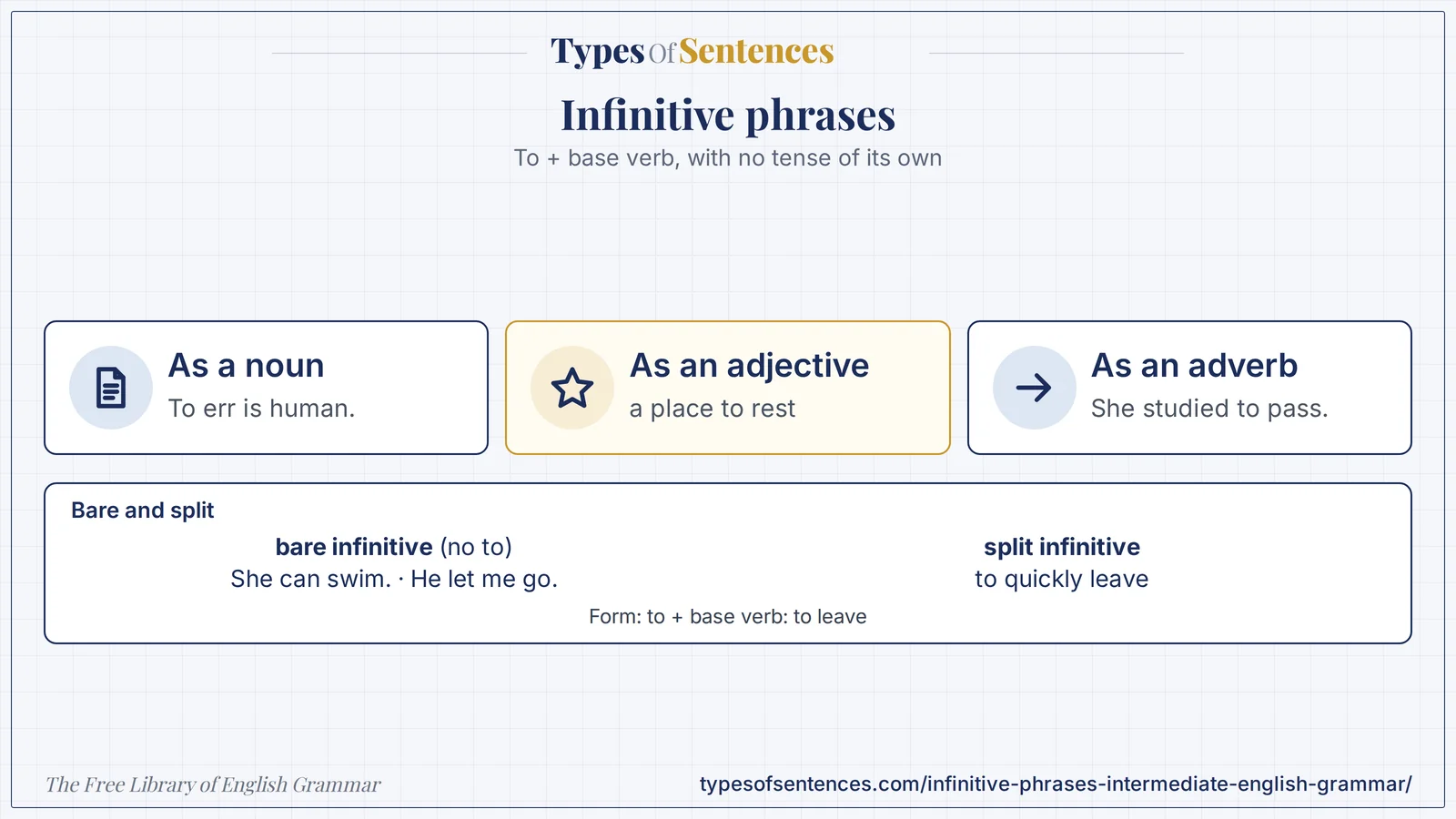
An infinitive is the basic form of a verb, usually with to. An infinitive phrase adds what the verb needs: to leave becomes to leave early or to leave the room.
Why it matters: Infinitive phrases express purposes, wishes, plans, and possibilities. They are different from gerunds and participles, which are other non-finite forms.
Summary: An infinitive phrase has the structure to + base verb + any objects or modifiers. It is non-finite: it has no tense or subject of its own. It works as a noun (To err is human), an adjective (a place to rest), or an adverb (She studied to pass).
- Form: to + base verb: to leave.
- Noun: subject, object, or complement. Adjective: after a noun. Adverb: purpose, reason, result.
- Bare infinitive (no to): after modals and verbs such as let and make.
- A split infinitive puts an adverb between to and the verb; it is acceptable in modern usage.
What You’ll Learn
- 1. Infinitive Phrases: What Is an Infinitive Phrase?
- 2. Infinitive Phrase Structure
- 3. Infinitives as Nouns
- 4. Infinitives as Adjectives
- 5. Infinitives as Adverbs
- 6. Bare Infinitives
- 7. Split Infinitives
- 8. Negative, Passive, and Perfect Infinitives
- 9. Choosing Between an Infinitive and Other Forms
- 10. Common Infinitive Phrase Errors
- 11. Exercises
- 12. Test Your Knowledge
- 13. Frequently Asked Questions
- 14. Conclusion
1. Infinitive Phrases: What Is an Infinitive Phrase?
The infinitive is the base form of a verb, usually with the marker to: to go, to write, to be. An infinitive phrase is the infinitive with its objects, complements, and modifiers. The structure is simple.
| Part | Example |
|---|---|
| to | to |
| base verb | to leave |
| + object | to leave the room |
| + modifier | to leave the room quietly |
| + subject marker | for him to leave the room quietly |
| Infinitive form | Example |
|---|---|
| simple | to write |
| continuous | to be writing |
| perfect | to have written |
| perfect continuous | to have been writing |
| passive | to be written |
| negative | not to write |
An infinitive has no tense and no subject of its own, so it is a non-finite form; see the guide to finite and non-finite verbs. Do not confuse the infinitive marker to with the preposition to (look forward to seeing you).
2. Infinitive Phrase Structure
The structure of an infinitive phrase follows the verb’s own pattern.
| Verb pattern | Infinitive phrase | In a sentence |
|---|---|---|
| intransitive | to arrive early | She hopes to arrive early. |
| transitive (object) | to finish the report | He wants to finish the report. |
| linking verb + complement | to be a doctor | She wants to be a doctor. |
| with an adverbial | to live in Paris | They plan to live in Paris. |
| with its own subject | for her to win | It is hard for her to win. |
When the infinitive has its own subject, it is introduced by for (for her to win) or follows a verb or adjective directly (I want him to win). The pronoun is in the object form: him, her, them. The three jobs (infinitive as noun, adjective, adverb) are described next.
3. Infinitives as Nouns
A noun infinitive phrase can do any job of a noun.
| Job | Example |
|---|---|
| Subject | To err is human. To learn a language takes time. |
| Direct object | She wants to leave. He decided to stay. |
| Subject complement | His goal is to win. My plan is to travel. |
| Object of an adjective (after it) | It is easy to make mistakes. |
| Appositive | Her ambition, to become a pilot, never changed. |
| Verbs often followed by an infinitive | Examples |
|---|---|
| want, need, hope, wish, expect | I hope to see you. |
| decide, plan, intend, choose | We decided to leave. |
| agree, refuse, promise, offer | She agreed to help. |
| learn, manage, fail, seem, appear | He managed to finish. |
| verb + object + infinitive: ask, tell, want, allow, order | She asked him to leave. |
Some verbs take a gerund instead (enjoy swimming), and some take either with a change in meaning. See the chapters on infinitives and gerunds for the full lists.
4. Infinitives as Adjectives
An adjective infinitive phrase follows a noun or pronoun and modifies it. It often shows purpose, possibility, or the first, last, or only one.
| Sentence | Noun modified | Meaning |
|---|---|---|
| I need a place to rest. | place | a place for resting |
| She has a report to write. | report | a report that she must write |
| He was the first student to arrive. | student | the first who arrived |
| There is nothing to eat. | nothing | no food available |
| It is time to go. | time | the time for going |
The adjective infinitive can be reduced from a relative clause: a place where I can rest becomes a place to rest; see the chapter on adjective clauses. An infinitive after a noun of order (first, last, next, only) is common: the last person to leave.
5. Infinitives as Adverbs
An adverb infinitive phrase modifies a verb, an adjective, or an adverb. It often shows purpose, reason, or result.
| Meaning | Example |
|---|---|
| Purpose | She studied to pass the exam. He went out to buy bread. |
| Purpose (stronger) | She studied in order to pass. He spoke softly so as not to wake the baby. |
| Reason (after an adjective) | I am glad to see you. She was sad to leave. |
| Result (after too, enough) | It is too hot to drink. She is old enough to vote. |
| Comment (sentence adverbial) | To be honest, I disagree. To tell the truth, I forgot. |
The purpose use is equivalent to an adverb clause of purpose: She studied so that she could pass; see the chapter on adverb clauses. Use in order to when the purpose needs to be stressed or when the plain infinitive could be misread.
Do not use for to. Either say to buy or for bread.
6. Bare Infinitives
A bare infinitive is the base form without to. It appears after modals, after certain verbs, and in a few fixed patterns.
| After… | Example |
|---|---|
| modal verbs: can, could, may, might, will, would, shall, should, must | She can swim. You must leave. |
| let, make, have + object | He let me go. She made them wait. I had him check it. |
| verbs of perception + object: see, hear, watch, feel | I saw him leave. We heard her sing. |
| help (to is optional) | She helped me (to) carry the box. |
| had better, would rather | You had better go. I would rather stay. |
| do as an auxiliary | She did not know. |
After make and let with an object, use the bare infinitive. In the passive, to returns: He was made to wait.
7. Split Infinitives
A split infinitive has a word, usually an adverb, between to and the verb: to boldly go, to quickly finish, to really understand.
| Split | Unsplit |
|---|---|
| She decided to quickly finish the report. | She decided to finish the report quickly. |
| He wants to fully understand the problem. | He wants to understand the problem fully. |
| To boldly go where no one has gone before. | To go boldly where no one has gone before. |
The old rule against splitting infinitives came from Latin, where the infinitive is one word and cannot be split. Modern usage guides accept the split infinitive, and some say that avoiding it can make a sentence awkward or change its meaning. Two guidelines help: do not split when the unsplit form is smoother, and do split when avoiding it would create ambiguity.
Some editors and teachers still avoid split infinitives in formal writing. The usage is widely accepted today, but it helps to know your reader or your style guide. A sentence with a long phrase between to and the verb (to, in order to save money, buy) is difficult to read, whatever the rule.
8. Negative, Passive, and Perfect Infinitives
| Form | Example |
|---|---|
| negative: not to + verb | She decided not to go. (not: to not go in formal style) |
| passive: to be + past participle | She wants to be told the truth. |
| perfect: to have + past participle | He seems to have forgotten. She hoped to have finished. |
| continuous: to be + -ing | She seems to be waiting. |
The perfect infinitive shows an action before the main verb: He seems to have left means that he left earlier. The continuous infinitive shows an action in progress.
9. Choosing Between an Infinitive and Other Forms
English often offers a choice between an infinitive and another way of saying the same thing. The infinitive is usually the shorter, more direct option, and the alternatives are useful when you need a different emphasis.
| Meaning | Infinitive | Alternative |
|---|---|---|
| purpose | She studied to pass the exam. | She studied in order to pass. / She studied so that she could pass. |
| negative purpose | She spoke softly so as not to wake the baby. | She spoke softly in order that she would not wake the baby. |
| a different subject | It is hard for him to say. | It is hard that he must say it. (less natural) |
| result | too tired to continue | so tired that he could not continue |
| ability or suitability | old enough to vote | old enough that he can vote (less natural) |
| reason for feeling | glad to see you | glad because I see you (less natural) |
- Use in order to or so as to when you want to make a purpose explicit or to avoid confusion with another meaning of to.
- Use for + noun phrase + to-infinitive to introduce a different subject: It is important for students to read.
- Use so that when the purpose clause has its own subject: She left early so that he could rest.
- After question words, an infinitive can replace a clause: I know what to do means I know what I should do.
The infinitive differs from the -ing form in meaning after some verbs. I stopped to talk means that I paused so that I could talk, and I stopped talking means that I ended the talking. Learning these pairs avoids errors that change the meaning of a sentence.
10. Common Infinitive Phrase Errors
| Error | Correction | Rule |
|---|---|---|
| I look forward to see you. | I look forward to seeing you. | to is a preposition here: use a gerund |
| She made him to wait. | She made him wait. | bare infinitive after make |
| She can to swim. | She can swim. | bare infinitive after a modal |
| I want that you come. | I want you to come. | verb + object + infinitive |
| He suggested me to go. | He suggested that I go. / He suggested going. | suggest does not take an object + infinitive |
| She went for to buy bread. | She went to buy bread. | no for to |
| It is too hot for drinking. | It is too hot to drink. | too + adjective + infinitive |
| I enjoy to swim. | I enjoy swimming. | enjoy takes a gerund |
Fix: I look forward to meet you, and I want that you to come early for to help me.
- look forward to uses a preposition: to meeting you.
- want that you to come: use object + infinitive: want you to come.
- for to help: remove for: to help me.
- Result: I look forward to meeting you, and I want you to come early to help me.
Recap in 12 seconds
Watch the lesson build itself: An infinitive phrase works as a noun, an adjective, or an adverb; modals and some verbs take the bare infinitive. The video has no sound.
Exercises
Part A: Recognizing Infinitive Phrases (Exercises 1–6)
Exercise 1: Find the infinitive phrase: She wants to leave early.
Show Answer
Answer: to leave early.
Exercise 2: Find the infinitive phrase: I need a place to rest.
Show Answer
Answer: to rest.
Exercise 3: Find the infinitive phrase: She studied to pass the exam.
Show Answer
Answer: to pass the exam.
Exercise 4: Is to an infinitive marker or a preposition: I want to go.
Show Answer
Answer: Infinitive marker.
Exercise 5: Is to an infinitive marker or a preposition: I look forward to seeing you.
Show Answer
Answer: Preposition.
Exercise 6: Form the perfect infinitive of forget.
Show Answer
Answer: to have forgotten.
Part B: Infinitive as Noun (Exercises 7–11)
Exercise 7: Job of to err: To err is human.
Show Answer
Answer: Subject.
Exercise 8: Job of to leave: She wants to leave.
Show Answer
Answer: Direct object.
Exercise 9: Job of to win: His goal is to win.
Show Answer
Answer: Subject complement.
Exercise 10: Choose: She hopes (to see/seeing) you.
Show Answer
Answer: to see.
Exercise 11: Choose: He enjoys (to swim/swimming).
Show Answer
Answer: swimming.
Part C: Infinitive as Adjective or Adverb (Exercises 12–18)
Exercise 12: Which noun is modified: a report to write?
Show Answer
Answer: report.
Exercise 13: Which noun is modified: the first student to arrive?
Show Answer
Answer: student.
Exercise 14: Adjective or adverb: There is nothing to eat.
Show Answer
Answer: Adjective (modifies nothing).
Exercise 15: Adjective or adverb: She studied to pass.
Show Answer
Answer: Adverb (purpose).
Exercise 16: Adjective or adverb: I am glad to see you.
Show Answer
Answer: Adverb (reason, after an adjective).
Exercise 17: Complete: It is too hot ___ drink.
Show Answer
Answer: to.
Exercise 18: Complete: She is old enough ___ vote.
Show Answer
Answer: to.
Part D: Bare Infinitives (Exercises 19–23)
Exercise 19: Choose: She made him (wait/to wait).
Show Answer
Answer: wait.
Exercise 20: Choose: They let me (go/to go).
Show Answer
Answer: go.
Exercise 21: Choose: I saw him (leave/to leave).
Show Answer
Answer: leave.
Exercise 22: Choose: He was made (wait/to wait). (passive)
Show Answer
Answer: to wait.
Exercise 23: Fix it: She can to swim.
Show Answer
Answer: She can swim.
Part E: Split Infinitives and Forms (Exercises 24–27)
Exercise 24: Is to quickly finish a split infinitive?
Show Answer
Answer: Yes.
Exercise 25: Unsplit: to fully understand the problem
Show Answer
Answer: to understand the problem fully.
Exercise 26: Negative infinitive of go:
Show Answer
Answer: not to go.
Exercise 27: Passive infinitive of tell:
Show Answer
Answer: to be told.
Part F: Errors (Exercises 28–30)
Exercise 28: Fix it: I want that you come.
Show Answer
Answer: I want you to come.
Exercise 29: Fix it: She went for to buy bread.
Show Answer
Answer: She went to buy bread.
Exercise 30: Fix it: He suggested me to go.
Show Answer
Answer: He suggested that I go.
Test Your Knowledge
Ready to check what you learned? Answer all 10 questions, then submit. You need 80% (8 of 10) to pass. Your answers are not stored.
View correct answers and explanations
Question 1: What is the structure of an infinitive phrase?
✓ Correct Answer: B – to + base verb
An infinitive phrase is to plus the base verb.
Question 2: Which is an infinitive phrase?
✓ Correct Answer: B – to leave early
To leave early begins with to + base verb.
Question 3: Which sentence uses the infinitive as a noun?
✓ Correct Answer: A – To err is human.
To err is the subject.
Question 4: Which uses the infinitive as an adjective?
✓ Correct Answer: C – I need a place to rest.
To rest modifies place.
Question 5: Which uses the infinitive as an adverb?
✓ Correct Answer: D – She studied to pass.
To pass shows purpose.
Question 6: Which is correct?
✓ Correct Answer: B – She made him wait.
After make, use the bare infinitive.
Question 7: Which is correct?
✓ Correct Answer: C – I look forward to seeing you.
To is a preposition here.
Question 8: Which is a split infinitive?
✓ Correct Answer: A – to quickly finish
An adverb is between to and finish.
Question 9: Which is correct?
✓ Correct Answer: D – I want you to come.
Use verb + object + infinitive.
Question 10: Why was the rule against split infinitives made?
✓ Correct Answer: A – From Latin
In Latin, the infinitive is one word and cannot be split.
Frequently Asked Questions
What are infinitive phrases?
Infinitive phrases are phrases that begin with to plus a base verb, with any objects and modifiers, such as to leave early. They work as nouns, adjectives, or adverbs.
What are some infinitive phrase examples?
To leave early, to see the sea, to be honest, to finish the report, and to pass the exam are infinitive phrase examples.
What is infinitive phrase structure?
The structure is to + base verb + any objects, complements, or modifiers: to leave the room quietly. The phrase can also have its own subject introduced by for.
How is an infinitive as noun, adjective, adverb used?
An infinitive can be a noun (To err is human), an adjective (a place to rest), or an adverb (She studied to pass). The job depends on the word it relates to.
What are split infinitives?
Split infinitives are infinitives with a word between to and the verb, as in to boldly go. They are accepted in modern usage, though some writers avoid them in formal writing.
What is a bare infinitive?
A bare infinitive is the base form of the verb without to. It follows modals and verbs such as let, make, and the verbs of perception (I saw him leave).
What is the difference between an infinitive and a gerund?
An infinitive is to + base verb; a gerund is a verb with -ing used as a noun. Some verbs take one and some the other, and a few take both with different meanings.
Conclusion
You now know how to use an infinitive phrase. You can recognize its structure, use it as a noun, adjective, or adverb, choose between the full and the bare infinitive, decide about a split infinitive, and avoid the common errors.
When you see to + verb, ask what job the phrase is doing. Next, you will study gerund phrases.
- Merriam-Webster Dictionary: infinitive: the dictionary definition of an infinitive.
- Purdue Online Writing Lab: Grammar: reference section on verbals.
- Quirk, Randolph, et al. A Comprehensive Grammar of the English Language. Longman, 1985.: infinitive clauses and their functions.
- Huddleston, Rodney, and Geoffrey K. Pullum. The Cambridge Grammar of the English Language. Cambridge University Press, 2002.: infinitival clauses and the split infinitive.
Last reviewed: October 29, 2026. How it was made: drafted with AI assistance, then checked with automated tests (structure, links, answer keys, spelling) and against the sources above. A person has not yet read this chapter line by line. Found a mistake? Report it.