What is the difference between who vs whom? Who is a subject pronoun: Who called? Whom is an object pronoun: Whom did you call? A simple test settles it: if you can answer the question with he or she, use who; if the answer is him or her, use whom. Whom is formal and rare in speech, but it is still expected in careful writing, especially after a preposition (to whom, with whom).
This page explains who or whom with four tests, and shows who in a sentence and whom in a sentence with 20 examples of each. It explains when to use whom in questions and in relative clauses, the forms whoever and whomever, the difference between formal and informal usage, and the common mistake of using whom where who is needed. It ends with 30 exercises and a 10-question quiz.
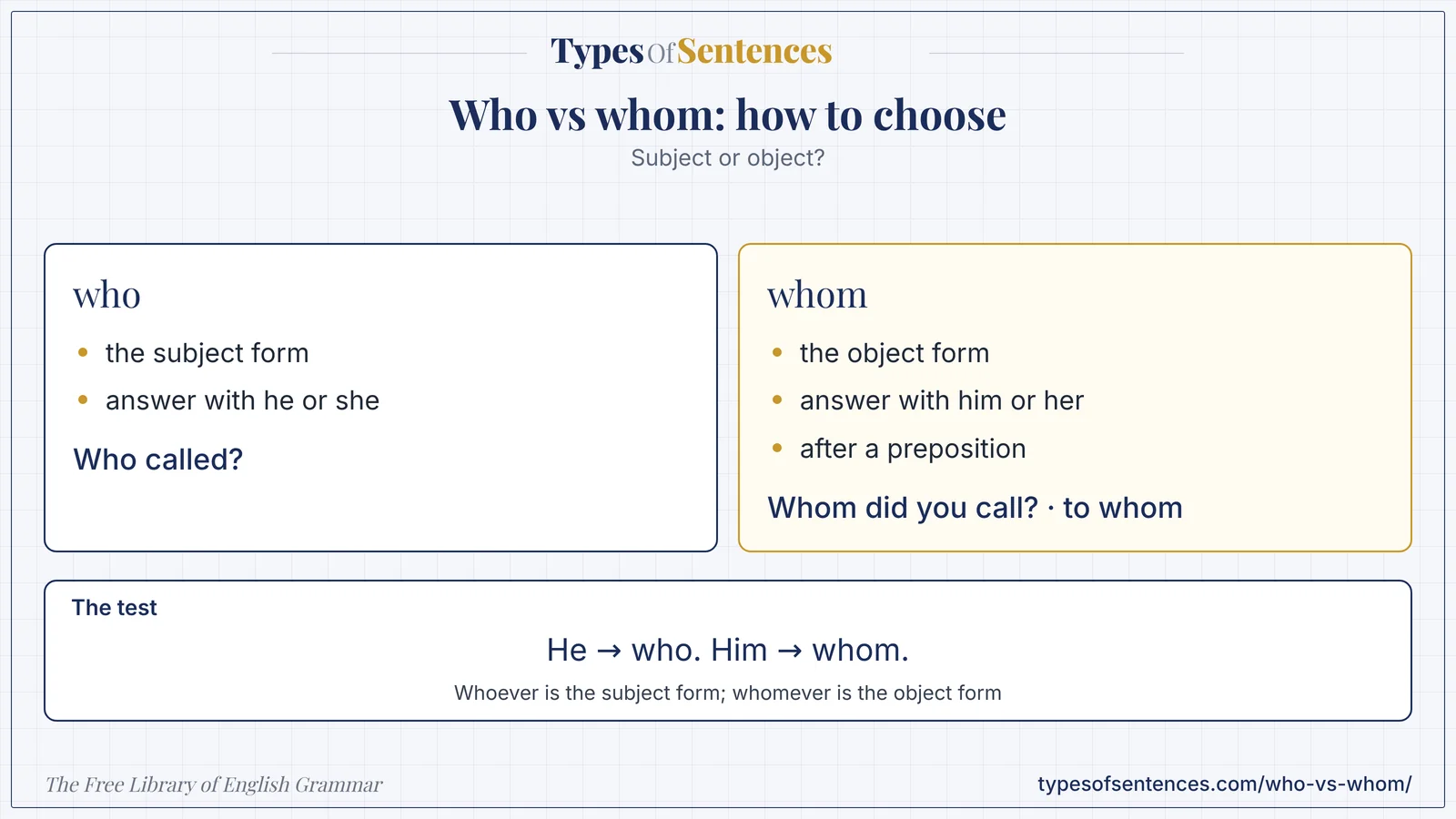
Who does the action: Who called? Whom receives it: You called whom? Both words ask about a person; they differ in the job they do in the sentence.
Why it matters: If you cannot decide, answer the question in your head. He called means who. You called him means whom. The match of m in him and whom is the memory aid.
Summary: Who is the subject form and whom is the object form of the pronoun that asks about or refers to a person. The tests are: (1) answer with he or she (who) or him or her (whom); (2) after a preposition use whom (to whom, for whom); (3) reorder the sentence into a statement and see whether the word is a subject or an object; (4) inside a relative clause, decide the pronoun’s job within that clause, not within the main sentence. In informal speech and writing, who is often used for both; in formal writing whom is used for objects. The compound forms are whoever (subject) and whomever (object). Whose is the possessive and who’s is the contraction of who is or who has.
- Who = subject; whom = object.
- He or she → who; him or her → whom.
- After a preposition: whom.
- Whose = possessive; who’s = who is.
What You’ll Learn
- 1. Who vs Whom: The Short Answer
- 2. Who in a Sentence: 20 Examples of the Subject Form
- 3. Whom in a Sentence: 20 Examples of the Object Form
- 4. Who or Whom? Four Tests
- 5. When to Use Whom: Formal and Informal Usage
- 6. Common Mistakes With Who and Whom
- 7. Exercises
- 8. Test Your Knowledge
- 9. Frequently Asked Questions
- 10. Conclusion
1. Who vs Whom: The Short Answer
| Who | Whom | |
|---|---|---|
| case | subject | object |
| replace with | he or she | him or her |
| after a preposition? | no | yes: to whom, with whom |
| example (question) | Who called? | Whom did you call? |
| example (relative clause) | the man who called | the man whom I called |
| formality | neutral | formal; rare in speech |
| compound form | whoever | whomever |
| Memory aid | Idea |
|---|---|
| m in him and whom | both end in m and both are object forms |
| he and who | neither has an m and both are subject forms |
| who ends in o, like who is | when you can say who is or who has, use who |
The same case system governs I and me, he and him, and they and them; it is described in the advanced chapter on pronoun concepts.
2. Who in a Sentence: 20 Examples of the Subject Form
In each of these examples, who is the subject of a verb. Each sentence can be answered or rewritten with he or she in place of who.
| Who in a sentence | Job of who |
|---|---|
| Who called? | subject of called |
| Who is your teacher? | subject of is |
| Who wrote this book? | subject of wrote |
| I know who won. | subject of won |
| She is the woman who helped me. | subject of helped |
| The man who lives next door is a doctor. | subject of lives |
| Who knows the answer? | subject of knows |
| Tell me who is coming. | subject of is coming |
| Anyone who studies will pass. | subject of studies |
| Who was at the door? | subject of was |
| He is a teacher who loves his job. | subject of loves |
| Who do you think will win? | subject of will win |
| The students who passed celebrated. | subject of passed |
| Who left the light on? | subject of left |
| I wonder who is calling. | subject of is calling |
| The person who called is here. | subject of called |
| Who could have done it? | subject of could have done |
| They are people who care. | subject of care |
| Who made this cake? | subject of made |
| Ask who is responsible. | subject of is |
Notice Who do you think will win?. Although do you think sits between who and its verb, who is the subject of will win (you think he will win), so who is correct.
3. Whom in a Sentence: 20 Examples of the Object Form
In each of these examples, whom is the object of a verb or a preposition. Each sentence can be rewritten with him or her in place of whom.
| Whom in a sentence | Job of whom |
|---|---|
| Whom did you call? | object of call |
| To whom did you speak? | object of to |
| The woman whom I met was kind. | object of met |
| With whom are you going? | object of with |
| Whom do you trust? | object of trust |
| The man to whom I gave the book left. | object of to |
| She is the teacher whom everyone admires. | object of admires |
| For whom is this gift? | object of for |
| Whom should we invite? | object of invite |
| The students whom she taught passed. | object of taught |
| I do not know whom to ask. | object of ask |
| He is someone whom I respect. | object of respect |
| From whom did you hear this? | object of from |
| Whom did they choose? | object of choose |
| The people with whom he worked were friendly. | object of with |
| About whom were you talking? | object of about |
| She is a person whom you can trust. | object of trust |
| Whom did she marry? | object of marry |
| The author whom I admire most is Austen. | object of admire |
| To whom it may concern, I am writing. | object of to |
Most of these sentences are formal. In everyday speech many people say Who did you call? and Who do you trust?; the guide below explains when each form is expected.
4. Who or Whom? Four Tests
| Test | How it works | Example |
|---|---|---|
| 1 the he/him test | answer the question: if he or she fits, use who; if him or her fits, use whom | ___ did you call? → You called him. → whom |
| 2 the preposition test | after a preposition (to, with, for, from), use whom | With ___ are you going? → whom |
| 3 the reorder test | turn the question into a statement | ___ is calling? → He is calling. → who |
| 4 the clause test | inside a relative clause, find the pronoun’s own job | the man ___ I met → I met him → whom · the man ___ lives here → he lives here → who |
Fill in: (Who/Whom) is the person (who/whom) you asked, and with (who/whom) did you speak?
- First blank: ___ is the person; the answer is He is the person, so Who.
- Second blank: the person ___ you asked; you asked him, so whom (in formal writing).
- Third blank: with ___; a preposition takes whom.
- Result: Who is the person whom you asked, and with whom did you speak? (the sentence is invented)
5. When to Use Whom: Formal and Informal Usage
| Situation | Formal writing | Informal writing and speech |
|---|---|---|
| object of a verb at the start of a question | Whom did you invite? | Who did you invite? (very common) |
| object after a preposition | To whom did you speak? | Who did you speak to? (preposition at the end) |
| relative clause object | the man whom I met | the man who I met or the man I met |
| subject | who | who |
| after than or as | than whom (rare) | avoid |
| Related forms | Meaning | Example |
|---|---|---|
| whoever | any person (subject) | Whoever wins gets the prize. |
| whomever | any person (object) | Invite whomever you like. |
| whose | belonging to which person | Whose coat is this? |
| who’s | who is, or who has | Who’s there? · Who’s been here? |
The relative clauses in which these forms appear are described in the Intermediate chapter on noun clauses, and the look-alike pair whose and who’s follows the same rule as its and it’s: the possessive has no apostrophe.
6. Common Mistakes With Who and Whom
| Mistake | Example | Correction |
|---|---|---|
| whom for a subject (overcorrection) | *Whom is calling? | Who is calling? |
| who after a preposition (formal) | *To who did you speak? | To whom did you speak? |
| whom before a verb | *The man whom lives here is kind. | The man who lives here is kind. |
| who for an object in formal writing | *The woman who I met was kind. | The woman whom I met was kind. |
| confusing whose and who’s | *Who’s coat is this? | Whose coat is this? |
| whom in a clause after think | *Whom do you think is coming? | Who do you think is coming? |
| whomever for a subject | *Give it to whomever wins. | Give it to whoever wins. |
| who for an indirect object (formal) | *Give who the book? | Give whom the book? |
| whom after a linking verb | *It was whom I saw. | It was he whom I saw. or He was the one whom I saw. |
| mixing forms in one sentence | *Who did you give it to, whom you trust? | To whom did you give it, the person you trust? |
Fix: Whom is the person who I should ask, and to who should I send the form?
- Whom is the person: He is the person, so the subject Who is correct.
- who I should ask: I should ask him, so in formal writing whom.
- to who: after a preposition, use to whom.
- Result: Who is the person whom I should ask, and to whom should I send the form? (the sentence is invented)
Recap in 12 seconds
Watch the lesson build itself: Who is the subject form and whom the object form; the he or him test settles most cases. The video has no sound.
Exercises
Part A: Choose Who or Whom (Exercises 1–10)
Exercise 1: ___ called?
Show Answer
Answer: Who.
Exercise 2: ___ did you call?
Show Answer
Answer: Whom (formal).
Exercise 3: To ___ did you speak?
Show Answer
Answer: whom.
Exercise 4: The man ___ lives next door is a doctor.
Show Answer
Answer: who.
Exercise 5: The woman ___ I met was kind.
Show Answer
Answer: whom (formal).
Exercise 6: ___ wrote this book?
Show Answer
Answer: Who.
Exercise 7: With ___ are you going?
Show Answer
Answer: whom.
Exercise 8: I know ___ won.
Show Answer
Answer: who.
Exercise 9: I do not know ___ to ask.
Show Answer
Answer: whom.
Exercise 10: ___ do you think will win?
Show Answer
Answer: Who.
Part B: Apply the Test (Exercises 11–18)
Exercise 11: Which test fits ___ is calling?
Show Answer
Answer: he → who.
Exercise 12: Which test fits You called ___.
Show Answer
Answer: him → whom.
Exercise 13: Which word follows for: who or whom?
Show Answer
Answer: whom.
Exercise 14: Choose: Anyone (who/whom) studies will pass.
Show Answer
Answer: who.
Exercise 15: Choose: He is someone (who/whom) I respect.
Show Answer
Answer: whom (formal).
Exercise 16: Choose: Give it to (whoever/whomever) wins.
Show Answer
Answer: whoever (subject of wins).
Exercise 17: Choose: Invite (whoever/whomever) you like.
Show Answer
Answer: whomever.
Exercise 18: Choose: (Whose/Who’s) coat is this?
Show Answer
Answer: Whose.
Part C: Formal and Informal (Exercises 19–24)
Exercise 19: Rewrite informally: Whom did you invite?
Show Answer
Answer: Who did you invite?
Exercise 20: Rewrite formally: Who did you speak to?
Show Answer
Answer: To whom did you speak?
Exercise 21: Is Who did you call? acceptable in speech?
Show Answer
Answer: Yes; it is very common.
Exercise 22: Is To who did you speak? acceptable in formal writing?
Show Answer
Answer: No; use to whom.
Exercise 23: What does who’s mean?
Show Answer
Answer: who is or who has.
Exercise 24: What is the possessive form?
Show Answer
Answer: whose.
Part D: Correct the Errors (Exercises 25–30)
Exercise 25: Correct: *Whom is calling?
Show Answer
Answer: Who is calling?
Exercise 26: Correct: *To who did you speak?
Show Answer
Answer: To whom did you speak?
Exercise 27: Correct: *The man whom lives here is kind.
Show Answer
Answer: The man who lives here is kind.
Exercise 28: Correct: *Who’s coat is this?
Show Answer
Answer: Whose coat is this?
Exercise 29: Correct: *Whom do you think is coming?
Show Answer
Answer: Who do you think is coming?
Exercise 30: Correct: *Give it to whomever wins.
Show Answer
Answer: Give it to whoever wins.
Test Your Knowledge
Ready to check what you learned? Answer all 10 questions, then submit. You need 80% (8 of 10) to pass. Your answers are not stored.
View correct answers and explanations
Question 1: Which is the subject form?
✓ Correct Answer: C – who
Who.
Question 2: To ___ did you speak?
✓ Correct Answer: A – whom
After a preposition.
Question 3: Which test works for who?
✓ Correct Answer: B – replace with he or she
The he/she test.
Question 4: ___ wrote this book?
✓ Correct Answer: D – Who
A subject.
Question 5: The man ___ I met was kind. (formal)
✓ Correct Answer: B – whom
An object.
Question 6: Give it to ___ wins.
✓ Correct Answer: A – whoever
A subject of wins.
Question 7: ___ coat is this?
✓ Correct Answer: D – Whose
Possessive.
Question 8: Which is a contraction?
✓ Correct Answer: C – who’s
Who is or who has.
Question 9: Who do you think will win? In this sentence who is
✓ Correct Answer: A – a subject
Subject of will win.
Question 10: In informal speech, who is often used for
✓ Correct Answer: B – both subject and object
Informal usage.
Frequently Asked Questions
What is the difference between who vs whom?
Who is the subject form (Who called?), and whom is the object form (Whom did you call?). If he or she fits, use who; if him or her fits, use whom.
How do I know who or whom?
Answer the question in your head. He called means who; You called him means whom. After a preposition always use whom. These are the same tests for who or whom.
When to use whom?
Use whom when the pronoun is the object of a verb or a preposition and the writing is formal: To whom did you speak? The woman whom I met was kind. That is when to use whom.
How do I use whom in a sentence?
Use whom as the object: Whom did you invite? The man to whom I gave the book left. Each of those is a whom in a sentence example where him or her could take its place.
Is it okay to use who instead of whom?
In informal speech and writing, yes: Who did you call? is common. In formal and academic writing, use whom for objects, and especially after prepositions.
What is the difference between whoever and whomever?
Whoever is the subject form (Whoever wins gets the prize), and whomever is the object form (Invite whomever you like). The same he or him test works for both.
What is the difference between whose and who’s?
Whose is possessive (Whose coat is this?), and who’s means who is or who has (Who’s there?). The possessive never has an apostrophe.
Conclusion
You now know the rule for who vs whom: who is the subject form and whom is the object form, and the he or him test settles most cases. You have seen who in a sentence and whom in a sentence, when to use whom, the formal and informal usage, whoever and whomever, and the common mistakes.
When you are unsure, answer the question with he or him. Next, study another pair that depends on a verb’s object: lay and lie.
- Garner, Bryan A. Garner’s Modern English Usage. 5th ed. Oxford University Press, 2022.: the entry on who and whom, including the informal use of who.
- Swan, Michael. Practical English Usage. 4th ed. Oxford University Press, 2016.: who and whom, and relative pronouns.
- Huddleston, Rodney, and Geoffrey K. Pullum. The Cambridge Grammar of the English Language. Cambridge University Press, 2002.: case and the pronouns who and whom (chapters 5 and 17).
- Merriam-Webster Dictionary: whom: the dictionary entry (not opened when this page was written).
Last reviewed: October 29, 2026. How it was made: drafted with AI assistance, then checked with automated tests (structure, links, answer keys, spelling) and against the sources above. A person has not yet read this chapter line by line. Found a mistake? Report it.