What is the difference between lay vs lie? Lie means to recline or be in a position, and it never takes an object: I lie on the sofa. Lay means to put or place something, and it always takes an object: I lay the book on the table. The confusion comes from the forms: the past tense of lie is lay (Yesterday I lay in bed), and the past tense of lay is laid (Yesterday I laid the book down). A third verb, lie meaning to tell an untruth, is regular: lie, lied, lied.
Whether the question is lie vs lay or laying vs lying, the same test applies. This page gives the table of forms, shows lie or lay in 50 example sentences (20 for each of the two irregular verbs and 10 for the regular lie), and explains two tests, the idioms, and the common mistakes with lay and lie. It ends with 30 exercises and a 10-question quiz.
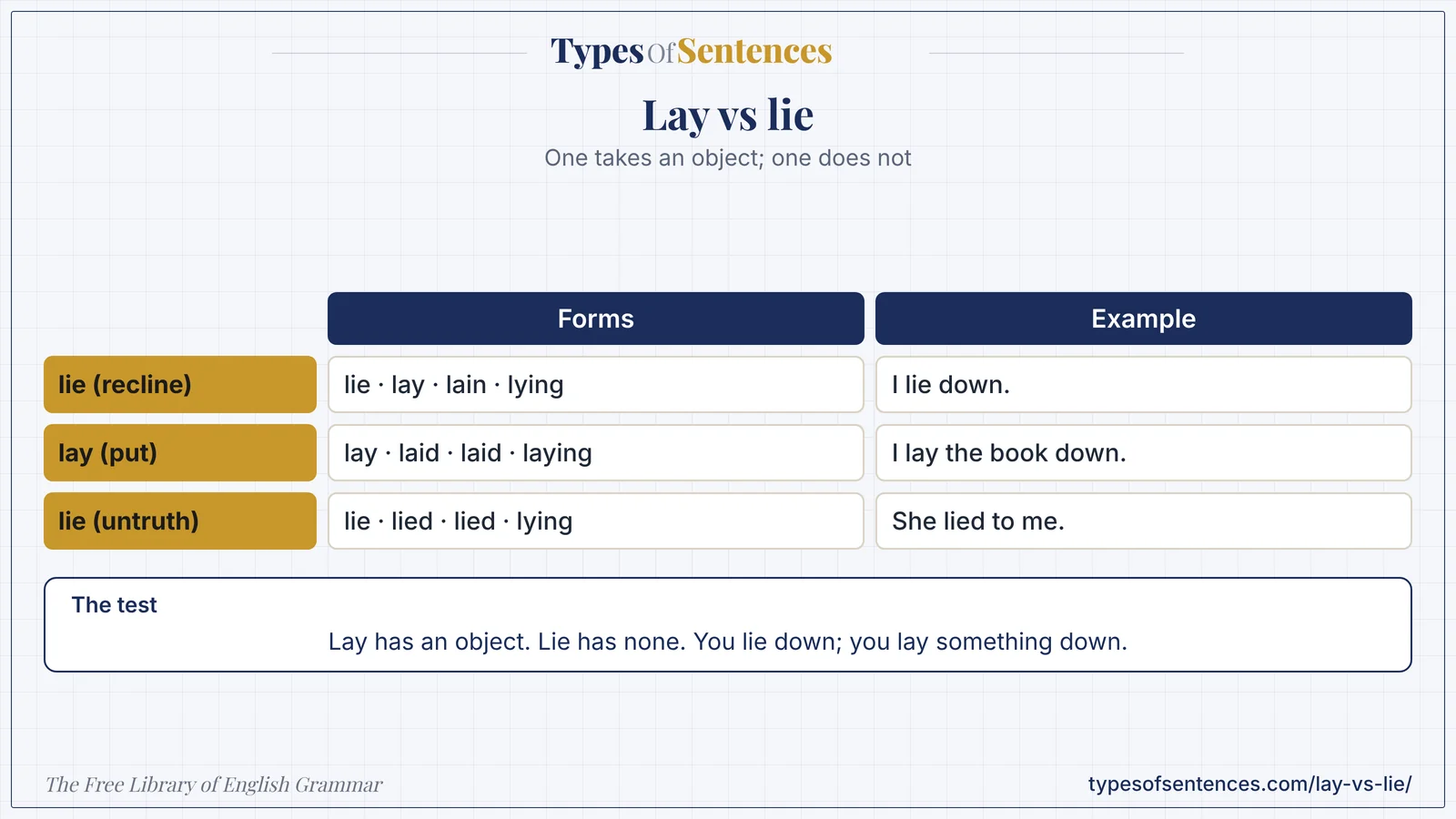
To lie is to rest; to lay is to place. Something that lies is already there. Something that is laid is put there by someone.
Why it matters: If the verb has an object (the book), use lay. If there is no object (I am tired; I will ___ down), use lie.
Summary: Lie (to recline) is intransitive and irregular: lie, lay, lain, lying. Lay (to put) is transitive and irregular: lay, laid, laid, laying. Lie (to tell an untruth) is regular: lie, lied, lied, lying. The object test: if the verb has a direct object, use lay; if not, use lie. The down test: you lie down, but you lay something down. The past of lie (lay) is the same as the present of lay, which is the source of most errors. Hens lay eggs (an object); people lie on beds (no object). Idioms: lie low, lie in wait, lay off, lay claim, lay the table.
- Lie = recline; no object.
- Lay = put; has an object.
- Lie, lay, lain / lay, laid, laid.
- Lie (untruth) = lied.
What You’ll Learn
- 1. Lay vs Lie: The Short Answer
- 2. Lie or Lay? Lie in a Sentence: 20 Examples of Reclining
- 3. Lay in a Sentence: 20 Examples of Putting
- 4. Lie, Lied, Lied: The Regular Verb for an Untruth
- 5. Idioms With Lay and Lie
- 6. Common Mistakes With Lay and Lie
- 7. Exercises
- 8. Test Your Knowledge
- 9. Frequently Asked Questions
- 10. Conclusion
1. Lay vs Lie: The Short Answer
| Verb | Meaning | Object? | Present | Past | Past participle | -ing form |
|---|---|---|---|---|---|---|
| lie | to recline; to be in a position | no (intransitive) | lie, lies | lay | lain | lying |
| lay | to put or place something | yes (transitive) | lay, lays | laid | laid | laying |
| lie (untruth) | to say what is not true | no | lie, lies | lied | lied | lying |
| Test | How it works | Example |
|---|---|---|
| the object test | if the verb has a direct object, use lay; if it has none, use lie | I will ___ the book on the table. (object: book) → lay |
| the down test | you lie down; you lay something down | I will ___ down. → lie · I will ___ it down. → lay |
| the place test | replace with place; if it fits, use lay | She ___ the keys on the counter. → placed ✓ → laid |
| the recline test | replace with rest or recline; if it fits, use lie | The cat ___ in the sun. → lies |
The pair lie vs lay causes the most trouble in the past tense, and laying vs lying causes the most trouble in the -ing form. The irregular forms are the reason for the confusion; they are listed with the other irregular verbs in the chapter on irregular verbs, and the participle lain is covered in the chapter on the past participle.
2. Lie or Lay? Lie in a Sentence: 20 Examples of Reclining
In each of these examples, lie (or lay as its past, or lain as its participle) has no object: someone or something is in a position. Each sentence can be rewritten with rest, recline, or be (in a place).
| Lie in a sentence | Form |
|---|---|
| I lie down every afternoon. | present |
| She is lying on the sofa. | present participle |
| The cat lies in the sun. | present, third person |
| Yesterday I lay in bed until noon. | past |
| The village lay in ruins. | past |
| He has lain awake all night. | past participle |
| The keys lie on the table. | present (they are there) |
| Lie down and rest. | imperative |
| The book lay open on the desk. | past |
| She lay on the grass and watched the clouds. | past |
| The documents had lain there for years. | past participle |
| The road lies ahead. | present |
| He was lying in wait. | present participle |
| Dogs lie at their owners’ feet. | present |
| The lake lay calm. | past |
| They have lain low since the scandal. | past participle |
| I am going to lie down for an hour. | infinitive |
| The old city lies at the foot of the mountain. | present |
| The snow lay thick on the ground. | past |
| She lies awake worrying. | present, third person |
Notice that the past tense is lay: The village lay in ruins. This is the same word as the present tense of lay (I lay the book down), which is why the two verbs are so easily confused.
3. Lay in a Sentence: 20 Examples of Putting
In each of these examples, lay (or laid) has an object: someone puts something somewhere. Each sentence can be rewritten with place or put.
| Lay in a sentence | Form |
|---|---|
| Lay the book on the table. | imperative |
| She lays the cards on the table. | present, third person |
| He laid the baby in the crib. | past |
| The hens lay eggs every morning. | present |
| I have laid the table for dinner. | past participle |
| They are laying a new carpet. | present participle |
| The workers laid the bricks. | past |
| Please lay your coat on the bed. | imperative |
| She had laid her keys on the counter. | past participle |
| The company laid off fifty workers. | past (with off) |
| We laid the foundation last year. | past |
| He lays the blame on others. | present, third person |
| The bird laid three eggs. | past |
| Lay the napkins beside the plates. | imperative |
| The soldiers laid down their arms. | past |
| She has laid a trap. | past participle |
| He is laying the groundwork. | present participle |
| I lay the paper flat before I cut it. | present |
| They laid claim to the land. | past |
| The storm laid waste to the town. | past |
The verb lay is also used for what hens do: The hens lay eggs. The object is eggs, so lay is correct. A related pair of transitive and intransitive verbs is sit and set, rise and raise; the difference is explained in the guide to transitive and intransitive verbs.
4. Lie, Lied, Lied: The Regular Verb for an Untruth
| Lie (untruth) in a sentence | Form |
|---|---|
| Do not lie to me. | present |
| He lied about his age. | past |
| She has lied before. | past participle |
| Why are you lying? | present participle |
| Children sometimes lie to avoid trouble. | present |
| The witness lied under oath. | past |
| It is wrong to lie. | infinitive |
| They had lied to the police. | past participle |
| He lies without blushing. | present, third person |
| She never lied to her friends. | past |
| Which lie? | Past | Past participle | Example |
|---|---|---|---|
| to recline | lay | lain | She lay in bed. She has lain there all day. |
| to tell an untruth | lied | lied | She lied. She has lied before. |
| to put | — | — | this meaning belongs to lay, not lie |
Only the context tells which lie is meant, and the two share the form lying: She is lying on the sofa (reclining) and She is lying about it (untruth). The other irregular and regular verbs are listed in the list of verbs.
5. Idioms With Lay and Lie
| Idiom | Verb | Meaning | Example |
|---|---|---|---|
| lie low | lie | stay hidden | He is lying low until the trouble passes. |
| lie in wait | lie | wait in hiding | The cat lay in wait. |
| lie ahead | lie | be in the future | Great things lie ahead. |
| lie in state | lie | be displayed after death | The president lay in state. |
| lay off | lay | dismiss from work | The firm laid off fifty workers. |
| lay claim to | lay | assert ownership of | They laid claim to the land. |
| lay the table | lay | set it with plates | She lays the table every evening. |
| lay down the law | lay | state rules firmly | The coach laid down the law. |
| lay waste to | lay | destroy completely | The storm laid waste to the town. |
| the lay of the land | lay (noun) | the layout of the land | Check the lay of the land first. |
| laid-back | laid (adjective) | relaxed | He is a laid-back person. |
| lay bare | lay | reveal | The report laid bare the truth. |
6. Common Mistakes With Lay and Lie
| Mistake | Example | Correction |
|---|---|---|
| lay without an object | *I am going to lay down. | I am going to lie down. |
| lie with an object | *Lie the book on the table. | Lay the book on the table. |
| laid for the past of lie | *Yesterday I laid in bed. | Yesterday I lay in bed. |
| lay for the past of lay | *She lay the keys down. (past) | She laid the keys down. |
| laid as the participle of lie | *He has laid there all day. | He has lain there all day. |
| lied for reclining | *She lied down. | She lay down. |
| laying for lying | *He is laying on the sofa. | He is lying on the sofa. |
| lying for laying | *She is lying the table. | She is laying the table. |
| lain for laid | *She had lain the book down. | She had laid the book down. |
| lay for lie in a command | *Lay down and rest. | Lie down and rest. |
Fix: Yesterday I laid on the sofa, and my brother lay the blanket over me, but I have laid there all morning, so now I will lay down again.
- I laid on the sofa: no object, past of lie, so I lay on the sofa.
- my brother lay the blanket: an object, past of lay, so laid the blanket.
- I have laid there: no object, past participle of lie, so I have lain there.
- I will lay down: no object, so I will lie down.
- Result: Yesterday I lay on the sofa, and my brother laid the blanket over me, but I have lain there all morning, so now I will lie down again. (the sentence is invented)
Recap in 12 seconds
Watch the lesson build itself: Lie means to recline and has no object; lay means to put and has an object; lie meaning an untruth is regular. The video has no sound.
Exercises
Part A: Choose Lay or Lie (Exercises 1–10)
Exercise 1: I will ___ down for an hour.
Show Answer
Answer: lie (no object).
Exercise 2: Please ___ the book on the table.
Show Answer
Answer: lay (object: book).
Exercise 3: The cat ___ in the sun.
Show Answer
Answer: lies.
Exercise 4: She ___ the keys on the counter.
Show Answer
Answer: lays (or laid in the past).
Exercise 5: The hens ___ eggs every morning.
Show Answer
Answer: lay.
Exercise 6: ___ down and rest.
Show Answer
Answer: Lie.
Exercise 7: He is ___ on the sofa.
Show Answer
Answer: lying.
Exercise 8: She is ___ the table for dinner.
Show Answer
Answer: laying.
Exercise 9: The documents ___ on the desk.
Show Answer
Answer: lie.
Exercise 10: ___ your coat on the bed.
Show Answer
Answer: Lay.
Part B: Choose the Right Form (Exercises 11–20)
Exercise 11: Past of lie (recline): Yesterday I ___ in bed.
Show Answer
Answer: lay.
Exercise 12: Past participle of lie: He has ___ there all day.
Show Answer
Answer: lain.
Exercise 13: Past of lay: She ___ the baby in the crib.
Show Answer
Answer: laid.
Exercise 14: Past participle of lay: I have ___ the table.
Show Answer
Answer: laid.
Exercise 15: Past of lie (untruth): He ___ about his age.
Show Answer
Answer: lied.
Exercise 16: Past participle of lie (untruth): She has ___ before.
Show Answer
Answer: lied.
Exercise 17: -ing of lie (recline): He is ___ down.
Show Answer
Answer: lying.
Exercise 18: -ing of lay: They are ___ a new carpet.
Show Answer
Answer: laying.
Exercise 19: The village ___ in ruins. (past of lie)
Show Answer
Answer: lay.
Exercise 20: The workers ___ the bricks. (past of lay)
Show Answer
Answer: laid.
Part C: Tests and Idioms (Exercises 21–25)
Exercise 21: Which test fits I will ___ it down?
Show Answer
Answer: the object test → lay.
Exercise 22: Which verb fits He is ___ low until the trouble passes?
Show Answer
Answer: lying (lie low).
Exercise 23: Which verb fits The firm ___ off fifty workers (past)?
Show Answer
Answer: laid.
Exercise 24: Which verb fits They ___ claim to the land (past)?
Show Answer
Answer: laid.
Exercise 25: Which verb fits Great things ___ ahead?
Show Answer
Answer: lie.
Part D: Correct the Errors (Exercises 26–30)
Exercise 26: Correct: *I am going to lay down.
Show Answer
Answer: I am going to lie down.
Exercise 27: Correct: *Yesterday I laid in bed.
Show Answer
Answer: Yesterday I lay in bed.
Exercise 28: Correct: *He has laid there all day.
Show Answer
Answer: He has lain there all day.
Exercise 29: Correct: *She lied down.
Show Answer
Answer: She lay down.
Exercise 30: Correct: *Lay down and rest.
Show Answer
Answer: Lie down and rest.
Test Your Knowledge
Ready to check what you learned? Answer all 10 questions, then submit. You need 80% (8 of 10) to pass. Your answers are not stored.
View correct answers and explanations
Question 1: Which verb takes an object?
✓ Correct Answer: A – lay
Lay.
Question 2: The past tense of lie (recline) is
✓ Correct Answer: B – lay
Lay.
Question 3: The past participle of lay is
✓ Correct Answer: C – laid
Laid.
Question 4: I will ___ down.
✓ Correct Answer: D – lie
No object.
Question 5: She ___ the keys on the counter. (past)
✓ Correct Answer: A – laid
An object; past of lay.
Question 6: The past participle of lie (recline) is
✓ Correct Answer: B – lain
Lain.
Question 7: Which is the regular verb?
✓ Correct Answer: C – lie (untruth)
Lied.
Question 8: He is ___ on the sofa.
✓ Correct Answer: D – lying
Reclining.
Question 9: She is ___ the table.
✓ Correct Answer: A – laying
An object.
Question 10: The hens ___ eggs.
✓ Correct Answer: B – lay
An object (eggs).
Frequently Asked Questions
What is the difference between lay vs lie?
Lie means to recline and takes no object (I lie on the sofa). Lay means to put something down and takes an object (I lay the book on the table).
How do I choose lay or lie?
Check for an object. If the verb has a direct object (the thing put down), use lay. If there is no object, use lie. The down test also works: you lie down, but you lay something down.
What is the past tense of lie?
For reclining, the past tense is lay and the past participle is lain (She lay in bed. She has lain there all day). For telling an untruth, the past and participle are both lied.
What is the past tense of lay?
The past tense and the past participle of lay are both laid: She laid the keys down. She has laid the table.
Is it laying or lying?
Lying is the -ing form of lie (He is lying on the sofa), and laying is the -ing form of lay (She is laying the table).
Is it lay down or lie down?
For a person reclining, it is lie down: I will lie down. You can lay an object down: I will lay the book down. Many people say lay down informally, but careful writing keeps the two apart.
Do hens lay or lie eggs?
Hens lay eggs. The verb has an object (eggs), so it is lay.
Conclusion
You now know the rule for lay vs lie: lie means to recline and has no object, lay means to put and has an object, and the forms are lie, lay, lain and lay, laid, laid. You have seen lie in a sentence and lay in a sentence, the regular verb for an untruth, the idioms, and the common mistakes.
Check for an object before you choose, and learn the three forms of each verb. Next, study the lists and references in this series, such as the guide to transitive and intransitive verbs.
- Garner, Bryan A. Garner’s Modern English Usage. 5th ed. Oxford University Press, 2022.: the entry on lay and lie, including the forms and the common errors.
- Swan, Michael. Practical English Usage. 4th ed. Oxford University Press, 2016.: lie and lay.
- Strunk, William, Jr., and E. B. White. The Elements of Style. 4th ed. Longman, 1999.: the entry on lay and lie among the words commonly misused.
- Merriam-Webster Dictionary: lay and lie: the dictionary entries (not opened when this page was written).
Last reviewed: October 29, 2026. How it was made: drafted with AI assistance, then checked with automated tests (structure, links, answer keys, spelling) and against the sources above. A person has not yet read this chapter line by line. Found a mistake? Report it.