An absolute phrase is a group of words made of a noun or pronoun plus a participle (or another modifier) that modifies a whole clause rather than a single word: Her hands trembling, she opened the letter. The phrase has its own subject (her hands), so it does not depend on the subject of the main clause, and that is why it is called absolute: it is “free” from the rest of the sentence.
This chapter explains the structure of the absolute phrase, with absolute phrase examples. You will see the absolute construction with a present participle, a past participle, and with no participle at all, the role of with, how absolute phrases add detail in description and narrative, how to punctuate them, and how they differ from participial phrases. Thirty exercises and a quiz follow.
This phrase adds a detail about a scene, a cause, or a circumstance: how she looked, why the others left, what was happening around her. It works like a short, reduced clause with its own subject.
Why it matters: Because it is a compact, literary structure, it makes description vivid. It is not used much in speech, but it is a mark of polished writing.
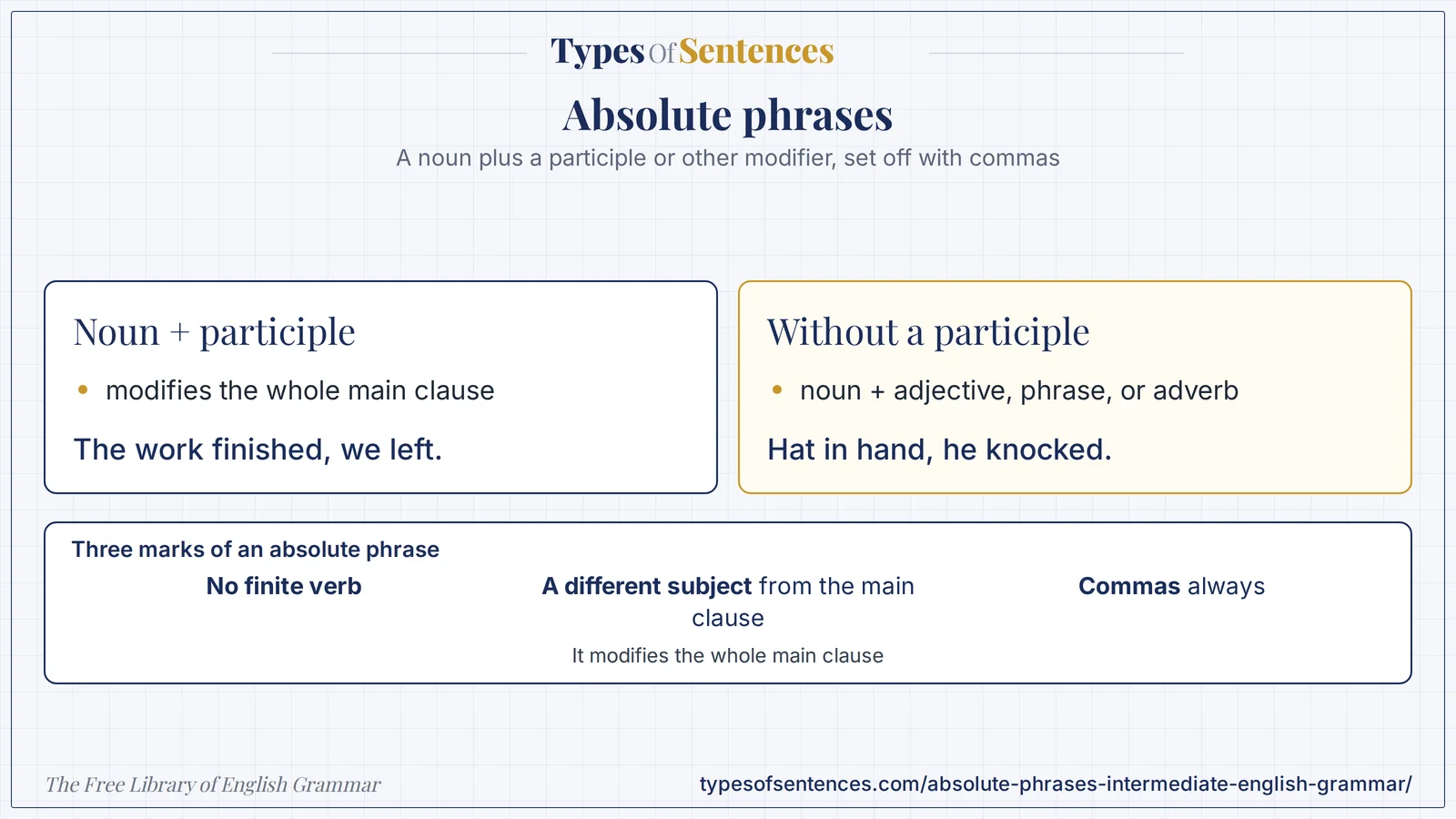
Summary: An absolute phrase = noun or pronoun + participle (+ modifiers), or noun + adjective, prepositional phrase, or adverb. It modifies the whole main clause, has no finite verb, and is set off with commas. The traditional name is the nominative absolute.
- Structure: noun + participle: The work finished, we left.
- Without a participle: Hat in hand, he knocked.
- The subject of the phrase is different from the subject of the main clause.
- Always set off with commas; a participial phrase must share the main subject, but this phrase does not.
What You’ll Learn
- 1. What Is an Absolute Phrase?
- 2. Structure of an Absolute Phrase
- 3. Uses of Absolute Phrases
- 4. Absolute Phrases with “With”
- 5. Absolute Phrase vs. Participial Phrase
- 6. Punctuation of Absolute Phrases
- 7. Fixed Absolute Expressions
- 8. Style: When to Use Absolute Phrases
- 9. Where Writers Use Them
- 10. Common Errors with Absolute Phrases
- 11. Exercises
- 12. Test Your Knowledge
- 13. Frequently Asked Questions
- 14. Conclusion
1. What Is an Absolute Phrase?
It modifies a whole clause by adding a circumstance, a cause, a condition, or a descriptive detail. It is made of a noun or pronoun and a modifier, and it has no finite verb. It is sometimes called an absolute construction or a nominative absolute, because its subject is in the nominative (subject) case.
| Sentence | Absolute phrase | Subject of the phrase |
|---|---|---|
| Her hands trembling, she opened the letter. | her hands trembling | her hands |
| The work finished, we left. | the work finished | the work |
| The sun having set, we lit a fire. | the sun having set | the sun |
| He stood at the door, hat in hand. | hat in hand | hat |
The phrase gives extra information. It is not essential, and the sentence is complete without it: She opened the letter; We left; He stood at the door.
2. Structure of an Absolute Phrase
The structure has two required parts: a noun or pronoun (the “subject”) and a modifier, usually a participle.
| Type | Structure | Example |
|---|---|---|
| present participle | noun + -ing (+ object or modifier) | The rain falling steadily, we stayed in. |
| past participle | noun + past participle | The work finished, we left. |
| perfect participle | noun + having + past participle | The sun having set, we lit a fire. |
| with being or been (often omitted) | noun + (being) + adjective | The room (being) empty, she sat down. |
| no participle: adjective | noun + adjective | Eyes wide, she stared. |
| no participle: prepositional phrase | noun + prepositional phrase | Hat in hand, he knocked. |
| no participle: adverb | noun + adverb | Dinner over, we went out. |
The participle here is not the verb of the sentence. It cannot be a finite verb: The work was finished, we left is a comma splice, not an absolute construction. For participles in general, see the chapter on participles.
3. Uses of Absolute Phrases
This phrase can express several relationships with the main clause. The relationship is understood from the context, and not stated by a conjunction.
| Meaning | Absolute phrase | Equivalent clause |
|---|---|---|
| Time | The meeting over, we went home. | After the meeting was over, we went home. |
| Cause | The road being icy, we drove slowly. | Because the road was icy, we drove slowly. |
| Condition | Weather permitting, we will go. | If the weather permits, we will go. |
| Circumstance | She sat there, her eyes closed. | She sat there with her eyes closed. |
| Description (accompanying detail) | He entered, his coat dripping wet. | He entered, and his coat was dripping wet. |
The adverb clauses these phrases replace are in the chapter on adverb clauses. The phrase is a more compact and more literary choice.
- The crowd cheering wildly, the team ran onto the field. showing a circumstance
- Her homework done, she watched television. showing time
- The students having left, the teacher locked the door. with a perfect participle
4. Absolute Phrases with “With”
A with + noun + participle or adjective pattern works like one. It is very common in modern English.
| With with | Without with |
|---|---|
| With the sun setting, we lit a fire. | The sun setting, we lit a fire. |
| She sat with her eyes closed. | She sat, her eyes closed. |
| With the work finished, we left. | The work finished, we left. |
| He spoke with a smile on his face. | He spoke, a smile on his face. |
The with version is easier to read and more common in speech and in ordinary writing. The version without with is more formal and more literary. The with + noun phrase is technically a prepositional phrase with a clause-like object.
5. Absolute Phrase vs. Participial Phrase
The two phrases look alike, but they work differently. A participial phrase modifies a noun in the main clause and has no subject of its own. The absolute construction has its own subject and modifies the whole clause.
| Participial phrase | Absolute phrase |
|---|---|
| Walking home, she met Tom. (she is walking) | Her bag heavy, she walked home slowly. (the bag is heavy) |
| Exhausted, he slept. (he is exhausted) | His work finished, he slept. (the work is finished) |
| No subject inside the phrase | The phrase has its own subject |
| Modifies one noun (the subject) | Modifies the whole clause |
| A dangling error is possible | Cannot dangle, because it has a subject |
Because it has its own subject, it cannot be a dangling modifier. The rain falling, the match was canceled is correct, whereas the participial Walking home, the rain started is wrong. See the chapter on participial phrases.
6. Punctuation of Absolute Phrases
| Position | Example | Punctuation |
|---|---|---|
| Beginning | The work finished, we left. | comma after |
| Middle | We, the work finished, left. | commas on both sides (rare) |
| End | We left, the work finished. | comma before |
Without a comma, the phrase runs into the clause and the sentence is hard to read.
7. Fixed Absolute Expressions
Some absolute phrases have become fixed expressions.
| Expression | Example |
|---|---|
| all things considered | All things considered, the trip was a success. |
| weather permitting | We will play outside, weather permitting. |
| God willing | We will meet again, God willing. |
| that being said / that said | That being said, the plan has risks. |
| all else being equal | All else being equal, choose the cheaper one. |
| this done / that done | That done, we can go home. |
| time permitting | We will review the notes, time permitting. |
These phrases follow the pattern noun + participle but are used so often that they are learned as units. Weather permitting is a conditional absolute phrase with the meaning if the weather permits.
8. Style: When to Use Absolute Phrases
Absolute phrases are most useful in narrative and descriptive writing, where they add detail without adding clauses. They suit literary and formal styles.
| Plain version | With an absolute phrase |
|---|---|
| She walked into the room, and her heart was pounding. | She walked into the room, her heart pounding. |
| The soldiers marched, and their flags were waving. | The soldiers marched, flags waving. |
| Because the match was over, the fans left. | The match over, the fans left. |
Absolute phrases are rare in conversation and appear mostly in writing. Some style guides advise using them sparingly in business writing, because they can sound literary. Choose them where they improve the rhythm and clarity of a sentence.
9. Where Writers Use Them
These constructions are most common in descriptive and narrative writing, where they add a detail of circumstance without a new sentence. They can also express time, cause, and condition, which makes them useful in more formal prose.
| Meaning | Example |
|---|---|
| cause | The road being flooded, we turned back. |
| time | The meeting over, everyone went home. |
| condition | Weather permitting, the match will start at noon. |
| accompanying circumstance | She stood at the door, arms folded. |
| description of a person | He entered the room, hat in hand and eyes on the floor. |
| description of a scene | The sun having set, the street grew quiet. |
- The phrase is set off by commas because it adds information to the whole clause.
- It has its own subject (a noun), so it is not a dangling modifier even though it does not share the subject of the main clause.
- It sounds formal or literary when it uses having or being. Without the participle (arms folded, hat in hand), it is more common in everyday description.
- Do not overuse it. One such phrase in a paragraph adds variety; several in a row make prose heavy.
10. Common Errors with Absolute Phrases
| Error | Correction | Rule |
|---|---|---|
| The work was finished, we left. | The work finished, we left. / The work was finished, so we left. | an absolute phrase has no finite verb; this is a comma splice |
| The work finished we left. | The work finished, we left. | set off with a comma |
| Walking home, the rain started. | Walking home, I felt the rain start. / The rain starting, I hurried home. | participial phrase needs the right subject, or use an absolute phrase |
| Him being late, we left. | He being late, we left. | formal nominative case in the subject of an absolute phrase |
| The rain falling. We stayed in. | The rain falling, we stayed in. | a phrase alone is a fragment |
| With the work finishing, we left. (unclear) | With the work finished, we left. | choose the right participle |
Fix: The meeting over everyone went home and the lights off the building was quiet.
- The meeting over is an absolute phrase: put a comma after it.
- and the lights off is a second absolute phrase joined by and: separate it.
- Result: The meeting over, everyone went home, the lights off and the building quiet.
Recap in 12 seconds
Watch the lesson build itself: An absolute phrase has no finite verb, its own subject, and commas, and it modifies the whole main clause. The video has no sound.
Exercises
Part A: Recognizing Absolute Phrases (Exercises 1–6)
Exercise 1: Find the phrase: Her hands trembling, she opened the letter.
Show Answer
Answer: Her hands trembling.
Exercise 2: Find the phrase: The work finished, we left.
Show Answer
Answer: The work finished.
Exercise 3: Name the subject of the phrase: The sun having set, we lit a fire.
Show Answer
Answer: the sun.
Exercise 4: Find the phrase: He stood at the door, hat in hand.
Show Answer
Answer: hat in hand.
Exercise 5: Does an absolute phrase have a finite verb?
Show Answer
Answer: No.
Exercise 6: What is another name for the absolute construction?
Show Answer
Answer: Nominative absolute.
Part B: Structure (Exercises 7–12)
Exercise 7: Type: The rain falling steadily
Show Answer
Answer: Noun + present participle.
Exercise 8: Type: The work finished
Show Answer
Answer: Noun + past participle.
Exercise 9: Type: Eyes wide
Show Answer
Answer: Noun + adjective (no participle).
Exercise 10: Type: Hat in hand
Show Answer
Answer: Noun + prepositional phrase.
Exercise 11: Complete: The sun ___ set, we lit a fire. (perfect participle)
Show Answer
Answer: having.
Exercise 12: Is The work was finished an absolute phrase?
Show Answer
Answer: No. Was is a finite verb, so it is a clause.
Part C: Uses (Exercises 13–18)
Exercise 13: Meaning: The meeting over, we went home.
Show Answer
Answer: Time.
Exercise 14: Meaning: The road being icy, we drove slowly.
Show Answer
Answer: Cause.
Exercise 15: Meaning: Weather permitting, we will go.
Show Answer
Answer: Condition.
Exercise 16: Expand: The match over, the fans left.
Show Answer
Answer: After the match was over, the fans left.
Exercise 17: Reduce: Because the road was icy, we drove slowly.
Show Answer
Answer: The road being icy, we drove slowly.
Exercise 18: Reduce: After the meeting was over, we went home.
Show Answer
Answer: The meeting over, we went home.
Part D: With, and Participial vs Absolute (Exercises 19–24)
Exercise 19: Rewrite with with: The sun setting, we lit a fire.
Show Answer
Answer: With the sun setting, we lit a fire.
Exercise 20: Rewrite without with: She sat with her eyes closed.
Show Answer
Answer: She sat, her eyes closed.
Exercise 21: Participial or absolute: Walking home, she met Tom.
Show Answer
Answer: Participial.
Exercise 22: Participial or absolute: Her bag heavy, she walked home slowly.
Show Answer
Answer: Absolute.
Exercise 23: Which can dangle?
Show Answer
Answer: The participial phrase.
Exercise 24: Why can an absolute phrase not dangle?
Show Answer
Answer: Because it has its own subject.
Part E: Punctuation (Exercises 25–28)
Exercise 25: Punctuate: The work finished we left.
Show Answer
Answer: The work finished, we left.
Exercise 26: Punctuate: We left the work finished.
Show Answer
Answer: We left, the work finished.
Exercise 27: Punctuate: All things considered the trip was a success.
Show Answer
Answer: All things considered, the trip was a success.
Exercise 28: Punctuate: We will play outside weather permitting.
Show Answer
Answer: We will play outside, weather permitting.
Part F: Errors (Exercises 29–30)
Exercise 29: Fix it: The work was finished, we left.
Show Answer
Answer: The work finished, we left.
Exercise 30: Fix it: Him being late, we left.
Show Answer
Answer: He being late, we left. (formal)
Test Your Knowledge
Ready to check what you learned? Answer all 10 questions, then submit. You need 80% (8 of 10) to pass. Your answers are not stored.
View correct answers and explanations
Question 1: What does this kind of phrase modify?
✓ Correct Answer: C – The whole clause
An absolute phrase modifies the whole clause.
Question 2: Which is an absolute phrase?
✓ Correct Answer: A – the work finished
It has its own subject and a participle.
Question 3: What is the subject of the phrase in Her hands trembling, she opened it?
✓ Correct Answer: D – her hands
Her hands is the subject of the phrase.
Question 4: Which is correct?
✓ Correct Answer: B – The work finished, we left.
Set the phrase off with a comma.
Question 5: Which expression is a fixed absolute phrase?
✓ Correct Answer: C – weather permitting
Weather permitting means if the weather permits.
Question 6: Which is a participial phrase, not an absolute phrase?
✓ Correct Answer: D – Walking home, she met Tom.
It has no subject of its own.
Question 7: Can such a phrase have a finite verb?
✓ Correct Answer: C – No
It has no finite verb.
Question 8: Which equals The road being icy, we drove slowly?
✓ Correct Answer: A – Because the road was icy, we drove slowly.
It expresses cause.
Question 9: Why is the construction called nominative?
✓ Correct Answer: A – Its subject is in the nominative case
The subject of the phrase is in the nominative (subject) case.
Question 10: Which form is correct in formal English?
✓ Correct Answer: B – He being late, we left.
Use the subject form he.
Frequently Asked Questions
What is an absolute phrase?
An absolute phrase is a noun or pronoun plus a participle or other modifier that modifies a whole clause, as in Her hands trembling, she opened the letter. It has its own subject and no finite verb.
What are absolute phrases used for?
Absolute phrases add time, cause, condition, or descriptive detail to a clause in a compact way. They are common in narrative and descriptive writing.
What are some absolute phrase examples?
The work finished, her hands trembling, hat in hand, weather permitting, and all things considered are absolute phrase examples.
What is an absolute construction?
An absolute construction is another name for an absolute phrase: a group of words that is grammatically independent of the rest of the sentence, with its own subject.
What is a nominative absolute?
A nominative absolute is an absolute phrase whose subject is in the nominative case. The name comes from the Latin grammar tradition, and the English form is used the same way.
How is an absolute phrase different from a participial phrase?
A participial phrase has no subject of its own and modifies a noun in the main clause. An absolute phrase has its own subject and modifies the whole clause, so it cannot dangle.
Do I need a comma with an absolute phrase?
Yes. It is nonessential and is always set off with a comma or commas, whether it comes first, in the middle, or at the end.
Conclusion
You now know how to use an absolute phrase. You can recognize its structure (a noun with a participle or other modifier), use it to express time, cause, condition, and circumstance, punctuate it, and tell it from a participial phrase. You have also seen the fixed expressions.
Use an absolute phrase to add one vivid detail to a sentence. Next, Part 5 begins with the elements of a sentence.
- Merriam-Webster Dictionary: absolute construction: the dictionary definition of an absolute construction.
- Purdue Online Writing Lab: Grammar: reference section on phrases.
- Quirk, Randolph, et al. A Comprehensive Grammar of the English Language. Longman, 1985.: absolute clauses.
- Huddleston, Rodney, and Geoffrey K. Pullum. The Cambridge Grammar of the English Language. Cambridge University Press, 2002.: absolute and supplementary clauses.
Last reviewed: October 29, 2026. How it was made: drafted with AI assistance, then checked with automated tests (structure, links, answer keys, spelling) and against the sources above. A person has not yet read this chapter line by line. Found a mistake? Report it.