Participles are verb forms that work as adjectives or help to make verb tenses. English has a present form ending in -ing (running, writing) and a past form ending in -ed or irregular (walked, written). A participle describes a noun (a running tap, a broken window), forms the continuous and perfect tenses (is running, has run), and forms the passive (was written).
This chapter is a complete study of participles. You will learn the participle meaning, the present participles and the past forms, participle examples as adjectives and in verb tenses, the difference between -ing and -ed adjectives (boring and bored), the perfect participle, participial phrases, dangling modifiers, and the participles that act as prepositions. Thirty exercises and a quiz follow.
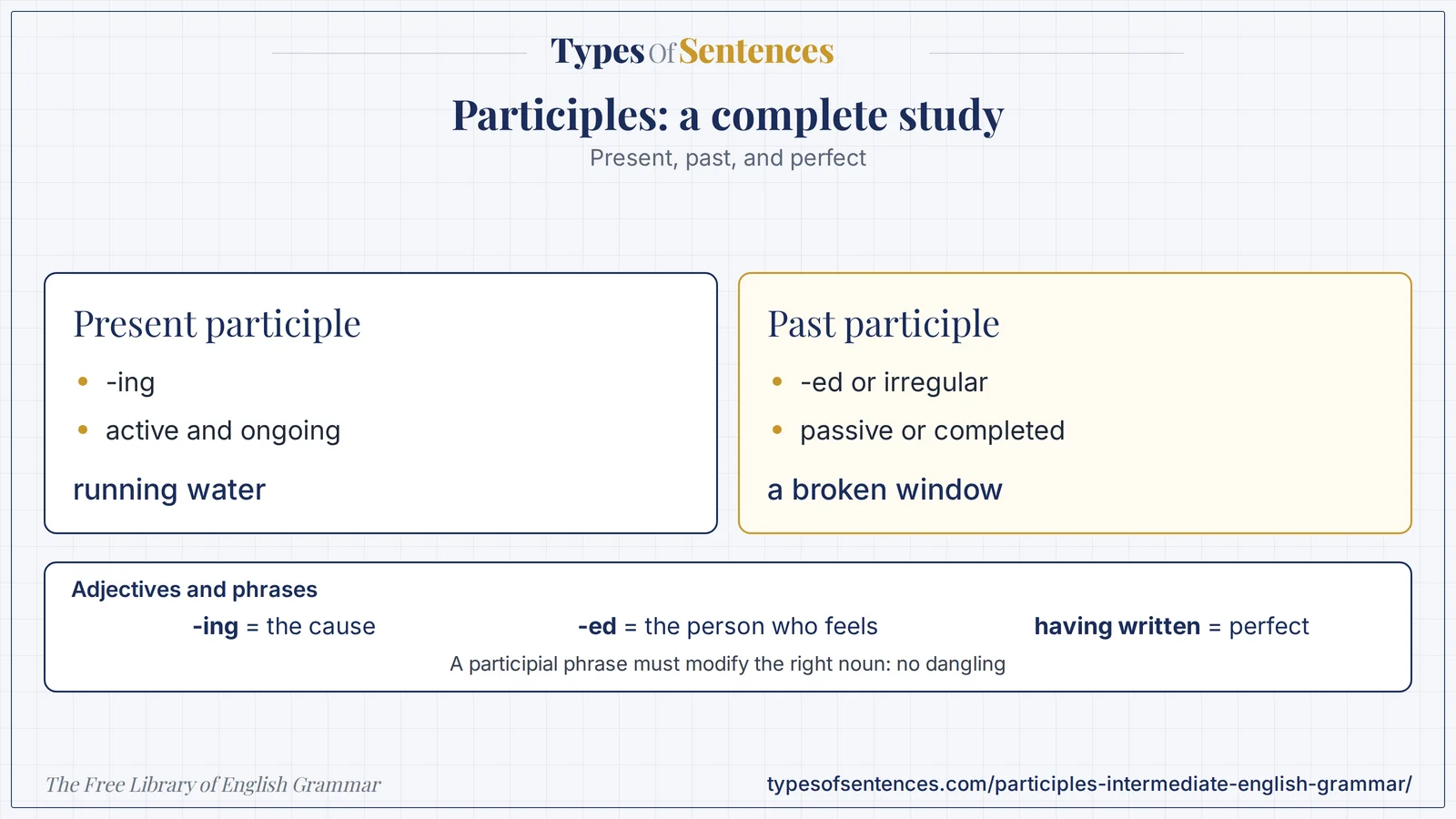
A participle is a verb that has taken a second job. In a crying baby, crying describes the baby. In She has cried, cried is part of the verb phrase.
Why it matters: The most useful distinction is between the two adjective forms: the -ing form tells what causes a feeling (boring, surprising), and the -ed form tells who feels it (bored, surprised).
Summary: There are two simple participles: the present (-ing: writing) and the past (-ed or irregular: written). A perfect form is made with having (having written). They are used as adjectives (a closed door), in the continuous (is writing), perfect (has written), and passive (was written), and in participial phrases (Walking home, she met Tom).
- Present: -ing, active, ongoing: running water.
- Past: -ed/irregular, passive or completed: a broken window.
- -ing adjectives = cause; -ed adjectives = the person who feels.
- A participial phrase must modify the right noun (no dangling).
What You’ll Learn
- 1. Participles: What Are Participles?
- 2. Present Participles
- 3. Past Participles
- 4. Participles as Adjectives
- 5. -ing vs. -ed Adjectives
- 6. Participles in Verb Tenses
- 7. Participle Phrases and Reduced Clauses
- 8. Perfect Participles
- 9. Dangling and Misplaced Participles
- 10. Participles That Act as Prepositions or Conjunctions
- 11. Common Errors with Participles
- 12. Exercises
- 13. Test Your Knowledge
- 14. Frequently Asked Questions
- 15. Conclusion
1. Participles: What Are Participles?
The participle meaning has two parts. A participle is a verb form (it comes from a verb and can take an object), and it can work like an adjective (it describes a noun). Participles are non-finite, like the infinitive and the gerund, so they have no tense or subject of their own; see the guide to finite and non-finite verbs.
| Kind | Form | Example verb | As adjective | In a verb phrase |
|---|---|---|---|---|
| present | verb + -ing | write | a writing desk | She is writing. |
| past (regular) | verb + -ed | walk | a walked path (rare) | She has walked. |
| past (irregular) | irregular form | write | a written note | She has written. |
| perfect | having + past form | write | — | Having written, she left. |
| passive (present) | being + past form | write | — | Being written, it takes time. |
The past forms of irregular verbs are listed in the guide to the past participle and the guide to irregular verbs. Many look different from the past tense: write – wrote – written.
2. Present Participles
The present participles end in -ing. They are active and often show an action in progress or happening at the same time as another.
| Use | Example |
|---|---|
| continuous tenses | She is working. They were sleeping. He has been waiting. |
| adjective before a noun | a running tap, a sleeping baby, an interesting book |
| adjective after a noun (with a phrase) | The man talking to Tom is my uncle. |
| after verbs of perception | I saw him running. We heard her singing. |
| after catch, find, keep, leave | I caught him stealing. She found it lying there. They kept me waiting. |
| a participial phrase | Walking home, she met Tom. |
| after go and come (activities) | They went swimming. She came running. |
The spelling of the -ing form is the same as for the gerund: drop silent e (make → making), double the final consonant after a short stressed vowel (run → running), change ie to y (lie → lying). The gerund, which has the same form but acts as a noun, is covered in the chapter on gerunds.
3. Past Participles
The past forms end in -ed for regular verbs and are irregular for many common ones. They are often passive in meaning (the thing receives the action) or show a completed state.
| Use | Example |
|---|---|
| perfect tenses | She has finished. They had left. He will have arrived. |
| passive voice | The window was broken. The letters are written by hand. |
| adjective before a noun | a broken window, a written note, a closed door, fried rice |
| adjective after a noun (with a phrase) | The letter written by Maria arrived. The people involved agreed. |
| after get, have, want (causative) | I had my hair cut. She got her car repaired. |
| a participial phrase | Exhausted by the trip, he slept. |
| Regular | Irregular (three forms) |
|---|---|
| work – worked – worked | write – wrote – written |
| walk – walked – walked | break – broke – broken |
| study – studied – studied | go – went – gone |
| stop – stopped – stopped | see – saw – seen |
The past forms combine with be in the passive, as in the chapter on active and passive voice, and with have in the perfect, as in the chapter on verb phrases.
4. Participles as Adjectives
Both kinds can be used as adjectives. They describe a noun in the same way as any other adjective, and they can come before the noun or after a linking verb.
| Position | Present | Past |
|---|---|---|
| before a noun | a boring film, a surprising result, a running tap | a bored student, a surprised look, a broken window |
| after a linking verb | The film is boring. The news was surprising. | The student is bored. She seemed surprised. |
| after a noun (with a phrase) | a man waiting outside, the people sitting here | a letter sent yesterday, the people involved |
Participial adjectives are also covered with the other adjective types in the chapter on adjective types. Some are formed with a prefix or adverb: well-known, hard-working, good-looking, newly built, badly damaged. A hyphen joins the parts before a noun, and no hyphen is used after an -ly adverb.
5. -ing vs. -ed Adjectives
The pair boring and bored is one of the most common sources of mistakes. The difference is the role of the noun.
| -ing adjective (the cause) | -ed adjective (the one who feels) |
|---|---|
| The film is boring. (it makes people bored) | I am bored. (I feel bored) |
| The news is surprising. | We were surprised. |
| It is an interesting book. | I am interested in it. |
| The class was tiring. | The students were tired. |
| The result is disappointing. | She was disappointed. |
| It was a frightening noise. | The children were frightened. |
I am boring means that I make other people bored. To say how you feel, use bored.
| Verb of feeling | -ing (causes the feeling) | -ed (has the feeling) |
|---|---|---|
| amaze | amazing | amazed |
| annoy | annoying | annoyed |
| confuse | confusing | confused |
| embarrass | embarrassing | embarrassed |
| excite | exciting | excited |
| exhaust | exhausting | exhausted |
| interest | interesting | interested |
| shock | shocking | shocked |
| worry | worrying | worried |
6. Participles in Verb Tenses
| Tense or voice | Form | Example |
|---|---|---|
| present continuous | be + present form | She is writing. |
| past continuous | was/were + present form | She was writing. |
| present perfect | have/has + past form | She has written. |
| past perfect | had + past form | She had written. |
| future perfect | will have + past form | She will have written. |
| perfect continuous | have been + present form | She has been writing. |
| passive | be + past form | The letter was written. |
| continuous passive | be being + past form | The letter is being written. |
In every case, the first auxiliary carries the tense, and the participle follows it unchanged. The 12 tenses are described in the chapter on verb tenses. A participle in a verb phrase is not an adjective, although some can be both: The door is closed (a state) and The door was closed by the guard (an action).
7. Participle Phrases and Reduced Clauses
A participial phrase is a participle with its objects and modifiers. It works as an adjective and modifies a noun or pronoun.
| Type | Example |
|---|---|
| present | Walking down the street, she found a wallet. The man standing by the door is my uncle. |
| past | Exhausted by the trip, he slept. The letter written by Maria arrived. |
| perfect | Having finished the work, we left. |
| negative | Not knowing the answer, he guessed. |
| reduced adverb clause | While walking home, I met Tom. (= While I was walking home) |
| reduced adjective clause | The man who is standing there = The man standing there. |
The full treatment of the phrases, their position and punctuation, is in the chapter on participial phrases. The participial phrase must modify the right noun, which brings us to the common error below.
8. Perfect Participles
| Form | Pattern | Example | Meaning |
|---|---|---|---|
| perfect active | having + past form | Having finished, we left. | after we had finished |
| perfect passive | having been + past form | Having been warned, she took care. | because she had been warned |
| negative | not having + past form | Not having seen him, I did not know. | because I had not seen him |
| after a preposition | after having + past form | After having eaten, we left. | (a gerund use) |
The perfect form shows that the action happened before the main verb and is often used to give a reason. In everyday writing, a simple form often replaces it when the order is clear: After eating, we left.
9. Dangling and Misplaced Participles
A participial phrase must modify the noun that is the doer of its action, usually the subject of the main clause. If it does not, the phrase dangles.
| Dangling | Fixed |
|---|---|
| Walking down the street, the trees were beautiful. | Walking down the street, I thought the trees were beautiful. |
| Having finished the report, the phone rang. | Having finished the report, she answered the phone. |
| Exhausted, the bed looked inviting. | Exhausted, he thought the bed looked inviting. |
| Reading the letter, tears came to her eyes. | Reading the letter, she began to cry. |
| Misplaced | Fixed |
|---|---|
| I gave the toy to the child made of wood. | I gave the child the toy made of wood. |
| The man was arrested by the police carrying a gun. | The police arrested the man carrying a gun. |
Check each participial phrase by asking, Who or what is doing this? The answer must be the noun next to the phrase. The fixes are the same as in the chapter on participial phrases and in the earlier chapter on sentence fragments, where a participial phrase alone is a fragment.
10. Participles That Act as Prepositions or Conjunctions
Some participles have become prepositions, conjunctions, or sentence adverbs and are accepted without a subject.
| Word | Use | Example |
|---|---|---|
| according to | preposition | According to the report, sales fell. |
| regarding / concerning | preposition | I have a question regarding your offer. |
| including / excluding | preposition | Everyone, including Tom, came. |
| given | preposition | Given the weather, we stayed in. |
| considering | preposition | Considering his age, he did well. |
| provided / providing (that) | conjunction | You may go provided that you finish. |
| assuming (that) | conjunction | Assuming that it rains, we will stay. |
| generally speaking / judging by | sentence adverbial | Generally speaking, the test was fair. |
These are not dangling participles, because they no longer modify a noun. The conjunctions provided that and assuming that are conditional patterns.
11. Common Errors with Participles
| Error | Correction | Rule |
|---|---|---|
| I am very boring today. | I am very bored today. | -ed for the person who feels |
| The movie was bored. | The movie was boring. | -ing for the cause |
| She was interesting in the book. | She was interested in the book. | -ed adjective |
| The window was broke. | The window was broken. | past form, not the past tense |
| She has wrote a letter. | She has written a letter. | past form after have |
| The man standing by the door standing is my uncle. | The man standing by the door is my uncle. | one participle |
| Walking home, the rain started. | Walking home, I felt the rain start. | dangling participle |
| Having went home, she slept. | Having gone home, she slept. | perfect form uses the past form |
| a well-known author is | a well-known author | hyphen before a noun |
| I am exciting about the trip. | I am excited about the trip. | -ed for the person who feels |
Fix: The film was very bored, and I was boring, having went home, the rain started, and I felt exciting about the broke window.
- the film was very bored: the film causes the feeling: boring.
- I was boring: I feel it: bored.
- having went: having gone.
- having went home, the rain started: dangling: having gone home, I noticed that the rain had started.
- felt exciting: excited; the broke window: the broken window.
- Result: The film was very boring, and I was bored. Having gone home, I noticed that the rain had started, and I felt excited about the broken window.
Recap in 12 seconds
Watch the lesson build itself: The present and past participles, the perfect form, and their uses as adjectives and in phrases. The video has no sound.
Exercises
Part A: Forms (Exercises 1–6)
Exercise 1: Present form of write:
Show Answer
Answer: writing.
Exercise 2: Past form of break:
Show Answer
Answer: broken.
Exercise 3: Past form of go:
Show Answer
Answer: gone.
Exercise 4: Perfect form of finish:
Show Answer
Answer: having finished.
Exercise 5: Present form of make:
Show Answer
Answer: making.
Exercise 6: Name the kind: a broken window
Show Answer
Answer: Past form used as an adjective.
Part B: Uses (Exercises 7–12)
Exercise 7: Use of sleeping: a sleeping baby
Show Answer
Answer: Adjective.
Exercise 8: Use of writing: She is writing.
Show Answer
Answer: Part of a continuous tense.
Exercise 9: Use of written: She has written.
Show Answer
Answer: Part of the present perfect.
Exercise 10: Use of broken: The window was broken.
Show Answer
Answer: Part of the passive.
Exercise 11: Use of talking: The man talking to Tom is my uncle.
Show Answer
Answer: A participial phrase (adjective).
Exercise 12: Causative: I had my hair (cut). Which form?
Show Answer
Answer: cut (the past form).
Part C: -ing vs -ed (Exercises 13–20)
Exercise 13: Choose: The film is (boring/bored).
Show Answer
Answer: boring.
Exercise 14: Choose: I am (boring/bored). (I feel it)
Show Answer
Answer: bored.
Exercise 15: Choose: It is an (interesting/interested) book.
Show Answer
Answer: interesting.
Exercise 16: Choose: She was (surprising/surprised).
Show Answer
Answer: surprised.
Exercise 17: Choose: The news was (shocking/shocked).
Show Answer
Answer: shocking.
Exercise 18: Fix it: I am very boring today.
Show Answer
Answer: I am very bored today.
Exercise 19: Fix it: She was interesting in the book.
Show Answer
Answer: She was interested in the book.
Exercise 20: Fix it: I am exciting about the trip.
Show Answer
Answer: I am excited about the trip.
Part D: Phrases and Perfect (Exercises 21–25)
Exercise 21: Reduce: The man who is standing there
Show Answer
Answer: The man standing there.
Exercise 22: Reduce: While I was walking home, I met Tom.
Show Answer
Answer: While walking home, I met Tom.
Exercise 23: Perfect form: After he had finished, he left.
Show Answer
Answer: Having finished, he left.
Exercise 24: Negative: Because he did not know the answer, he guessed.
Show Answer
Answer: Not knowing the answer, he guessed.
Exercise 25: Fix it: Having went home, she slept.
Show Answer
Answer: Having gone home, she slept.
Part E: Dangling and Prepositions (Exercises 26–30)
Exercise 26: Fix: Walking down the street, the trees were beautiful.
Show Answer
Answer: Walking down the street, I thought the trees were beautiful.
Exercise 27: Fix: Having finished the report, the phone rang.
Show Answer
Answer: Having finished the report, she answered the phone.
Exercise 28: Is Considering the weather, the trip went well an error?
Show Answer
Answer: No. Considering acts as a preposition.
Exercise 29: Name a participle that acts as a conjunction.
Show Answer
Answer: provided (that) or assuming (that).
Exercise 30: Which participle acts as a preposition: according or happening?
Show Answer
Answer: according (in according to).
Test Your Knowledge
Ready to check what you learned? Answer all 10 questions, then submit. You need 80% (8 of 10) to pass. Your answers are not stored.
View correct answers and explanations
Question 1: Which is a present form?
✓ Correct Answer: D – writing
Writing ends in -ing.
Question 2: Which is a past form?
✓ Correct Answer: C – written
Written is the past form.
Question 3: Which is correct?
✓ Correct Answer: C – The film is boring.
The -ing form describes the cause.
Question 4: Which is correct?
✓ Correct Answer: A – I am bored.
The -ed form describes the one who feels.
Question 5: Which is a verb phrase use?
✓ Correct Answer: D – She has broken the window.
Has broken is a verb phrase.
Question 6: Which is correct?
✓ Correct Answer: B – She has written a letter.
The past form follows have.
Question 7: Which is a dangling participle?
✓ Correct Answer: B – Walking home, the rain started.
The rain was not walking.
Question 8: Which is the perfect form?
✓ Correct Answer: A – having finished
Having plus the past form.
Question 9: Which participle acts as a preposition?
✓ Correct Answer: C – according
According to is a preposition.
Question 10: Which is correct?
✓ Correct Answer: B – I am excited about it.
The -ed form for the one who feels.
Frequently Asked Questions
What are participles?
Participles are verb forms that work as adjectives or help to make verb tenses and the passive. The present form ends in -ing (running) and the past form in -ed or an irregular ending (walked, written).
What is the participle meaning?
The participle meaning is a verb form used like an adjective or inside a verb phrase. It comes from a verb, can take an object, and describes a noun.
What are some participle examples?
a running tap, a broken window, She is working, She has written, Having finished, we left, and the people involved are participle examples.
What are present participles?
Present participles are the -ing forms of verbs. They are active and show an action in progress: a sleeping baby, She is working. They look like gerunds but act as adjectives or parts of verbs.
What is the difference between -ing and -ed adjectives?
The -ing adjective describes the cause of a feeling (a boring film), and the -ed adjective describes the person who feels it (a bored student).
What is a dangling participle?
A dangling participle is a participial phrase that does not modify the right noun, as in Walking home, the rain started. Fix it by making the doer the subject of the main clause.
Are gerunds and present participles the same?
They have the same form but different jobs. A gerund is a noun (Swimming is fun); a present participle is an adjective or part of a verb (the swimming child, She is swimming).
Conclusion
You now have a complete study of participles: the present and past forms, their use as adjectives and in verb tenses, the difference between -ing and -ed adjectives, participial phrases, perfect forms, dangling modifiers, and participles that act as prepositions. You can avoid the common errors.
Remember the memory trick: -ing describes the cause, and -ed describes the person who feels. Next, you begin the study of punctuation.
- Merriam-Webster Dictionary: participle: the dictionary definition of a participle.
- Purdue Online Writing Lab: Grammar: reference section on verbals.
- Quirk, Randolph, et al. A Comprehensive Grammar of the English Language. Longman, 1985.: -ing and -ed participles and clauses.
- Huddleston, Rodney, and Geoffrey K. Pullum. The Cambridge Grammar of the English Language. Cambridge University Press, 2002.: gerund-participles and past participles.
Last reviewed: October 29, 2026. How it was made: drafted with AI assistance, then checked with automated tests (structure, links, answer keys, spelling) and against the sources above. A person has not yet read this chapter line by line. Found a mistake? Report it.