Non-finite verbs are the verb forms that do not show tense, person, or number: the infinitive (to write), the gerund and present participle (writing), and the past participle (written). They look simple, but they can be extended into perfect, progressive, and passive forms (to have been written, having been warned) and can head whole clauses that take the place of finite clauses. In academic and formal writing, advanced infinitives, gerunds, and participles carry much of the information that a simpler style would put in finite clauses.
You will study the full set of non-finite verb forms, how the perfect shows earlier time, the passive forms, complex infinitive constructions with catenative verbs and multiple embeddings, gerund subjects and the possessive, absolute constructions (Weather permitting), non-finite clauses that replace finite clauses in formal style, and the rule of the understood subject that explains dangling modifiers. This is the road to complex non-finite structures and expert non-finite control. Thirty editing exercises and a quiz follow.
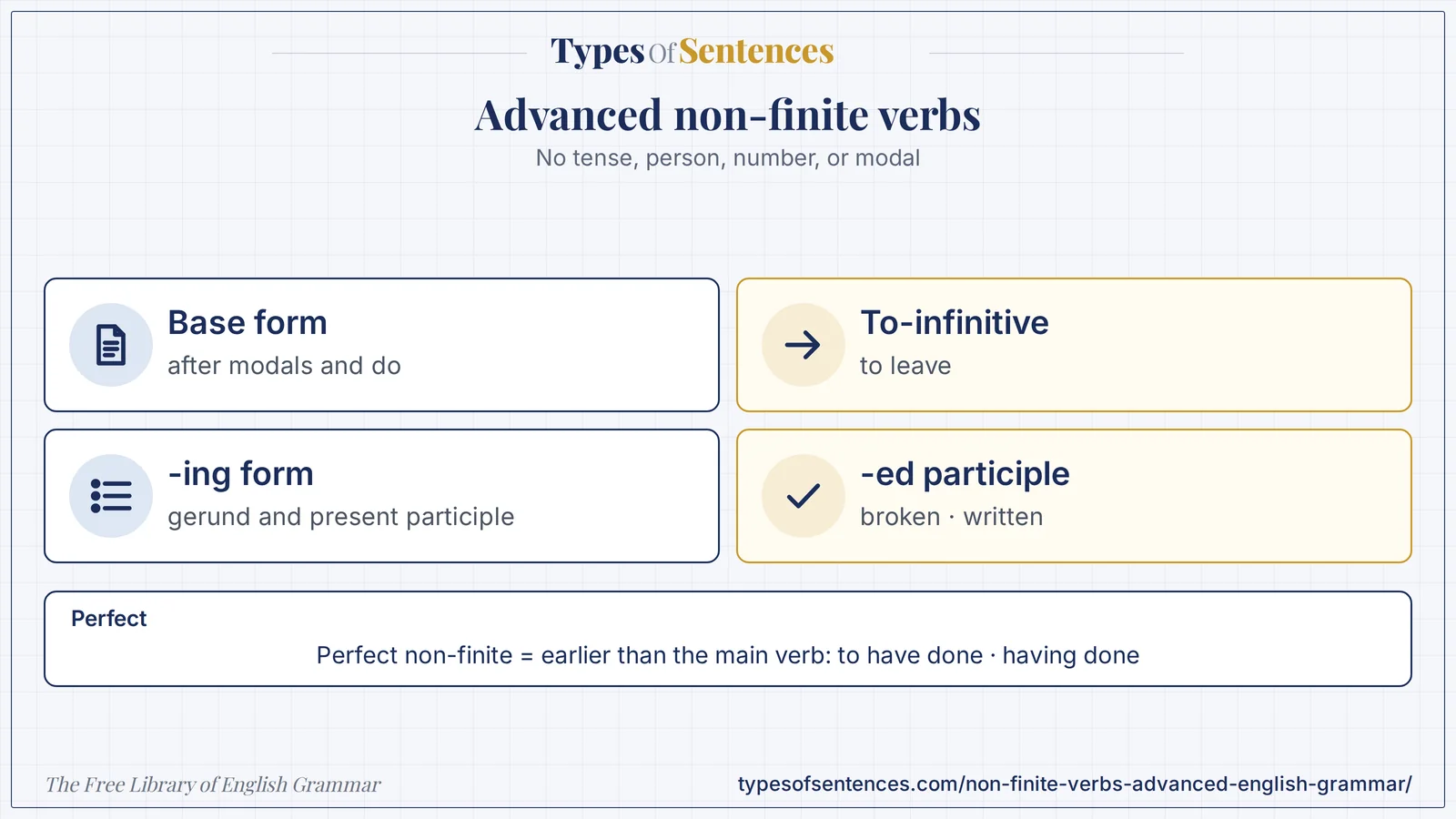
A finite verb tells you when (tense) and who (agreement): She writes, They wrote. A non-finite verb does neither: to write, writing, written are the same whoever does the writing and whenever it happens. Their time and subject come from the sentence around them.
Why it matters: Because they are free of tense, non-finite forms are compact. They let a writer compress a whole clause into a phrase, and that is why they are so common in formal prose.
Summary: English has four non-finite forms: the base form (after modals and do), the to-infinitive, the -ing form (gerund and present participle), and the -ed participle. Each can be perfect (to have done, having done), progressive (to be doing), or passive (to be done, being done, having been done). Simple forms show time that is simultaneous with or later than the main verb; perfect forms show an earlier time. Non-finite clauses can replace finite ones (Having finished, she left) and need an understood subject that matches the main clause, unless they are absolute constructions with their own subject (Weather permitting, we will go).
- Non-finite = no tense, person, number, or modal.
- Forms: base, to-infinitive, -ing, -ed; each with perfect and passive varieties.
- Perfect non-finite = earlier than the main verb.
- Understood subject = the main clause subject (otherwise dangling) unless an absolute construction.
What You’ll Learn
- 1. Non-Finite Verbs: Forms and Varieties
- 2. Perfect Non-Finite Forms
- 3. Passive Non-Finite Forms
- 4. Complex Infinitive Constructions: Catenative Verbs and Multiple Embeddings
- 5. Complex Gerund Constructions: Gerund Subjects and the Possessive
- 6. Absolute Constructions
- 7. Non-Finite Clauses That Replace Finite Clauses
- 8. The Understood Subject and Dangling Modifiers
- 9. Common Errors with Non-Finite Verbs
- 10. Exercises
- 11. Test Your Knowledge
- 12. Frequently Asked Questions
- 13. Conclusion
1. Non-Finite Verbs: Forms and Varieties
| Feature | Finite verb | Non-finite verb |
|---|---|---|
| tense | yes (writes, wrote) | no |
| agreement with a subject | yes (she writes, they write) | no |
| modals before it | no (the modal is the finite verb) | yes: to be able to write |
| can stand alone as the main verb of a sentence | yes | no (apart from some fragments) |
| subject | required | absent (understood) or introduced by for |
| Form | Simple | Progressive | Perfect | Perfect progressive | Passive | Perfect passive |
|---|---|---|---|---|---|---|
| base infinitive | write | be writing | have written | have been writing | be written | have been written |
| to-infinitive | to write | to be writing | to have written | to have been writing | to be written | to have been written |
| -ing (gerund-participle) | writing | — | having written | having been writing | being written | having been written |
| -ed participle | written | — | — | — | — | — |
Huddleston and Pullum call the -ing form the “gerund-participle” because the same form serves the traditional gerund (Writing is fun) and the present participle (the man writing). The traditional terms are used in this course. The verb phrase structure that these forms enter is described in the chapter on complex verb phrases.
2. Perfect Non-Finite Forms
A simple non-finite form takes its time from the main verb: it is simultaneous with it or later. A perfect non-finite form (to have done, having done) shows that the action is earlier than the main verb, or, with some verbs, that the hoped-for event did not happen.
| Simple | Perfect | Difference |
|---|---|---|
| She seems to be happy. | She seems to have been happy. | now / earlier |
| I am glad to meet you. | I am glad to have met you. | at meeting / after meeting (a polite parting) |
| He denied stealing the car. | He denied having stolen the car. | the perfect makes the time order explicit; either is acceptable |
| Walking home, I saw him. | Having walked home, I was tired. | simultaneous / earlier |
| He is said to leave tomorrow. | He is said to have left yesterday. | later or present / earlier |
| I wanted to see the film. | I wanted to have seen the film. | unfulfilled desire (formal) |
| They hoped to win. | They had hoped to have won by now. | — |
| She was believed to be innocent. | She was believed to have been innocent. | the state at the time of belief / earlier |
| Perfect form | Use | Example |
|---|---|---|
| to have + -en after a raising verb | a judgment about an earlier event | He appears to have left. |
| to have + -en after a verb of saying or believing | report an earlier event | She is reported to have won. |
| to have + -en after a past desire verb | an unfulfilled wish | I would like to have seen it. (but did not) |
| having + -en (participle clause) | an earlier action; a reason | Having finished, she left. Having lost the key, he waited. |
| having + -en (gerund) | an earlier action after a verb of recall or denial | He regretted having said it. |
| ought to have, should have | a past duty (finite modal perfect, not non-finite) | You should have called. |
Use the perfect only when the time order would otherwise be unclear. I am glad to have met you is polite at a farewell, but I regret having told her and I regret telling her mean the same, so the simpler form is usually better. The relative time of non-finite forms is part of the system of tense and aspect, treated in the chapter on tense and aspect.
3. Passive Non-Finite Forms
| Form | Example | Notes |
|---|---|---|
| to be + -en | She wants to be promoted. The work needs to be done. | infinitive after a verb or adjective |
| to have been + -en | He seems to have been forgotten. The suspect is believed to have been arrested. | perfect passive infinitive |
| being + -en | I hate being told what to do. He escaped being caught. | gerund after a verb or preposition |
| having been + -en | She remembers having been taken to the zoo. Having been warned, he left. | perfect passive gerund or participle |
| -ed participle clause | Written in 1990, the book is still read. Given the chance, she would win. | a passive meaning without being |
| bare passive (needs + -ing) | The car needs washing. | see the chapter on voice |
| noun + to be + -en | the work to be done; the plan to be approved | postmodifier |
The passive non-finite forms avoid naming the agent, like the finite passive. They are common in reports and instructions: The samples to be analyzed are in the box. The use of the passive is discussed in the chapter on voice. Note that the -ed clause Written in 1990 is a reduced passive: it means which was written in 1990 or because it was written in 1990.
4. Complex Infinitive Constructions: Catenative Verbs and Multiple Embeddings
A catenative verb is a verb that takes a non-finite verb as its complement, which can itself take another. The result is a chain: She seems to want to try to learn to swim. Each link follows the pattern of its own verb.
| Chain | Analysis |
|---|---|
| She seems to want to try to learn to swim. | seems + to want + to try + to learn + to swim |
| He used to like to go swimming. | used to + like to + go + -ing |
| She hopes to be able to start working next year. | hopes to + be able to + start + -ing |
| They are likely to be asked to leave. | are likely to + be asked + to leave |
| I want him to try to persuade her to come. | want him to + try to + persuade her to + come |
| Group | Verbs | Example |
|---|---|---|
| raising verbs | seem, appear, happen, tend, prove, turn out | She tends to arrive early. |
| aspectual verbs | begin, start, continue, cease, keep, stop, finish | It began to rain. |
| desire and intention | want, hope, wish, intend, plan, decide, choose | He decided to leave. |
| effort and success | try, attempt, manage, fail, succeed (in), avoid | She managed to finish. |
| obligation and modality | have to, ought to, need to, be able to, be supposed to | You need to sign. |
| perception (bare infinitive) | see, hear, watch, feel + object | I saw him leave. |
| causative | make, let, have, get, help + object | She made him wait. She got him to wait. |
| Other infinitive constructions | Example |
|---|---|
| for + subject + to | It is hard for him to say. I am waiting for you to call. |
| infinitive of purpose | She left early to catch the train. He worked hard in order to succeed. |
| infinitive of result | She grew up to be a doctor. He woke to find it gone. |
| infinitive as a postmodifier | a chance to win; the first to arrive; nothing to eat |
| absolute (comment) infinitive | To be honest, I disagree. To tell the truth, it failed. To put it simply, … |
| be + to | The president is to visit Delhi. You are to report at six. |
| split infinitive | to boldly go; to completely understand |
| negative | She told him not to go. (the split to not go is also found) |
5. Complex Gerund Constructions: Gerund Subjects and the Possessive
| Pattern | Example | Notes |
|---|---|---|
| gerund as subject | Swimming is good exercise. Reading takes time. | singular verb |
| gerund with a possessive | His being late annoyed her. I appreciate your helping us. | formal; the possessive is the subject of the gerund |
| gerund with an accusative (informal) | Him being late annoyed her. I appreciate you helping us. | informal; common in speech |
| noun + gerund (common case) | The teacher leaving early surprised us. | noun without ’s |
| noun with ’s + gerund | The teacher’s leaving early surprised us. | formal |
| gerund with a perfect or passive form | Having been warned did not help. Being asked made him nervous. | — |
| gerund + object (verbal gerund) | Reading novels is fun. | keeps the object |
| nominal gerund with of | the reading of the will; his handling of the matter | a noun-like gerund |
| mixed gerund | his writing of the letter; his writing the letter | both exist; the first is more noun-like |
| gerund after a preposition | She insisted on paying. He is good at drawing. | — |
| fixed patterns | There is no point in waiting. It’s no use crying. It’s worth trying. | — |
| Pronoun subject of a gerund | Formal | Informal |
|---|---|---|
| subject of a sentence | His being late annoyed her. | Him being late annoyed her. |
| object of a verb | I dislike his leaving early. | I dislike him leaving early. |
| after a verb of perception | I saw him leaving. (participle, not gerund) | same |
The “fused participle” (I dislike him leaving, I appreciate you helping) has been criticized by traditional usage guides, which prefer the possessive (his leaving, your helping). Modern usage guides accept the object form in informal writing, especially with a noun (I dislike the children leaving). In formal writing, the possessive is safer, especially when it is the subject of a sentence. After a verb of perception the -ing form is a participle, and the object form is correct (I saw him leaving). The Intermediate chapter on gerunds described the basic forms.
6. Absolute Constructions
An absolute construction is a non-finite clause (or a verbless phrase) with its own subject, which is different from the subject of the main clause. The construction is set off by commas and adds time, cause, condition, or circumstance.
| Type | Example | Meaning |
|---|---|---|
| participle with own subject (cause) | The road being flooded, we turned back. | because |
| participle with own subject (time) | The meeting over, everyone went home. | when |
| condition | Weather permitting, the match will begin at noon. Time permitting, we will visit. | if |
| with + noun + participle | With the work finished, they went home. She stood there, with her arms folded. | circumstance |
| without a verb | He entered, hat in hand. She sat, eyes closed. | accompanying circumstance |
| fixed expressions | All things considered, it was a success. Everything being equal, … That being said, … God willing, … Other things being equal, … | formal or idiomatic |
| unattached participle (not absolute) | Generally speaking, … Strictly speaking, … Judging by the sky, … Considering the cost, … Given the facts, … | conventional disjuncts; no subject needed |
The absolute construction should not be confused with a dangling modifier. The road being flooded, we turned back is correct because the participle has its own subject (the road). Walking home, the rain started is wrong because the participle has no subject of its own and its understood subject (I) does not match the main clause (the rain). The Intermediate chapter on absolute phrases introduced the form.
7. Non-Finite Clauses That Replace Finite Clauses
| Finite clause | Non-finite clause | Type |
|---|---|---|
| the man who is standing there | the man standing there | present participle (relative) |
| the book that was written by her | the book written by her | past participle (relative) |
| the first person who arrives | the first person to arrive | infinitive (relative) |
| Because he was tired, he slept. | Being tired, he slept. / Tired, he slept. | participle (reason) |
| After she had finished the report, she left. | Having finished the report, she left. | perfect participle (time) |
| When he left the room, he turned off the light. | On leaving the room, he turned off the light. | on + gerund |
| If you are asked, say so. | If asked, say so. | participle (condition, reduced) |
| She did it so that she could win. | She did it to win. / …in order to win. | infinitive (purpose) |
| That she left surprised us. | Her leaving surprised us. | gerund (nominal) |
| I expect that she will win. | I expect her to win. | infinitive (complement) |
| She was so tired that she could not work. | She was too tired to work. | infinitive (result) |
8. The Understood Subject and Dangling Modifiers
| Dangling (error) | Corrected | Rule |
|---|---|---|
| Walking down the street, a car hit him. | Walking down the street, he was hit by a car. | the participle’s subject must be the main subject |
| To pass the exam, studying is necessary. | To pass the exam, you must study. | the infinitive’s subject is you |
| Having finished the report, the window was opened. | Having finished the report, she opened the window. | — |
| Being a student, the library is useful. | As a student, I find the library useful. | — |
| After reading the article, the idea became clear. | After reading the article, I understood the idea. | — |
| Tired after the trip, the bed looked inviting. | Tired after the trip, she found the bed inviting. | — |
- Check the subject of every introductory non-finite clause. Ask “Who is doing it?” and make that person the subject of the main clause.
- Use an absolute construction when the subjects must differ: The report finished, the window was opened.
- Use a finite clause if in doubt: After I had read the article, the idea became clear.
- Conventional disjuncts are allowed: Generally speaking, …, Judging by the results, …, Considering the cost, ….
9. Common Errors with Non-Finite Verbs
| Error | Correction | Rule |
|---|---|---|
| I look forward to see you. | I look forward to seeing you. | to is a preposition |
| She enjoys to read. | She enjoys reading. | -ing after enjoy |
| I want that you come. | I want you to come. | object + infinitive |
| He made me to laugh. | He made me laugh. | bare infinitive after make |
| She avoided to answer. | She avoided answering. | -ing after avoid |
| I regret to have said it. (past regret) | I regret having said it. | -ing for a past action that one regrets |
| I like to reading. | I like reading. / I like to read. | one form |
| To read and writing are skills. | Reading and writing are skills. | parallel forms |
| Having been warned, the sign was ignored. | Having been warned, he ignored the sign. | understood subject |
| I am used to get up early. | I am used to getting up early. | be used to + -ing |
| I stopped to smoke. (meaning: gave up) | I stopped smoking. | stop to = pause in order to |
| I appreciate that you help me. (informal wordy) | I appreciate your help. / I appreciate your helping me. | compact |
Edit: I look forward to see you, and she enjoys to read, but I want that you come, and he made me to laugh, and walking down the street, a car hit him, and to read and writing are skills, and I am used to get up early.
- look forward to see: look forward to seeing.
- enjoys to read: enjoys reading.
- want that you come: want you to come.
- made me to laugh: made me laugh.
- walking down the street, a car hit him: walking down the street, he was hit by a car.
- to read and writing: reading and writing.
- used to get up: used to getting up.
- Result: I look forward to seeing you, and she enjoys reading, but I want you to come, and he made me laugh, and walking down the street, he was hit by a car, and reading and writing are skills, and I am used to getting up early.
Recap in 12 seconds
Watch the lesson build itself: The four non-finite forms and their perfect and progressive variants. The video has no sound.
Exercises
Part A: Forms (Exercises 1–7)
Exercise 1: Name the form: to write
Show Answer
Answer: The to-infinitive.
Exercise 2: Name the form: having written
Show Answer
Answer: The perfect -ing form (participle or gerund).
Exercise 3: Name the form: to be written
Show Answer
Answer: The passive infinitive.
Exercise 4: Name the form: having been written
Show Answer
Answer: The perfect passive -ing form.
Exercise 5: Name the form: to have been writing
Show Answer
Answer: The perfect progressive infinitive.
Exercise 6: Does a non-finite verb show tense?
Show Answer
Answer: No.
Exercise 7: Which verb in She wants to leave is finite?
Show Answer
Answer: wants.
Part B: Perfect and Passive (Exercises 8–14)
Exercise 8: Show the earlier time: She seems to be happy. (earlier)
Show Answer
Answer: She seems to have been happy.
Exercise 9: Show the earlier time: He denied stealing the car.
Show Answer
Answer: He denied having stolen the car.
Exercise 10: Name the meaning: I would like to have seen it.
Show Answer
Answer: An unfulfilled wish.
Exercise 11: Make passive: She wants someone to promote her.
Show Answer
Answer: She wants to be promoted.
Exercise 12: Make passive: I hate it when people tell me what to do. (gerund)
Show Answer
Answer: I hate being told what to do.
Exercise 13: Name the form: Written in 1990, the book is still read.
Show Answer
Answer: A past participle clause (reduced passive).
Exercise 14: Name the form: He is believed to have been seen.
Show Answer
Answer: A perfect passive infinitive.
Part C: Infinitives and Gerunds (Exercises 15–21)
Exercise 15: Find the chain: She seems to want to try to learn to swim. How many catenative links?
Show Answer
Answer: Four (seems to, want to, try to, learn to).
Exercise 16: Edit: I look forward to see you.
Show Answer
Answer: I look forward to seeing you.
Exercise 17: Edit: She enjoys to read.
Show Answer
Answer: She enjoys reading.
Exercise 18: Edit: He made me to laugh.
Show Answer
Answer: He made me laugh.
Exercise 19: Formal form: I dislike him leaving early.
Show Answer
Answer: I dislike his leaving early.
Exercise 20: Name the type: the reading of the will
Show Answer
Answer: A nominal gerund with of.
Exercise 21: Edit: I am used to get up early.
Show Answer
Answer: I am used to getting up early.
Part D: Absolute and Replacement (Exercises 22–26)
Exercise 22: Name the construction: Weather permitting, we will go.
Show Answer
Answer: Absolute construction.
Exercise 23: Name the meaning: The road being flooded, we turned back.
Show Answer
Answer: Cause.
Exercise 24: Replace with a non-finite clause: After she had finished the report, she left.
Show Answer
Answer: Having finished the report, she left.
Exercise 25: Replace: the man who is standing there
Show Answer
Answer: the man standing there.
Exercise 26: Replace: the first person who arrives
Show Answer
Answer: the first person to arrive.
Part E: Dangling Modifiers (Exercises 27–30)
Exercise 27: Fix: Walking down the street, a car hit him.
Show Answer
Answer: Walking down the street, he was hit by a car.
Exercise 28: Fix: To pass the exam, studying is necessary.
Show Answer
Answer: To pass the exam, you must study.
Exercise 29: Fix: Having been warned, the sign was ignored.
Show Answer
Answer: Having been warned, he ignored the sign.
Exercise 30: Is Generally speaking a dangling modifier?
Show Answer
Answer: No (a conventional disjunct).
Test Your Knowledge
Ready to check what you learned? Answer all 10 questions, then submit. You need 80% (8 of 10) to pass. Your answers are not stored.
View correct answers and explanations
Question 1: Which is non-finite?
✓ Correct Answer: B – written
The past participle is non-finite.
Question 2: Which shows an earlier time?
✓ Correct Answer: C – to have written
The perfect infinitive.
Question 3: Which is the perfect passive gerund?
✓ Correct Answer: D – having been written
Having been + -en.
Question 4: Which is correct?
✓ Correct Answer: B – I look forward to seeing you.
To is a preposition.
Question 5: Which is correct?
✓ Correct Answer: C – He made me laugh.
Bare infinitive after make.
Question 6: Which is an absolute construction?
✓ Correct Answer: A – Weather permitting, we will go.
It has its own subject (weather).
Question 7: Which is a dangling modifier?
✓ Correct Answer: D – Walking down the street, a car hit him.
The subject does not match.
Question 8: Which is the formal form?
✓ Correct Answer: C – I dislike his leaving.
The possessive before a gerund.
Question 9: What is a catenative verb?
✓ Correct Answer: A – a verb that takes a non-finite complement
Catenative verbs chain complements.
Question 10: Which replaces the man who is standing there?
✓ Correct Answer: B – the man standing there
A reduced relative clause.
Frequently Asked Questions
What are non-finite verbs?
Non-finite verbs are verb forms that do not show tense, person, or number: the infinitive (to write), the -ing form (writing), and the past participle (written).
What are advanced infinitives, gerunds, and participles?
They are the perfect, passive, and progressive forms of the infinitive and gerund, catenative chains, gerund subjects with the possessive, and absolute constructions.
What is complex non-finite structure?
Complex non-finite structures are chains and combinations of non-finite forms: She seems to want to try to learn to swim, He is believed to have been seen, or Having been warned, he left.
What are non-finite verb forms?
Non-finite verb forms are the base form, the to-infinitive, the -ing form, and the -ed participle, each with perfect and passive varieties.
What does expert non-finite control mean?
Expert non-finite use means choosing the right form, showing time with the perfect when needed, matching the understood subject, avoiding dangling modifiers, and using non-finite clauses to compress a text.
What is the difference between a gerund and a participle?
A gerund works as a noun (Swimming is fun); a present participle works as an adjective or adverb (the swimming boy, Swimming home, he …). They have the same form.
What is a dangling modifier?
A dangling modifier is a non-finite clause whose understood subject does not match the subject of the main clause: Walking down the street, a car hit him.
Conclusion
You now have a deep study of non-finite verbs: the forms and their perfect and passive varieties, perfect and passive non-finite forms, complex infinitive and gerund constructions, absolute constructions, non-finite clauses that replace finite clauses, and the understood subject. You can use non-finite forms with expert control and avoid the usual errors.
When you write a non-finite clause, check its time and its understood subject. Next, you will study complementation patterns.
- Huddleston, Rodney, and Geoffrey K. Pullum. The Cambridge Grammar of the English Language. Cambridge University Press, 2002.: the reference analysis of non-finite clauses and the gerund-participle.
- Quirk, Randolph, et al. A Comprehensive Grammar of the English Language. Longman, 1985.: the classic treatment of non-finite clauses and catenative verbs.
- Biber, Douglas, et al. Longman Grammar of Spoken and Written English. Longman, 1999.: corpus evidence on non-finite clauses in academic prose.
- Garner, Bryan A. Garner’s Modern English Usage, 5th ed. Oxford University Press, 2022.: usage guidance on the possessive before a gerund and dangling modifiers.
- Merriam-Webster Dictionary: gerund: the dictionary entry.
Last reviewed: October 29, 2026. How it was made: drafted with AI assistance, then checked with automated tests (structure, links, answer keys, spelling) and against the sources above. A person has not yet read this chapter line by line. Found a mistake? Report it.