An appositive phrase is a noun or noun phrase that renames another noun right beside it: in My brother, a doctor in Dallas, called, the words a doctor in Dallas are an appositive phrase that tells more about my brother. Learners often ask what is appositive, and the answer is simple: it is another name for the same person or thing.
This chapter shows how an appositive works, with appositive examples for each type. You will learn the difference between essential and nonessential appositives, how an appositive phrase gets its modifiers, where it can stand in a sentence, how to punctuate it, and how it relates to relative clauses and adjective phrases. Thirty exercises and a quiz follow.
An appositive is a shortcut. Instead of writing two sentences, Maria is my sister. She lives in Texas, you can write My sister Maria lives in Texas or Maria, my sister, lives in Texas.
Why it matters: The only real difficulty is the commas. They depend on one question: is the appositive necessary to identify the noun, or is it extra?
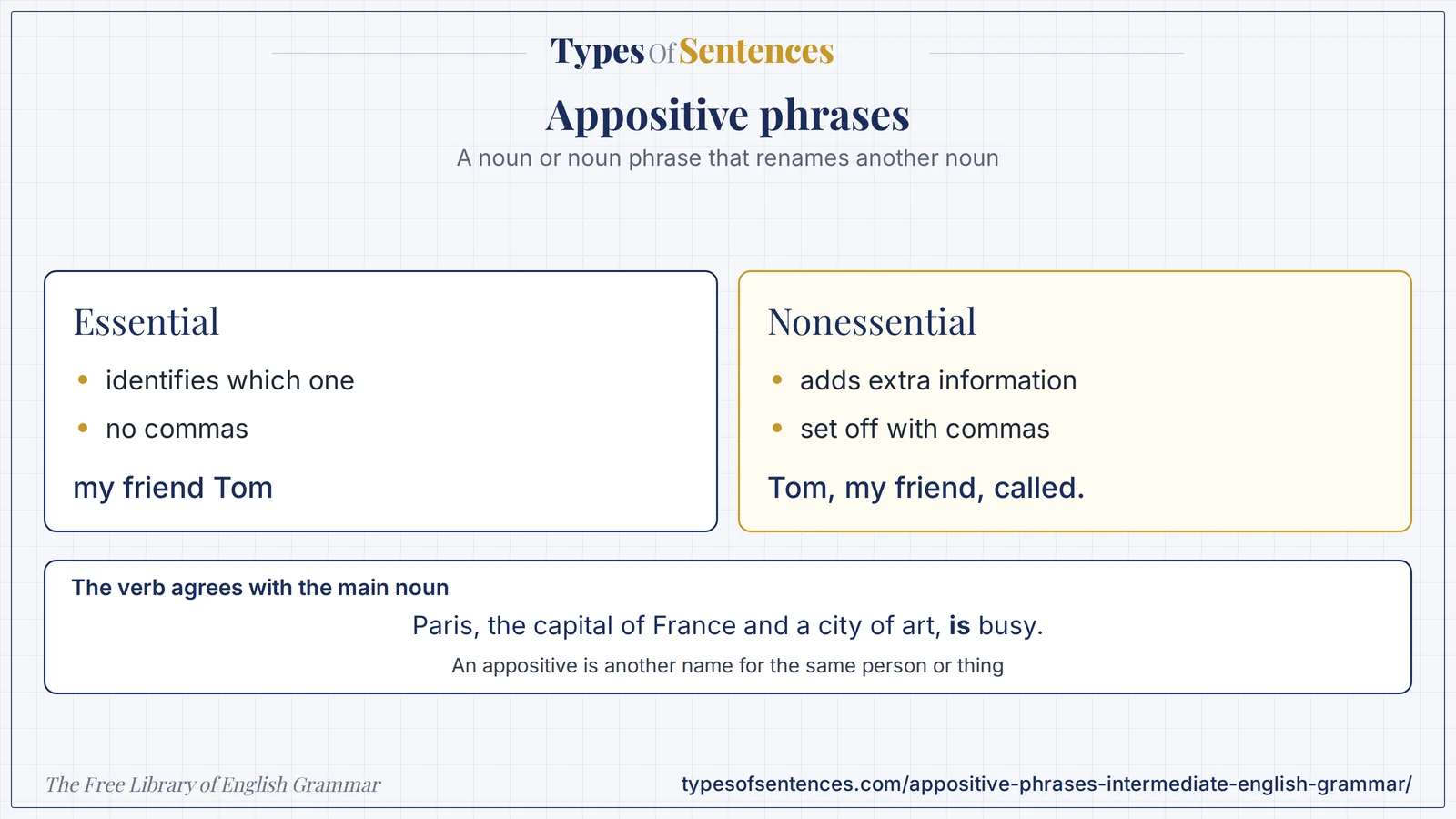
Summary: An appositive is a noun or noun phrase placed next to another noun to rename or identify it. An appositive phrase includes the appositive and its modifiers. An essential (restrictive) appositive has no commas; a nonessential (nonrestrictive) one is set off with commas. It can come after the noun, at the beginning of a sentence, or at the end.
- Appositive = another name for the same person or thing.
- Essential: my friend Tom. Nonessential: Tom, my friend,.
- Appositive phrase: Paris, the capital of France and a city of art,.
- The verb agrees with the main noun, not the appositive.
What You’ll Learn
- 1. What Is an Appositive?
- 2. Essential Appositives
- 3. Nonessential Appositives
- 4. Appositive Phrases
- 5. Position in Sentences
- 6. Punctuation and Agreement
- 7. Appositive vs. Other Structures
- 8. Using Appositives to Combine Sentences
- 9. Common Appositive Errors
- 10. Exercises
- 11. Test Your Knowledge
- 12. Frequently Asked Questions
- 13. Conclusion
1. What Is an Appositive?
An appositive is a noun, a pronoun, or a noun phrase that sits next to another noun and renames it. The two have the same reference: they name the same person, place, or thing. The word comes from the Latin for “placed next to.”
| Sentence | Noun | Appositive |
|---|---|---|
| My brother Tom called. | my brother | Tom |
| Tom, my brother, called. | Tom | my brother |
| The poet Robert Frost was born in San Francisco. | the poet | Robert Frost |
| Paris, the capital of France, is beautiful. | Paris | the capital of France |
| I read the word freedom. | the word | freedom |
Test: if you put is or are between the two nouns, the sentence should make sense: Tom is my brother; Paris is the capital of France. If it does not, the second noun is not an appositive.
2. Essential Appositives
An essential (restrictive) appositive identifies which person or thing you mean. Without it, the noun would be unclear. It is not set off by commas.
| Sentence | Why it is essential |
|---|---|
| My friend Tom called. | I have several friends; Tom tells which |
| The poet Robert Frost wrote it. | several poets exist |
| The word love has many meanings. | which word |
| The movie Titanic won eleven Oscars. | which movie |
| We visited the city of Chicago. | which city |
3. Nonessential Appositives
A nonessential (nonrestrictive) appositive gives extra information about a noun that is already identified. Commas set it off.
| Sentence | Why it is nonessential |
|---|---|
| Tom, my brother, called. | the name already identifies him |
| Paris, the capital of France, is beautiful. | Paris is unique |
| My brother, a doctor in Dallas, called. | I have one brother |
| Mr. Rao, our principal, spoke. | Mr. Rao is identified by name |
The commas can change the meaning. Compare My brother Tom called (I have more than one brother, and Tom is the one) with My brother, Tom, called (I have one brother, and his name is Tom). The comma version tells the reader that the name is extra information.
A nonessential appositive in the middle of a sentence needs a comma at both ends.
4. Appositive Phrases
An appositive phrase is an appositive with its modifiers. The modifiers can be adjectives, prepositional phrases, relative clauses, or participial phrases.
| Appositive | Appositive phrase |
|---|---|
| a doctor | a doctor in Dallas |
| a city | a city known for its music and food |
| the winner | the winner of the national championship |
| a book | a book that changed my life |
| a teacher | a teacher who never gave up on her students |
- Maria, my sister and a talented pianist, won the prize. two appositives joined by and
- Our school, a three-story building with a large garden, opened in 1990. modifiers after the appositive
- The festival, a celebration of lights and music, lasts a week. prepositional phrases in the appositive
The appositive phrase is a kind of noun phrase; see the chapter on noun phrases. A nonessential appositive phrase is often a reduced non-defining relative clause: Tom, who is my brother, becomes Tom, my brother,. See the chapter on adjective clauses.
5. Position in Sentences
| Position | Example | Punctuation |
|---|---|---|
| After the noun (most common) | Maria, my sister, lives in Texas. | commas around it |
| At the beginning | A talented pianist, Maria won the prize. | comma after it |
| At the end | We invited Maria, my sister. | comma before it |
| Essential, directly after | My sister Maria lives in Texas. | no commas |
| With a colon or dash for emphasis | He had one goal: victory. She wanted one thing—success. | colon or dash |
6. Punctuation and Agreement
| Rule | Example |
|---|---|
| Use commas for nonessential appositives. | Tom, my brother, called. |
| No commas for essential appositives. | My brother Tom called. |
| Use dashes when the appositive contains commas. | The team—Tom, Maria, and Raj—won. |
| The verb agrees with the main noun, not the appositive. | Tom, my brother and my best friend, is here. The students, a group of ten, are here. |
| A pronoun used as an appositive takes the case of the noun it renames. | The prize went to two students, Tom and me. Two students, Tom and I, won the prize. |
The comma rules in this section are part of the larger system in the chapter on punctuation marks.
The appositive Tom and me renames students, which is the object of to, so the object form me is correct. Test: The prize went to me.
7. Appositive vs. Other Structures
| Structure | Example | Difference |
|---|---|---|
| Appositive | Tom, my brother, called. | renames the noun |
| Adjective phrase | Tom, tired and hungry, called. | describes the noun |
| Relative clause | Tom, who is my brother, called. | a full clause with a verb |
| Introductory phrase with “such as” | Fruits such as apples are healthy. | gives examples, not the same thing |
| Series | I met Tom, Maria, and Raj. | a list of different people, not renaming |
An appositive is not a list: I met Tom, Maria, and Raj names three people. But I met Tom, my brother, and Maria is ambiguous: two people or three? Rewrite as I met Tom, who is my brother, and Maria or use dashes.
8. Using Appositives to Combine Sentences
Appositives are one of the best tools for combining short, choppy sentences. Instead of writing two sentences about the same person or thing, you can fold the second into the first as a renaming phrase.
| Two short sentences | Combined with an appositive |
|---|---|
| Tom is a teacher. Tom lives in Delhi. | Tom, a teacher, lives in Delhi. |
| Mount Everest is the tallest mountain on Earth. It is in Nepal. | Mount Everest, the tallest mountain on Earth, is in Nepal. |
| We visited the Taj Mahal. It is a marble tomb in Agra. | We visited the Taj Mahal, a marble tomb in Agra. |
| I met Dr. Rao. She is the new principal. | I met Dr. Rao, the new principal. |
- Put the appositive next to the noun it renames. If it is far away, the reader may link it to the wrong noun.
- Use commas for extra information and no commas for essential information (my friend Tom versus Tom, my friend,).
- Use a dash or colon for emphasis: She had one fear: heights.
- Do not stack too many. Two appositives in one sentence can be graceful; four are heavy.
Appositives can come at the start of a sentence (A gifted pianist, she played for hours), in the middle, or at the end. Moving one changes the rhythm and the emphasis, so try each position when you revise.
9. Common Appositive Errors
| Error | Correction | Rule |
|---|---|---|
| My brother, a doctor in Dallas called. | My brother, a doctor in Dallas, called. | commas at both ends |
| My friend, Tom called. | My friend Tom called. | essential: no commas |
| Tom, a doctor. | Tom, a doctor, called. | an appositive phrase is not a sentence |
| A talented pianist, the prize went to Maria. | A talented pianist, Maria won the prize. | the appositive must rename the subject |
| The prize went to Tom and I, my best friends. | The prize went to Tom and me, my best friends. | appositive case follows the main noun |
| The students, a group of ten, is here. | The students, a group of ten, are here. | agree with the main noun |
| I met Tom, my brother, and Maria. (ambiguous) | I met my brother Tom and Maria. | avoid ambiguity |
Fix: Mr. Rao our principal and a former teacher gave the speech, a speech that moved the students to tears.
- our principal and a former teacher is a nonessential appositive after Mr. Rao: it needs commas at both ends.
- a speech that moved the students to tears repeats the noun speech; turn it into a relative clause instead.
- Result: Mr. Rao, our principal and a former teacher, gave a speech that moved the students to tears.
Some writers and style guides allow an appositive to be treated as essential or nonessential depending on emphasis, and some call phrases like the year 2020 “close appositives.” The practical rule is the same: if the appositive identifies, use no commas; if it adds, use commas.
Recap in 12 seconds
Watch the lesson build itself: An appositive renames a noun; an essential one takes no commas and a nonessential one takes commas. The video has no sound.
Exercises
Part A: Recognizing Appositives (Exercises 1–6)
Exercise 1: Find the appositive: Tom, my brother, called.
Show Answer
Answer: my brother.
Exercise 2: Find the appositive: The poet Robert Frost wrote it.
Show Answer
Answer: Robert Frost.
Exercise 3: Find the noun renamed: Paris, the capital of France, is beautiful.
Show Answer
Answer: Paris.
Exercise 4: Apply the test: is Tom is my brother sensible?
Show Answer
Answer: Yes, so my brother is an appositive.
Exercise 5: Find the appositive phrase: Our school, a three-story building with a large garden, opened in 1990.
Show Answer
Answer: a three-story building with a large garden.
Exercise 6: Is such as apples an appositive?
Show Answer
Answer: No. It gives examples; it does not rename.
Part B: Essential or Nonessential? (Exercises 7–12)
Exercise 7: Essential or nonessential: My friend Tom called.
Show Answer
Answer: Essential.
Exercise 8: Essential or nonessential: Tom, my friend, called.
Show Answer
Answer: Nonessential.
Exercise 9: Essential or nonessential: The word love has many meanings.
Show Answer
Answer: Essential.
Exercise 10: Essential or nonessential: Mr. Rao, our principal, spoke.
Show Answer
Answer: Nonessential.
Exercise 11: Explain the difference: My brother Tom called. and My brother, Tom, called.
Show Answer
Answer: The first suggests more than one brother; the second suggests one brother.
Exercise 12: Add commas if needed: The movie Titanic won eleven Oscars.
Show Answer
Answer: No commas.
Part C: Punctuation (Exercises 13–18)
Exercise 13: Punctuate: My brother a doctor in Dallas called.
Show Answer
Answer: My brother, a doctor in Dallas, called.
Exercise 14: Punctuate: Maria my sister lives in Texas.
Show Answer
Answer: Maria, my sister, lives in Texas.
Exercise 15: Punctuate: A talented pianist Maria won the prize.
Show Answer
Answer: A talented pianist, Maria won the prize.
Exercise 16: Punctuate: We invited Maria my sister.
Show Answer
Answer: We invited Maria, my sister.
Exercise 17: Punctuate (dashes): My three friends Tom Maria and Raj arrived early.
Show Answer
Answer: My three friends—Tom, Maria, and Raj—arrived early.
Exercise 18: Fix it: My friend, Tom called.
Show Answer
Answer: My friend Tom called.
Part D: Agreement and Case (Exercises 19–23)
Exercise 19: Choose: Tom, my brother and my best friend, (is/are) here.
Show Answer
Answer: is.
Exercise 20: Choose: The students, a group of ten, (is/are) here.
Show Answer
Answer: are.
Exercise 21: Choose: The prize went to two students, Tom and (I/me).
Show Answer
Answer: me.
Exercise 22: Choose: Two students, Tom and (I/me), won the prize.
Show Answer
Answer: I.
Exercise 23: Which noun controls the verb: the main noun or the appositive?
Show Answer
Answer: The main noun.
Part E: Phrases and Structures (Exercises 24–27)
Exercise 24: Reduce: Tom, who is my brother, called.
Show Answer
Answer: Tom, my brother, called.
Exercise 25: Expand: Tom, my brother, called. (relative clause)
Show Answer
Answer: Tom, who is my brother, called.
Exercise 26: Appositive or adjective phrase: Tom, tired and hungry, called.
Show Answer
Answer: Adjective phrase.
Exercise 27: Combine: Maria is my sister. She lives in Texas.
Show Answer
Answer: Maria, my sister, lives in Texas.
Part F: Errors (Exercises 28–30)
Exercise 28: Fix the fragment: Tom, a doctor.
Show Answer
Answer: Tom, a doctor, called. (join it to a clause)
Exercise 29: Fix it: A talented pianist, the prize went to Maria.
Show Answer
Answer: A talented pianist, Maria won the prize.
Exercise 30: Fix it: The students, a group of ten, is here.
Show Answer
Answer: The students, a group of ten, are here.
Test Your Knowledge
Ready to check what you learned? Answer all 10 questions, then submit. You need 80% (8 of 10) to pass. Your answers are not stored.
View correct answers and explanations
Question 1: What does an appositive do?
✓ Correct Answer: C – Renames a noun
An appositive renames a noun beside it.
Question 2: Which sentence has an essential appositive?
✓ Correct Answer: B – My brother Tom called.
Tom tells which brother; no commas.
Question 3: Which is correct?
✓ Correct Answer: A – My brother, a doctor in Dallas, called.
A nonessential appositive needs commas at both ends.
Question 4: What word marks an appositive test?
✓ Correct Answer: C – is
Test with is: Tom is my brother.
Question 5: Which is an appositive phrase?
✓ Correct Answer: B – a doctor in Dallas
A doctor in Dallas renames a noun.
Question 6: Which is correct?
✓ Correct Answer: C – The prize went to Tom and me.
Use the object form after to.
Question 7: Which verb agrees: The students, a group of ten, ___ here.
✓ Correct Answer: D – are
The main noun, students, is plural.
Question 8: Which is a fragment?
✓ Correct Answer: A – Tom, a doctor.
An appositive phrase alone is a fragment.
Question 9: When do you use dashes with an appositive?
✓ Correct Answer: B – When it contains commas
Dashes avoid confusion when the appositive already has commas.
Question 10: Which is not an appositive?
✓ Correct Answer: D – such as apples
Such as gives examples; it does not rename.
Frequently Asked Questions
What is an appositive phrase?
An appositive phrase is an appositive (a noun or noun phrase that renames another noun) together with its modifiers, such as my brother, a doctor in Dallas, called.
What is an appositive?
An appositive is a noun, pronoun, or noun phrase placed next to another noun to rename or identify it: Tom, my brother,.
What are appositive phrases used for?
Appositive phrases add identifying or extra information in a compact way. They combine two sentences into one and make writing more concise.
What are some appositive examples?
Tom, my brother; the poet Robert Frost; Paris, the capital of France; the word love; and my friend Maria are appositive examples.
What is appositive and how is it different from an adjective?
An appositive is a noun that renames another noun (Tom, my brother). An adjective describes a noun (Tom, tired and hungry). A noun can be an appositive; an adjective cannot.
When do I use commas with an appositive?
Use commas for a nonessential appositive (Tom, my brother, called) and no commas for an essential one that identifies the noun (My brother Tom called).
Can an appositive come at the beginning of a sentence?
Yes: A talented pianist, Maria won the prize. It must rename the subject of the sentence, and a comma follows it.
Conclusion
You now know how to use an appositive phrase. You can tell essential from nonessential appositives, build appositive phrases with modifiers, place them at the beginning, middle, or end of a sentence, punctuate them with commas or dashes, and avoid the common errors.
When you read, look for two nouns side by side that name the same thing. Next, you will study absolute phrases.
- Merriam-Webster Dictionary: appositive: the dictionary definition of an appositive.
- Purdue Online Writing Lab: Grammar: reference section on appositives and commas.
- Quirk, Randolph, et al. A Comprehensive Grammar of the English Language. Longman, 1985.: apposition and restrictive and nonrestrictive modification.
- Huddleston, Rodney, and Geoffrey K. Pullum. The Cambridge Grammar of the English Language. Cambridge University Press, 2002.: supplementary and integrated appositives.
Last reviewed: October 29, 2026. How it was made: drafted with AI assistance, then checked with automated tests (structure, links, answer keys, spelling) and against the sources above. A person has not yet read this chapter line by line. Found a mistake? Report it.